Monday, March 18, 2019

What will Silverpines do now?

If you've kept up with the Silverpines multi-author series, you know that March 19 is the release date for the next book. It's my Wanted:Developer.

Denver Hughes arrives in Silverpines just as the fire is being put out. His job was to help bring new services to town such as water, sewer, telephone, and other development that would bring growth to the town. All his plans went up in smoke, literally. Now that job is much bigger.

Isabelle Stewart, called Belle by everyone in town, needs to find a job to support her two children, her mother-in-law, as well as herself. With the business district destroyed there is no opportunity for employment. Or is there?

Here's a snippet.

Belle walked to the door. She straightened her jacket, patted an escaped curl back in place, took a deep breath, and knocked.
“Come in,” came from behind the door.
Belle pasted a smile on her face and entered.
Mr. Hughes looked up and stood. “Mrs. Stewart, it’s a pleasure to see you again.” He came around the desk and held out his hand to her. Belle made sure to shake it with a firm grip. She wasn’t going to be a limp-wristed female, quaking with fear. “Please, have a seat.”
When they were seated, Belle looked straight at the man she wanted to hire her. “I’ve thought of a way I can help you with the challenges of your job.”
“Oh?” Mr. Hughes leaned back in his chair and steepled his fingers under his chin.
“Yes.” She paused then continued. “Whatever plans you had developed for Silverpines went up with the smoke of the fire two days ago. Now, not only do you need to make the improvements to the town, but you need to negotiate with the business owners who will want their businesses rebuilt and opened as soon as possible. For that you need me.”
He raised his eyebrows. “I do?” There was a slight smile on his face that irked Belle. He wasn’t taking her seriously.
“Yes, I know the people. I know what personality quirks they have. I know what appeals to them. How you can overcome their objections to whatever you might suggest.
“Some will accept the changes being made in town. Others will want to rebuild just as it was before. We are at the start of a new century. The improvements the city council have envisioned will improve Silverpines, leading to growth and development some will embrace. I, for one, am looking forward to running water in my home. Others will fight any sort of change. You need someone who everyone knows who can be a buffer between the newcomer, you, and the new ideas you bring with you. That someone is me.”
“What you say has merit. Why should I hire you as my assistant?”
“I know everyone in town. Every business owner. I also know their wives. Many were my playmates as a child. I am also efficient, competent, and talented. I’ve taken a course in typewriting, so I can type your correspondence.” Belle didn’t mention that had been eight years ago, before she was married, and she hadn’t touched one of the machines since. It wouldn’t take long to become proficient again.
“Why is knowing the business owners wives a benefit?”
Belle nearly snorted. “You know of the disasters that happened a year ago. The women left behind ran those businesses after the men’s deaths. They survived and stayed here in Silverpines. They bravely advertised for husbands to help with their businesses. Don’t think that just because they have married they turned everything over to their husbands. Each lady is actively involved. They won’t be left out of the decisions being made about rebuilding. If you think you only have to convince the men, you will fail. The women won’t be shunted aside.”
He nodded, a thoughtful expression on his face. “You are a widow, aren’t you?”
“Yes.” Belle swallowed down her grief. Though Emery had been gone over a year now, it still felt like she’d kissed him goodbye as he headed for the mine that terrible morning.
“You didn’t have a business?”
“No, my husband was a miner.” She hoped she didn’t have to explain more.

Does Belle get the job? Read Wanted: Developer and find out. Kindle, KU, and print(soon if not the 19th.)


Friday, March 15, 2019

WEDDING NIGHT FUN? YOU DECIDE.

WEDDING NIGHT FUN?  YOU DECIDE.
Barbara Goss

Did you know?  In 19thcentury rural America, a newly-married couple might be treated to a mock serenade, performed with pots, pans, homemade instruments, and other noisemakers.  Such cacophonous serenades were traditionally considered especially appropriate for second marriage or for unions deemed incongruous because of age discrepancy or some other cause. 
Shivaree was a nineteenth and early twentieth century Appalachian custom (originally dating back to the sixteenth century in France) of teasing a married couple on their wedding night or shortly thereafter. The bride was carried around in a tub at times, and the groom was ridden on a rail.  In Tennessee the custom was more commonly called serenading, and in West Virginia and western Virginia the term belling also referred to this raucous, spontaneous celebration. The first known use of shivaree was in 1843.


The tradition carried into the West, eventually.  The guests would often return uninvited to the homes of newlyweds, and make as much noise as possible.  More times than not, in the West, they shot guns as well as beating on pots and pans. Of course, it was all in good fun, and the couple was eventually allowed to consummate their marriage.  Most communities carried out the practice in the first half of the 20thcentury.

Communities viewed it as an important first ordeal for the couple to tackle together, kicking off their wild ride through married life on the frontier – somewhat of a hazing to induct them into the community of other married couples.
One Kansan recalls when he married, he was “shivered good:
“Those shiveree clowns and their wives busted right into our house and dragged us out by force.  I fought, but it was no use.
They set my young bride in a wheelbarrow that hadn’t been greased for years.  They made me push her in the wheelbarrow down our main street to a beer palace.  It seemed like miles.
They forced me, and I mean forced, to treat everyone to beer and salami, rye bread, cigars, candy and so on, in fact to about everything eatable and drinkable in the joint.
Then they put my bride back in the wheelbarrow and made me push her home again…”


Many communities throughout history have practiced traditions similar to shivaree, but the American version is uniquely lighthearted.  In Medieval France the tradition seems to have initially been celebratory, but eventually transformed into a brutal way for communities to enforce social norms.
Charivari, as it was known in England and Canada, was a way for communities to break up any relationships they didn’t approve of.  Adulterers, wife beaters and couples seen as having illegitimate marriages were all at risk to have their doors knocked down by an angry mob in the middle of the night. Some communities disapproved of a large age-gap between spouses, or if a widow re-married too soon after her husband died.


The intervention involved noisemaking, shaming activities (being paraded around town on a donkey) and sometimes even killing.  While they sometimes resulted in the permanent dissolution of the couple, they often were just a way for the community to loudly voice their disapproval of the event- many times life resumed as normal afterward.
Historians disagree as to whether or not the tradition spread down to the U.S. from Canada, or across the Atlantic through our ancestors – either way, we’re certainly thankful that when our ancestors bothered newlyweds with shivaree, it was only for fun!


Don't miss my new release on April 4th: The Secret Diary, a Lockets and Lace series book.  https://www.amazon.com/dp/B07PCPRF5Q


Thursday, March 14, 2019

Building Toward the Sky

by Shanna Hatfield

I've been digging into research for a new sweet romance novel and one historical fact that caught my interest was the opening of the world's tallest building in 1913.

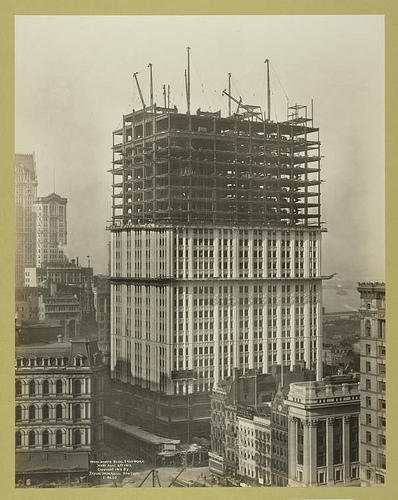
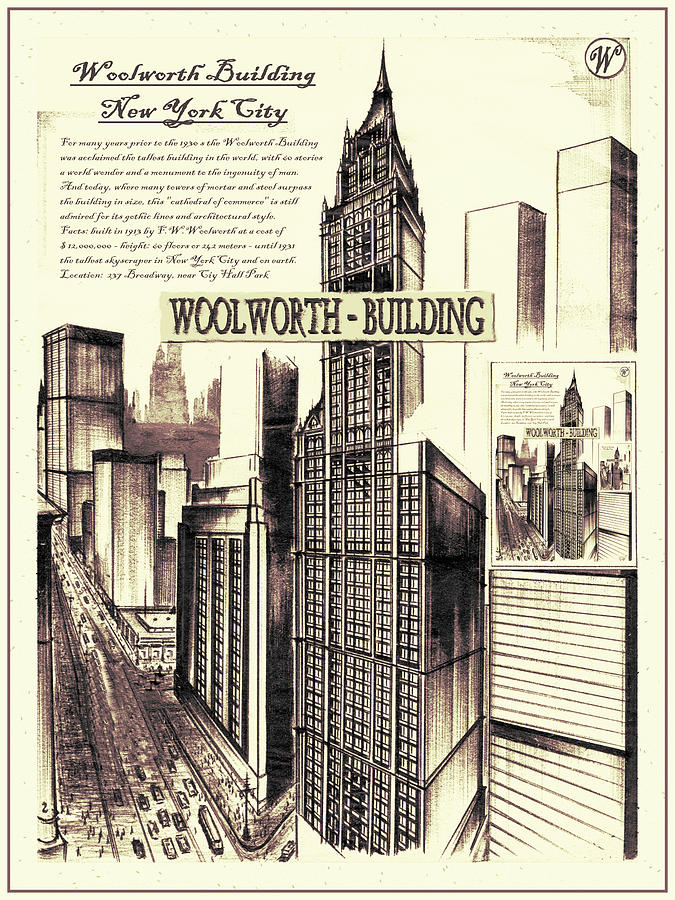
The Woolworth Building opened in April of that year in New York as not only the tallest building in the world but the second tallest structure (the Eiffel Tower was the tallest). At 60 stories high, the building soared 792 feet above Broadway between Park Place and Barclay Street in downtown Manhattan.


Although the building was no match in height for later skyscrapers, it was regarded as a model of construction for many years and even today remains a favorite sight on the New York City skyline.

Frank W. Woolworth, the chief executive of the F.W. Woolworth Company, owned 318 five- and ten-cent stores across the United States, Canada, and England. In April 1910, he set plans in motion to add to his empire through a new building that would make it's mark not just in New York, but the world.

He commissioned architect Cass Gilbert to design a masterpiece. The Singer Sewing Machine Company headquarters, completed in 1908, was the tallest building in the world until the Metropolitan Life Insurance Company completed the Metropolitan Life Tower in 1910, taking over the title.


Woolworth wanted his building to steal the thunder from Met Life and become the tallest building in the world. He worked closely with Gilbert to make sure his goal was achieved. The total cost of the building expanded from $5 million to around $13.5 million. Woolworth financed the project in cash, giving him an unheard of degree of freedom in the design and construction.

Trained at the Massachusetts Institute of Technology, Gilbert attracted national attention for his work designing the Minnesota state capitol in St. Paul.  When Woolworth engaged his talents for the new building, he created a Beaux-Arts design with ornate Gothic detail. It was said this style reflected Woolworth's vision of himself as a descendant of the great medieval merchants of the past.


Construction set a record for speed as the massive base of the building stretched over a full block and quickly took shape. A slender tower soon emerged over a steel frame, and garnered world-wide acclaim. The entire design soon became a model for skyscrapers that many copied for years.

The building won widespread acclaim for its steel-frame structure as well as interior and exterior appearances. The white terracotta facade featured subtle colored accents while the interior appeared luxurious.

A cathedral-like lobby with mosaics, sculptures, and a gold-decked ceiling added to the sumptuous atmosphere. It featured a water supply system, high-speed electric elevators, offices, a shopping arcade, health club, barber shop, restaurant, and social club.


On April 24, 1913, President Woodrow Wilson pressed a button in the White House that lit up the interior floors and exterior floodlights of the Woolworth Building, leaving the entire facade illuminated.  The Reverend C. Parkes Cadman dubbed the building the "Cathedral of Commerce."

The Woolworth headquarters occupied a mere floor and a half of the new building, leaving ample space for others to rent.

The building remained the tallest in the world for 17 years, until the Chrysler Building was completed in 1930. The Empire State Building opened in 1931, drawing both.  Made a National Historic Landmark in 1966, the Woolworth Building remains one of the tallest buildings in New York City.


After spending her formative years on a farm in eastern Oregon, hopeless romantic Shanna Hatfield turns her rural experiences into sweet historical and contemporary romances filled with sarcasm, humor, and hunky heroes.
When this USA Today bestselling author isn’t writing or covertly hiding decadent chocolate from the other occupants of her home, Shanna hangs out with her beloved husband, Captain Cavedweller.
Shanna loves to hear from readers. Follow her online at:
Find Shanna’s books at:


Tuesday, March 12, 2019

The Life of a Female Teacher in the late 19th Century by Kimberly Grist


One of my goals, when I write, is to combine my love of history with an inspirational theme, a bit of romance and believable characters. As I was researching the life of a teacher during the late 19th century, I was astounded by the rules that a female teacher had to adhere to. Which do you find the most outrageous?


Fast forward twenty years later and although society was in a phase of rapid industrialization with the introductions of electrical power and telephones, very little changed for the rules for female teachers. The idea that married women didn't need income was the most common rationale for the ban of marriage for female teachers.
Boarding was both common and practical for teachers and allowed them to live within walking distance to the schoolhouse and to live as well as their students. 


New, inexperienced teachers, hired by the lowest paying districts, often endured poor living conditions.  


Excerpt from A Promised Land: "What about a beau? You are an attractive young woman. Was there no one special in your life?" Mrs. Baker added cream to her coffee.

She shook her head. "According to the rules of the school board, male teachers could court one evening a week and twice if they attended church regularly. But they have different rules for females. We are not allowed to be seen in public after dark unless it's for a school or church function. I was also required to spend my days off working in the community, to teach Sunday School and sing in the choir. Even if the school board allowed me to have a beau, which they didn't, I don't know when I would have found the time."

"Goodness, I never realized there were so many rules involved for a teacher." Mrs. Baker took a sip of coffee.

Meriwether giggled. "They had rules for everything including how and when petticoats and other unmentionables could hang on the clothesline."


 https://www.amazon.com/Promised-Land-Lockets-Lace-Book-ebook/dp/B07P7F5RPF


In my new novel, twenty-year-old Meriwether Walker enjoys teaching students of various ages and skills in a one-room schoolhouse. What she hates is the nomadic lifestyle that comes with it as she rotates boarding with families in the community every month. From feeling like an unwanted guest to leaky roofs and bedbugs, Meriwether longs for a place to call home. Unexpectedly she inherits an estate from a devoted uncle. 
A buyer is already lined up. But Meriwether snatches at the opportunity to put down roots in Trickling Springs, Texas. The handsome prospective buyer thinks she's holding out for more money and she finds him rude and offputting. 
Circumstances cause them to work together and their feelings change. But is he interested in her, or is the real attraction the property and the water rights he needs and she has inherited?


Combing History, Humor and Romance with an emphasis on Faith, Friends and Good Clean Fun, A Promised Land is available on April 8th and for pre-order now:
 https://www.amazon.com/Promised-Land-Lockets-Lace-Book-ebook/dp/B07P7F5RPF

Connect with Kimberly 

Facebook: https://www.facebook.com/FaithFunandFriends/ 
Twitter: https://twitter.com/GristKimberly
Amazon Author Page:  https://www.amazon.com/Kimberly-Grist/e/B07H2NTJ71 
Website: https://kimberlygrist.com/ 
Bookbub: https://www.bookbub.com/profile/kimberly-grist


Monday, March 11, 2019

My Shepherd Will Supply My Need- an American Folk Hymn


The local congregation to which I belong allows me to sing in the choir, which proves the people with whom I attend church believe in charity. In recent weeks we have been practicing a hymn we will sing Easter Sunday titled “My Shepherd Will Supply My Need.” I noticed on the cover it is billed as an American folk hymn. That prompted me to look more closely at the history of this piece of music.

The arrangement we are using is by Mack Wilberg and has been sung and recorded more than once by the Tabernacle Choir out of Salt Lake City. The choir in my local congregation is no Tabernacle Choir, but our rehearsals have produced a hymn that is stirring, even though we have not yet practiced with the instrumentation. CLICK HERE to listen to one of the YouTube recordings of this hymn while you read the rest of this blog post.

Isaac Watts
The words to “My Shepherd Will Supply My Need” were written by Isaac Watts (1674-1748). He is considered by many as the father of English hymnody. He was an English Christian minister (Congregational), hymn writer, theologian, and logician. He was a prolific and popular hymn writer and is credited with some 750 hymns. Many of his hymns remain in use today and have been translated into numerous languages. To learn more about this hymn writer and his history, please CLICK HERE.

This particular hymn is a re-working of the familiar text of Psalm 23, which begins: 'The Lord is my shepherd; I shall not want'.  Here is the text of this hymn:
 
Ctsy Cadetgray
My Shepherd will supply my need:
Jehovah is His Name;
In pastures fresh He makes me feed,
Beside the living stream.
He brings my wandering spirit back
When I forsake His ways,
And leads me, for His mercy's sake,
In paths of truth and grace.

When I walk through the shades of death
Thy presence is my stay;
One word of Thy supporting breath
Drives all my fears away.
Thy hand, in sight of all my foes,
Doth still my table spread;
My cup with blessings overflows,
Thine oil anoints my head.

The sure provisions of my God
Attend me all my days;
O may Thy house be my abode,
And all my work be praise.
There would I find a settled rest,
While others go and come;
No more a stranger, nor a guest,
But like a child at home.

This hymn was also performed by the Choir of Washington National Cathedral in a memorial service in September 2001, shortly after the attacks on Washington and New York City on September 11. To listen to a recording of that performance, please CLICK HERE.

This folk hymn is usually sung to the Appalachian folk tune “Resignation” by an unknown composer.  It first appeared in the 1835 hymnbook, Southern Harmony, a collection of church music from the rural American south. Like most folk music, it is fairly repetitious and entirely pentatonic, meaning it uses only a five-note scale analogous to the black keys on the piano. The basic tune itself is easy to learn both vocally and instrumentally.


Above is a copy of the musical score and words for this hymn. However, it is important to keep in mind that in the nineteenth century and before, hymnals did not generally include the musical score. Only the words of the hymns were printed. As long as the meters matched, most could be sung to more than one tune. The person leading a congregation in singing would not only announce the name of the hymn, and for those fortunate enough to have a printed hymnal, the page number, but he or she would also announce the name of the tune to which it would be sung.

Appalachian music is the traditional music of the mountain regions of Appalachia in the Eastern United States. Several cultures have influenced the music of this region over the decades, both European and African. English ballads, Irish and Scottish traditional music (especially fiddle music), hymns, and African-American blues.

Religious music, including white Country gospel, was probably the most prevalent music heard in Appalachia.  During the Colonial period the press was controlled by a clergy which had no interest in the spread of secular music, therefore, not much of the latter survived in written form.  There were three types of religious music: ballads, hymns, and revival spiritual songs.  The latter directly arose out of the call and response of the African song tradition.  These were popularized among the white inhabitants after the revival circuit started in Kentucky in 1800.  Their simpler, repetitious text of verse and refrain was easier to sing and learn and produced an emotional fervor in the congregation. 


The fiddle was at first the main instrument, often played by itself since pianos were not only expensive to purchase, but difficult to transport over the rough, stair-step terrain of that mountain range. Early tunes tended to be more rhythmic as opposed to using a lot of harmony.

Although Appalachian music in earlier days was generally played primarily on a fiddle, I tried unsuccessfully to find a version of “Resignation” using only that instrument, or perhaps the violin combined with other traditional instruments such as a dulcimer or banjo. Here is a rendition using both violin and piano. CLICK HERE.

As much as I love the Mack Wilberg’s arrangement for “My Shepherd Will Supply My Need,” this piano version is probably closer to the original meter of the tune. CLICK HERE.

I felt so impressed by the history of this American folk hymn, I decided to use part of it in one of my latest books, Diantha. My secondary romance involves Hilaina, a young woman who, along with her mother, came from the Appalachian region. When she invites Buck to Sunday supper, after the meal, they read from the Bible and sing this hymn.

Here is an excerpt from the book:

          Elmira turned to Buck. “Know ‘My Savior Will Supply My Need’ sung to ‘Resignation?’ Hilaina’s pa favored that tune.”
          “Can’t say I know that one.”
          “Time you learned.”
          The two women cleared their throats and began to sing in unison. 

My Shepherd will supply my need:
Jehovah is His Name;
In pastures fresh He makes me feed,
Beside the living stream.

          Buck winced inside upon hearing Elmira sing with a slightly flat, gravelly voice. Hilaina’s voice sounded clear and he could tell she stayed on key. He liked the catchy melody with several repetitions. He formed his mouth and folded his tongue as he silently practiced whistling it. It would be easy to learn.
          By the third verse, he felt comfortable enough to softly join in as an accompaniment to their vocal performance. When the song ended, Elmira smiled at Buck, the first smile he had seen on the woman’s face.
          “Ain’t nary heard such slap-fine whistling since afore Hilaina’s pa passed. I’d be right pleased to sing it again.”
          They ended up singing the hymn three more times until Buck got the notes and timing down perfectly and the three performed the number in perfect harmony.
          As the sun began to set, while Buck walked back to the livery, he reviewed the afternoon he had spent with Hilaina and her mother. As much as he felt the heightened awareness that came from being in the same room with Hilaina and regretted the necessity of keeping his hands to himself and not pulling her on his lap in the presence of her mother, he admitted he also enjoyed being around Elmira Dowd. He failed to reconcile the jokes and snide remarks about mothers-in-law he heard through the years with the thought of her as a member of his family. He enjoyed her abrupt manner of speaking so different from her daughter. Besides, Elmira seemed to appreciate his whistling as much as Hilaina did. Being with them filled him with a sense of belonging to a family again, something he never really felt living and working on the Grassy Fork Ranch.
          Buck began to whistle the new tune Hilaina and her ma had taught him that day. He did not remember all the words to the hymn, but the last line kept repeating itself in his head:

No more a stranger, nor a guest,
But like a child at home.

Diantha is currently on preorder and scheduled to be released on April 1, 2019. You may read the full book description by CLICKING HERE.

Sources:
https://www.reformedworship.org/article/june-1990/hymn-month
Hymnary.org
Wikipedia
YouTube.com