Showing posts with label corsets. Show all posts

Tuesday, September 5, 2023

CHOOSING MY CHARACTER'S CORSET by Marisa Masterson

 Tight laces. Loosened laces. No laces. Which is best for my heroine?

When I envision a typical nineteenth century lady in an American city, I envision a small waist and tight corset. But the female lead in the novel I am currently writing decides to pursue the rational dress movement, a push to allow females to clothe themselves in a healthy and safe manner. Would she head to the backyard and burn her corset?


Definitely not! As little sense as it might make to us today since women don't commonly wear laces around our waists, the women of the 1800s held tightly to the belief that a corset was a necessity. They were not about to quit wearing them.

The alternative? Women needed to be convinced that both their shape and posture could be enhanced without lacing their corsets tightly. Along came the Jackson Waist.

As a Michigan resident, I found the Jackson Waist interesting. At one time, Jackson--a relatively small town in my state--was the leading producer of corsets in the US. The town had sixteen corset manufacturing companies at one time, but the Jackson Corset Company outsold them all.

This corset did away with whale bone and laces. It advertised steel sown into the front and back to aid with a woman's posture instead. Some corsets merely settled over a women's shape after being slipped down over the head and shoulders. Others had fasteners and even laces that had a limited ability to be tightened. They promoted healthy blood flow and free breathing. 

A woman could have her cake whilel wearing this corset and eat it too. No wonder the product was a huge hit. Definitely what my heroine will be wearing in Clarice's Chance.


Coming November 2023. 

Pre-order now!

Friday, January 6, 2023

WHY I DON'T WEAR A CORSET: Rational Dress by Marisa Masterson


 If you're a woman, maybe you've wondered it the same as me. Why don't we wear corsets? And when did women stop wearing long hems? 

https://en.wikipedia.org/wiki/Corset_controversy

It's a complex answer. In these few paragraphs, I'll attempt only one small part. It has to do with the Rational Dress Movement pushing to change female fashion.

https://helenrappaport.com/footnotes/rational-dress/

At the same time that women were pushing to gain the vote, some pushed in the area of fashion. Women argued that corsets restricted movement, as did overly long hems. The corset even constricted breathing which limited what a woman could do as well as the speed at which she could do it. With the creation in the 1800s of many of our popular sports, women were left out of them.
https://cyclehistory.wordpress.com/2015/01/30/women-on-the-move-cycling-and-the-rational-dress-movement/

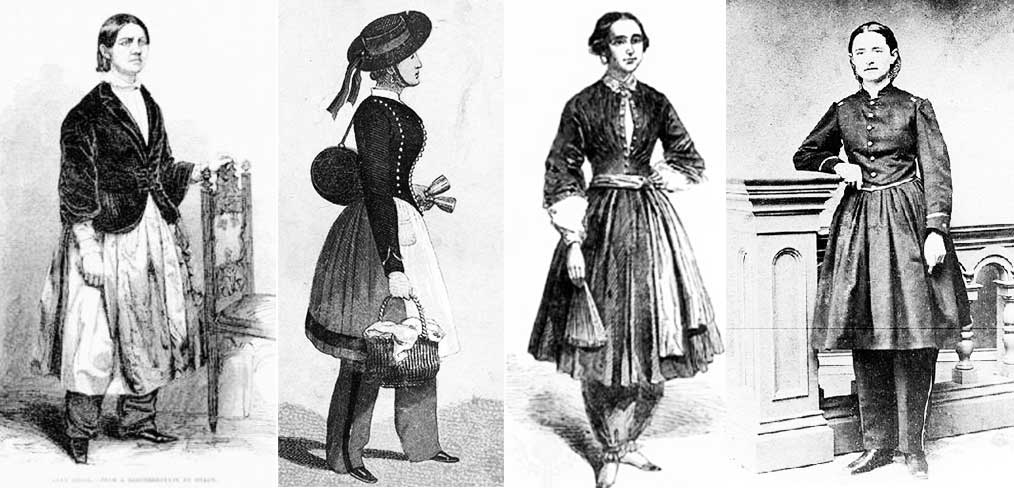
I like the above photo because it shows the shorter hems and the divided skirt that women adopted. They were more willing to do this than to wear bloomers. Those were for the truly militant woman of the age.

This commonsense movement also proposed something called the Liberty Bodice. Instead of steel or bone shaping the waist, this garment had stiff cloth. It was tight over the bust and had a row of buttons running down the front so a woman no longer needed someone to tighten her laces for her. Independence and more freedom of movement!

I wove this into Sylvia's Secret (a romance featuring the suffragist movement and rational dress):

The two women hurriedly packed. Each had a maid who helped. Helga cried as she found nightgowns and delicate undergarments in drawers and placed them in Sylvia’s small trunk. When she brought out corsets, her employer stopped her.
“No, I won’t be wearing them. And I don’t want the dresses that require them.” She bent over to touch her toes. “See, Helga, I’m free for the first time in a very long time. I won’t give that up.”


And later, in a scene where the heroine needed to escape from the villain of my piece:

His sneer turned into glowing triumph as he smiled widely. “I have a carriage ready to take you for a ride.”

Don’t show fear! “Do you know, Horace, that you remind me of the wolf in Little Red Riding Hood?”

Sylvia forced out a laugh. It sounded high and shrill to her pounding ears. “Grandmother, what big ears you have? That fits, doesn’t it?”

Horace lifted his hand from the arm he held to cover one ear. He kept his hair long to hide this defect. Some part of his captive felt badly about bullying him. Even so, she had to escape somehow.

When he moved that hand, Sylvia bolted for the streetcar. It had just arrived while Horace waylaid her. As it pulled away, she jumped onto it. Thank the Lord for freer movement through rational dress. 


https://en.wikipedia.org/wiki/Liberty_bodice

In the image above, I can see the beginnings of the modern bra. That was still years in the future, though. The Liberty Bodice did not catch on as "all the rage" among women. The corset remained a necessary garment for the rest of the nineteenth century.

But here is some very strange irony. The garment for men that the Rational Dress Movement promoted DID become extremely popular. The one-piece wool union suit or long johns was introduced by this group. Men took to them like hogs to slop. 

https://www.pinterest.com/pin/503840277032505890/

Go figure! Does this show the male dominance of the century as they could adapt to the group's ideas but women couldn't? I expect that would be for socialogists to debate.


https://www.amazon.com/dp/B0B6D4PQMF

Sylvia wants to be free to make her own choices. Ernest hopes she’ll choose him. When a threat sends them running, it forces them into marrying. Will love follow?

Sylvia makes up her mind to no longer be the "good daughter". Not when Chinese children couldn’t attend school. Besides, she's nearly thirty-years-old, already a spinster! She was old enough to make decisions.

Her secret teaching leads her into danger. That danger sends her running for safety. Dodging into a hall to escape her pursuer, she finds that safety at a suffragette meeting.

What an odd place to fall instantly in love! Who would expect to meet a handsome man in a women’s rally?

A quick marriage and threats to her new husband’s life make Sylvia realize that some secrets have to come out into the open.

If you enjoy sweet romance with a historical flavor, then sink into a chair and start reading Sylvia's Secret.


Monday, August 20, 2018

Victorian Underpinnings.

By Sophie Dawson

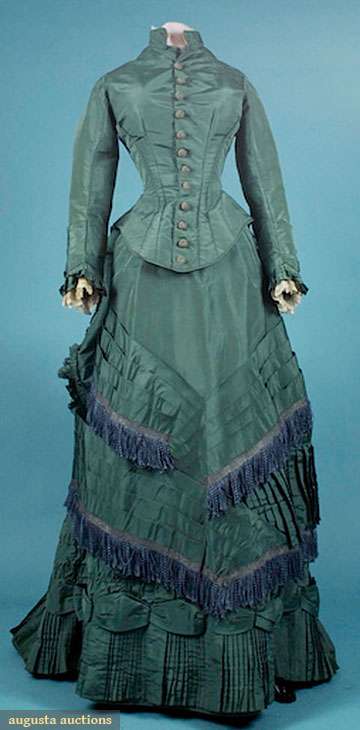
I’m in the midst of making historical garments. Authentic reproductions of late Victorian and Edwardian dresses, which actually are a bodice and skirt. They called one piece garments gowns. In doing so I’m doing a lot of research and looking at many photos.

We don’t think too much about the undergarments a lady wore beneath the beautiful bustle dress or Gibson Girl clothing. There were quite a few layers which we no longer think necessary. Each had a specific purpose that makes sense when you know the reasons.

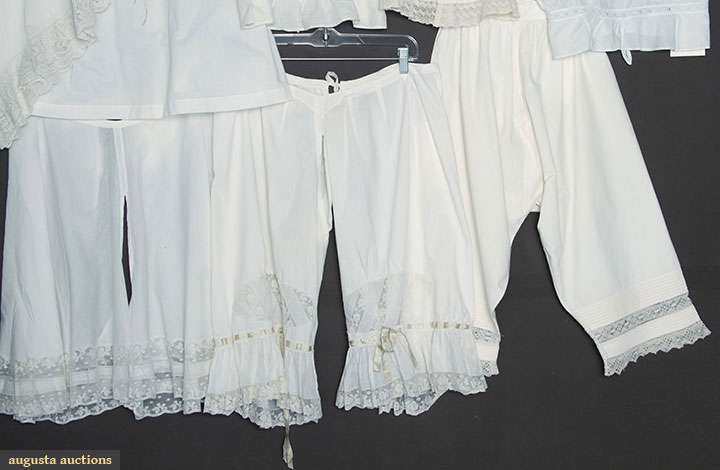
The first layers, those against the skin were the drawers and chemise. I know it sounds sort of gross to us, the drawers had open crotches. There was a method to their madness, however. I’ll lit you know why in a minute.

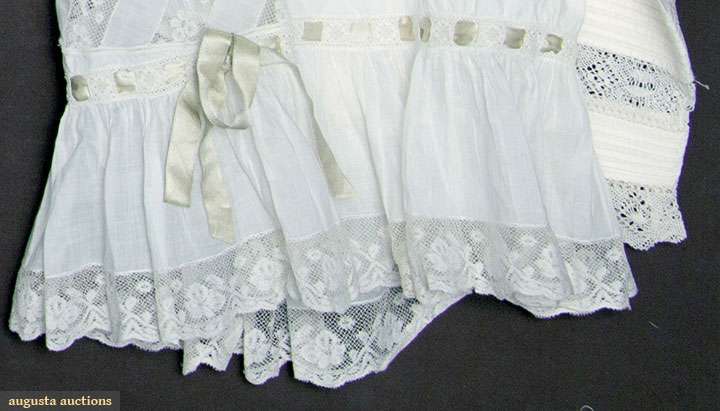
The drawers were basically two legs attacked to a drawstring waistband. You can see the slit in the photos below of the drawers on the bottom row. They were the first item of clothing put on. Over that was worn the chemise. Note the lace and ribbon trim on these.
Next came the stockings (not socks) which came up to or over the knees. Early they tied ribbons or garters to hold them up. Later garter clips appeared attached either the the corset or a garter belt. Then the shoes were put on. It was much easier to do these before the corset since bending down was limited after.

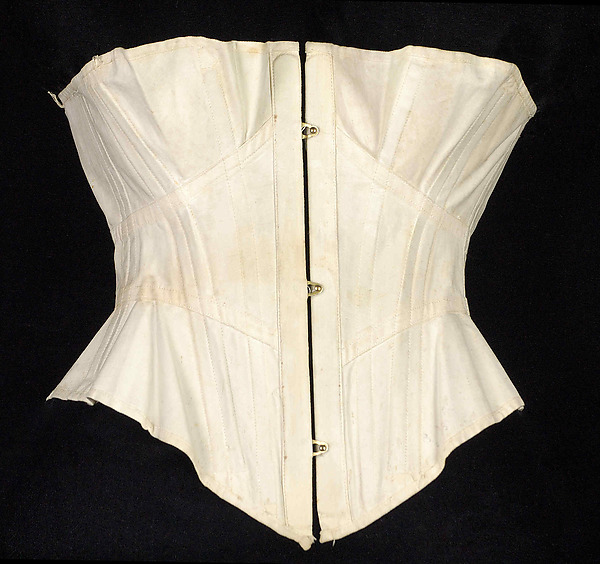
Everyone girl and woman wore a corset. Yes, even children, boys and girls. When looking at corsets and their waist size remember one thing; the back had space of 2-6 inches between the lacings. So add that to whatever the waist measurement says. Suddenly those tiny waists aren’t so tiny. Also, smaller corsets were most likely worn by teenagers. Much smaller all over than grown women. Many of the corsets that survived to this day are probably those of teenagers and only worn for a short time. Those worn as women with more mature figures were used for many years and wore out.
Anyway, the corset was placed over the chemise which often reached do to the knees.
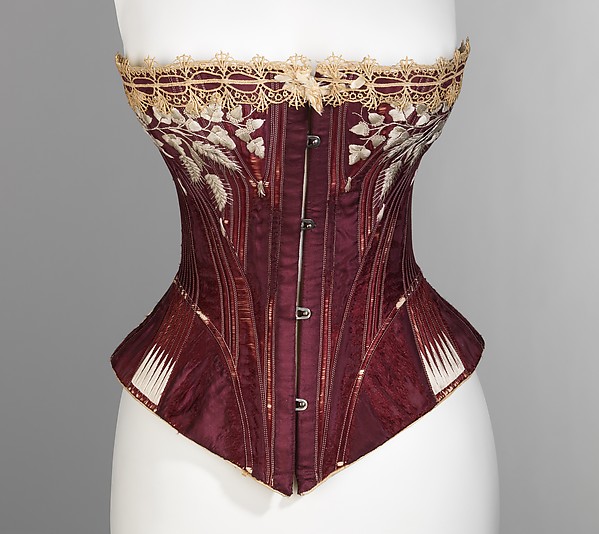
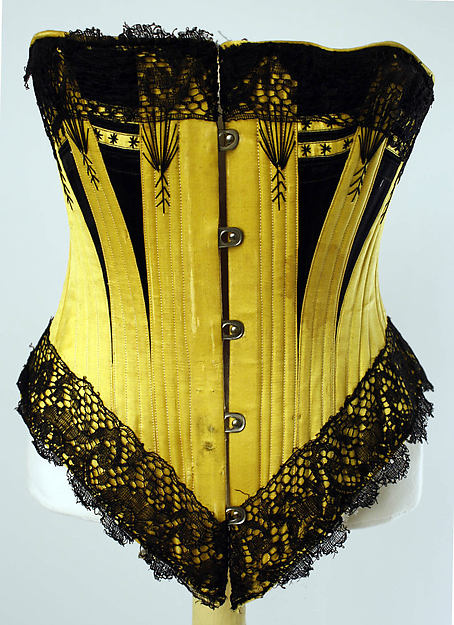
As you can see from the images, many corsets were made from satin or brocade and decorated with embroidery and lace. We ladies love our fancy underpinnings.

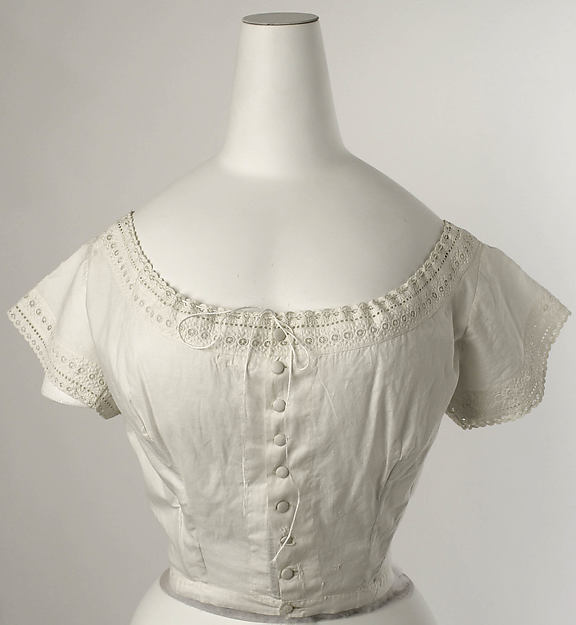
Next came the corset cover. Excessive, you say? In a day when laundry was hard physical labor and most women had to do their own, wearing the chemise and corset cover protected the corset, which couldn’t be washed or only sparingly, those two cotton garments surrounding it kept the corset from body oils and sweat, and stains.
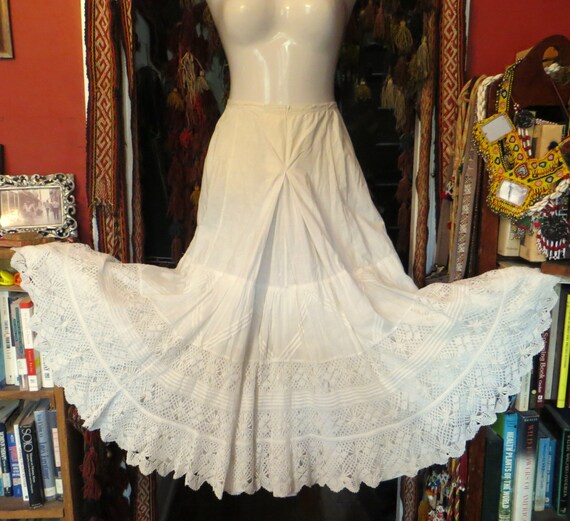
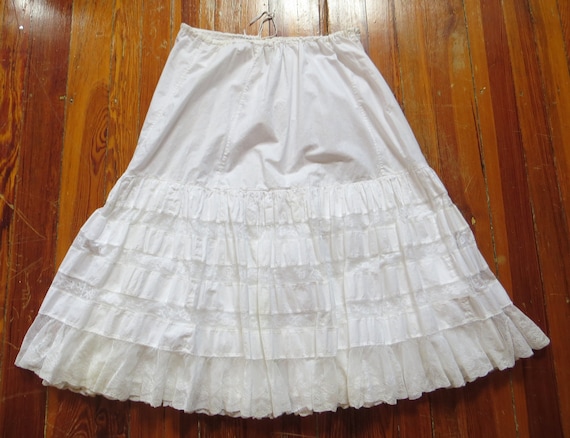
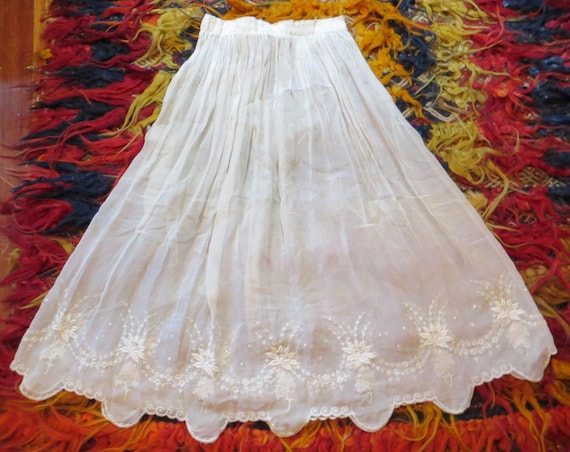
One function for the corset not thought about much concerns the bustle and petticoats. The boning in the corset allowed that to support those layers that gave structure to the skirt itself. Each layer of petticoat had a waist tie. Women often wore up to five layers, plus the bustle. Imagine all those ribbons tied around your waist with the petticoats hanging below.
Lace, ruffles, tucks and ribbon often decorated the petticoats. Ruffles added support for the skirts again. Plus they are pretty.
After all this, the lady finally dawned her skirt, bodice, and overskirt. And don’t forget the hat and gloves.

 As I said, I’ve been researching Victorian garments and, though I knew it before, those ladies, whether rich or more like the rest of us, liked pretty undergarments. Chemises, drawers, corsets, petticoats, whether they were handmade or made for some socialite, were adorned with lace and ribbons. Ruffles and tucks also were used as decoration. Even though no one, or very few, saw them other than the wearer, those unmentionables were beautiful garments in their own right.

Oh, those open crotches... They were so you could easily do your business in the ladies retiring room. Imagine trying to find a waist tie under all those layers, laced into a corset, take them down, pull them back up, and rearrange those layers to be presentable before your joined the public again. Now you know why they wore split crotch drawers.


~~~~~~~~~~~~~~~~~~~~~~~~~~~~~~~~~~~~~~~~~~~~~~~~~~~~~~~~~~~~~~~~~~~~~~~~~~

Sophie Dawson is an award-winning author of romance, both historical and contemporary. An eclectic conglomeration of interests and accomplishments, she has made up stories in her head all her life. Now she types them out. Her critically acclaimed series include Cottonwood, Stones Creek, and Love’s Infestation. She’s also been part of several Multi-Author projects.
Her latest release is Wanted: Shopkeeper available in Kindle, print, and KU 
https://www.amazon.com/dp/B07BWZ4ZF3

Monday, October 30, 2017

Working Woman's Corset


Working Woman's Corset
by Sophie Dawson

My new release, Music of Her Heart, is set in 1869. It’s book two in my Stones Creek - Ladies of Sanctuary House series. In writing one of the early scenes, I needed to be sure what sort of corseting the main character, Gema, would be wearing and whether she could easily take it off without help. I realize much has been written about corsets, a lot negative. 


Gema is a Russian immigrant, orphaned at sixteen and taken to live at Sanctuary Place. It’s a woman’s mission set just outside of Dubuque, Iowa, fictional of course, that offers shelter, education, safety, and the Gospel to girls and women who are in need from circumstances beyond their control, or from poor life choices. 


With the opening of the West, and the dearth of women, Sanctuary House is built in Stones Creek, Colorado for the women, Ladies as I call them, and their children to move to and begin new lives, possibly become brides to men in the area. So far, two books have been released concerning these ladies: Chloe’s Sanctuary and Laundry Ladies Love.

Okay, back to Gema and her underpinnings, now that I’ve given you some background. When we think of corsets, we naturally think of the Victorian corsets of the late 1800’s. Post Civil War from about 1870 onward. Actually, we probably think of Madonna’s and Lady Gaga’s corsets worn when they perform. Not what ladies would wear back then, and certainly they would not show. Soiled doves the exception.

Stays and corsets were the foundation garments for centuries before the invention of the bra, girdle, and Spanx, not to mention control top pantyhose. They held up the bosom and created the shape of the torso popular at the time. If you have anything up top, you probably understand why women throughout the ages wore something to keep the girls contained. I’m not going into a detailed history of stays and corsets, or the pros and cons. I was more interested in what Gema, a poor woman, would have worn and whether it had a split busk or not.


A busk is a stiff rod down the center front that keeps the garment from sagging. Think of it as the underwire of the day. Until the 1830’s they were made of one piece. This only allowed the stays to be put on by lacing and removed by unlacing down the back. When the split busk was invented, it allowed a woman to much more easily dress by herself. The innovation took over and by the 1850’s nearly all corsets and stays were made with split busks.


The historic stays and corsets we see in photos and museums were most likely those of wealthy, elite women. My Ladies of Sanctuary House are anything but that. They were poor women hoping to improve their lot in life by moving and possibly marrying men in the West. They probably wouldn’t have had whale-boned corsets made of silk. Theirs, which they may have sewn themselves, would have been cotton or linen, quilted with cording or tightly rolled paper rather than bones simply because of the cost. They would have worn them until they fell apart. Women protected their corsets by wearing a chemise under and corset over over them. Those were easily washed. Corsets were not. Corsets with steel bones couldn't be washed since the rods would rust.


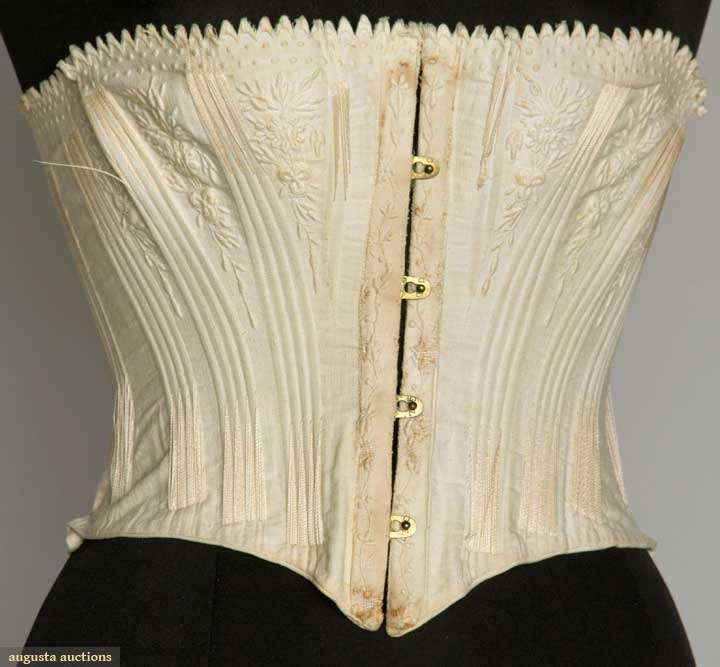
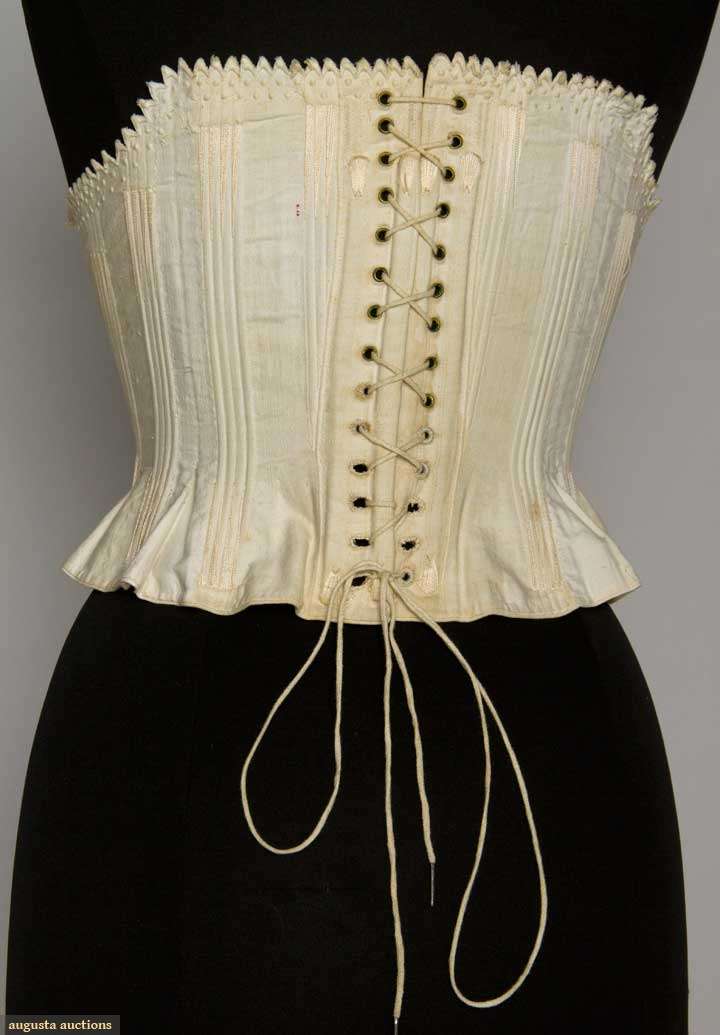
Here's a corded corset from 1855-1865. It would have had cotton cords quilted in for the stays, or possibly rolled paper.

Photos from Augusta Auctions 

Notice the lacing pulling the sides together. This was not the way a corset would be worn. At least 2-4 inches gap should remain between the edges. The waist size of a corset is the measure that is of the garment without the gap. This one measures 25 inches, the person would have an actual waist measurement of at least 27-30 inches.


The corset ends just below the waist and would have allowed for ease of movement as a woman went about her daily duties. This is the sort of garment Gema, a hotel maid, might have been wearing, although hers would not have had the lovely trapunto quilted floral sprays between the ribs.


So my problem was solved. Gema could get out of her corset, by herself, and flop it over the back of the chair like I wanted her to.