Wednesday, December 21, 2022

A LOOK AT EARLY COLORADO CHRISTMASES


EARLY COLORADO CHRISTMASES

Post (c) Doris McCraw aka Angela Raines

Photo property of the Author


As the Christmas and Holiday season approaches, I'm taking a look at some early celebrations in Colorado. Imagine if you will, in 1858, you have followed the siren's call to Colorado in search of the 'golden fleece' known as gold and silver. Life has been busy and the high desert with its mild weather has fooled you. Then when you do the figuring, it's Christmas, what do you do? Or maybe you have traveled with your family and now you plan to celebrate in the middle of nowhere. Join me as I share some of the stories I have found.

According to the records, the area around what is now Denver had about 200 men and 5 women (four were married) and assorted children. Perhaps I should add the two towns that made up the area were about sixty days old. Plans were being made in the two camps for a festive meal. One camp was planning candles for a tree that had been cut in the foothills. This was the German couple and trees were a part of their home country festivities. The other party had a meal of buffalo, rabbit, wild turkey, and rice pudding along with peach and apple pie, according to the listing of the menu.

USGS Topographic Mapping Field Camp

It is written that Christmas morning that year was 'soft and genial as a May day...'. Into this lovely mix "Uncle Dick" Wootton (sp) brought his gift, "Taos Lightening". Needless to say, the day was one to be remembered, if you hadn't taken in too much of the free gift Uncle Dick brought to the party. (I'll have to tell you more about Uncle Dick later)

One family on the Arkansas river, up close to the cut-off to what is now Monarch pass, had been cut off from others and the towns due to heavy fall snow storms that year of 1863.  They had been working their claim, even in the heart of winter. When Christmas arrived, they had plenty of food, but not much variety. So the one daughter decided to bring out the good china brought from their home in Nebraska and serve up a feast. According to the story, they made mock turkey from beef, and beans, and substitute coffee, made from browned bran. The parents were the guest of honor. This creative young lady set this up with the help of her siblings.

. Harding sandstone on gneiss and schists 1.5 miles northwest of Canyon [City]/USGS. “

In the early trapper days around 1842, the northeast corner of Colorado/Utah saw a holiday take shape with the help of the Indians in the area. Their Holiday meal consisted of appalost, a type of shish kabob with lean meat and fat roasted over a low fire, buffalo cider, a liquid found in the stomach of buffalo, supplemented with washena, marrow fat, and pomme blanc from the Indians.

In Leadville in 1888, Dick Berryman's Saloon offered the following bill of fare: Possum, Turkey, Roast Pig, Sweet Potatoes, and Corn Dodgers.

Leadville, Colorado, mining district, subject of an early mining-geology study, 1879.

As you can see, even back in the early days, people did what they could to celebrate. I will leave you with a lovely passage from Isabella Bird's book, "A Lady's Life in the Rocky Mountains". As Isabella traveled the Rocky Mountains, alone, she wrote letters back to her sister in England. This passage is from her time in the Estes Park area of Colorado in 1873 as she rode her horse Birdie through the fir-covered area.  "...I think I never saw such a brilliant atmosphere. That curious phenomena called frost-fall was occurring in which, whatever moisture may exist in the air, somehow aggregates into feather and fern leaves, the loveliest of creations, only seen in rarefied air and intense cold. One breath and they vanish. The air was filled with diamond sparks quite intangible. They seemed just glitter and no more. It was still and cloudless, and the shapes of violet mountains were softened by a veil of the tenderest blue."


Wishing everyone the best Christmas and New Year possible.

Doris


Tuesday, December 20, 2022

Cowboy Sayings - Raring to go


“Are you ready to go to the party?”

“I’m more than ready. I’m raring to go!”

In the early 1800’s this saying increased in popularity, but its origins come from those who worked with horses. When a horse wants to move forward but is held back, they often will go up on their hind legs and stand up in a manner to resist the hand that is holding them back. The more excited the horse is to go forward, the higher they might go up, or they will hop up and down over and over again.

This action among horses is called “rearing,” but often cowboys called it “raring” instead, and the words became interchangeable. Excitement, exuberance, youth, fear—all of these can be driving factors that cause the horse to stand on its hind legs if they are stopped from going forward when they desperately want to.

Over time, this phrase became used to show that the person is very excited and prepared to move forward on whatever action when asked if they are ready.

Have you ever heard this saying before? Used it yourself? Could you see yourself using it now? Let me know in a comment!


On average, P. Creeden releases a story every other month. Interested in learning more? 
Join her reader group on Facebook:

Friday, December 16, 2022

How Bicycles Influenced 1890s Fashions by Zina Abbott


The 1890’s were known as the “Gay Nineties” for more than one reason. One was the direction taken in women’s fashions that allowed them greater freedom of movement. As the new decade approached, the stiffness and fussiness typical of the Victorian Era eased. Much of this was due to the technologies that developed, as well as women’s involvement in those technologies.

1895 Women on bicycles- Victoria and Albert Museum, the Ashton Collection

Perhaps the innovation that had the greatest influence on the change in women’s fashions was the drop-frame safety bicycle. The 1890s became an era of great dress reforms which allowed women the opportunity to ride bicycles more comfortably, and therefore, created the need for appropriate clothing.


Keep in mind, in the late 1860s, after the end of the Civil War, fabric was in shorter supply, so the hoop skirts wider than the Mississippi River became narrower, with a slight protrusion in back. That protrusion developed into the bustle, which, by the mid-1880s, often stuck out on a woman's rear like a small mountain. All during this, the ladies were contained in a stiff corset that squeezed their inner organs and often prevented breathing easily. It definitely restricted movement.

Big-wheeler bicycles 1887

Although horses and horse-driven conveyances still dominated in the more rustic West, t
oward the end of the 1880s, bicycles and—for the ladies with their more restrictive clothing—tricycles became available. 


These were probably seen more in the East and possibly the around the larger cities (read: roads that weren’t a dust bowl in the summer and a muddy swamp in the rainy season) in the West.

Photographer unknown. Staff of the Mechanics Institute Reference Library, 1895. Photograph. Toronto: Toronto Public Library

However, Western society in Europe and North America began to move away from the stiff, moralistic, Victorian Era. Women were enjoying new levels of independence as opposed to the Victorian Era (and back through time) belief that they should restrict their interests and activities to those involved in being a homemaker. During the decade, the number of women employed outside of the home almost doubled. The “New Woman” was an intellectual, young female. 


1898 Women in bathing costumes--ooh! Look at those bare legs!

As more and more began working outside the home, they began to pursue interests in cycling and participating in sports (as opposed to always being the admiring audience to the wonderfulness of men’s sporting activities).

1895-1900 students Atlanta Univ. George


In order to do this effectively, women needed clothing that was less restrictive. The introduction of electricity in clothing manufacturing produced a boon in the ready-to-wear market.


Less restrictive it did become, as heavily boned corsets so stiff and tightly laced they were strapless gave way to straight front corsets, also known as health corsets, athletic corsets, hygienic corsets, and sanitary corsets. They did not have the heavy boning, but were buttoned in the front and held in place with shoulder straps.

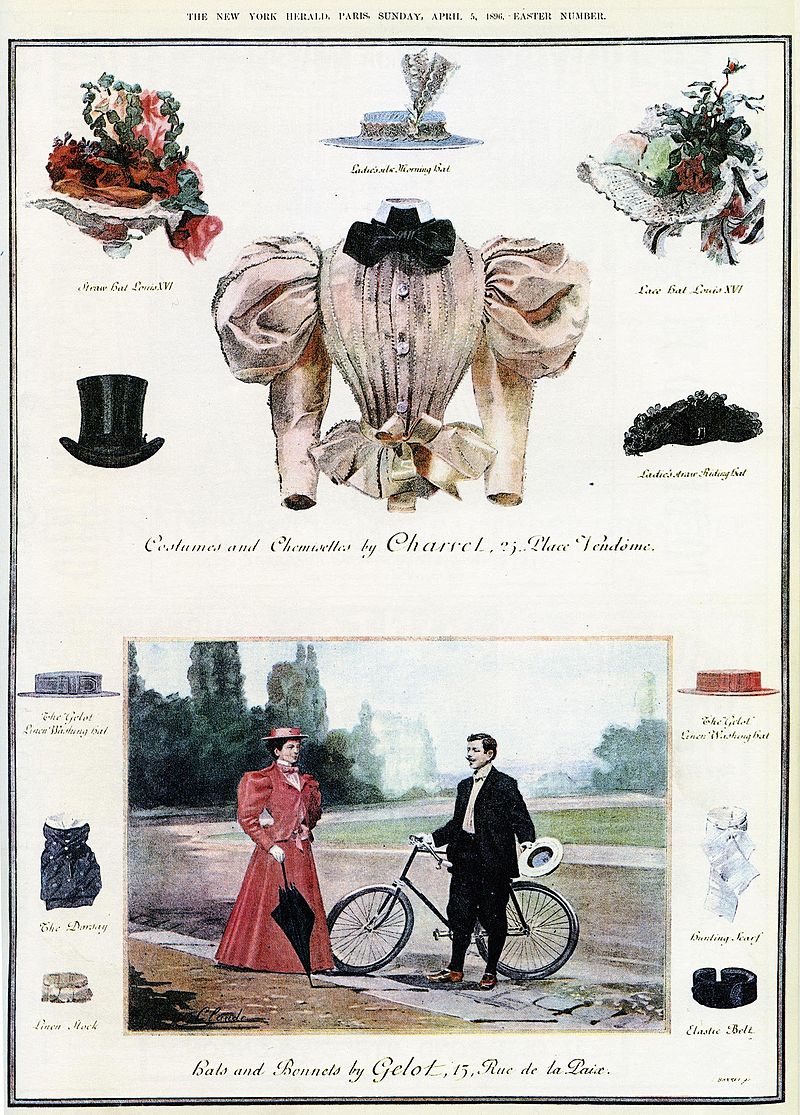
1896 Charvet Avertisement


Dresses focused more on mobility, with free-flowing skirts and leg-o-mutton sleeves. The “mutton sleeve”—the vertical puff at the shoulders—developed to allow greater freedom of movement in the arms. This style reached its peak in 1895. By the end of the century, it gradually diminished.

Skirts were bell-shaped, gored to fit smoothly over the hips. Gone were the multitude of heavy petticoats. This allowed for more self-expression and a more natural silhouette for women’s bodies.

These skirts also allowed for greater mobility. They made it possible for women to ride the drop-frame safety bicycle instead of being restricted to the tricycle of the previous decade.


Along with the floor-length that used for everyday wear, to appeal to the athletic woman, a “walking skirt”—a skirt that fell to just above the ankles—also came into style. For younger girls, the walking skirt fell to just below the knees.


On occasion, such as bicycle riding, women set their skirts aside and wore what were formerly referred to as bloomers. This was a bold move, and it was not universally approved due to the controversy surrounding women wearing pants.

1895 Bicycle Suit
Text on image:

Gertrude. "My dear Jessie, what on earth is that bicycle suit for!"

Jessie. "Why, to wear, of course."

Gertrude. "But you haven't got a bicycle!"

Jessie. "No, but I've got a sewing machine!"
 

In this era, they were also known as "rationals" or "knickerbockers." The entire outfit, including the jacket, was known as a “bicycle suit.”


So, hail, hail to the 1890s new woman with her greater freedom of movement, her greater selection of choices, and her greater health—all largely made possible by the adaptions made in clothing styles so she could more comfortably ride the humble drop-frame safety bicycle.

~o0o~

One of my two 2022 romances set in the 1890s was Joshua's Bride, set during the 1893 Cherokee Land Run. Although neither Rose Calloway nor her sister, Marigold, wore bicycle suits or rode bicycles during the land run, there were those who did. The sisters, who rode the train to where they wished to claim land, wore walking skirts.

To find the book description and purchase options for Joshua's Bride, 

please CLICK HERE.


Marigold Calloway has her romance in 1894 after she is already on the two city residential lots she claimed during the land run. Having spent her life as a schoolteacher, she definitely fits the description of the modern woman who works outside the home. The streamline skirts and looser clothing of the era suit her just fine.

To find the book description and purchase options for Marigold, 

please  CLICK HERE.


Sources:

https://www.familysearch.org/en/blog/1890s-fashion-changes

https://fashionhistory.fitnyc.edu/1890-1899/

https://recollections.biz/blog/achieving-the-gibson-girl-s-silhouette/

https://en.wikipedia.org/wiki/1890s_in_Western_fashion

https://en.wikipedia.org/wiki/Aestheticism

Wikimedia Commons

Tuesday, December 13, 2022

Bringing and Ringing in Christmas Traditions by Kimberly Grist


When Prince Albert married Queen Victoria in 1840, he introduced the German tradition of celebrating Yuletide by decorating a tree to his family, which changed the face of Christmas.

The above picture was based on an image of Queen Victoria and her decorated Christmas tree previously published in The Illustrated London News in December 1848. 

A revised version was copied in Godley's in 1850 and removed what was referred to as royal trappings from Victoria's tiara and Prince Albert's mustache to remake the picture into an American scene. It was the first widely circulated picture of a decorated evergreen Christmas tree in America and was reprinted in 1860. By the 1870s, a Christmas tree was common in the United States.

New traditions also inspired caroling and Christmas music. Notable Songs from the 19th Century include:
  • "Joy to the World" 
  • "Hark! The Herald Angels Sing" 
  • "It Came Upon a Midnight Clear" 
  • "O Holy Night"
  • "Angels We Have Heard On High"
  • "We Three Kings of Orient Are"
  • "Jingle Bells" 

One of my favorite Christmas songs was inspired by a poem written by Henry Wadsworth Longfellow.


Tragically in 1861, Longfellow's beloved wife of eighteen years died after her dress caught on fire. Longfellow could not attend her funeral due to the extensive burns he received attempting to save her life. His facial injuries caused him to stop shaving. He wore a beard from then on, which became his trademark.


In March 1863, Longfellow's oldest son Charley, left home unannounced to travel to join the Union Army. On December 1, 1863, Henry received a telegram that his son had been severely wounded while involved in a skirmish during the battle of the Mine Run Campaign.

On Christmas day in 1863, Longfellow, a 57-year-old widowed father of six children, heard the Christmas bells proclaiming "peace on earth" and wrote, "I Heard The Bells on Christmas Day."


The poem was first published in 1865. Longfellow's despair can be felt in its message that "hate is strong and mocks the song of peace on earth, good will to men." However, the conclusion of the poem and song is the message of renewed hope. The powerful message resonates with many dealing with loss, worry, and grief during the holiday season.

More on Longfellow's Poem, Set to Music:

In 1872, the song would later be called "The Civil War Christmas Song" and continues to be popular today. The song with background photos taken during the Civil War can be viewed here:
I Heard The Bells on Christmas Day with Civil War photos


The Carol remains popular today, carrying renewed hope for peace among men.

New Release:


https://www.amazon.com/dp/B0BD2M5GHG

Thursday, December 8, 2022

Kissing Balls


It all started with a kissing ball.

I saw a beautiful one in a shop window and considered making one. Then, as things tend to go, I ran out of time before the holiday season arrived.

But the idea of a kissing ball being involved in a holiday romance stuck with me. 

In my sweet historical romance, The Christmas Kiss (releasing today!), a cousin to the hero gives him a kissing ball for a decoration. 

He knows exactly what it represents and thinks about kicking it outside, but refrains. 

As I was writing about the kissing ball, I decided to do a little research about them. Kissing balls have been around a long, long time.

During the Middle Ages, villagers would wind twine and evergreen branches into a ball shape. In the center of the boughs, they would place a clay figure to represent baby Jesus. The boughs were hung from the ceiling to render blessings and good fortune to all who passed beneath it.

It was during Tudor times that the kissing bough became a popular Christmas tradition. They were made with two intertwined hoops covered with evergreens that included holly, bay, and mistletoe, and were hung over doorways to welcome guests. Legend says the tradition of the day was to salute or kiss in greeting or leave-taking. Amid the Christmas season, this bough gave free license for the activity. Those who met beneath it would often pick a berry from the mistletoe as proof of a kiss.

Victorian England brought a new look and name to the ornament. The kissing ball was elaborately decorated, incorporating mistletoe and evergreens such as pine, as well as flowers and herbs. Herbs were chosen for both beauty and symbolic value. Lavender and rosemary signified loyalty and devotion, mistletoe brought good fortune and fertility, while thyme promoted courage. An apple or potato frequently served as the base. Victorians emphasized romance with the kissing ball, waltzing beneath it at parties and women lingering near it in hopes of a suitor catching them there.


He’s a devoted single dad still grieving the loss of his wife.
She’s an outrageously fun female with a temper that runs as hot as a teakettle.
Will the two of them find a way to work together to give his son a Merry Christmas?


When Gracy Randall returns to Hardman after almost six years away, she can’t wait to see the look of surprise on her parents’ faces. But the surprises are for her, it seems, as everything she thought she could depend on turns out to be different than she expected. The family ranch? Sold. The fabulous job she lined up for her return? Gone. The life she left behind? Memories. Now what will she do?

Cord Granger has problems of his own. The ranch he bought to make a fresh start requires far more work and time than he’d anticipated. Until he can find someone to take care of the house and his son, Bodie, he struggles to keep up with each day’s demands. Yet, the thought of letting another woman into his home, even if she is hired to be there, feels like dishonoring the memory of his wife. But he has to do something. The work? Piling up. The grief he faces every day? Staggering. The life he left behind? Memories. Who can he trust to help?

After landing on the wrong foot the moment they meet, the last thing Gracy and Cord want to admit is that the other may hold the answer to their problems. Can a little holiday hope help Gracy bring fun and joy back into Cord’s world? Will Cord’s return to the land of the living break the heart she locked up six years ago?

Find out in The Christmas Kiss, a sweet historical holiday romance brimming with the wonder of the season, a town full of humorous characters, and heartwarming story of love.


His head lowered toward hers and their lips had just barely brushed when Bodie ran into the room, full of giggles.

“What’s this, Daddy? Is it a ball? Can I kick it like my other ball?”

Cord sighed and stepped back, grasping at the unraveled threads of his composure. Everything in him wanted to tell Bodie to kick the kissing ball until it was an obliterated pile of leaves, but he experienced the desire to kick it a few times himself, preferably at Luke.

Instead, he forced himself to smile and turned to face his son. “It’s not a toy, Bode. Your cousin Maura made it as a decoration.” He knelt beside Bodie, took the kissing ball from him, and dangled it from his index finger. “See, it hangs from this ribbon here. Where do you think we should put it?”

“I … I …” Bodie was so excited about the decoration, he raced out of the kitchen, scurried right back in, and grabbed Cord’s hand. “Come on, Daddy. We gots to find a good place for it!”

Cord stood and let Bodie tug him from the room but not before glancing back at Gracy with a look of promise. Maybe next time he cornered her at the sink, he’d make sure the kissing ball was hanging overhead.


What's your favorite holiday decoration or tradition?


Connect with Shanna at shannahatfield.com


Tuesday, December 6, 2022

SAVING CHRISTMAS by Marisa Masterson


Fifteen people answered the call to leave their homeland behind to live out their Christian faith. What does that have to do with Christmas? 

Not far from my home is a German-themed community called Frankenmuth. It's quite a popular place. More than three million tourists visit the town each year. And it all began with the call to establish a Lutheran town.

Frankenmuth, Michigan
www.frankenmuth.org/about-frankenmuth/history/

Twenty years before in the 1820s, a German colony had been established in the area that is now Ann Arbor. (Think University of Michigan. Yes, that Ann Arbor.) The pastor there called on a fellow Lutheran minister to recruit Germans. They would come to the new state of Michigan and claim land. Fifteen agreed, coming from the Franconia area in Germany.

First, they built a church. (That church has celebrated its 175th anniversary and is well-attended church today.) Next, they erected a school. Both were focused on their misson to evangelize the Chippewa Indians. Sadly, that people group was nearly wiped out not long after that by small pox. The remaining members left to join with another tribe.


https://www.frankenmuth.org/blog/stlorenz-history/


Fine. But how does this connect to Christmas? This might seem a stretch, but many of our beloved holiday traditions came to the United States with German immigrants--the Christmas tree and the lights or candles on it, hanging stockings, the Christmas angel, the advent calendar. They all go back to Germany,

https://www.facebook.com/ConcordiaBuffalo/photos

Frankenmuth retained its German identity. It was a farming community. Then, the United States went Christmas crazy. The economy was good. Ornaments were now being massed produced instead of hand blown. And people wanted to give their children what they themselves had missed by growing up during the Great Depression. Wally Bronner opened a Christmas store in Frankenmuth as a part of the German identity.

After that, Tiny Zehnder changed the look of the buildings. He gave them a Bavarian facelift and put traditional Alpine outfits on his waitresses at The Bavarian Inn. People flocked to the town to enjoy Christmas and the German theme. Oh, and the famous chicken dinners also.

https://www.bavarianinn.com/

Maybe those men didn't save Christmas. Christmas saved Frankenmuth. It brings a continual flood of visitors to the small town, tourists who want to shop in an old general store and enjoy the year-round Christmas feeling.


My Contemporary Christmas new release is set in Frankenmuth, Michigan. I take the reader on a trip around the town.


For Reese, it’s love at first sight. As far as Calliope is concerned, it’s one more risk that she’s afraid to take. Can he build her confidence enough to accept his love?

Calliope Schmidt loves her hometown of Frankenmuth, Michigan-- a German American town that keeps the holiday alive all year long. She is even content with her job as a classroom aide.
That is, until the teacher collapses. The new principal offers Calliope the chance to be the real teacher—the role she’d already been playing for the students. The handsome, intimidating man thinks she can do it. He’ll even mentor her.

Voices from the past say that he’s wrong. She’ll fail. She always fails. Whose voice will she allow to sway her? Will she be ready to accept the surprise her gorgeous boss springs on her?

A sweet Christmas romance with a guaranteed Christmas surprise and a happily ever after.