Showing posts with label Winning the Widow's Heart. Show all posts

Thursday, February 23, 2023

Nappies - A Short History on Diapers by Jo-Ann Roberts


While plotting out my current work in progress, Winning the Widow's Heart - Book 2 set during the Civil War, I needed to uncover--forgive the pun--how our great-great-grandmothers diapered their children.

Weather permitting, native American babies might have gone without pants, and would potty train early. Absorbent materials like moss, grass or weeds might be stuffed around a baby's bottom before he was wrapped up tightly in a cradleboard. When soiled, the material would be discarded and decompose naturally. In colder climates, mothers might use covers made of animal skin.

Used as a diaper material since ancient times, rabbit skins were especially sought-after since they were soft and gentle on delicate baby skin. Additionally, they were incredibly absorbent, holding up to 30% of its own weight in moisture, making it an ideal material for keeping babies dry.  


In Colonial times until the late 1800s, diapers were made from cotton, muslin, flannel or linen.  While waiting for their little one to make an appearance, it was a good way for mothers to keep busy, and a useful way to re-purpose worn-out clothes.


Because they were handmade, the shape of diapers varied. They might be squares, rectangles, or triangles. Fasteners could be buttons, sewn-on ties or straight pins (Yikes!) The modern safety pin wasn't invented until 1849. Wool covers (soakers, pilchers) were sometimes used, but generally babies only wore diapers.

Burnt flour, witch hazel, bee pollen, and beeswax were often used for diaper rash.

Because the colonies were still tied closely to England, colonists referred to diapers as napkins, "nappies", or clouts (a piece of cloth or leather). Mothers could purchase yards of special diapering cloth made of linen or muslin.

As the westward movement progressed, pioneer women carried on the same practices of diapering. However, their choices of fabric were severely limited unless they brought a layette with them. 

How Diapers Were Laundered

Mothers usually set aside a day or two each week to tend to the family's laundry, since water was scarce (especially on the Plains), and the work backbreaking. Often, women just rinsed and wrung out the wet diapers and hung them to dry. Can you imagine the odor when diapers were dried by the fireplace in the winter... Ew! 
Soiled diapers would be scraped, rinsed and set aside for washing. 


New Century...New Innovations...Disposables & More

In the late 1880s, all-cotton cloth diapers were mass-produced. Mothers were encouraged to sanitize diapers by boiling them before re-using.

A welcomed boost arrived in the 1940s and 1950s when washing machines became more affordable.

Even with these advancements, many women still sewed diapers and covers at home. During and after World War II, there was a shift in the use of cloth diapers-- namely, a shortage of cotton, and the flood of women into the workforce. With less time for housework, mothers looked for innovation and convenience. As a result, diaper washing services delivered diapers daily alongside their milk and eggs. 


In 1942, a Swedish inventor created the first throwaway diaper made of paper; in 1947, Valerie Gordon created a disposable diaper made from parachutes, cotton wadding, and wool. A housewife, Marion Donovan, filed a patent for a reusable cover. She was a young mother struggling with a leaky cloth diaper. She took down her shower curtain, ripped it up, and stitched it into a waterproof diaper cover using a sewing machine. She called her invention, 'Boater', utilizing snaps instead of pins, allowing for a better fit. She later used nylon parachute material. 


But despite progress in the design of washable diapers, disposables had become the wave of the future. Convenience, absorbency, fit, and lower incidence of diaper rash were the major selling points. Pampers© produced its first disposable diaper in 1951, complete with flushable insert. What made Pampers© an instant success was that they used cellulose fibers instead of paper fibers. 

The Modern Cloth Diaper

The properties of cloth diapers have changed dramatically over the last 150 years. While many of properties are the same, including prefolds, flats, and diaper covers, parents can purchase all-in-one diapers, hybrids, and pocket diapers that replicate the ease of the disposable diaper.

In the 1990, when global warming was first being tossed around, and parents began to understand the environmental impact disposable diapers had on the planet, cloth diapers began their resurgence.

 
On a personal note, in my teens, I babysat for my younger cousins, and have very vivid memories of cloth diapers, diaper pails, rubber pants, and diaper pins.

Gratefully, we were fortunate enough to buy disposable diapers when our children were born...

...which brings me back to the reason for my research on diapers since they play a minor role in the romance between Sofie Bishop, a Georgia widow, and Yankee captain, Seth Ramsey.

Releases April 26th!


Thursday, January 26, 2023

The Civil War Trail of Tears - Plight of the Roswell Women by Jo-Ann Roberts


"Only think of it! Four hundred weeping and terrified Ellens, Susans, and Maggies, transported in springless and seatless army wagons, away from their loves and brothers of the sunny South, and all for the offenses of weaving tent cloth."

Disclaimer: Although there are no personal accounts written by the women themselves, their voices are still silent. However, the evidence that is available confirms their plight, and although the disappearance of the Roswell women is somewhat shrouded in mystery, it is easy to fit the pieces of the puzzle together. I am not condemning nor condoning the actions of the U.S. Army during the Civil War.

Several years ago, I watched a story on PBS about a little-known event of the Civil War, telling myself that if I ever had the time, I'd love to create a historical romance based on the life of one of those women who was branded a traitor and sent North.

Fast forward to 2021 when I created the Mended Hearts series. Each book is based on true facts during the latter half of the Civil War. Marrying the Major released in November 2021, and Winning the Widow's Heart will release April 26th, finally telling the romance that had been in my heart and head for so long. The plight of the Roswell women has long been lost to the forgotten passageways of history, and this story is to give one woman a voice to her tragic tale.

At the time of the Civil War, 400 women were employed by the Roswell Mills in Roswell, Georgia. As production increased, so did the number of people living in the area. As the war dragged on the leading families of Roswell fled in advance of Sherman's army, leaving the fate of the mills and their employees to fend for themselves. These women had no choice but to work in the mills. In addition, they were forced to take their children with them. No doubt, they would have preferred to be elsewhere...tending home and hearth. Instead, these women wove cloth to outfit their husbands, sweethearts, fathers, brothers, and sons.

Roswell women in front of Ivy Woolen Mill 1863
Ivy Woolen Mill 1830s

Ivy Woolen Mill 2002

Sherman, looking for a way to get the army across the Chattahoochee, and thus into Atlanta, sent General Garrard to capture Roswell. Initially, the general promised no harm would come to the mill unless he found evidence they were supplying the Confederate army with goods (rope, canvas, tent cloth). Unfortunately, he did discover the letters "C.S.A." printed into the cloth and burned the mill. 

Upon learning this, Sherman sent the message:

"..."I repeat my orders, that you arrest all people, male and female, connected with those factories, no matter the clamour, and let them foot it under guard to Marietta, the I will send them by cars to the North."

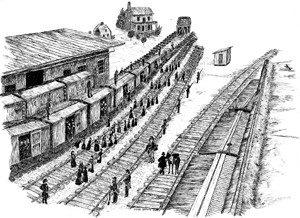
The women and children were given a short time to gather their belongings and then marched out to the Roswell town square where they waited long hours for supply wagons to transport them to Marietta. On their arrival, the millworkers were imprisoned in the abandoned Georgia Military Institute where they remained for the next week.

Marietta train station

From there, they were loaded into boxcars and given several days' rations. Not knowing where they were going or if they would return, they were not even the opportunity to leave messages for their loved ones.

"The train which arrived at Louisville from Nashville ...brought up from the South two hundred forty-nine women and children, who are sent by order of General Sherman..."

Once they arrived in the North, their hardships continued. Despite Sherman's assurances they would "live in peace and security", a very different future lay in store. There was no aid, no work and no shelter. Some of the refugees died of disease which reached epidemic proportions in late 1864.

Once the news of the atrocities suffered by these women reached the newspapers, both Northerners and Southerners were outraged.

"It is hardly conceivable that an officer bearing a United States commission of Major General should have so far forgotten the commonest dictates of decency and humanity...as to drive four hundred penniless girls hundreds of miles from their homes and friends to seek livelihood amid strange and hostile people."

So moved by the article, General Dodge, one of Sherman's commanders, took $100 from his pocket and instructed his chief surgeon to hire some of the Roswell girls to help care for his sick and wounded.

Whew, what an ordeal these women endured! Their fate of these workers has long been considered a mystery. Though a few returned to Roswell, many of them married men in Kentucky, Indiana, or Ohio and settled there. Returning to Roswell would have been very difficult especially for a young woman or single mother. Even if she obtained the means for the journey, she had no idea what awaited her in a land laid waste by Sherman's army.

Adeline Bagley Buice Grave Marker & Inscription
Roswell Mill Worker Caught & Exiled to Chicago by Yankee Army in 1964- Returned on Foot 1869

Below is a memorial dedicated to the 400 women and children who were lost to their families and to history.


For the past year--between writing for two MAPS series--I have read and researched this unfortunate, haunting, yet little-known episode in American history. I hope Winning the Widow's Heart will do the women's story justice.

Sources:
"The Roswell Mills: A Civil War Tragedy" by C.M. Dillman
"Days Gone by in Alpharetta & Roswell"
"The Long Walk Home: The Story of Adeline Bagley Buice
"Historic Roswell" by Joe McTyre, Rebecca Nash Paden

Here is a link to read more about Roswell, Georgia   CLICK HERE