Showing posts with label Mended Heart series. Show all posts

Thursday, April 27, 2023

The Mother's Friend by Jo-Ann Roberts


If you've been reading my past blogs about products or inventions in the 19th and early 20th century, you know I'm a history nerd and how easy it is for me to go down the rabbit hole when I'm researching a new book. Such was the case when I needed to know about teething medicines for my upcoming release, Winning the Widow's Heart. While it mentions Mrs. Winslow's Soothing Syrup only once, I wanted to make sure the information was accurate.

Imagine, if you will, that you are a first-time mother with a teething baby in the middle of the 19th century. Her cries keep everyone in the household awake for nights on end.

What's a mother to do?

Enter Mrs. Winslow's Soothing Syrup, one of the most successful, famous or infamous medicines from the past and was called the "baby killer" by some.


Charlotte Winslow was a midwife and studied infant teething and other related pains. Sometime prior to 1844, she prepared this highly successful potion for children teething. Soon after, she gave the recipe to her son-in-law, Jeremiah Curtis and his partner Benjamin Perkins, druggists in Bangor, Maine. They manufactured and sold it under the name Mrs. Winslow's Soothing Syrup.

The syrup claimed "to sooth any human or animal", and it quieted restless infants
and small children. Widely marketed in the U.K. and the U.S., the company promoted their product in recipe books, calendars, and trade cards. 


The syrup was sold in bottles about five inches tall by one and one-quarter inches in diameter.

The primary ingredients were morphine, alcohol, water softener, and aqua ammonia. 

Eww! I can't even begin to imagine what this may have tasted like! 

A teaspoon of the syrup had the morphine content of twenty drops of laudanum. It's inconceivable that the dosage suggested was that a month-old baby receive no more than two to three drops, and children six months old and up were to be given a half teaspoonful three or four times a day is alarming! The recommended dosage for children with dysentery was similar to the amounts already given but was to be repeated every two hours until improvement was noticed.

So, it isn't hard to understand why so many babies who were given this concoction went to sleep only to never wake up gain, coining the syrup's nickname, "the baby killer". However, many parents swore by the syrup as evidenced by the following letter written by a Massachusetts father...

Dear Sir: I am happy to be able to certify to the efficiency of Mrs. Winslow's Soothing Syrup, and to the truth of what it is represented to accomplish. Having a little boy suffering greatly from teething, who could not rest and at night by his cries would not permit any of the family to do so, I purchased a bottle of the Soothing Syrup, in order to test the remedy, and, when given to the boy according to the directions, its effect upon him was like magic; he soon went to sleep, and all pain...disappeared....Every mother who regards the health and life of her children should possess it.                     Mr. H.A.Alger, Lowell, Mass.

Once the Pure Food and Drug Act passed in the U.S., Mrs. Winslow's Soothing Syrup was forced to remove morphine from their syrup and remove "soothing" from the brand name. Even so, the syrup was sold until the 1930s.

So, the question begs to be asked: Why would a parent give their child such lethal medication?

Ingredients in 19th and early 20th century medicines weren't stated as they are today nor did people understand the full effects of these ingredients. So, without this information, people living in the era of Mrs. Winslow's Soothing Syrup put their trust in druggists and doctors about the medicines they were prescribing. Yet even those who had medical training may not have known the full effects of certain drugs.

It's easy to understand how a product like this syrup would have appealed to weary parents looking for a cure-all for fussy babies and infants. 

Thankfully, advances in today's modern medicine ensure that such a loss of so many children as a result of this syrup, and other drugs like it, does not happen again.

Disclaimer: Before you think that I had my heroine give the baby several doses of the syrup, please let me assure you, no babies were harmed in the telling of this story.  

New Release!

She was branded as a traitor to the Union.
He was her sworn enemy.
A marriage of convenience would be perilous...wouldn't it?

In the summer of 1864 in Roswell, Georgia, widow Sofie Bishop struggles to manage the small family vineyard on her own. Now with her home in ruins her only option was working at the Ivy Woolen Mill. Her woes go from bad to worse when the Yankees arrive on Roswell's doorstep.

Courteous and kind, Captain Seth Ramsey is not what Sofie expects from a Union officer. However charming he might be, she's determined to keep her distance. Even when she finds herself branded as a traitor, arrested, and transported north to an uncertain destiny, she didn't think she could lose much more to the Yankees.

But she was wrong.

Will his vow of love mend her wounded heart? Or would a marriage of convenience be the best she can offer?

 FB Page: https://www.facebook.com/jrobertsauthor/


Thursday, March 23, 2023

Spring Cleaning - Tips & Tricks from the Mid-1800's by Jo-Ann Roberts

How do you feel about Spring cleaning? For some it's an opportunity to freshen the home; for others it's not worth something to be bothered about. For years, when I'd return home from school to find the house topsy-turvy, I knew my mother had started spring cleaning. Windows devoid of curtains would be wide open, the beds stripped, the vacuum in middle of the hall, and the combine scents of furniture polish and vinegar hung in the air.

As much as I like an orderly house, I don't go crazy for spring cleaning. 

Except when I'm on a deadline (which is presently the case), I daily dry sweep the floors, clean the kitchen counters, straighten things up, do a load or two or laundry, and make the bed. And whenever my husband pitches in, I consider it a bonus.

Spring arrives this week. So, let's spare a thought for 19th century housekeepers who spent considerable time, elbow grease, and disruption on Spring cleaning. From my research, it appears that many households in the mid-1800s had mixed feelings.

"Spring cleaning! Oh misery! Ceilings to be whitewashed walls to be cleaned, paint to be scoured, carpets to be taken up, shaken, and put down again...I might spring my feet off and not get all that done."                                                                                                                               - Sara Willis Parton

"It must be confessed, however, that after the great turmoil is over, whether it be a week, fortnight, or three weeks of scrubbing, scouring, there is a moment of delightful repose in the family...This is very pleasant, but it is a pity that it should be purchased at the cost of so much confusion --so many petty annoyances."                                                 - Susan Fenimore Cooper

Yet, while you think that Victorians were strict about cleanliness, it was noted in one handbook published in 1899 reminding readers that while cleanliness is important, one should maintain a laid-back attitude about it.

A sentiment I highly embrace.

Here, in no particular order of importance are a few methods our great-great-grandparents used for spring cleaning.

Gilded Frames

Freshen up the shine of gilt picture frames by going over them with a soft brush dipped in water in which three or four onions have been boiled for about an hour." The expert cleaner


Sweeping 

"While sweeping, keep all doors shut, that the dust may not spread. And let those who are not active assist in the operations know as little as possible of what is going on. Keep all brooms, brushes, water pails and dust out of the way so as not to endanger people's shins."  The Expert Cleaner 


Wallpaper

"If a good wallpaper is soiled, it may be refreshed by rubbing it lightly with a piece of breadcrumb; this is best done by straight long strokes."   The Expert Cleaner.


Bedding

"...a feather bed put in the sun for a day will have received almost as much benefit as if it had been sent to be cleaned and steamed. A feather should be put into all the screw holes and crevices of a bedstead, to rid it of dust; and if there is a suspicion of any unwelcome visitors, the feather should be dipped in turpentine."     The Expert Cleaner

The stove

"...moisten some black-lead with a little stale beer, if there is any; if not, water will do. Then with the small round blacking brush, put the lead over every part that is to be blacked...."


Windows

"...Dry whiting will polish the glass panes nicely. Weak black tea with some alcohol is the best liquid to wash the glass. Save all the tea grounds then when needed, boil them in a tin pail with two quarts water, and us the liquid on the windows. It takes off all the dust and fly specks. If applied with a newspaper, and rubbed off with another paper, they will look far better than if cloth is used."

P.S. Today, many people still used newspapers to clean windows.


Floors

"...Take a flannel cloth and saturate it in sweet unskimmed milk; wipe over the floor whenever it needs cleaning or brightening."      - The Expert Cleaner


Intrigue by these methods, I did some additional research. And, yes indeed, the use of black tea is currently a bonafide way to clean glass surfaces, and skim milk is often used on wood and stone floors in some ancestral homes in England.

So, once you try one or more of these methods, especially the tea and milk, you will not only have sparkling windows and clean floors, but you can relax with a soothing drink!

Sources:

19th-Century Cleaning Tips for the Modern Era - The New York Times (nytimes.com)

Victorian spring-cleaning tips and tricks - Recollections Blog

Spring Cleaning in the 19th Century - Shannon Selin

Spring Cleaning the Old-Fashioned Way | English Heritage (english-heritage.org.uk)

DIY Black Tea Window Cleaner | Apartment Therapy


Coming soon!


She was branded as a traitor to the Union.
He was her sworn enemy.
A marriage of convenience would be perilous…wouldn’t it?

In the summer of 1864 in Roswell, Georgia, widow Sofie Bishop struggles to manage the small family vineyard on her own. The War Between the States took her husband and her way of life. Now, with her home in ruins her only option was working at the Ivy Woolen Mill. Her woes go from bad to worse when the Yankees arrive on Roswell’s doorstep.
Courteous and kind, Captain Seth Ramsey is not what Sofie expects from a Union officer. However charming he might be, she’s determined to keep her distance. Even when she finds herself branded as a traitor, arrested, and transported north to an uncertain destiny, she didn’t think she could lose much more to the Yankees.
But she was wrong.
Will his vow of love mend her wounded heart? Or would a marriage of convenience be the best she can offer?


Thursday, January 26, 2023

The Civil War Trail of Tears - Plight of the Roswell Women by Jo-Ann Roberts


"Only think of it! Four hundred weeping and terrified Ellens, Susans, and Maggies, transported in springless and seatless army wagons, away from their loves and brothers of the sunny South, and all for the offenses of weaving tent cloth."

Disclaimer: Although there are no personal accounts written by the women themselves, their voices are still silent. However, the evidence that is available confirms their plight, and although the disappearance of the Roswell women is somewhat shrouded in mystery, it is easy to fit the pieces of the puzzle together. I am not condemning nor condoning the actions of the U.S. Army during the Civil War.

Several years ago, I watched a story on PBS about a little-known event of the Civil War, telling myself that if I ever had the time, I'd love to create a historical romance based on the life of one of those women who was branded a traitor and sent North.

Fast forward to 2021 when I created the Mended Hearts series. Each book is based on true facts during the latter half of the Civil War. Marrying the Major released in November 2021, and Winning the Widow's Heart will release April 26th, finally telling the romance that had been in my heart and head for so long. The plight of the Roswell women has long been lost to the forgotten passageways of history, and this story is to give one woman a voice to her tragic tale.

At the time of the Civil War, 400 women were employed by the Roswell Mills in Roswell, Georgia. As production increased, so did the number of people living in the area. As the war dragged on the leading families of Roswell fled in advance of Sherman's army, leaving the fate of the mills and their employees to fend for themselves. These women had no choice but to work in the mills. In addition, they were forced to take their children with them. No doubt, they would have preferred to be elsewhere...tending home and hearth. Instead, these women wove cloth to outfit their husbands, sweethearts, fathers, brothers, and sons.

Roswell women in front of Ivy Woolen Mill 1863
Ivy Woolen Mill 1830s

Ivy Woolen Mill 2002

Sherman, looking for a way to get the army across the Chattahoochee, and thus into Atlanta, sent General Garrard to capture Roswell. Initially, the general promised no harm would come to the mill unless he found evidence they were supplying the Confederate army with goods (rope, canvas, tent cloth). Unfortunately, he did discover the letters "C.S.A." printed into the cloth and burned the mill. 

Upon learning this, Sherman sent the message:

"..."I repeat my orders, that you arrest all people, male and female, connected with those factories, no matter the clamour, and let them foot it under guard to Marietta, the I will send them by cars to the North."

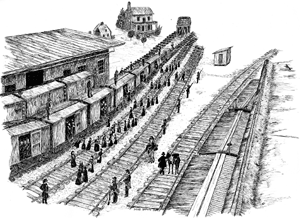
The women and children were given a short time to gather their belongings and then marched out to the Roswell town square where they waited long hours for supply wagons to transport them to Marietta. On their arrival, the millworkers were imprisoned in the abandoned Georgia Military Institute where they remained for the next week.

Marietta train station

From there, they were loaded into boxcars and given several days' rations. Not knowing where they were going or if they would return, they were not even the opportunity to leave messages for their loved ones.

"The train which arrived at Louisville from Nashville ...brought up from the South two hundred forty-nine women and children, who are sent by order of General Sherman..."

Once they arrived in the North, their hardships continued. Despite Sherman's assurances they would "live in peace and security", a very different future lay in store. There was no aid, no work and no shelter. Some of the refugees died of disease which reached epidemic proportions in late 1864.

Once the news of the atrocities suffered by these women reached the newspapers, both Northerners and Southerners were outraged.

"It is hardly conceivable that an officer bearing a United States commission of Major General should have so far forgotten the commonest dictates of decency and humanity...as to drive four hundred penniless girls hundreds of miles from their homes and friends to seek livelihood amid strange and hostile people."

So moved by the article, General Dodge, one of Sherman's commanders, took $100 from his pocket and instructed his chief surgeon to hire some of the Roswell girls to help care for his sick and wounded.

Whew, what an ordeal these women endured! Their fate of these workers has long been considered a mystery. Though a few returned to Roswell, many of them married men in Kentucky, Indiana, or Ohio and settled there. Returning to Roswell would have been very difficult especially for a young woman or single mother. Even if she obtained the means for the journey, she had no idea what awaited her in a land laid waste by Sherman's army.

Adeline Bagley Buice Grave Marker & Inscription
Roswell Mill Worker Caught & Exiled to Chicago by Yankee Army in 1964- Returned on Foot 1869

Below is a memorial dedicated to the 400 women and children who were lost to their families and to history.


For the past year--between writing for two MAPS series--I have read and researched this unfortunate, haunting, yet little-known episode in American history. I hope Winning the Widow's Heart will do the women's story justice.

Sources:
"The Roswell Mills: A Civil War Tragedy" by C.M. Dillman
"Days Gone by in Alpharetta & Roswell"
"The Long Walk Home: The Story of Adeline Bagley Buice
"Historic Roswell" by Joe McTyre, Rebecca Nash Paden

Here is a link to read more about Roswell, Georgia   CLICK HERE