Showing posts with label The Outlaw's Letter. Show all posts

Wednesday, May 18, 2022

Let's take a Ride

 Post by Doris McCraw

writing as Angela Raines

Photo Property of the Author
Stagecoach Tracks through the Grasslands

Imagine you are in Trinidad, Colorado. You are tired of walking and wish for a change. You decide to take a Streetcar. As you travel on this horse/mule-drawn car, perhaps you see Marshal Masterson as he goes about his business. The year is 1882 and the Trinidad Street Railway Company was founded that same year.

Perhaps Dolores Baca, who, along with her husband Felipe, donated land to create the town of Trinidad, is outside her home on the Plaza. The location was perfect. The Sante Fe Trail ran through the land. Soon the wagons bound for Santa Fe were replaced by trains. Sheep gave way to cattle and then when coal was found nearby the city was on its way.

In the course of its history, many famous people came through the area. In 1872, Sister Blandina arrived to teach the poor in the area before she was sent on to Santa Fe in 1877.

To have a Street Railway Company was a sign that an area had the population to support such an endeavor. 

At the same time, the area was still a frontier town.

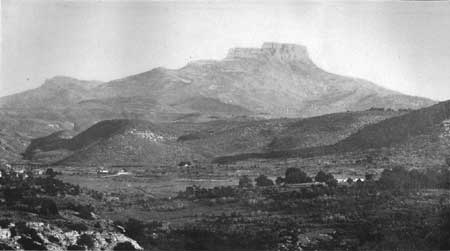
USGS Photo of Fishers Peak, 
West of Trinidad, CO

These types of research fuel my imagination and make my writing so much fun. The wonderful 'What If' of storytelling. I can see my young protagonist taking in the wonders of the area.

This is what I did when I told the story of Grant and Hetty in "The Outlaws Letter". Not only does it help add authenticity to the story, but I was also able to share things about my adopted state that fascinate me.

Below is a short excerpt from that story on just that subject of sharing bits of history. In this case the town of Canon City.

Amazon


 Pulling up about a hundred yards away from the prison wall, Hetty climbed down from the wagon, walking slowly forward. She took in the wall, built by the inmates she had been told, the three-story stone building where the prisoners were housed. There were men in the yard, their striped clothing marking them as criminals, along with armed guards watching them.

How did Grant survive? Hetty thought. To be confined, having to live by someone else's schedule. All these thoughts tumbled through Hetty's mind. She wasn't sure she'd ever understand. At the same time, she was thankful Grant had kept that concern for others. Where would she be now if he'd become hardened, jaded with the world, from having spent time behind these walls? What of Maude's husband? How would his time here change him?

Turning away, Hetty returned to the wagon where Maude and Clover waited.

"Thank you," Hetty began, "I know—"

"Don't ya let it bother ya," Maude interrupted. "My husband only has a few more months. Moved here ta be close jest in case—" Maude paused, then smiled. "In the meantime, I've my memories."

Hetty watched Maude as her eyes became unfocused, a smile on her face. Would she ever have that kind of joy with Grant? For that matter would she ever see him again?


Post (c) Doris McCraw 2022 

Wednesday, August 19, 2020

LESSON PLANS- EARLY COLORADO

Photo property of the author


Lesson Plans - Early Colorado

 Post by Doris McCraw writing as Angela Raines

I was talking with a friend the other day about the richness of the history that surrounds us here in Colorado, as well as other parts of this country. Not the major events, we all know those, but the stories of the smaller, yet important events. To that end, I'll be sharing history, the history that our stories are born from.

I started the series on another blog with 'Acting lessons for Writers' which you can read here. Acting Lessons for Writers

This post will cover the early days of what later became the state of Colorado.

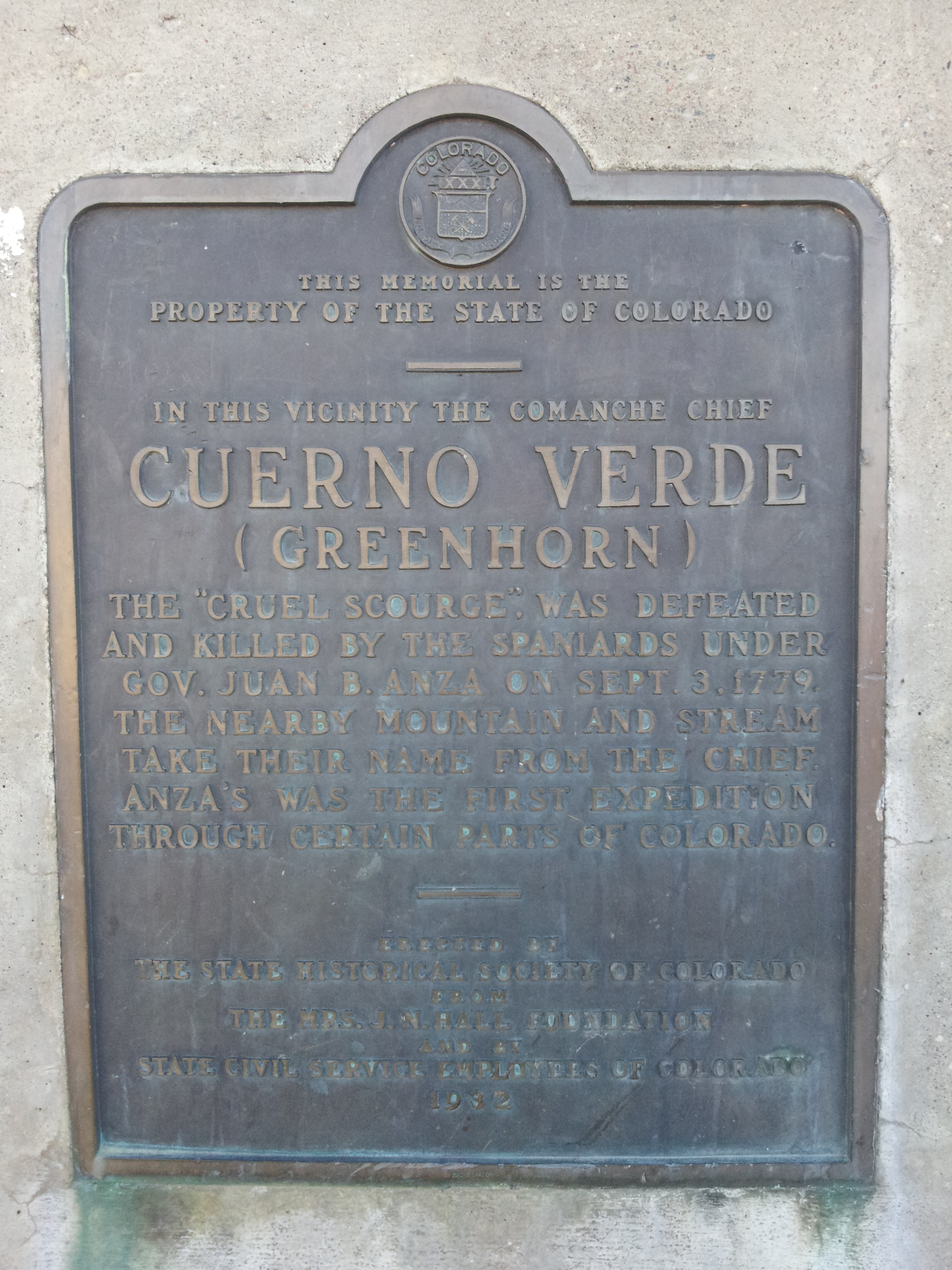
One of the first things I learned about early Colorado was the conflict between General DeAnza and Cuerno Verde. Cuerno Verde had been harassing the settlers in far Southern Colorado near what is now the New Mexico border. In 1779 De Anza traveled up from New Mexico probably through South Park and down Ute Pass. He had running battles along the front range and eventually caught up with Cuerno Verde near the Greenhorn Mountains. Cuerno Verde died Sept. 3, 1779. You can find the marker along near Highway 166. For more on this story: 

Juan Bautista de Anza: The King's Governor in New Mexico


Cuerno Verde - Wikipedia
Photo from en.wikipedia.org

Of course, Colorado was also known for its Fur Trading Forts. The most famous and well known is Bent's Fort, which was located near the Arkansas River near La Junta, Colorado. The current building is a reconstruction of the second fort and well worth a trip to visit. (While there be sure to take in the museums and the Comanche Grasslands, including Picketwire Canyon where you can still see dinosaur footprints.) This is a rich and deep history of the early days of Colorado when the Mountain Men and businessmen such as the Bents, Vazquez, and Rubidoux made their mark on the development of the territory. For more information: 

Colorado Forts: Historic Outposts on the Wild Frontier

The Fur Trade in Colorado


Bent's Old Fort view from the North
Photo from the National Park Service

Of course, no early history would be complete without the journey of Zebulon Pike, who traversed the central and southern part of the Front Range of Colorado. There is even a mountain that bears his name, although he never made it to the top. There is a reconstructed stockade about seventeen miles southeast of Alamosa on the Rio Conejos. You can also visit Pueblo, Colorado where Pike built another stockade during in 1806-07 expedition. An edited version of his diary is available for those who would like to read more. 

The Southwestern Journals of Zebulon Pike, 1806-1807

by Stephen Harding HartArcher Butler Hulbert, et al.


      Pike Stockade
From Colorado Encyclopedia.org

So for those of you who wish to learn more about the rich early history of Colorado here is a start. More lesson plans will be forthcoming.

The book "The Outlaw's Letter" contains later Colorado History. Here is just a small sample:

 "I'd like to check the train schedule when we get into town," Hetty said. "Without Odysseus, train travel would probably be the safest way to head back to Kiowa Wells."

"Station's near the edge o' town," Clover added from the front seat.

"You know you can visit me any time," Hetty offered to Maude and Clover.

Maude gave Hetty a sad smile. Hetty knew Maude didn't think she'd be welcomed, but Hetty knew everyone would love the woman. Before Maude could reply, Hetty saw a new three-story brick building going up.

"What's that?" Hetty asked.

A passerby hearing the question, shouting the answer, pride in his voice, "That's the new school, and we have a military academy being built also."

"It looks beautiful," Hetty called back, "you have a right to be proud." Looking over at Maude, Hetty caught a look of want and sadness. It gave her an idea.


The Outlaw's Letter (Lockets and Lace Book 15)
Amazon


Doris Gardner-McCraw -
Author, Speaker, Historian-specializing in
Colorado and Women's History
Angela Raines - author: Telling Stories Where Love & History Meet


Wednesday, June 19, 2019

BOOKS, WHAT WAS POPULAR

Post by Doris McCraw
writing as Angela Raines


I thought it might be fun to see what books were releasee and popular in the decades of the 1800s, from 1850-1890.  Do you recognize any of them? Have you read them? The below is just a sampling.

So here for your 'reading' pleasure is a selection of books from the past.

1850:
Fiction

Charles Dickens - "David Copperfield"
Nathanial Hawthorne - "The Scarlet Letter"
Caroline Lee Hentz - "Linda"
Susan Warner (as Susan Wetherwell) - "The Wide,Wide World"

Non-Fiction

Julia Kavanaugh - "Women in France During the Eighteenth Century"
Mary Anne Attwood - "A Suggestive Inquiry into the Hermetic Mystery"

1860

Fiction

R.M. Ballantyne - "The Dog Cursoe and his Master"
Mary Elizabeth Braddon - "Three Times Dead"
Charles Reade - "The Cloister and the Hearth"
Mary Howard Schoolcraft - "The Blacak Gauntlet: A Tale fo Plantation Life in South Carolina"

Non-Fiction

Ralph Waldo Emerson - "The Conduct of Life"
Gray's Anatomy (2nd edition)

1870

Fiction

Wilkie Collins - "Man and Wife"
Jules Verne - "Twenty Thousand Leagues Under the Sea"
                       "Around the Moon"
Charlotte M. Yonge - "The Caged Lion"
Bret Harte - "The Heathen Chinee"

Non-Fiction

Henry Maudsley - "Body and Mind"
William Robinson - "The Wild Garden"

1880

Fiction

Amelia Edwards - "Lord Brackenbury"
Mark Twain - "A Tramp Abroad"
Lew Wallace - "Ben-Hur: A Tale of the Christ"
Rhoda Broughton - "Second Thoughts"

Non-Fiction

Henry Charlton Bastian - "The Brain as an Organ of the Mind"
Algernon Charles Swinburne - "A Study of Shakespeare"

1890

Fiction

Kate Chopin - "At Fault"
Molly Elliot Seawell - "Little Jarvis"
Arthur Conan Doyle - "The Firm of Griddlestone"
Mary Elizabeth Braddon - "One Life, One Love"

Non-Fiction

James McNeill Whistler - "The Gentle Art of Making Enemies"
Algred Thayer Mahan - "The Influence of Sea Power Upon History"

So there you have it, a spattering of books from the past. Of course there were many more. I've left out children and poetry books, although I admit, I enjoy reading them. I wonder if our stories and books will make list one hundred years from now? It's something to think about. I know, in my latest novel, "The Outlaw's Letter", my heroine has a passion for Homer. Below is a short excerpt.

     As she stretched out on the ground, she turned, catching a glimpse of Grant's profile. If she didn't know better, she would swear he was a stone statue. With a sigh, she pulled her blanket to her shoulders and turned her gaze to the night sky. "I always loved Homer's Odyssey," Hetty said, smiling at the memory of herself sitting under the tree, living the adventure in her mind. She wondered now what people would say about her relating to the hero instead of the long-suffering wife. She looked up, hoping Grant would say something. His silence was disturbing.
     "And how do you think he would be as an old man, confined by age, to living within his four walls?" Grant asked, casting his eyes toward Hetty.
     "Never thought about it," Hetty responded. "I imagine he would still be a vital person. I don't think he'd even be slowed down. It wasn't his nature. What about you?"

Amazon

Doris Gardner-McCraw -
Author, Speaker, Historian-specializing in
Colorado and Women's History
Angela Raines - author: Where Love & History Meet
For a list of Angela Raines Books: Here 
Angela Raines FaceBook: Click Here


Wednesday, May 15, 2019

FIRE


Post by Doris McCraw
writing as Angela Raines

Burn Scars
Photo Property of the Author
We all know how dangerous fires were for those living in cities. We've heard of the Prairie Fires, but we sometimes forget the forest fires from the past.

Colorado has had its fair share of fires. This post is a look at a few from the 1800s.

There was said to be a fire around 1853-1854 that ran from north of Fountain Creek and up over Cheyenne Mountain, Ute pass to Wilkerson Divide. The story is told in the book "The Story of the Big Burn 1853-1854" by Herbert Sommers. According to forest service records, 1851 was a dry year, so fires in the early 1850s would not be out of the ordinary. The above fire was said to have burned for three weeks.

Before the westward expansion, the natives used fire to help in their hunting. Of course lightning was also a source of fires starting.

In 1880, there were fires being reported in the forest around Colorado. Of course 1879 had also been a very dry year.

This article from the June 19, 1880 Gunnison News newspaper talks about the fires from that year and the laws around starting such fires.

Block image


The same issue talks about a fire that came close to burning the town of Breckenridge

User clipping image


The June 12, 1880 issue of the Colorado Miner (weekly) talks about the Bear Creek fire

User clipping image

And from the Dolores News issue of June 19, 1880 comes this overview of the state of fires in Colorado.

Block image

So, although fires were part of life in the towns in the early days, the forest fires also were part of the struggles then as now.

In my latest novel "The Outlaw's Letter" my hero Grant has to outrun one of these fires as he makes his way back.

Amazon

Doris Gardner-McCraw -
Author, Speaker, Historian-specializing in
Colorado and Women's History
Angela Raines - author: Where Love & History Meet
For a list of Angela Raines Books: Here 
Photo and Poem: Click Here 
Angela Raines FaceBook: Click Here

Saturday, April 6, 2019

THE OUTLAW'S LETTER - Lockets and Lace #15

Post by Doris McCraw
writing as Angela Raines


I am thrilled "The Outlaw's Letter", the story of Grant and Hetty, is now live and joining the stories of the other authors in the Lockets and Lace series. This story is set in Colorado in 1880, one of my favorite time periods to write about.

Let's take care of the business part first.

One: I am giving away a surpise gift box. I will be picking a winner from those who comment on this post.

Two, As authors, we want to keep sharing our stories with you, but we also need you to share how you feel about what you have read. Please, even an 'I liked this story' on a review helps all of us continue to provide the stories you enjoy. For that we thank you ahead of time. I personally appreciate it so much.

Colorado became a state in 1876, hence the title 'Centennial' State. From 1859 when gold was found near what is now the Denver metro area, Colorado became a place where change, growth and all types of people made this place their home.

There were resort tows, such as Colorado Springs, and wild mountain towns like Leadville and Virginia City in the Tin Cup mining district. Railroads, stage lines, and Indian Trails moved from the plains with cities like Pueblo, Denver and Canon City, to the mountain towns of Georgetown and Leadville, to carry the gold and silver ore to the rest of the world.

Into this mix I placed Grant Davis and Harriett 'Hetty' Osgood. They meet and interact with the mix of outlaws, miners, lawmen and good people, to find their place in life and with each other.


Excerpt: "THE OUTLAW'S LETTER"


     Hetty had been so focused on following Grant, hoping they would soon arrive at the place he spoke about, she didn't realize she was swaying in the saddle. When she realized what was happening, she grabbed the saddle horn in a death grip. Just as she thought she was okay, everything went blurry then black. She fell from Odysseus, cracking her head against a rock.
     Grant heard Hetty's horse stop, glancing back he saw her on the ground. "Blasted woman, why didn't she say something?" he grumbled as he rode back.
     All complaints left him when he saw blood spreading out from the rock under Hetty's head. Grant didn't remember dismounting as he rushed to Hetty's side, feeling for a pulse, and using his kerchief to try and stop the flow of blood, but nothing he did helped.
     "Hetty, Harriet," Grant repeated over and over. Finally he heard a soft moan as Hetty moved her fingers. Letting go a sigh of relief, Grant continued working to revive Hetty. Kneeling on the gravel, Grant didn't notice the pain from the cuts to his knees.

You can purchase "The Outlaw's Letter" HERE 


Print Version :    Print Version Available Here
*** Winner will be chosen Tuesday morning April 9, 2019***

Doris Gardner-McCraw - writing as Angela Raines

Author, Speaker, Historian-specializing in
Colorado and Women's History
Angela Raines - author: Where Love & History Meet
For a list of Angela Raines Books: Here 
Angela Raines FaceBook: Click Here

Wednesday, March 20, 2019

LEADVILLE AND THE SISTERS OF CHARITY

Post by Doris McCraw
writing as Angela Raines

Image result for historic images of leadville colorado
1879 Map of Leadville Colorado
from World Maps Online
By 1880 Leadville, Colorado had grown from a tiny mining community to one of the largest towns in Colorado. This town, at an elevation of 10, 151', was a wild boom town. It saw the likes of Doc Holiday,Wyatt Earp and possibly the James brothers. Margaret Brown, known to the world as Molly Brown was there. It was also the scene of brawls, gunfights and killings. It was a place where many found their fortunes, including the Horace W. Tabor, who divorced his wife Augusta, to marry Elizabeth 'Baby Doe' McCort. 

Into this town, in late 1878, came the Sisters of Charity. They were: Sister Bernard Mary Pendergast, Sister Mary Crescentia Fischer, and Sister Francis Xavier Davey. According to the below article, from the June 3, 1879 issue of the Leadville Daily Evening Chronicle, they traveled through the treacherous winter weather, around Christmas time, through the mountains to care for the sick and build a hospital.


Of course the article alludes to six, but it began with the above three, as far as documentation shows.

In my upcoming novel, "The Outlaw's Letter", my hero, Grant Davis has need of the services provided by these noble and dedicated women.  Make sure to check out his story when the ebook releases on April 6, 2019 on Amazon. You can also pre-order here: The Outlaw's Letter


Doris Gardner-McCraw -
Author, Speaker, Historian-specializing in
Colorado and Women's History
Angela Raines - author: Where Love & History Meet
For a list of Angela Raines Books: Here 
Angela Raines FaceBook: Click Here