Showing posts with label Mail-Order Mama. Show all posts

Friday, June 18, 2021

California's First Lady Lawyer: Clara Shortridge Foltz by Zina Abbott


In 1878, Clara Shortridge Foltz began her quest to become California’s first woman lawyer. A mother of five small children abandoned by her husband, Foltz turned to the law “[n]ot from ambition and defiance of the norms of womanly conduct, but out of desperation,” in order to support her family. Although she turned to working as a lawyer to raise five children, mostly as a single mother, she encouraged women not to overlook their traditional domestic roles.

Clara Foltz was one of several intelligent women who understood the prejudices of the society in which she lived which relegated women to the home. However, she could not support herself and five children on the earnings of “traditionally” accepted female jobs like laundress, seamstress, or cook. She refused to bow to the detractors who discriminated against women joining any profession considered the domain of men.

Her name Clarissa Shortridge, she was born in Milton, Indiana to Talitha and Elias Willetts Shortridge, who was both a lawyer and preacher. Prior to the Civil War, the family moved to Mount Pleasant, Iowa. There, Clara attended a co-educational school (rare at the time). Her father often lamented that it was a shame she had been born a girl and not a boy, because she could have developed into a gifted lawyer.

In December 1864, at the age 15, she eloped with a farmer and Civil War veteran named Jeremiah D. Foltz. As children were born to them, he found it difficult to support his family. The Foltzes moved several times, first to Portland, Oregon, and second in 1872, to San Jose, California. During these times, she contributed articles to the New Northwest and the San Jose Mercury.

Around 1876, her husband abandoned Clara for another woman, leaving her with five children under the age of 11. She began studying law in the office of a local judge, in part through the support of local suffragette Sarah Knox-Goodrich. Starting in 1877, she also supported herself by giving public lectures on suffrage.


There were about fifty women attorneys throughout the United States. However, California prohibited women from practicing law due to the California's Code of Civil Procedure which prohibited women from joining the profession, expressly stating that only a "white male citizen" could apply to the bar. With the help of several male allies, suffragist campaigners, a supportive local press, and her mother's assistance with child care, Foltz successfully lobbied for a new bill, the Woman Lawyer's Act, that allowed women to take the bar.

Thanks to Foltz's commitment to her studies, legal training from her father and his partner C.C. Stephens and a local legal club where aspiring attorneys practiced arguing cases, Foltz passed the bar in 1878, just four months after the Woman Lawyer's Act was passed. This bill allowed admission to the bar of “any citizen or person.” The law was one of the earliest American statutes allowing women to practice law.

Clara became the first woman lawyer on the US West Coast. She practiced law in San Francisco. She sought courtroom work, but, at her core, she was a reformer. She believed that women attorneys “should work to improve the administration of justice.” 

Later that year, she wished to improve her knowledge and skills by attending law school. She and her ally, Laura DeForce Gordon, applied to Hastings College of the Law in San Francisco, which was part of the University of California. They were denied admission based on their gender.

Hastings School of the Law

Drawing upon both the Woman Lawyer Bill and the soon-to-be-ratified equal opportunity in employment statement in the constitution, at the state Supreme Court, Foltz and Gordon argued successfully that the state-supported Hastings Law School should not deny admission to women on the grounds of their sex. They were able to argue that, if women could serve as lawyers, they must certainly be allowed to attend law school at the University of California, which was a coeducational school. Judge Morrison agreed, and in Foltz v. Hoge ruled that Foltz and Gordon should be admitted to Hastings.

Although Clara Foltz successfully obtained admission for all qualified women to Hastings, the work to win the case left her impoverished. She returned to her legal career instead of pursuing her dream of attending law school. In addition to San Francisco, she lived in New York for four years in an attempt to build a corporate law practice. She ended up in San Diego.

It was Clara Foltz’s belief that "Genius, talent and hard labor know no sex." She was responsible for a number of firsts:


 * She spearheaded legislation to allow women to become law school students, notaries public, and administrators of estates.

 * In 1880, Foltz became the first female clerk for the State’s Assembly’s Judiciary Committee.

 * The first woman appointed to the State Board of Corrections.

 * The first woman named director of a major bank.

 * The first female licensed Notary Public.

 * In 1890, she led a campaign for nationwide public defenders' offices—over two decades before California got its first.

 * In 1910, Foltz was appointed to the Los Angeles District Attorney's Office, becoming the first female deputy district attorney in the United States. 

 * In 1930, at the age of 81, she was the first woman to run for governor of California.

Clara Foltz’s other accomplishments included being active in the suffrage 

movement and authoring the Women's Vote Amendment for California in 1911. She also founded and published the San Diego Daily Bee, and New American Woman Magazine, for which she wrote a monthly column until her death.

Clara Foltz died of heart failure on Sept. 2, 1934, at the age of 85. She was at home in Los Angeles at the time.

Clara Foltz’s legacy continues to inspire women who pursue the legal profession. At the insistence of its women students, Hastings College of the Law granted Foltz a posthumous degree of Doctor of Laws in 1991. Also, the primary social space inside UC Hastings's McAllister Tower student housing complex was christened the Clara S. Foltz Lounge.

In 2002, the Criminal Courts Building in downtown Los Angeles was renamed the Clara Shortridge Foltz Criminal Justice Center. 


Clara Shortridge Foltz Criminal Justice Center, Los Angeles

 ~o0o~


In keeping with my interest in genealogy research, I have studied early California laws and some of the accomplishments of early women in this state. I was pleased that my preparation for my novel, A Lawyer for Linton, led me to learn more about the pioneering women in California’s legal system. To find the book description and purchase link, please CLICK HERE.


Sources:

https://www.calbarjournal.com/March2012/TopHeadlines/TH4.aspx

https://www.berfrois.com/2013/08/jill-norgren-american-rebels-women-lawyers-nineteenth-century/

https://www.kqed.org/arts/13863165/the-wests-first-lady-lawyer-opened-doors-for-women-in-law

https://en.wikipedia.org/wiki/Clara_Shortridge_Foltz


Monday, May 10, 2021

Sonora, California-After the Gold Rush


Sonora was an early California gold rush town, and one of the early cities incorporated in the state. It had a wild and uncivilized start, but quickly developed into a regional commerce center.

1866 Sonora

Here are some 19th century highlights of early Sonora from about 1860 on:

In 1864, the Sonora Pass passing through the city was opened. It was a toll road that connected the San Joaquin Valley to the west and the foothill communities around Sonora to the communities of eastern California in Mono County. It is now known as State Highway 108.

In 1884, hydraulic mining was outlawed due to the debris (tailings) which filled the river. That form of mining ended in Sonora, but was soon replaced with hard rock mining.

By 1885, the time period in which my book, A Lawyer for Linton is set, Sonora was well established and in need of a large community facility that could be used for various types of entertainment. Citizens had always shown an appreciation for local and traveling entertainment troupes and other community events. The Sonora Opera Hall was the answer to this need.

Star Flouring Mill before it burned

James G. Divoll and Joseph Bray originally built the Star Flouring Mill on the site. They had made their fortune from the Bonanza Mine, which was located just north of the “Red Church.”

In August 1885, the flour mill burned under suspicious circumstances. Many believed that robbers had broken into the mill thinking gold from the Bonanza Mine was stored there.

View from the Opera Hall

After the fire, Divoll and Bray immediately set to using the surviving walls of the flour mill for the Opera Hall. Just three months later, on Christmas Eve 1885, the Opera Hall opened with its first event, a roller skating party. The Opera Hall was active as a community center only until 1896, when the owners decided it was no longer financially viable. After 1896 there were many uses of the building, the longest being the Opera Hall Garage which closed its doors in 1979. The City acquired the Opera Hall in 1985, and through several historic preservation grants and civic contributions, the City was able to restore the building as an elegant community and entertainment center.

Restored Opera Hall, originally built in 1885

Before and after the Civil War, the area suffered a depression. With the placer gold pretty much mined out of the area, Sonora, along with the rest of Tuolumne County experienced a large decrease in population. However, on or around January of 1870, marked by the incorporation of the Guild Mining Company, the area began what is known as Sonora’s second gold rush. Lode mining became important and the city remained the trade hub for the new hard-rock camps. Agriculture and timber operations also contributed to the lasting prosperity of the city.

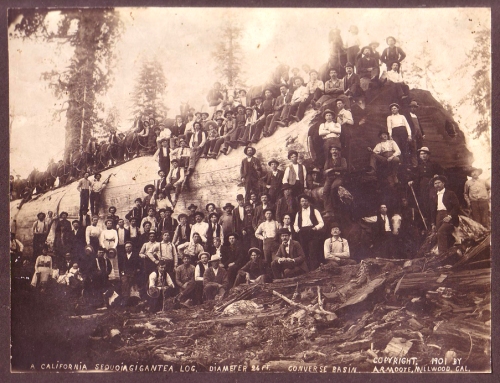
36 foot diameter log with crew and many others

 Lumber had always been an important industry for Tuolumne County and Sonora. At first, the primary use of the lumber was for mining needs. Then, as homes and businesses were built up, the need for lumber grew. Wood was transported by rivers and channels using water flumes. Also, horse and mule-drawn lumber wagons hauled much of the lumber. The market stayed fairly local for years due to the lack of a railroad to cost–effectively transport lumber far beyond the county. However, with the coming of the railroad, markets for lumber in the mountains surrounding Sonora increased.

In other respects, because the city was remote from the larger population centers in California, some amenities came to Sonora later than they did to other parts of California. The city did not receive electricity until 1982. The railroad—Sierra Railway—did not arrive until 1899. It first paved its roads in 1922. In 1899, a beautiful courthouse was built to replace the former 1853 courthouse, and began service in 1900. It is still in use today.

1900 Tuolumne County Courthouse, Sonora

In spite of that, Sonora became a town that continued to survive and move forward with the rise of mining and lumber into the 20th century.


I greatly enjoyed writing A Lawyer for Linton and setting it in a city I have enjoyed visiting several times. This book is currently available by CLICKING HERE.


Sources:

https://www.sonoraca.com/visit-sonora/sonora-california-history/short-history/

https://westernmininghistory.com/towns/california/sonora/

http://www.historichwy49.com/sonora/sonhist.html

http://www.tchistory.org

New Melones Dam from Wikipedia

https://tchistory.org/timber-lumber-industry/


Monday, April 12, 2021

Tuolumne County Courthouse by Zina Abbott


On February 18, 1850 the California legislature established Tuolumne County as one of California’s original 27 counties, and on May 1, 1851 incorporated the city of Sonora. Sonora remains the County Seat and is the only incorporated city in the County.

Built in 1853

The first Tuolumne County Courthouse was constructed of wood in 1853. It was a two-story structure that faced Green Street between Jackson Street and Yaney Avenue. It was on the same lot occupied by the present courthouse. 

Yaney business, left, on N. Washington Street, Sonora

Sonora's downtown business owners wanted the building erected in that section, but uptown brothers and merchants Israel P. Yaney and John Yaney pushed to have it built farther north. Together with William G. Heslep and Peter O. Bertine, they made five lots and a portion of two additional lots available to the county on such reasonable terms that the matter was settled. However, until then, a bitter battle raged in the various newspapers in circulation at the time in Tuolumne County about where the location of the new courthouse should be built.

Water to this building was furnished through one single faucet from which containers were filled for use in the various courthouse offices. On court days a bucket of fresh water was placed by the courtroom door with a long-handled dipper hanging conveniently nearby for community use. Other “amenities” included spittoons for the interior rooms and outside privies. Electric lights were not installed until 1892 when the City of Sonora was electrified.

First courthouse built 1853

The first courthouse remained occupied until 1898, By then, an economic resurgence occurred due to the “Second Gold Rush” which began in the early 1890's as hard rock mining developed. It soon became evident that the old building was no longer adequate for the county's needs. Not only was there a need for new county government facilities, but also the tax base needed to be increased to finance the improvements.

Last day at the old Tuolumne County courthouse

On August 14, 1897, the Board of Supervisors adopted a resolution that the old courthouse was "…in a dilapidated and unsafe condition, its vaults in which the records of the county are kept are wholly inadequate for the necessities and demands of the county." The resolution directed the Board's clerk to advertise for the submission of detailed plans and specifications for a brick and stone courthouse "to be erected at a cost not to exceed forty thousand dollars on the present courthouse site in the City of Sonora."

After several days of examining plans and specifications submitted by ten architects, two deadlock ballots, and an extended session, on January 6, 1898, the Board of Supervisors selected the San Francisco firm of William Mooser & Son by a 3-2 vote.

In 1898 the county tore down the old courthouse. The new courthouse was built on the same site. The difference was, the building no longer faced Green Street like the original courthouse. It was originally designed to face east towards Washington Street, Sonora's main thoroughfare. Pressure was brought upon the County Board of Supervisors by one of the county's most affluent citizens, lumber baron, Samuel S. Bradford, who resided across from the site on Yaney Avenue to the north. He did not want to look outside of his windows and see the side of the courthouse. He succeeded in having the plans altered so the structure faced his home. Instead, the side of the courthouse is seen from Washington Street, the main road through Sonora. Bradford’s home is no longer there, but the courthouse still faces north instead of North Washington Street.

A Union Democrat article published on January 15, 1898, reported, "The plan of the first floor is that the main entrance shall face to the north, with another place of ingress and egress on the south. All architects concur with Mr. Mooser that this is the true position for the main entrance, as it then comes to a street level and the surrounding view thereby afforded includes some of the handsomest buildings in town. . .".

The final plans from William Mooser & Son were officially adopted on April 5, 1898, with the understanding that the courthouse would be a fireproof building, with fire hoses on each floor.

Courthouse workers, courtesy of the City of Sonora

On May 21, 1898, the courthouse construction contract was awarded to the low bidder, Charles F. McCarthy. The contract called for the old courthouse to be removed and the site ready for the contractor to begin work by July 20, 1898. The various county officers, their records, and furnishings were located throughout the downtown area.

In mid-June, the old courthouse was auctioned off in three sections. Only about 50 people attended. The northern addition erected in 1891 was sold for $26.00, and the older addition on the south went for only $5.00. The original courthouse had been purchased by the contractor for $50.00.

Some sources claim the new courthouse was built in the Romanesque style. Others call it Spanish Revival style resembling the old missions of California.

The total cost of the new courthouse, including electrical work, painting, heating, ventilating, vaults, and new matching furnishings came to $100,843.00. While this sum was over budget, it is significantly less than the cost for such a structure today.

The cornerstone of the courthouse was dedicated on September 28, 1898, with approximately 500 spectators present in the midst of a drenching rainstorm. The formal dedication ceremonies were conducted by the Tuolumne Lodge No. 8, F. & A. M., and orator of the day, attorney Frank D. Nicol.

photo courtesy of California State Library

During the following year, a three-story building was erected of steel, concrete, and brick. The foundation of the courthouse required 500 barrels of cement, 300 wagon loads of gravel, and 150 loads of sand. It was estimated that 800,000 common red bricks were used during construction. They were made by the San Joaquin Brick Company, which erected a manufacturing plant where suitable clay had been found on the Charles Brusie ranch in Sonora. The hallways were laid with imported tile, the interior walls faced with fine local Columbia marble, and the open staircases were built with ornate iron railings. The exterior was finished off with eighty-five thousand yellow Roman pressed brick and sandstone from Colusa County.

Mosaic tile was laid in the grand entry, and in the hallway of the second floor. It is the same tile you see today. These were said to have come from Holland, although research casts some doubt on that. The marble wainscoting and steps that you see in the halls of the courthouse was quarried near Columbia.

This new courthouse featured several modern conveniences of the turn of the century. (I wonder if that means the bucket of drinking water and handy communal dipper were upgraded at that time.) It was designed to have an elevator, but the elevator was never installed. Instead, people must climb forty-eight steps to reach the third floor.

The Seth Thomas clock was installed in June, 1899. The bell weighs 1000 pounds and the weights attached to the bell weigh 1300 pounds. The remainder of the clock works was proportionately heavy. The clock was started to keep time at 5:00 p.m. on June 22, 1899. The Union Democrat reported that the bell could be heard at a considerable distance. Throughout the years, the accuracy of the clock has been a topic among residents in the downtown area, and remains so today. In the early 1930's, the weights and crank were replaced with electricity.

The lower floor of the courthouse originally housed the Sheriff's Office, Superintendent of Schools, and the boiler room that originally housed a steam boiler. The second and third floors of the courthouse originally housed the Offices of the Treasurer, Clerk, Assessor, District Attorney, Judge's chambers, law library, the Superior Courtroom, and the County Supervisors' Chambers.

A large room at the southeast corner of the lower level was not designated for any immediate purpose, and patent steel roller shutters were installed upon its four windows for protection. When the Tuolumne County High School District was formed in 1902, the first classes were held in that room for four years until they were moved to the newly constructed high school on Shaws Flat Road in 1906.

In the evening on Thanksgiving, November 30, 1899, all of the 232 electric lights in the courthouse were turned on at once, and many local residents came to witness the event.


The contractor and Board of Supervisors declared the courthouse to be fully completed and the work was accepted on July 23, 1900.

On January 1, 1981, the courthouse was listed on the National Register of Historic Places. Accordingly, regulations must be strictly adhered to in order to preserve the historic value of the building when considering repairs or improvements. The courthouse remains in use.

I was fortunate in that my last day trip before the Covid-19 pandemic hit was one to Sonora. I took several photos and was able to learn  more about this county's history. As for my recent book, this courthouse plays a role in both Cole which is part of the Cupids and Cowboys series, and A Lawyer for Linton which will be released later this month. Because both stories are set before 1898, the courthouse referred to would have been the old one.


Most of Cole is set in Stanislaus County to the west of Tuolumne County. However, after he buys ranch land in Tuolumne County, this is the courthouse where he would have recorded his deed and registered his cattle brand. To find this book's description and purchase link, please CLICK HERE.


In A Lawyer for Linton, After graduating from law school, Samantha travels to Sonora in 1885 to apply for a law partnership offer. The old courthouse is where she'll get her first courtroom experience. This book is still on preorder. To find the story description and link, please CLICK HERE.


Sources:

http://www.historichwy49.com/sonora/sonhist.html

https://tuolumne.courts.ca.gov/general-info/courthouse-history.shtml

(The information in this source was taken from two articles written by County Historian, Carlo M. De Ferrari, in Vol. 39, No. 1, July-Sept., 1999, and Vol. 39, No. 2, Oct.-Dec., 1999 of CHIPSA, the Quarterly of the Tuolumne County Historical Society. )

https://www.sonoraca.com/visit-sonora/sonora-california-history/short-history/

https://www.sonoraca.com/visit-sonora/sonora-california-history/sonora-ca-historic-landmarks/

https://en.wikipedia.org/wiki/Tuolumne_County_Superior_Court