Showing posts with label Colorado Springs History. Show all posts

Wednesday, September 17, 2025

Colorado Springs - 1907

Post (C) Doris McCraw

aka Angela Raines


Pikes Peak
Image (C) Doris McCraw

By 1907, Colorado Springs had grown from its founding in 1871 into a thriving 36-year-old community. In just over three decades, the city had undergone a significant transformation, shaping its identity through rapid growth, cultural development, and historic events.

1. It had been 101 years since Zebulon Pike had attempted his climb of Pikes Peak.

2. It had been 87 years since Dr. Edwin James had accomplished that feat as the first white man to reach the top of that mountain.

3. It had been 16 years since the Cog Railway, partially financed by Zalmon Simmons of the Simmons mattress company, had begun taking people to the top of Pikes Peak.

4. It had been 14 years since Katharine Lee Bates had taken a carriage and a mule ride to the top of Pikes Peak, which inspired her to write the phrase: "Oh beautiful for halcyon skies, for amber waves of grain."

5. It had been 33 years since the Colorado Deaf and Blind School was founded by the grandfather of the actor Lon Chaney.

In the Garden of the Gods
Image (C) Doris McCraw 

6. It had been 33 years since Colorado College was founded.

7. It had been 20 years since the trolley system began.

8. It had been 6 years since they buried the century chest to be opened in 2001.

9. It was the junction for six railways between 1870 and 1900: The Denver & Rio Grande, The Denver & New Orleans Manitou Branch, The Colorado Midland, Atchison, Topeka & Santa Fe, The Rock Island, and The Colorado Springs & Cripple Creek.

10. It had been 34 years since Helen (Hunt) Jackson, the author of "Ramona" and "Century of Dishonor," had made Colorado Springs her home. (She died in 1885 and is buried here.)

11. It had been 4 years since the El Paso County Courthouse had been built.

12. It had been 41years since the creation of the Goodnight-Loving Trail that ran just east of Colorado Springs.

13. It had been 34 years since Isabella Bird, the Englishwoman who wrote "A Lady's Life in the Rocky Mountains, spent time in Colorado Springs

14. It had been 48 years since Garden of the Gods received its name.

A lot happened in the town William Jackson Palmer and his associates founded back in 1871 as a tourist and resort area for his European investors. So much history to draw from as I write, and I do use it a lot. It plays a large role in my soon-to-be-released "Isabella: Rocky Mountain Bride" in the National Park Brides series. You can pre-order it here:

Amazon

Until Next Time: Stay safe, Stay happy, and Stay healthy. 


Doris


Wednesday, July 19, 2023

Digging Deeper

 Post (c) by Angela Raines 

aka Doris McCraw

Photo (c) Doris McCraw
all rights reserved.

On Wednesday, July 19, 2023, the day this post is published, I will present a program at the Evergreen Cemetery Chapel in Colorado Springs on the women doctors buried at that cemetery who practiced before 1900.

As I researched these fantastic women and wrote the book, I realized one thing: to tell the story it was necessary to dig deeper.

One of the first things I did, I started with the idea that women didn't have the 'horrid' issue about being a doctor that was the commonly held concept. By doing this I could look at the facts without a preconceived bias. Guess what? It allowed for deeper and more incredible research. For example:

I dug until I found the autobiography of Elizabeth Blackwell. In there, I found the following pieces of information: "Is it not perfectly true everywhere that a woman who respects herself will be respected by others..." and."...found that I had so shocked Geneva propriety that the theory was fully established either that I was a bad woman, whose designs would gradually become evident, or that, being insane, an outbreak of insanity would soon be apparent. Feeling the unfriendliness of the people, though quite unaware of all this gossip, I never walked abroad, but hastening daily to my college as to a sure refuge, I knew when I shut the great doors behind me that I had shut out all unkindly criticism, and I soon felt perfectly at home amongst my fellow students."

This sounds totally different from the commonly held idea that she was laughed at by the students of Geneva College.

I also found the autobiography of Harriott Kezia Hunt, the woman who, after studying under another doctor had a medical practice in Boston, MA. in the 1830s. Here is a link to a brief overview of this amazing woman's story Harriot Kezia Hunt - MD

By taking the opposite approach I wasn't hindered by limiting beliefs and kept digging to try to verify or disprove my thesis. That has served me well over the last ten-plus years as I continue to research and write about these pioneering women.

For those who might like to read about those doctors and medicine in Colorado Springs, CO. here is a link to my aforementioned book: Under the Stone


Until next time - Stay safe, Stay Healthy, and Happy Reading.

Doris


Wednesday, November 16, 2022

A PIECE OF COLORADO SPRINGS HISTORY

  Post by Doris McCraw aka Angela Raines

Photo property of the Author

In the early days of Colorado Springs William S. and Helen (Hunt) Jackson were quite the coupleWilliam, as the majority owner of the El Paso County Bank, treasurer of the Denver & Rio Grande Railroad, and later the receiver of the same company when it went into bankruptcy, was a major influence on the financial health and confidence in Colorado Springs. Helen (Hunt) was already an established author when she arrived in Colorado Springs. Her writings about the area were responsible for the view many Easterners and those from Europe had of the region.

How did these two come to achieve this status? Perhaps it will help to have a bit of background on the two individually.

William Sharpless Jackson

Born in Pennsylvania to Caleb S Jackson and Mary Ann Gause Jackson. His parents were involved in the Underground Railway, their home being a stop on that historical line, in Kennett Square, Chester County, Pennsylvania. His parents were also Quakers, the faith that William Jackson Palmer, one of the founders of Colorado Springs, also belonged to.

Helen was born Helen Marie Fiske on October 18, 1830, in Amherst Massachusetts. Her father Nathan Fiske was a teacher at Amherst College. Her mother Deborah Waterman Venal Fiske, taught Helen and her younger sister Anne at home whenever possible. There were two other children born to the Fiskes. Both were boys and died in infancy. Both of Helen's parents wrote. Her father wrote adult books and her mother wrote children's stories.

Helen came to Colorado in 1873 at the request of her doctor. She had been having fevers and sore throats. It was thought that the climate in Colorado would help Helen heal. She first arrived in Denver but did not like the town. It was suggested that she try Colorado Springs which was a few miles south of Denver.

Her doctor had said she needed to come to a warm, dry climate. When she arrived in Colorado Springs in the late fall it was snowing, overcast, and cold. She had thought that it might be best to go back to the east coast. To her Colorado Springs was raw, new, and not very welcoming. Helen felt the mountains were foreboding and the plains flat and ugly.

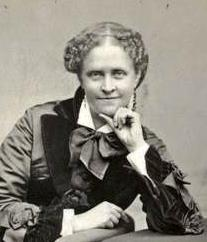
Helen H Jackson
from Wikipedia

Helen agreed to give Colorado one month. During that time, the sun came out again and Helen had a chance to see so many wonderful things. She soon fell in love with the area and over time traveled over a lot of Colorado. She wrote about what she saw and many of her essays were published in magazines back East. These essays described Colorado so well that people wanted to see what she wrote about.

While in Colorado Springs Helen met many people and one was William Sharpless Jackson. He worked for the Denver and Rio Grande Railroad and also was involved in banking. The two spent time traveling around the area and both loved the mountains and outdoors.

In October of 1875, Helen and William were married. This was Williams's first marriage and Helen's second. Helen was eight years older, but that did not seem to make any difference to William, or as Helen called him Will.

Williams's work kept him traveling a great deal; sometimes Helen would accompany him and sometimes she would stay in the home he had bought for them or travel on her own.

To Helen, Cheyenne mountain was the most beautiful mountain in the world. She and Will had spent much time around the mountain. Their favorite spot to 'camp' was an area in South Cheyenne canyon where it overlooked the city and the stream that flowed through the canyon.

Helen continued to write and travel. Sometimes she traveled without William and sometimes with him. Still, she kept writing her stories, essays, and poems. She would also return to the east coast where her sister Ann and family lived.

Up until Helen's death in 1885, this couple followed their own rules, and in the process did much that benefitted many. They both left a lasting legacy.


Doris McCraw

Wednesday, May 19, 2021

CLANG, CLANG WENT THE TROLLEY

 Post by Doris McCraw

writing as Angela Raines

Are you someone like me who gets excited when you find a special place when you're history hunting? Have you walked into that unexpected museum to find a treasure trove of unique history? That is exactly what happened to me when I walked through the doors of the Pikes Peak Trolley Museum and Restoration Shop located at 2333 Steele Dr. in Colorado Springs, CO. 

One of the trolleys (The Birney #135) 
in the process of being restored.

This small, but powerful, museum, is located in the roundhouse of the Rock Island Railroad which was one of the many railroads to serve Colorado Springs in the late 1800s and early 1900s. The museum itself tells the story of the trolley system that served Colorado Springs from its beginnings in the 1880s through the early 1930s.

Notice on the side of The Birney

While there I was welcomed by volunteers who love to share their knowledge and passion for trolleys and for some, railroads. Any question I had was answered in-depth and when possible, with visual representation. I was even given a lovely view of "The Polar Express", a miniature moving train system based on the beloved book of the same name.

Not only do you get to see photos and paraphernalia of those by-gone days, but you can also watch work being done to restore these amazing vehicles. Each trolley comes with its own history and if you speak with the volunteer who has been researching that particular one, you are lucky. It was while touring one of these I learned that not only Colorado Springs and Denver had trolley systems, but Aspen and Leadville did also. It is something I will be researching as I continue to write stories that take place in my adopted state.

Replica of a ticket office at the Museum

These sometimes forgotten transportation systems were so much a part of the growth of the towns and cities in the west. I know I will be writing more about this wonderful piece of history. 

In the meanwhile, think about how you might have ridden trolleys if you'd been alive back then. How would you have felt moving along in an open trolley as it took you through town, or to the sites that made the town famous? Oh, the possibilities.

What ticket buyers may have seen as they purchased their tickets.

All photos were taken by the author with the kind permission of the museum.

If you want to know more about the museum here is a link: https://coloradospringstrolleys.com/


Doris Gardner-McCraw -
Author, Speaker, Historian-specializing in
Colorado and Women's History
Author of the "Agate Gulch" novellas and "Kiowa Wells" novels.
Angela Raines - author: Telling Stories Where Love & History Meet


(c) Doris McCraw All Rights Reserved.