Turners are members of German-American
gymnastic clubs called Turnvereine.
They promoted German culture, physical culture, and liberal politics. Turners
were the leading sponsors of gymnastics as an American sport and the field of
academic study.
In
Germany, in the early 19th century when Germany was occupied by Napoleon, a major
gymnastic movement was started by Turnvater ("father of
gymnastics") and nationalist, Friedrich Ludwig Jahn. The Turnvereine
("gymnastic unions"; from German turnen meaning “to practice
gymnastics,” and Verein meaning “club, union”) were not only athletic
but also political. The origins of the movement were similar to other ethnocentric
"national gymnastic" organizations in Europe. The men not only
practiced gymnastic movements for physical fitness, but they were also
participants in various national movements for independence. The Turner
movement in Germany was generally liberal in nature, meaning they did not
hold to the old doctrine of division of classes with the ruling, moneyed
classes being superior to and controlling the working class. Many Turners took part in the
Revolutions of 1848. Because of these revolutions failed, and its members and
leaders were subject to arrest and imprisonment, many fled to other countries,
primarily the United States.
Besides
serving as physical education, social, political, and cultural organizations
for German immigrants, Turners were also active in public education and labor
movements. They gave German immigrants a way to assimilate into American
culture and politics and allowed them to stay fit and healthy in an urban
environment that did not always accommodate exercise. Turner clubs were leading
promoters of gymnastics in the United States as a sport and as a school
subject.
Germans
throughout the United States, including the “Forty-Eighters”, tended to be
strongly opposed to slavery. Many were Republicans for that reason. During the
1850s, when it became apparent that armed conflict might break out in the
United States, many German-Americans used the Turner Halls as opportunities to
meet, plan, and prepare.
Robert
J. Rombauer discussed the shooting club in his book The Union Cause in St.
Louis in 1861: “Soon after the organization of the society a rifle section
was formed with about fifty members, who were pledged to military obedience
when in service; they elected their officers and instructors and bought their
own rifles; took up regular weekly drills, arranged target practices and trial
marches to neighboring cities.”
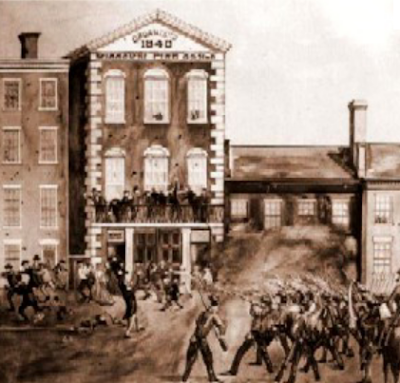 |
German Volunteers protecting the St. Louis Arsenal for the Union
|
It
was the men from this club that largely made up the German Brigade under In the
Camp Jackson Affair when a large force of German volunteers helped prevent
Confederate forces from seizing the government arsenal in St. Louis just prior
to the beginning of the Civil War.
Nationwide,
about 1000 Turners served as Union soldiers during the Civil War. Anti-slavery
was a common element. Many Republican leaders in German communities were
members. They provided the bodyguard at Abraham Lincoln's inauguration on March
4, 1861, and at his funeral in April 1865.
 |
Milwaukee Bundesturnhalle, Circa. 1900
|
After
the Civil War, the national organization took a new name, Nordamerikanischer
Turnerbund, and supported German-language teaching in public high schools,
as well as gymnastics. Women's auxiliaries were formed in the 1850s and 1860s.
The high point in membership came in 1894, with 317 societies and about 40,000
adult male members, along with 25,000 children and 3000 women.
In
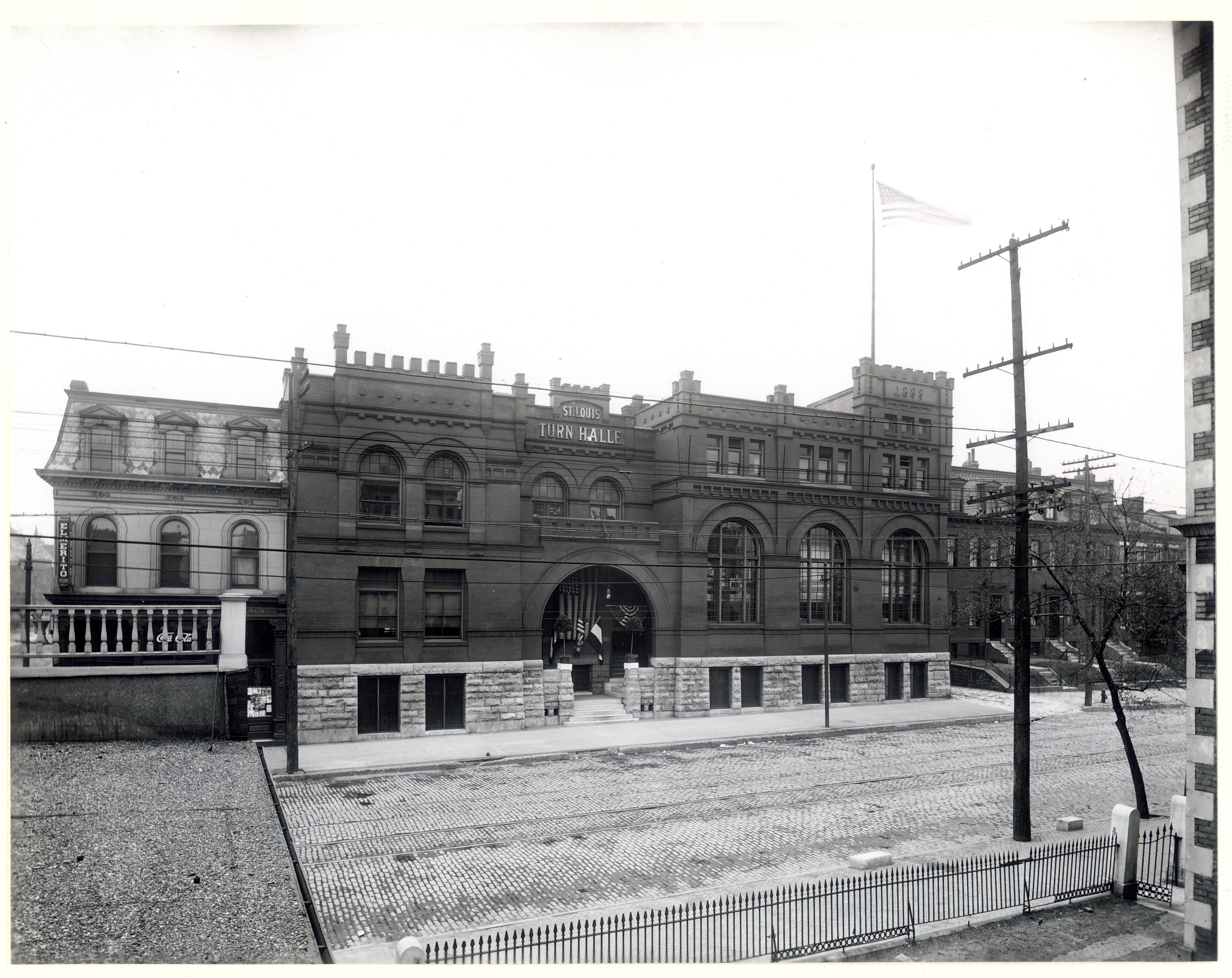
St. Louis, there were two Turnvereine of note in the city, one on the north and one on the south.
The
first Turner Hall was built at 1926 Salisbury on the North Side in the Hyde
Park neighborhood during 1870. Hyde Park was originally a German enclave
called Bremen. As it fell out of use, as many buildings in the north of
St. Louis did, it eventually was demolished.
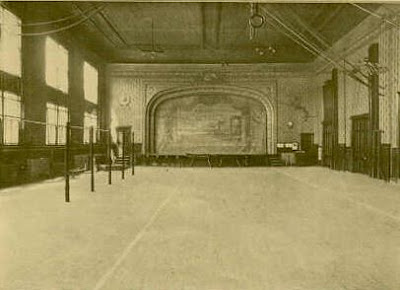 |
| Interior of south St. Louis Turnvereine |
The
second Turner Hall was built at 10th and Carroll Street on the South Side in
the La Salle Park neighborhood during 1884. Although no longer used for
gymnastics, it has never been vacant. Most recently, it was converted into
condos.
The Concordia Gymnastic Society was founded in 1875. It was named after
Concordia Park on the near south side of Saint Louis. Facilities in the park
were used for the initial activities of the organization. In 1877 Concordia
moved to its first home located at 13th and Arsenal.
There was also a
ladies' class of the German immigrant athletic society formed at the Concordia
Turnverein. It was later called the Concordia Gymnastic Society.
In
the United States, the Turner movement declined after 1900, and especially
after 1917 when the United States entered World War I, at which time there was
a violent backlash across the country against anything perceived to be German.
~o0o~
In
my most recent book, Bee Sting Cake by Brunhilde, several
of the earlier chapters take place in St. Louis, Missouri, where my hero Carl
Becker, and his family live. At one point, he was asked why he had not been
home for supper when a particular conversation took place. He responded that he
was at the Turnvereine, like he
usually was on a Monday night. Although he wistfully wished that the shooting
club would start up again, probably at the time of the story in 1873, the Turnvereine once again
focused on gymnastics, as well as political and social discussions.
Bee Sting Cake byBrunhilde has
been released and is now available as an ebook, plus it is available at no
additional cost with a Kindle Unlimited subscription. To find the book
description purchase link, please CLICK
HERE
Sources:
https://www.civilwarvirtualmuseum.org/1861-1862/german-americans-in-the-war/st-louis-german-turner-shooting-club/
https://commons.wikimedia.org/wiki/File:Ladies%27_class_of_the_German_immigrant_athletic_society,_Concordia_Turnverein_(later_called_the_Concordia_Gymnastic_Society).jpg
https://www.stlmag.com/culture/Learn-Everything-There-is-to-Know-about-St-Louis-Turnvereins-This-Friday-at-Landmarks/
https://www.ksdk.com/article/sports/olympics/1904-olympics/st-louis-olympic-games-history/63-4978a494-abc4-4b3a-ad73-79ea0300407f
https://en.wikipedia.org/wiki/Turners