Showing posts with label restaurants. Show all posts

Wednesday, February 26, 2025

Table for Two - Brief History of Dining Out for Valentine's Day - by Jo-Ann Roberts


"Candlelight dances on the table, and love dances in our hearts." Unknown


Happy February, friends! I know there is only one day left before we turn the calendar to March. But it's still the month of love, hearts, and...dining out with that special someone. Of course, these days none of us need a special occasion to eat out with friends, co-workers, or family members. The number of restaurants in any given city, town, and interstates crisscrossing the country is staggering.

However, the most common way to celebrate is with a romantic dinner for two at a nice restaurant. But was it always that way? After tumbling down the rabbit hole, I discovered that the answer was...no! In fact, romancing one's spouse was unheard of in many societies. Marriages were often more about political connections, wealth, or convenience than about love and romance. It wasn't until the Victorian era that love became a primary consideration. But even then, it was about cards, poems, and small sentimental gifts. Not dinner at a restaurant.


In the 19th century, it was considered scandalous for 
a couple--married or not--to 
have dinner at a restaurant. Mostly because those restaurants advertising romantic dinners were synonymous with brothels at that time. In 1923, Emily Post suggested that "...it was not proper for an engaged couple to dine together in a restaurant, but it is all right for them to lunch or have afternoon tea...They should take a chaperone if they motor to road-houses for meals."


According to food historians, it wasn't until the 1930s that taking a lady out to dinner became an acceptable way to celebrate. Charles Perry, a food historian believes "The tradition probably came about during the Depression, when any meal out was a special occasion.  Popular restaurants like Delmonico's and Sardi's had some tables with curtains so the couples could choose to see and be seen or have an intimate meal while still enjoying the sounds of the orchestra."

At some unsavory establishments, the heavy curtains and low light in private dining areas accommodated questionable conduct, especially if the restaurant had a back entrance where people could come and go discreetly.

However, by the 1960s, it was a common practice for a husband to take his wife to dinner. And what could be more romantic than a night off from her homemaking duties?


Today, dining out still seems to be the most romantic gesture a husband can do for his wife. For many, the idea is less about the restaurant or the meal itself as it is a return to the place where they first met, kissed, or had a realization that they want to marry their date. It may not be the most fancy or expensive place. Or perhaps their friends or family may not understand why they chose a certain corner tavern or a simple neighborhood pizza palace. Maybe they choose to explain why or maybe they don't. After all, shared secrets are a thing of romance, too.

I hope you shared some lovely Valentine's Day moments with someone special!

******************************************

Coming May 30th!


An outlaw looking for a fresh start. A schoolteacher who might hold the key to the entire town’s salvation.

Ash “Shotgun” McCrae can never make up for all the wrong he’s done. After leaving a notorious outlaw gang, he thought he’d discovered the peaceful existence he’d been looking for when he found work laying tracks for the railroad in Rivers Bend. Yet, when trouble shows up in town, he fears he may never free himself from the burden of his past.

Schoolteacher Kate Cummings stands as the one bright light in contrast to the curious looks and behind-the-glove whispers blowing through the town. The arrival of Padraic “Patch” Rooney and his gang challenges the small-town serenity she holds dear. Still, her steadfast trust in Ash awakens the strength of courage within them all, giving rise to the collective defiance against the approaching danger.

In a deadly game of dangerous outlaws and secret schemes, Kate and Ash must decide whether they are willing to risk everything for their love, including their lives.

 Pre-Order Link


 Series Order Link


Thursday, November 25, 2021

Thanksgiving A la Carte - by Jo-Ann Roberts


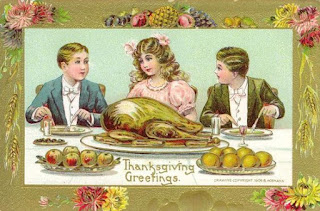
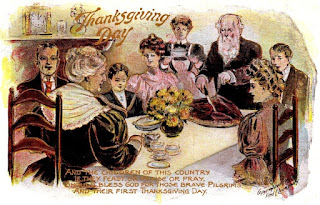
Although Thanksgiving has been celebrated in America in some form or another since the first day of giving thanks at Plymouth Plantation in October, 1621, the holiday didn't become an annual tradition in this country until 1863.


While the Thanksgiving turkey is a nod to the early Pilgrims and settlers who relied on wild turkey among other fowls found in the New World, cooks during the Victorian era became more creative. Instead of using ingredients like stale bread and corn meal, turkeys might be stuffed with chestnuts, cranberries, oysters or various fruits, and tended to vary depending upon what was locally fresh and available.

In early America there were taverns, inns, and boarding houses that offered supper, but there were no restaurants. Delmonico's, the first American restaurant, opened in 1831 in New York City. Along with a growing population, the number of restaurants grew with the patrons exclusively male! 


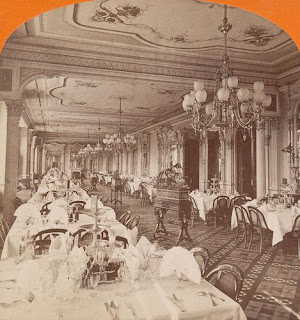
Soon, from the Waldorf-Astoria in New York to the Palmer House in Chicago, fine dining was the rage for the affluent, socially elite.

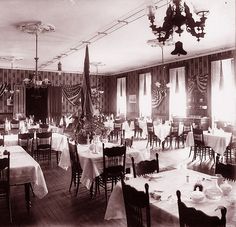
After the Civil War--with the expansion of the railroads and settlers moving westward--the number of restaurants expanded from north to south, east to west.  Though some restaurants served Thanksgiving dinner--mostly to lonely bachelors--the holiday was still a "home" occasion. 

By the 1880s, women had begun to join their husbands and brothers at restaurants--no lady would be caught dining out unless she had a male escort. Consequently, Thanksgiving dinner at restaurants soon became acceptable, if not attractive.

During America's gilded age (1890s - World War I), many restaurants were in grand new "palace" hotels. This was a time of over-abundance with an amazing volume of food prepared for the Thanksgiving menu. 


Hotels in Kansas City, Missouri, outdid themselves in 1888. Items on the Thanksgiving menu included Blue Point oysters, little neck clams, calf's brains, buffalo tongue, red snapper, salmon, turkey, duck, squirrel, asparagus, artichokes, puddings, pies, ice cream, macaroons, and a host of imported cheeses.

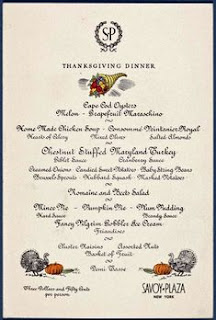
Menus, whether written on wooden planks with pieces of coal or on slates with chalk, or later, on paper, were the earliest bills of fare telling patrons what foods were offered for that particular day as well as prices. For special occasions, such as Thanksgiving, hotels designed fancy menus, using wonderful colors and images.


Menu's could be fringed, embossed or textured. Using silk ribbons, many showed great imagination and originality in terms of layout, illustrations and typeface.


In the early 20th century, the growing female workforce and the scarcity of household help led to foods that were practical and easy for everyday consumption, and especially for the holidays.

The 1925 Thanksgiving Day menu from the Hotel Brunswick..."the fare was "all American," from grapefruit with maraschino through pumpkin pie and sweet cider. The entrees were turkey, goose and scallops."

Fine dining, fueled by wine and liquor, met its demise by Prohibition. While Delmonico's closed, other restaurants housed inside hotels survived because its guests needed to be fed.

Soon, a new type of restaurant--the family restaurant--appeared in the 1930s. They served basic, simple wholesome "American" food. A 1935 Thanksgiving Day menu from the Governor Clinton Hotel featured..."for $2 patrons could feast on celery, American cheese with saltines, and condiments. Entrees were turkey, ham, and crab Newburgh."

Following World War II, refugees from war-torn Europe opened restaurants, featuring ethnic cuisine on Thanksgiving menus. Ethnic restaurants were not a new phenomenon in America. German immigrants came in 1850s, followed by the Chinese in 1870s, the Italians in 1880s, the Russians in the 1920s, and the Mexicans in the 1950s. 

Today, falafel, chicken shawarma, stuffed grape leaves, pho, and lasagna are just as likely to be featured on Thanksgiving Day menus as turkey, stuffing, and pumpkin pie.

Whether you rise early on Thanksgiving morning to pop that bird in the oven, cook the side dishes, and set the table for four, eight, or twelve or sleep in, watch the parade, then meet family and friends at a restaurant for a holiday feast, from our home to yours,

Happy Thanksgiving!