Showing posts with label brushing hair. Show all posts

Friday, April 3, 2020

Victorian Hair Receiver

Kristin Holt | Victorian Hair Receiver


What is a hair receiver?

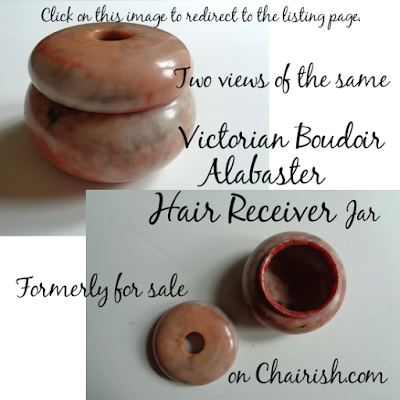
Kristin Holt | Victorian Hair Receiver: two photograph images of a singular Victorian Boudoir Alabaster Hair Receiver Jar. Formerly for sale on Chariish.com.


As with all "Dressing Table" accoutrements, Victorians gave family members and close friends items like hair receivers or brush-and-comb sets for their morning toilette.

Kristin Holt | Victorian Hair Receiver: Advertisement from The Boston Globe of Boston, Mass on December 3, 1899. Advertising "Comb and Brush Trays" for 49 cents, Hair Receivers (388 real China Hair Receivers, decorated by hand in choice patterns and traced with gold, at only.... 24 cents. 240 Royal Cobalt Thuringen Hair Receivers, beautiful underglaze, blue decoration and illuminated with best coin gold. Regular vaule $1.00. Special price 49c."
Hair Receivers Advertised in The Boston Globe (of Boston, Mass.), Dec 3, 1899.


Quick Price Comparison:  
49c in 1889 is approximately $15 in 2019 (latest date available).
24c in 1889 is approximately $7.50 in 2019 (latest date available).


Our nineteenth century ancestors had their own ideas about a lady’s toilette. (All the “getting pretty” one does in the morning.) You might be familiar with the old-fashioned “one-hundred strokes” of a hairbrush through one’s ankle-length, excruciatingly long 19th century hair. You might know all about the intricate hairstyles Victorian-American ladies twisted and braided and pinned. Oh, and curled. With 19th century curling irons. And augmented with hair that was never theirs to begin with. Let's just say Victorian ladies augmented and padded all sorts of things.

But what to do with the loose hairs in the hairbrush, comb, and clinging like a pestilence to one’s bustle? (If you have long hair like many of our 19th century ancestors before us, you know much HAIR is found by the vacuum and broom... it’s everywhere!)

Hence, ladies needed a place to stash all those loose hairs. Under the carpet won’t count, not even for lazy housekeepers or rich upper-crust Missus who have hired help to sweep up the mess later, Yes, including beneath the boudoir carpet. A lady requires a hair receiver.


Make Your Own, Like a 19th Century Gal

Kristin Holt | Victorian Hair Receiver. An 1876 set of craft instructions to create a lady's hair-receiver and hairpin cushion from a can, oiled silk, cardboard, ribbon, and more. From Perrysburg Journal of Perrysburg, Ohio on July 7, 1876.
Hair Receiver Craft Instructions from Perrysburg Journal, July 7, 1876.


If that style doesn’t appeal to you, here’s another! The writer’s descriptive words makes it possible to visualize the craft without requiring a photograph.

Kristin Holt | Victorian Hair Receiver (1 of 3). Uses of Paper-- an article from The Shosho Falls Post of Neosho Falls, KS (June 25, 1886), using paper to recover used containers and cardboard to decorate a lovely hair-receiver on very few pennies.

Kristin Holt | Victorian Hair Receiver (2 of 3). Uses of Paper-- an article from The Shosho Falls Post of Neosho Falls, KS (June 25, 1886), using paper to recover used containers and cardboard to decorate a lovely hair-receiver on very few pennies.

Kristin Holt | Victorian Hair Receiver (3 of 3). Uses of Paper-- an article from The Shosho Falls Post of Neosho Falls, KS (June 25, 1886), using paper to recover used containers and cardboard to decorate a lovely hair-receiver on very few pennies.


Why stash hair (of all things)?

To use it, of course.


Important 19th century uses of saved human hair:

1.      To fill a hair net (or twenty) [known in the day as a ratt or a rat], sewn closed, to fill out one’s own upd0. “It’s mine, naturally. All that luxurious fullness, all mine.”
2.    Specifically to stuff pin cushions—why? Because the oils on the hairs within would lubricate the pins each time they’re stored in the cushion, thus helping the pin slide through fabric.
3.    To stuff pillows, furniture upholstery, and padded clothing (like football pants)—as human hair was infinitely softer than other substances like straw. More importantly, hair is FREE. And it’s everywhere.
4.    Treasured artworkHair Embroidery is 3D in appearance and is often framed in a shadow box. Many Victorian fanciful artists won the equivalent of a blue ribbon (then known as PREMIUMS).
5.     Hair is so intimate, so personal, that women embroidered handkerchiefs for their soldier sweethearts or husbands to carry over their hearts. (I’m not kidding.) The embroidery would be in his lady’s hair—not ribbon, not dyed thread, but her hair. No matter the shade.
6.    When desperate, a beautiful head of hair could be sold. A market for human hair was alive and well throughout the Victorian era, around the world.
7.     To stuff mattresses, quilts, sugans, and anything else life might require.


A Unique Occupation

Kristin Holt | Victorian Hair Receiver. A Unique Occupation- Gray Hair Pullers. From The Dispatch of Moline, Illinois on August 31, 1895.
Do you recall the blog article I shared with you about the surprisingly LONG list of occupations in the Old American West? Let's add Gray Hair Puller.


Kristin Holt | Old West Employment, Well Beyond Sheriff, Livery Owner, Saloon Keeper, Cowboy and Rancher.


Invitation


Surprised? Do you know more about this fascinating subject?
Please scroll down and comment.


Related Articles

Kristin Holt writes articles about everything nineteenth century American West, and adores inter-connected ideas. This post scratches the surface of Victorian Hair and nineteenth-century grooming practices. Come explore!

Kristin Holt | Victorian Hair Augmentation
Kristin Holt | L-O-N-G Victorian Hair
Kristin Holt | Victorian Curling Irons

Kristin Holt | Styling Ladies' Hair: American 19th Century

Kristin Holt | Victorian Ladies' Hairdressers

Kristin Holt | Oatmeal in the Victorian Toilette
Kristin Holt | Freckles, Complexions, Cosmetics and Victorian Beauty Concoctions
Kristin Holt | False Beauty Spots
Kristin Holt | Lady Victorian's SecretKristin Holt | Victorian Hair: Indicative of Character
Kristin Holt | Old West Barber Shop
Kristin Holt | Old West Barber Shop Haircuts
Kristin Holt | Victorian Era Men's Hairstyles
Kristin Holt | Victorian Shaving, Part 1
Kristin Holt | What Did Pioneers Use for Quilt Batt?
Kristin Holt | Cowboy Quilts: Sugans
Kristin Holt | A Double-Topped Quilt: Remembering a Love of a Livetime
Kristin Holt | Victorian Era: The American West


Copyright © 2020 Kristin Holt LC

Tuesday, November 5, 2019

Victorian Hair Care by Abagail Eldan


As I previously mentioned in "Coming Clean," people in the 1800s took this Bible verse seriously: But if a woman have long hair, it is a glory to her: for her hair is given her for a covering (I Corinthians 11:15). Thus, most women never cut their hair. Some had hair over six feet in length. 
Hair down to there...

Or even to the floor! (Pics from Pinterest)

Even today, with our modern conveniences, caring for such long hair is difficult. Imagine what it must have been like in the 1800s. So, again, washing hair was not something done lightly. Brushing was the way hair was cleaned. Thus, hairbrushes were important to the ladies of the Victorian era.
Here are a few examples (again, from Pinterest):


The comb and brush are […] agents of the toilet by which the hair is kept clean, vigorous, and healthy.’ (Scientific American Supplement Volumes, 1883) ‘Much washing of the hair with water is bad […] it is possible by much brushing to avoid any excessive use of water.’ (Every Woman’s Encyclopaedia, 1910-2

A brush consists ‘of a collection of hairs or bristles, fastened in a frame of wood, bone, or ivory; with, or without a handle’ (Domestic Encyclopedia Or A Dictionary Of Facts, And Useful Knowledge, 1802)

Hairbrushes in the Victorian and Edwardian era were often made of ivory, ebony, silver, or alpacca (German silver). Usually horsehair bristles were used for softer, and boar bristles for stiffer brushes. White and yellow boar bristles were imported from Russia and Siberia, whereas dark grey and black were imported from India and China (The Brushmaker, And The Secrets Of His Craft And Romance, 1870s). Hairbrushes were handmade: A wooden brush-back was drilled, bristles ‘drawn’ through each hole with thin wire and secured with a knot.

Interestingly enough, today many hair experts now agree that excessive washing strips hair of its natural oils and can be damaging. Many women brushed their hair for 100 strokes in the morning and before retiring at night. This helped distribute the natural oils to the ends of the hair. All that brushing dirtied the brushes. Some women washed brushes daily while others washed them at least once a week. And yes, there was a correct way to do so.


‘Never use soap. Take a piece of soda, dissolve it in warm water, stand the brush in it, taking care that the water only covers the bristles; it will almost immediately become white and clean; stand it to dry in the open air with the bristles downwards, and it will be found to be as firm as a new brush.’ (The Corner Cupboard; Or, Facts For Everybody, 1859)

‘The best mode is to use soda, dissolved in cold water, instead of soap and hot water; the latter very soon softens the hairs of the brush, and the rubbing completes their destruction. Soda having an affinity for grease, cleans the brush with very little friction.’ (The Workwoman’s Guide, 1840)

Caring for such long hair was a long, tiring business and yet a glorious one.

Darlin', give me a head with hair, long beautiful hair
Shining, gleaming, steaming, flaxen, waxen
Give me down to there hair, shoulder length or longer
Hair, hair, hair, hair, hair, hair, hair, hair
Flow it, show it, long as God can grow it. 

(Lyric to the song, Hair)


Abagail Eldan received a B.S. in Education from Troy University, with a major in biology and a minor in psychology. She continued her graduate work at Columbus State University, Troy University, and Auburn University, becoming certified to teach English, all mathematics, and all sciences. After teaching for nineteen years, she retired and lives in south Alabama with her husband. Look for her next book, Brokken Promises, coming soon.