Wednesday, April 19, 2023

Doc Susie's Colorado Contemporaries


Post by Doris McCraw/Angela Raines-author


Photo property of the author

I've spent more time looking at the larger picture of the women doctors who received their license to practice medicine around the same time as Susan, Doc Susie, Anderson, who started her practice in Cripple Creek, Colorado in 1897. She did not move to Fraser, Colorado until 1907 where she earned her 'fame'.

While the list is fairly long, I thought I would share some additional names and their contributions to Colorado and medicine from the latter part of the nineteenth century and the beginning of the twentieth. 

Dr. Josepha Williams and Dr. Madeline Marquette opened a private hospital and sanatorium in Denver in 1889. In 1892 they added a nursing school to the Hospital/ Sanatorium. Dr. Williams was the superintendent of the facility. On a side note,  Dr. Williams married Canon Charles Winfred Douglas a musician and Episcopal priest in 1896.

Dr.Genevieve M Tucker wrote "Mother, Baby, and Nursery: A Manuel for Mothers" published by Roberts Brothers, copyright 1896. She practiced in Pueblo, Colorado. Around 1898 she was elected president of the Colorado Homeopathic Medical Society.

Dr. Ida Putnam began her practice in Chicago, but in 1898 she received her Colorado license and began a practice in Telluride, Colorado.

Dr. Florence Sabin was a research doctor who did much to advance the area of medical research. Her accomplishments are too numerous to list here. If you wish to know more: https://en.wikipedia.org/wiki/Florence_R._Sabin 

Dr. Rose Kidd Beere was written up in the “History of Colorado” edited by Wilber Fiske Stone. She participated in the Philippine War of 1898-99 and WWI. She was unable to travel to the Philippines as a doctor so she gathered women to go there as nurses. 

From Find a Grave Website

Dr. Mary Elizabeth Bates, whom I have spoken of before. As you know she was the first woman intern at Cook County Hospital in Chicago, Illinois. In the book “A History of Surgery at Cook County Hospital” by Patrick D. Guinan, Kenneth J. Printen, James L. Stone, and James S.T. Yao, we find in the nineteen months she worked as an intern she worked in the morgue, took part in fourteen amputations. Of her time there she later said “...the first six months were hell, the second six months were purgatory, the next six months were heaven; when it came time for me to leave, I wept bitter tears.”

These are just a few of Doc Susie's contemporaries. The stories of these women along with those who preceded them have given amazing gifts to this researcher.

Until Next Time: Stay safe, Stay happy, and Stay healthy.

Doris

Thursday, April 13, 2023

Pulp Fiction Leads to Pink Pistol Magazine


Eleven bestselling, award-winning authors, all members of Petticoats & Pistols blog for western romance, combined their talents and efforts to create a sweet romance series that honors the influence Annie Oakley had over women during her reign as “Little Sure Shot.”


In the new series, a one-of-a-kind pink-handled pistol is gifted to Annie Oakley. The pistol comes with a legend, one promising that whoever possesses it will find true love. Annie passes the gun on to one of her students and sets the whimsical journey in motion that starts with In Her Sights by Karen Witemeyer. The pistol travels from woman to woman from 1893 to the modern day until the series concludes with USA Today Bestselling Author Jessie Gussman’s contemporary romance Pistol Perfect.

 I like to say the series is kind of like The Sisterhood of the Traveling Pants meets Dr. Quinn, Medicine Woman. 


When we were talking about ways to promote the book, Pam Crooks and I started discussing creating something like the old pulp fiction novels that were popular in the 1920s-1940s.  How fun would it be to make our own magazine.

So we did. 


You can get the first two issues of Pink Pistol Magazine absolutely free! Each issue includes excerpts from the new series, author interviews, recipes, games, and more! 
Download 
Pink Pistol Magazine Volume 1 here
and
Pink Pistol Magazine Volume 2 here 

My contribution to the series is Love on Target, a sweet romance set in 1894.


Will romance hit its mark when true love is the target?

 Desperate for a fresh start, Rena Burke journeys from Texas to Oregon with only her father’s pistol and a plodding old mule for company. She takes a job working with explosives at a mine, spends her free time emulating her hero Annie Oakley, and secretly longs to be loved.

 Saddlemaker Josh Gatlin has one purpose in life and that is his daughter. Gabi is his joy and the sunshine in his days. Then he meets a trouser-wearing woman living life on her own terms. Rena is nothing like his perception of what he wants in a wife and mother for his child, but she might just prove to be everything he needs.

 When tragedy strikes, will the two of them be able to release past wounds and embrace the possibilities tomorrow may bring? 


Also, be sure to enter my giveaway for a Love on Target Prize pack!


USA Today bestselling author Shanna Hatfield grew up on a farm where her childhood brimmed with sunshine, hay fever, and an ongoing supply of learning experiences.

Today, Shanna draws on her rural roots to create sweet romances filled with hope, humor, quirky small-town characters, realistic heroes, and women of strength.

When this award-winning author isn’t writing or testing out new recipes (she loves to bake!), Shanna hangs out at home in the Pacific Northwest with her beloved husband, better known as Captain Cavedweller.


Monday, April 10, 2023

Travel Essentials- What's a Mail-Order Bride to Do?


Go West, Young Man

By the 1800s, mostly male settlers answered the call to head west following stories that painted a picture of a land of milk and honey. A shortage of females developed as they searched for gold and plowed up the prairies building shelters out of sod. While back east, the opposite problem occurred. In many cases, answering an ad to become a mail-order bride was a literal ticket for a chance at a new life. Is it any wonder that advertisements like this became common?
Courtesy of Glacier National Park Photo Archives, photo HPF 9871.

In 1851, One California Paper pleaded:

“We want an emigration of respectable females to California: of rosy-cheeked ‘down east’ Yankee girls—of stout ‘hoosier’ and ‘badger’ lasses, who shall be wives to our farmers and mechanics, and mothers to a generation of ‘Yankee Californians.’ ” Quoted by Chris Enss in his book Hearts West: True Stories of Mail

Travel Essentials

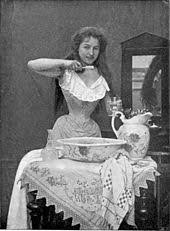
American Etiquette Rules of Politeness, written by Walter Houghton in 1883, gave lots of advice, and some specifically included travel: “There is no situation in which a lady is more exposed than when she travels, and there is no position where a dignified, lady-like deportment is more indispensable and more certain to command respect.” Mr. Houghton also recommended carrying a sponge, tooth and nail brushes, and soap in an oilskin bag.

William Addis designed the more modern toothbrush in England around 1780. The handle was carved from cattle bone, and the brush was made from pigs' hair. In 1844, the first 3-row bristle brush was designed. The first U.S. patent for a toothbrush was filed in 1857.

Safety- What's a Lady to Do? 

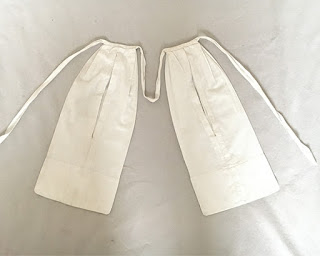
Another recommendation from the American Etiquette Rules of Politeness was to carry money in a strong pocket made in your upper petticoat, only reserving a small sum for incidental expenses in your dress pocket.
A pair of pockets from the early 19th century.

Safety First- Looking Beyond Mr. Houghton's Recommendations-Pocket Pistols

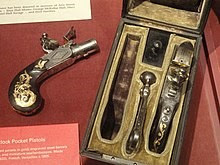
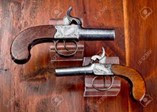
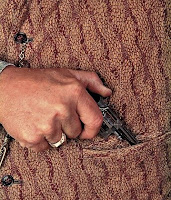
The pocket pistol, also known as the Queen Anne pistol, originated in the mid-17th century as a small, concealable coat or pocket pistol. This style was used during the 18th century, evolving from a weapon reserved for the wealthy to a common sidearm in broader use as more and more manufacturers made them by the start of the 19th century.
 

The boot pistol was another version of the muff pistol produced from 1800 until the 1850s became popular with the Union army officers during the Civil War. These types of weapons were also frequently used by women because they were concealable in a purse.


During the 18th century, wealthy travelers concealed small single-shot pistols in the pocket of a coat as protection from highwaymen. Overcoat pistols with a turn-off barrel were designed for women to carry in their muffs or purses.
https://en.m.wikipedia.org/wiki/File:Dragoon_Baby_Dragoon.jpg

Affectionately known as the "Baby Dragoon" and made without a loading lever, Colt turned out about 15,000 between 1847-1850, and the public loved them. This pocket model became the most successful of all of Colt’s percussion revolvers.
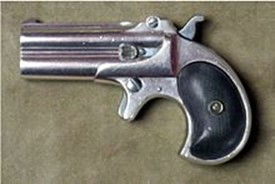
Original Remington Model 95 derringer

When tucked into a vest or coat pocket, a derringer would not produce any more of a bulge in one’s clothing than would a pocket watch. Some manufacturers marketed their small firearms directly to the ladies. In 1866, Charles Converse and Samuel Hopkins manufactured approximately 800 pistols and sold under the trade name of “Ladies Companion.”

The 19th-century vest-sized pocket pistol was the double-barrel Philadelphia Deringer. The Rimfire Remington Model 95 was widely popular and overshadowed all other designs, and became synonymous with the word "Derringer." It is estimated that 150,000 were produced between 1866 and 1935. The Remington double-barrel derringer design is still being manufactured today.

New Release:

In my upcoming new release, our heroine is on the run and as nervous as a long-tailed cat on a porch filled with rocking chairs. Regarding travel, she'll follow her cousin's advice and ask to be seated next to another woman, preferably with children or a matronly appearance, and fade right into the background.

https://www.amazon.com/dp/B0BLZ9J2Z4

A hopeless romantic, Abilene is on the run again, dreaming of her happily ever after- a trustworthy and devoted husband, a house in the country, and peace.
Sheriff Mark Joseph learned the hard way that love only leads to heartache and is not worth the risk. The last thing he needs is a wife. Long work hours with a healthy dose of danger are the best antidote to a broken heart.

The Bloomer Women Who Walked to Wyoming Territory Part 2 by Zina Abbott


Last month, I shared a blog post about two early Wyoming Territory women which I learned about as part of my research for my recent book, Lauren, I came across an account of two women who made an impact on early Wyoming history. I saved their story for Women’s History Month, focusing on the mother, Alice Willing Bloomer. This month, I wish to finish with more details about the daughter, Mary Jane Bloomer Morey Stimpson Richardson. You may find the previous post by CLICKING HERE.

Mary Jane Bloomer’s three husbands were the following, the second two marriages taking place after her move onto the Wyoming Territory frontier:

Marriage to Charles Norman Morey 1857
Marriage to William G Stimpson 1869
Marriage to William Richardson 1880

At the end of the Civil War, Mary Jane Bloomer Morey, finding herself destitute after her husband suffered a disabling brain injury as a result of his war service, put him in a home for the insane and looked for a means to support herself and her family. Her mother, Alice Willing Bloomer, who was widowed because of the war, and Mary Jane’s three-year-old son, Frank Morey, traveled to Leavenworth, Kansas, where, for a time, they worked at the Dexter Hotel.

Mary Jane's mother, Alice, was suffering from consumption. At wars end, it was widely proclaimed that consumption could be cured by moving west to the high and dry climate. They walked with a hand cart to Grand Island Nebraska in the middle of February 1868.  The ladies then rode a train to the new town of Cheyenne near the end of the tracks.  They next rode the train to the Dale Creek Bridge construction site, then they walked about twenty miles to Fort Sanders, arriving on March 4th. There, they stayed for a short time while the town of Laramie was platted out and started building.  As soon as the first hotel, the "Frontier", was completed, the ladies took over management of the eating establishment there.

In August 1868, railroad officials offered Mary Jane a job operating the services at Percy Station north of Elk Mountain. It was also the time when she married her second husband, William Stimpson, a merchant from England. They boarded the train to Cheyenne for the wedding. Percy Station was a loading point for ties from the Elk Mountain area. Mary Jane had Chinese employees in her kitchen, and she soon learned to speak Chinese and several Indian dialects. 

By 1873, business at the Percy Station had greatly decreased, so it closed. Mary Jane and William Stimpson purchased the old Overland Trail Stage Station at "The Crossings" on the Medicine Bow River, which thirty later became known the town of Elk Mountain. This location served as a way-point for early American settlers heading west along the Overland Trail and other routes.  There, Mary Jane operated a boarding house, toll bridge, supply store, and tavern. Local histories are full of stories about Indian fights, bandits trying to rob the store, and Mary Jane sitting on the bridge with a shotgun in order to "collect" the toll bridge charge from immigrants moving up the Overland Trail.

Relationship of Elk Mountain and Medicine Bow, both along Medicine Bow River -  courtesy of Google Maps


In 1874, a daughter the Stimpsons named Mary Alice was born. In 1876, four years after Mary Jane's mother’s death, William Stimpson also died. He had been growing progressively weaker, and it was suspected he had cancer. This forced the family to move to Carbon, where Mary Jane worked at a boarding house. The only record of his death is the listing in Mary Jane’s family Bible.

Not long after William Stimpson’s death, the Trabing Brothers, who already owned a store in Rock Creek along the Union Pacific Railroad line, which was located about twelve miles north of present day Rock River, decided to expand their mercantile empire by  purchasing the store at "The Crossings" from the widow, Mary Jane. More details about the Trabing Brothers businesses may be found in a post I wrote for another blog. Please CLICK HERE.


The summer after Custer's battle at Little Big Horn, the Bozeman trail re-opened. The Trabing Brothers decided to be the first to open a store in northern Wyoming and chose a site at Crazy Woman Creek.  August Trabing hired Mary Jane to be the store manager. 


Not Mary Jane, but, yes, women did drive ox teams


Mary Jane drove two wagon loads of supplies with her fifteen-year-old son, Frank Morey-Stimpson, and five-year-old daughter, Mary Alice Stimpson, . Again, with no protection and traveling alone, Mary Jane headed to Fort Fetterman and on up the Bozeman Trail to the Trabing Trading Post Store on Crazy Woman Creek, arriving in good order while the store was still under construction in the fall of 1877.

While at Crazy Woman Creek, Mary Jane's daughter died of scarlet fever in 1878. She was probably buried somewhere near the old store site.

While working at the Trabing store at Crazy Woman Creek, Mary Jane was also robbed by a gang, which was later identified as the Big Nose George gang. This could have been around the same time as the attempted railroad derailment outside of Medicine Bow in August, 1878, which was thwarted by an observant section crew foreman.

Mary Jane also acted as the area doctor, housed Moreton Frewen, the Englishman who brought the first cattle to northern Wyoming, and dealt with freighters and stage coach drivers, including Calamity Jane and Wild Bill Hickock.

Mary Jane operated the store at Crazy Woman Creek for just over a year, before the Trabing Brothers moved the location to what would soon be the town of Buffalo.  In the 1880 census there are only five families in northern Wyoming who were not connected with the military. Among those five families was Mary Jane and her son, Frank Morey.

William Richardson, a coal miner in Carbon and a good friend of William Stimpson, received the news of Mary Jane’s daughter’s death. Richardson,was an immigrant coal miner from West Auckland, Durham, England. He rode north to Buffalo and brought Mary Jane back to Carbon. There they were married. Mary Jane then had three more children while she was between the ages of forty and forty-four: Thomas Darrow Richardson, Edward Richardson, and Willing Gay Richardson.

Eventually, the family moved back to Elk Mountain. Several incidences of Mary Jane’s life include fighting off three renegade Indians and killing one in hand-to-hand combat at the ranch, "engineering" the irrigation for the Medicine Bow River Valley, building a post office, and challenging a neighbor to a gunfight when he threatened the family.

A newspaper article states that "the first irrigation ditch was built out of the Medicine Bow River by (Mary Jane) Mrs. Richardson and is still known as the "Garden Ditch". She also owned a toll bridge, store, hotel and saloon at Medicine Bow Crossing Station, today known as the town of Elk Mountain."   We do not believe this date could be correct as she did not move to "the crossing" until after 1870. A more reliable date for the garden ditch at Elk Mountain would be 1878.  A quote from the same article, "From a reliable source it was learned that it was a fact that Buffalo Bill, for some reason or other was ejected from the hotel by Mrs Richardson."


Mary Jane Bloomer Morey Stimpson Richardson died at the age of sixty-nine on December 21, 1910 in Elk Mountain, Carbon County, Wyoming. Elk Mountain played a crucial role in supporting the coal mining and timber industries vital to the Union Pacific Railroad's success. Many families settled here, immigrating from Finland, Sweden, and other European countries, bringing with them a rich diversity of cultures and traditions. She was buried in Elk Mountain cemetery.


Lauren
, Book 2 in the Rescue Me (Mail-order Brides) series, takes place several years after, some of these incidences. However, Mary Jane was still alive and active in that general region of Wyoming Territory during the timeframe of this book. The incident with Big Nose George robbery would have taken place at the same time as Lauren’s story. To read the book description and find the purchase options, please CLICK HERE.  


Mary Jane Bloomer Morey Stimpson Richardson was still in the region at the same time as my story, Ellie, from the Runaway Brides of the West series. To find the book description and purchase options, please CLICK HERE.


Sources:

http://genealogytrails.com/wyo/carbon/bio3.html

https://www.familysearch.org/service/records/storage/das-mem/patron/v2/TH-904-69401-62-33/dist.txt?ctx=ArtCtxPublic

https://www.findagrave.com/memorial/142211768/mary-jane-richardson

https://www.wyomingcarboncounty.com/places-to-visit/elk-mountain