

Showing posts with label Titanic. Show all posts

Thursday, February 24, 2022

Unpacking History - Steamer Trunks by Jo-Ann Roberts


Some months ago, author Pam Crooks invited me to be part of a multi-author project, "The Love Train" with nine other talented authors. All sweet western historicals, the couples meet on the Union Pacific, their fledging romance aided by a matchmaking conductor, a baggage handler, and a dog named Scruffy. Their stories would then move to a town, city, or ranch.

Never having been part of a project of this sort, I agreed...whole heartedly!

It's 1872, and my heroine, Ainsley MacKenzie, is traveling aboard the Union Pacific from Boston to New Hope, Kansas to visit her brother and his family for the Christmas holiday. If you read Brides of New Hope, you'll recall that Eli and Lessie MacKenzie play an integral part in the series. 

Raised in a gracious, aristocratic Bostonian family and accustomed to the finer things in life, Ainsley needed a trunk or two or maybe six to hold all her necessities.  

Thus, let the research begin...


History of the Steamer Trunk

From 1870 to 1925, steamer trunks rose in popularity initially because of the railroad's expansion in the United States that created the notion of fast, modern travel. But steam ships quickly came to the forefront because of the speed with which they could cross the Atlantic. Consequently, the steamer trunk was created to carry those all-important personal belongings onboard the ship for long voyages.   

By the 1920s, steamer trunks had started to go out of fashion. They were replaced with larger trunk models that would act as a wardrobe and more modern luggage choices.

Construction

Trunks were generally made of a pine or metal box and covered with leather, vellum, waterproof paper, wood slats, canvas or animal hides. Some were bound by metal bands for strength, while other had detachable leather straps with buckles. Most trunks had a sturdy handle at each end for easy transportation.  

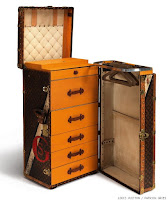
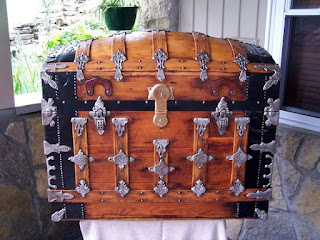
High-end steamer trunks--similar to the variety Ainsley MacKenzie might have used--had unique designs blended into the material. Most of these trunks had inside trays, hangers, or compartments making them more functional for storage or placement of personal items, such as parasols or jewelry. Considerably more expensive, these trunks needed more craftmanship.


Popular Styles

Like most things during the Victorian period, trunks began with a simple construction but soon featured a variety of different designs

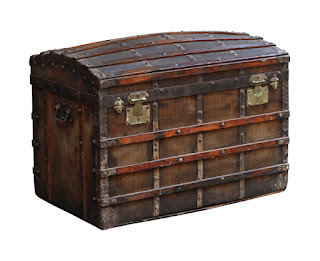
The Dome Top

Because of its ornate design and cost, the dome top trunks were mainly owned by the wealthy. It would have been purchased for a bride on her wedding day or used in the home to store valuable items.
The Bevel Top

The bevel top trunk could have been either flat or domed, but it had more ornate beveling on the top. These would have been practical for traveling, because you could stack them if they were flat. While still expensive, they were used by more middle-class travelers who could afford a little bit extra ornamentation.
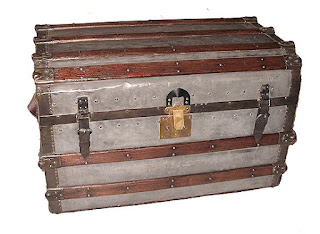

Monitor Top

A monitor top trunk is flat but with rounded edges. Some were very ornate, while others were plain. They varied both in hardware and in price. They provided more space than the flat top trunk, but still would have been practical.


Saratoga Trunk 

Named after Saratoga, New York, these trunks were larger with numerous decorative touches in their design. They were covered in metal detailing or decorative leather. Plus, they had large compartments for personal belongings. One of the fancier options, they were the reflection of wealth and affluence of their owners.


Steam Trunk Manufacturers

Most trunk manufacturers didn't inscribe their trunks with a mark, and those that did, the simple paper marking did not last.

However, some of the more reputable manufacturers designed and installed proprietary hardware. Martin Maier of Detroit, Michigan was one such manufacturer. He used cast iron hardware, hinges, and decorative tin corner pieces. On most of his trunks, two M's were stamped into the metal hardware. His trunks were easily identified by their rounded oak slats, each specially fitted, and hand turned.


Other popular, high-end trunk manufacturers of the time were M.M. Secor, Goyard, and Louis Vuitton...yes, that Louis Vuitton!
  

Many of the middle- and lower-class travelers opted for more affordable trunks manufactured by Moynat, Malloy, Oshkosh, and the Shwayder Trunk Company.


An Interesting Steamer Trunk Fact

Steamer trunks were recovered from the wreckage of the Titanic and documents were found intact inside their oxygen starved compartments!

Presently, antique steamer trunks are a high sought-after find in thrift stores or antique shops. You can often find these "resting travelers adorning the center of a living room or housing antique quilts in a bedroom.

Can you imagine the adventurous, wondrous tales they could tell?

******************************

Books by Jo-Ann Roberts


Releasing July 15, 2022


Wednesday, December 9, 2015

Fashion in the Edwardian Era


I have never been a fashion enthusiast so it comes as no surprise to me that one of the things I dislike as an author is to dress my characters. I realize it is necessary, but thinking of the words to describe a particular material for a vest or hat or blouse just makes my eyes cross! Researching the presence of a certain material (sequins in 1880?) is enough to make me turn off the computer. Considering all this, I find it particularly strange that one of my favorite times in history is the Edwardian period.

YES! That period between 1901 & 1914 that was dripping in opulence and extravagance.

How could this be?

Well, I believe my fascination with the Edwardian period came about when I first saw the ultra romantic movie Somewhere in Time. It was the beautiful clothes, not to mention the romantic leisure atmosphere at the Grand Hotel on Mackinac Island.  (Check out http://www.somewhereintime.tv/news.htm ) Flash forward to the 1997 movie Titanic. Remember the hat 'Rose' wore? Wow! I was hooked! (And worried--this was so unlike me!)
The Edwardian period is generally considered to be the years that King Edward VII reigned in the United Kingdom, 1901 to 1910 and up to the start of WWI in 1914. King Edward, in stark contrast to his mother Queen Victoria, enjoyed a lifestyle full to the brim with art, traveling, gambling and mistresses. This was the height of the British Empire. Britain led the world in finance, trade, and shipping. London was the financial capital of the world. People were prosperous, times were peaceful, and the class-system prevailed.

But there were grumblings. Society was on the brink of change and transition was starting even 'across the pond' here in the United States. 
In fashion, the hourglass corset and small bustle of the early 1900s gave way to a straighter, more tubular corset (which in some cases reached almost to the knees!) Mature women more often than not preferred dressing in the full skirt and puffy-sleeved blouses of the early 1900s, but on younger women, hems inched up nearly to their ankles! The yards and yards of material it took to make a ruffled petticoat and skirt decreased. On dresses ornamental beading and jewelry became a mark of wealth. Broad-brimmed hats on women topped off full, swept-up hairstyles shaped with the help of horse-hair "rats." The hats were decorated with ribbons, feathers, stuffed birds, and netting.

About this time, America along with Paris and London became fascinated with Japan and fashions of the time reveal this. the Kimono-style dress became popular, along with oriental silk materials. In 1910, some women wore skirts so slender and tubular that they were called hobble skirts. These were an influence from the Japanese Geisha and forced women to take short, dainty steps.
Although I would not be comfortable wearing so many layer of clothing today, I still have a fascination for this beautiful, opulent period. I have a Pinterest board devoted to the Edwardian era--mostly ladies fashions--and another board devoted to Art Nouveau from the same period. I would love to have you stop by and take a look.

Someday, I hope to set a story in this interesting time in history. I may even give in and describe a dress or hat...

Visit me on Facebook, Pinterest, or Goodreads!


Thursday, July 9, 2015

The Teutonic

by Shanna Hatfield


Have you ever wondered what it would have been like to cross the ocean in a grand ship like the Titanic?

http://www.amazon.com/Crumpets-Cowpies-Historical-Western-Romance-ebook/dp/B00QMTZYM2/ref=sr_1_1?s=digital-text&ie=UTF8&qid=1420499308&sr=1-1&keywords=crumpets+and+cowpies

In Crumpets and Cowpies, the first book in my Baker City Brides series, Oregon rancher Thane Jordan reluctantly travels to England to settle his brother’s estate. He arrives to find he’s inherited much more than he could possibly have imagined, including a niece and nephew he didn't know existed. They live with their incredibly beautiful and maddeningly proper aunt.

 Lady Jemma Bryan has no desire to spend a single minute in Thane Jordan’s insufferable presence much less live under the same roof with the handsome, arrogant American. Forced to choose between poverty or marriage to the man, she travels across an ocean and America to reach his ranch in Oregon. The solicitor that handled Thane's brother's estate happened to book them first class accommodations on a ship called Teutonic.

 Teutonic-Liverpool2 

Sister ship to the Majestic, both keels were laid in 1887 as part of the White Star Line. The Teutonic was built under the Auxiliary Armed Cruiser Agreement. An extremely fast ship, she set a transatlantic crossing record twice. Teutonic was the first armed merchant cruiser and one of two White Star Line vessels ever armed with guns. The Teutonic was one of the first ships in the White Star Line to offer second class accommodations. The ship was in service from 1889-1921.

Teutonic 

This staircase reminds me of Titanic (also a White Star Line ship). Teutonic sailed on the route from the home port of Liverpool, England, to New York City. Each week a ship sailed from Liverpool on a specific day, commonly Wednesday or Thursday. From there, they would stop at the small port of Queenstown, Ireland, to pick up more passengers. As many as eight hundred Irish immigrants might board in the single stop. After Queenstown, the ship would then begin the long voyage to New York, almost 2,500 miles of open sea. Once passengers were disbursed at either the White Star Line pier in New York or the immigration center at Castle Garden, the ship would be prepared for her return voyage.

This is one of the staterooms from the ship. Look at the side rails on the bed and the beautiful furnishings.

Teutonic dining saloon 
And this was the first class dining saloon. In the story, this is where Thane, Jemma, and the children took their meals, unless they ate in their room.

TeutonicMenuCard 
Here's a Second Class Menu card from 1907.

teutonic 2 
 I confess, I spent hours and hours admiring photos of the Teutonic.
It was an amazing, beautiful ship.


A hopeless romantic with a bit of sarcasm thrown in for good measure, Shanna Hatfield is a bestselling author of sweet romantic fiction written with a healthy dose of humor. In addition to blogging and eating too much chocolate, she is completely smitten with her husband, lovingly known as Captain Cavedweller.

Shanna creates character-driven romances with realistic heroes and heroines. Her historical westerns have been described as “reminiscent of the era captured by Bonanza and The Virginian” while her contemporary works have been called “laugh-out-loud funny, and a little heart-pumping sexy without being explicit in any way.”

She is a member of Western Writers of America, Women Writing the West, and Romance Writers of America.

Find Shanna’s books at:
Amazon | Amazon UK | Barnes & Noble | Smashwords | Apple

Shanna loves to hear from readers! Follow her online:
ShannaHatfield | Facebook | Pinterest | Goodreads | You Tube | Twitter