One of the joys of writing history is the research. As I take the journey
of the next book, I look for the pieces that add reality to the story.
The upcoming story takes place in the Mancos area of Colorado in the
1890s. In addition to the Cliff Dwellings located near the town of Mancos,
there was also ranching, farming, and mining.
As the following article shows:
The Rocky Mountain News (Daily) June 1, 1893
And this fun article:
Mancos Times April 6, 1894,
I also like to look at the advertisements. The following gives you an idea of what people were eating:
Mancos Times, November 2nd, 1894
Of course, with my background, I always look for the crimes. This one fascinated me:
Daily Sentinel, Grand Junction, October 4th, 1895
And of course, this partial article shows what we now know the reason for:
Rocky
Mountain News Daily, Volume 34, January 29th, 1893
How do you research, and what do you look for when you are developing a story?
Those who are part of the Sweet Americana Sweethearts blog are
here probably because of an interest in our country’s history. And possibly, by
extension, also historical information from around the world.
For the past month, I’ve been in the process of refreshing
and expanding three novellas I wrote several years ago with the common theme of
lighthouses and the keepers who maintained them. My goal is to include more
details about the duties performed by these individuals—and in some cases,
families—who lived in remote locations. Maintaining the light and keeping watch
for mishaps on the water provided essential services to ocean-traveling ship
captains, as well as those sailing on the Great Lakes in the upper Midwest.
Hendricks Head courtesy of Boothbay Register
In my search for more details about this profession, I came
across a fantastic website that describes jobs throughout the ages. There you
can find listings including: a description of the overall duties, the years/centuries
when the profession thrived, including why the profession died, the salary, what
a typical day might be like, tools involved in the trade, and what skills were
required to succeed. Also available are many FAQs that provide more
information.
The Jobs Museum site includes professions ranging
from a flint knapper in prehistoric times to a groom of the stool in Tudor
times to a slubber doffer in the Industrial Revolution to a stereoscopist in the
Victorian era. And, of course, you can explore jobs that you know the name of
like paper boy, blacksmith, newspaper typesetter, Pony Express rider,
wainwright, and scrivener. Not only would the site be of interest to authors
and armchair historians but also to genealogists who might want to know more
about what their ancestors lives were like.
Wainwright courtesy of Jobs Museum
Here’s the URL https://museum.jobzmall.com.
But fair warning, you might spend more time there than you planned for because
the information is so fascinating.
I
now have a free historical novelette titled Bewitching
Gypsy I’m using as a reader magnet on Book Funnel for those who register
for my occasional newsletter. https://dl.bookfunnel.com/ipfc1m6vaw
For those who know me, you know how important learning the stories of people who lived so many years ago, is to me. Old newspapers, cemetery headstones, early biographies, and old books are where I spend a lot of time.
In these quiet research times, I can immerse myself in the stories of not only the famous but also the everyday people who went about living their lives, and ultimately in their own way impacted the time we now live in. It is these people who helped the famous achieve their success.
Photo (C) Doris McCraw
In my spare reading time, I enjoy hunting down early biographies such as "Following the Guidon" by Elizabeth Bacon Custer, which I am working through. Any book by Helen (Hunt) Jackson, for the history of Illinois, where I grew up, "The History of Warsaw, Illinois" a town on the Mississippi River.
Each story I read, and each headstone I research allows me to use my imagination to step back in time, to visualize how people lived and thought. The historic newspapers give me a sense of what people thought was important, their sense of humor, and how they celebrated life.
This is what I choose to continue to experience in 2024. What do you plan to experience in the coming year?
When researching for a new story it is always fun to look at what was happening during the time and location you're writing about. Here are some pieces of news that happened when my current work in progress occurred.
For example, here's the beginning of an article on the origins of Merino Sheep from the December 3, 1880 issue of the Pueblo Daily Chieftain
Here is a weather report from the Rocky Mountain News of December 3, 1880
And this from the Denver Tribune on December 3, 1880, about ranchers in the Fairplay area regarding the rounrd-up tax.
Sometimes these older newspapers are a bit hard to read, but the information adds to the authenticity of conversations. Personally, I enjoy reading about what happened back in the day.
This month I thought I'd list ten of those random books that contain unique information. I hope you all enjoy some fun reading.
1. "I Never Knew That About Colorado" by Abbott Fay
2. "The American Family Keepsake" by The Good Samaritan and all other books in the American Antiquarian Cookbook Collection.
3. "Midas of the Rockies: The story of Stratton and Cripple Creek" by Frank Waters
4. "Cripple Creek Days" by Mabel Barbee Lee
5. "The Bad Old Days of Colorado: Untold Stories of the Wild West" by Randi Samuelson-Brown
6. " A Quick History of Victor: Colorado's "City of Mines" by Leland Feitz
7. "Alias Soapy Smith: The Life and Death of a Scoundrel" by Jeff Smith
8. "The Prospector: Story of the Lidew of Nicholas C. Creede" by Cy Warman
9. "Around Monarch Pass" by Duane Vandenbusch
10. "The Cripple Creek Strike" by Emma F. Langdon
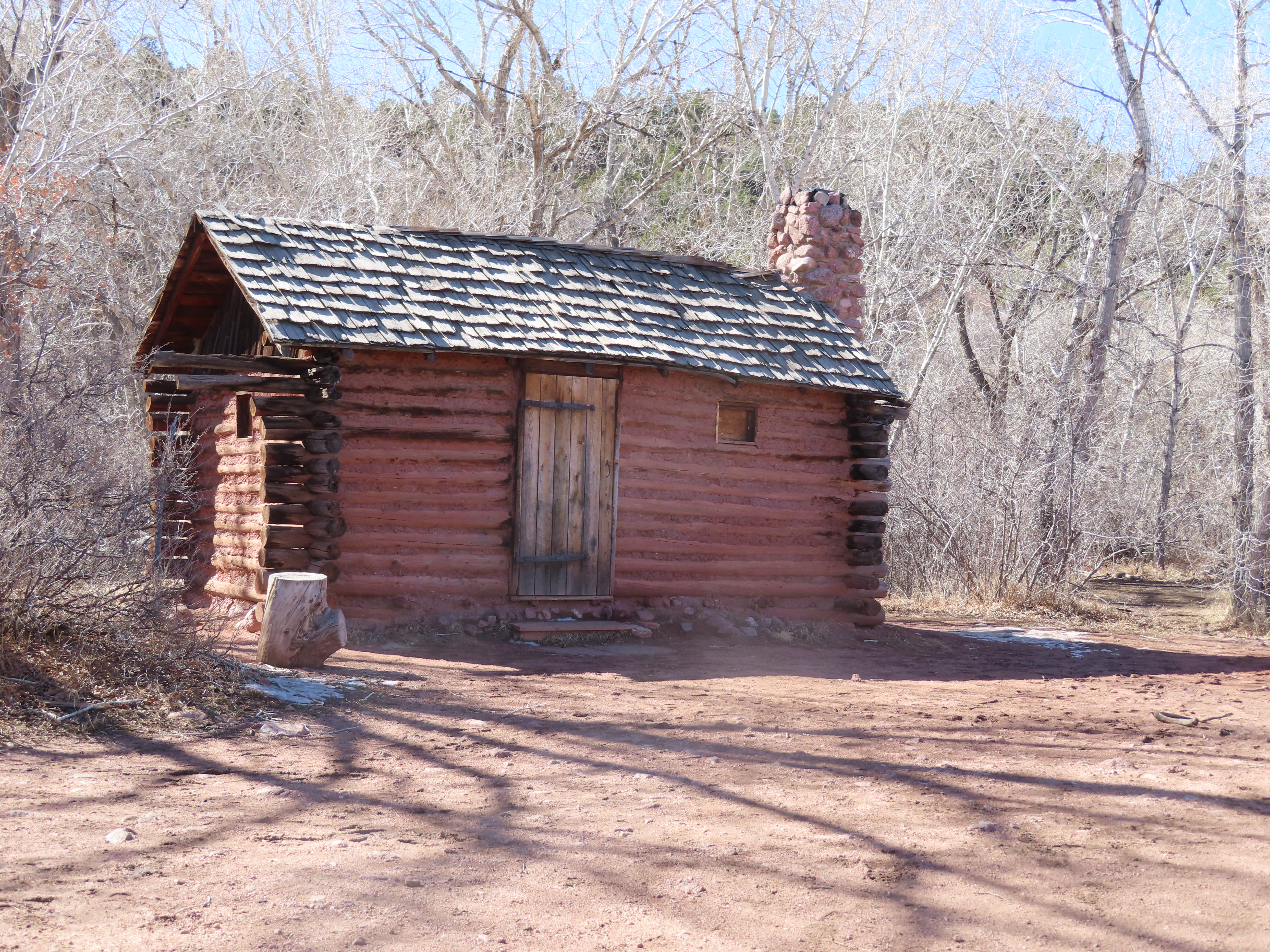
Garvin cabin - Rock Ledge Ranch Historic Site Photo (c) and property of the Author
I have used and/or own a number of these books. Yes, I realize most have to do with Colorado, but all are about life and times in the early West.
In addition to my non-fiction, such as "Under the Stone: Early Women Doctors in Evergreen Cemetery", most of my fiction, which takes place in Colorado is grounded in the history of the state and region I wrote about. To me, having those pieces of history adds realism to the story.
Until Next Time: Stay safe, Stay happy, and Stay healthy.
With my most recent novella, A Christmas Tree for Trudel, I wanted to set it near where I live
in the southern California mountains. As I started researching, I realized I
had the perfect resource at hand. Years earlier, a visit to a local museum
introduced me to the wealth of information offered by local historical
societies. In my particular case, a year’s membership in the group also earned
me a copy of Saga of the San Bernardinos. The book details events in the county
from 1769 to 1930 with two epilogues written in 1971 and 1984.
In relating the history of the largest county geographical
in the state, the author included:
·Early plats of land ownership
·Original names of towns
·Distances between locations
·Names of
settlers (from which can be construed general ethnic groups)
·Types of businesses
·Unusual weather occurrences
·Exceptional events
·Transportation and years introduced
·Costs of goods and services
As I wrote, I had the sense of detailing events in a more
personal way about characters who might have been found amongst the builders of
the community. If you’re a lover of history, be sure to seek out what local
historical societies, and by extension local museums, have to offer.
Blurb for A Christmas for Trudel, book 12 in Mail-Order
Brides’ First Christmas multi-author series
1890, Bear Valley, CA
Rancher Gibson Bartleigh travels to Pine Knot to investigate
how his younger brother was swindled out of his mining claim. He finds the
suspect, businessman Bernard Heinrik, at a poker table and squares off opposite
him. Gib goads the man into betting big, staking the mining claim and then ends
up with the winning hand and retrieves the deed. Goal achieved, he heads back
to the hotel, planning how he’ll leave in the morning and arrive triumphant in
Redlands at the family home in time for holiday festivities.
Mail-order bride Trudel Andersen traveled from Los Angeles
to Pine Knot to meet up with her fiancé, Mister Heinrik, with whom she’s been
corresponding for several months. But he’s a day overdue in meeting her. She
waits in the hotel lobby with her lace-making materials and her little dog,
Butterscotch. Released from the orphanage two months earlier, Trudel has been
on her own and terrified she will always be so.
When Gibson realizes he’s the cause for the lovely lady’s
misfortune, he’s stuck with a dilemma. If he confesses what he did, he’ll have
to offer the woman a ride back to where she came from. Propriety demands they
marry, and both agree it’s only for the duration of the trip. But will forced
proximity deepen the relationship into something more?
I love to hear what you have discovered at a museum in your
city. An ecopy of A Christmas for Trudel
will be awarded on January 31st at noon to one commenter drawn at random.
There were actually two 'Boston' Colorados. One was the name of a company that had mining concerns in the mountains. The second was a town in the Southeast part of the state. It was the one near Lamar, Colorado that sparked an idea for a story way back in 2015. Below is a news clipping about the town that caught my eye.
Boston Colorado.
And a second article I found that same year.
Badman killed in Boston, Colorado
It was these clippings and other stories that eventually became the seed of the story "Chasing A Chance" My 'what-if'? What would a man do if he found his first love was in that town and possibly in danger. The story began to take shape.
Below is a short excerpt:
"Chet, where did you see her? Why would I need to help her?" Edwin knew he'd frightened Chet,
but the mention of Mary brought back so many memories, memories he'd kept safe. Now, he couldn't let Chet go without finding out where Mary was. He had to admit, he'd never stopped loving her.
July is almost over. For most of us, we are more than half-way through the year. I like to take the time to take stock of where I am in my plans and goals.

Perhaps you’ve asked yourselves these same questions. Am I on target in our writing? How about that ‘blessed’ thing called marketing? How does blogging, and the time it takes, fit into all that? Why blog if no one reads or comments on what I’ve taken the time to think, research and write about? I rethink this every year, asking myself the same thing, why blog?

For me the answer is a bit complex. I’ll break it down into three sections. 1. Marketing 2. Research and 3. Name recognition, (the one that’s a bit tricky for me.)

1. Marketing:

If we write stories, be they short, flash or full length, we want people to read them. Even with non-fiction we want the information to get to those who might enjoy what we’ve researched and written.

For someone like me, who writes slow, there can be a long time between the various stories. Added to that, I write in two historical genres: Western and Medieval. I love both equally. You add to that the poetry I occasionally write, along with non-fiction work, and it gets busy. Facebook can only do so much, as well as emails. Plus, how do you expand your readership. To me, blogging is one of those ways.

I realize not everyone will like what I write, despite my desire that they do. At the same time, finding those readers who will like my work, is a challenge. It helps to use all the options at my disposal, and blogging is one of those for me.


Photo property of the author


2. Research:
This is probably the primary reason I blog. I want to share the research I have done with others. History and the people who made it are a compulsion with me. To tell the stories of the people and places from history is something I want to do. I don’t want those pieces from the past to be lost. The nice thing about blogs, especially with the tags, your posts are available via searches almost forever.

For over ten years I’ve researched the story of a Colorado criminal. I told his story at the Pikes Peak Library History Symposium presentation on June 9 of 2018. It is my hope to complete the story of the whole family. A very telling piece of history and the time in which they lived.

The other research that’s important for me to share is the story of the early women doctors in Colorado. While ‘Doc Susie’ is a part of that story, it has been slanted her way for far to long. There were so many others who did as much if not more than she. Between blog posts and articles I've begun to balance that scale. For those who may be interested, the article in Saddlebag Dispatches can be read here: Dr. Quinn, Doc Susie and the Reality of Colorado Women Doctors

The stories of the doctors and so many others need to be preserved for future generations. When you feel like you can’t do something, just take a look at what those who preceded you did. It sometimes helps when put into that perspective.


 3. Name Recognition:

Since I write fiction under a pen name: Angela Raines, it is important I share that information on my posts. When you add my online name, Renawomyn, it gets a bit tricky.

At the same time, my non-fiction work is important. I simply do not want readers of romance to pick up a book with my real name expecting a sweet story and they are reading about juvenile delinquents, early criminals or lynchings. By using pen names I hope to avoid that problem. Of course the reverse could also be true. Can you imagine buying one of my books about the trials and tribulations of early women doctors, and find your reading a story about a medieval woman and the man she loves?

In the end, whether anyone reads or comments on my blog posts, I have things I want to say. Yes, it hurts when no one seems to care, but in the long run, it’s the future I write for. So, here’s to the future and to the readers who want to know what I have to share.

And on a lighter note, the book birthday for my first story is this July. It will be six years old. How time does fly.

Here is a brief excerpt:

He wrapped strong arms around her, pulled her close, bent his head to kiss her forehead. He looked into her eyes, and without warning, put his hand under her chin and raised her lips to his. Clara stiffened at his touch. Then, he was kissing her. Clara put her arms to his shoulders. She relaxed, leaned into his strong chest. Their lips touched, breath slowing until nothing else existed except the two of them. It felt so good to think someone cared, someone loved her… even if it wasn’t really true.

Sam drew back, his breath deep, as if swimming for the surface of the water. He stared into Clara’s eyes, as though he were trying to see if she had felt what he did. Lightening the moment, he stepped back, but continued to gently hold onto her. “Whoa, if I knew that kissing you... well I’d have done it a lot sooner.” He smiled
As we make our way through this interesting time of staying at home, I'm sure we deal with the fatigue of all the news and frustration of things going so slowly. I know I am, and I still get to work from home. However, being at home has not translated into more writing. On the plus side, I've been able to indulge my love of hiking while still being safe. (For those who follow my personal Facebook posts, you can see some of the places I have traversed)
I thought a look back at some of the challenges faced by our ancestors might be something to ponder. Of course, there were the outbreaks of cholera, malaria, smallpox, and measles. We've all heard of the 1918 Spanish flu pandemic and the dustbowl from the early 20th century.
But what about smaller areas that had many challenges that we may have forgotten about? I did some research on Vernon County Missouri during and after the Civil War. This was an area that faced many devastating events in a short time.
Photo property of the author
History tells us Vernon County was ravaged by many incidents prior to and during the Civil War.
In December 1858 according to the book "Osages, Bushwhacker's, Etc.”, John Brown and his men came down from Kansas entering Vernon County, Missouri, and attacking three farms. The three farms were that of David Cruise, James Lawrence, and Isaac LaRue. The reason for the raid according to Brown was a slave of the late James Lawrence had sought him out in Kansas, telling Brown that slaves were about to be sold in Texas. Using this reason Brown entered Vernon County and attacked the Lawrence farm. Brown or his men also attacked the other farms during this raid. Although Brown and his associates were indicted for grand larceny and murder by the Vernon County Circuit Court, nothing ever came of that indictment.
From the book, " History of Vernon County Missouri": written and compiled from the most authentic official and private sources", by the end of the Civil War, Vernon County, was “fire-blackened, bloodstained and desolate”. The book also said the people of the county would welcome peace on almost any terms. At the time of the signing of the treaty at Appomattox, the whole county had no more than one hundred families living there. “There was neither town or village. At Nevada City, a dozen small, scattered houses, out of repair; at Balltown, or little Osage, a dozen; at Montevallo, none. Riding from Nevada to Balltown, one did not pass a house.”
What did remain in Vernon County was the rich fertile soil. Many of the returning soldiers took solace in that fact. The country also had timber, water, coal, and stone which could be used to rebuild homes, water their crops, and heat their homes.
Photo property of the author
Into this area families came from other parts of the country, the ex-federal soldiers, searching for a place to call home. A place to find work. This same book on the history of the county said, “Between them [the ex-Union soldier] and the ex-Confederates there was neither clash nor collusion. There was instead a mutual alliance for the rebuilding of the country, and a hearty rivalry as to which of the contracting parties should best discharge their duty.”
According to the county's history, 1875 was the year the county was infested with grasshoppers. To quote, 1875 was the "grasshopper year. In May vast swarms of grasshoppers known as Rocky Mountain Locust, made their appearance in western Missouri and eastern Kansas, devastating vast regions of the country, stripping the earth the vegetation and of almost every green thing. In this county, they were indeed such numbers that in many places the ground was covered with them. Entire fields of wheat and young corn and meadows “a burden," and it seemed as if the mentioned Ecclesiastes was at hand.” The locust swooped in and in just a few hours devoured everything in their path. Although the crops were replanted, and it was a good crop year, to someone who was trying to make a new start, it would be a devastating event.
I confess I'm sure I would have felt like the world was against me. This small area to me is a microcosm of what life might have been like back in the time I write about. It gives me something to ponder as I research and write the stories my mind creates from these true events. I'm thankful I live at a time when even when I can't hug someone, I can 'converse' with them instantaneously via phone, internet, or facetime.
In my very first novella, my hero served in the Civil War as a child soldier. Here is a brief excerpt:
Sam awoke from a nightmare
shaking and covered with sweat. It was the same nightmare he had
been having since the war had ended. He had gotten used to them, but
this time it was different.
Instead of the usual comrades and other drum and fife boys in his
group being blown apart
by bullets, cannon fire or bayonets, it was his friends, Clara, Paul,
Sally. This one terrified him.
Sam
buried the young man and started out, following the tracks of the
horses that
had been in camp. If Sam was correct the murderer had taken the
horses and mules. From the
looks of it, the man had made quite a haul.
Pushing
ahead as quickly as he could, Sam hoped to find the killer before he
had the chance
to do anything else. At that thought, Sam went cold. He could see
Clara's eyes, those gray/green
eyes, telling him to hurry.