Thursday, September 20, 2018

Defiance and the Cosmic Well

Funny how authors seem to dip from the same cosmic well. They can write completely different novels, never meet each other or share information, yet similarities in the books can be staggering, even shocking. I’ve had this experience with my book, A Lady in Defiance. But rather than point out some spooky similarities between it and another author’s story, I want to talk about where fact and fiction meet.
The town of Defiance--er, I mean, Glenwood Springs!

In my book, Defiance is a fictional town in the San Juan mountain range of Colorado. The history of it is based loosely on the bawdy mining town of Mineral Point. In my story, three good, Christian girls roll into town and shake things up for God.

To my delight, I learned recently that the REAL town of Glenwood Springs, CO used to be named Defiance! And what happened to change the name? Why, a God-fearing, red-blooded American girl rolled into town. That’s what happened.

Sarah Cooper and her husband settled in the encampment of Defiance in 1883. A pair of no-nonsense Iowans, they weren’t thrilled with the name of the town or the behavior of the citizens and worked with the founders to incorporate the settlement into a real municipality. Law and order and churches followed and Sarah pushed to rename Defiance Glenwood Springs, after her hometown of Glenwood, Iowa.

Give an American pioneer woman an inch and she’ll take a mile every time. I love it.

Wednesday, September 19, 2018

ROAD TRIP #history #SweetAmericanaSweethearts


Have you ever experienced that road trip where you have to get there and get back, and have no time to stop and visit the history that is flying by? Recently I did just that on my way to the Western Fictioneers Convention in Oklahoma City, OK. So, I've decided to write a post about what I wished I'd had time to see. At least with some research, I can share what might have been. 

Heading south on Interstate 25 through Colorado I passed Pueblo, Trinidad and went over Raton Pass. All three are part of the Latin American Heritage of Colorado. I know Bat Masterson was city marshal of Trinidad, and Pueblo had its beginnings as a commercial fort. Raton Pass was an early crossing on the Santa Fe Trail. (for more on Raton Pass Raton Pass History)


Capulin Volcano
I headed east along the northern part of New Mexico and Texas.  As anyone who knows Texas, they have so many wonderful historic markers along their roads. Some day I'll read most. Of course the route also took me by Capulin Volcano National Monument. (more on this volcano can be found here: Capulin )


Historic Marker - Texas
Hitting Oklahoma City, I had the chance to visit the National Cowboy & Western Heritage Museum and so what they had on display. The rest of the time was spent with other Western authors and listening to their shared expertise. 

Leaving I headed north toward Dodge City. I drove through the lands that the Indians made their own after being driven to the area. I traveled part of the Chisholm Trail. 

In Kansas, I saw the sign for St. Jacob's Well. I had no idea what it was until I did a search. Pretty interesting. St. Jacob's Well

Of course, who hasn't heard of Dodge City, Kansas. The end of the trail drive. The wild and woolly west with Wyatt Earp, Bat Masterson and all the others who passed through the town. 

Once I made it to Highway 50 heading west, I was traversing The Santa Fe Trail and Scenic and History Byway Auto Tour Route. It is a lonely stretch of road, but what a time to take in all I'd missed along the way. (Santa Fe Trail- Mountain Route)


Marker in Coolidge, KS
I drove through Syracuse and Coolidge, Kansas. There was something about that area that drew me to it. In fact it was the only place I stopped to take a photo. Since it was Sunday, there was nothing open. When I did some research, I found out why. (Hamilton County Kansas) For those who would enjoy deeper research (Bibliography of Hamilton County) For some history on Coolidge, which from what I understand was a wild place in the 1880s. (Coolidge History) The one thing I really loved, from the site "Coolidge has a city ordinance that prohibits women from riding naked on horseback. Yes this is left over from the late 1880's indicating the wild west issues that occurred with Trail City (headlined in the 1880's as the wickedest town in the west) only two miles away." 

I wondered what the travel would have been like for those who traveled the Santa Fe trail to trade with those businesses in New Mexico. What was it like for Zebulon Pike as he explored the region at the behest of the government? Looking at the land and its features, I wondered at the cattle drives as the made their way north, looking for water, going up and down the rolling land of Northern Oklahoma and Southern Kansas. The twelve hundred plus miles I drove in two day, how long would it have taken a man or woman on horseback? What of the towns that began as someones dreams, some of which grew and others that faded or are just barely holding one?

So the next time a Road Trip comes up, I may have to take a few extra days and stop along the way.  What would your dream trip be?


Building in Coolidge, KS

In the novel "Josie's Dream", Josie travels from her home in Iowa to the plains of Colorado in search of the place she will call 'home'.  Here is a short excerpt:


Breathing deeply of the independence she felt, Josie reached down to pick up her cases. Looking around, Josie took in the small town. It was just as she had dreamed, the main street with its business buildings standing like sentinels to keep the town safe, help it grow. Houses, some with fences, some without, ringed the outer reaches of the area.
Since corresponding with Dr. Harriett Leonard, a past student of her medical school and dear friend, despite the difference in age, Josie had been dreaming of coming to Colorado. Dr. Leonard had offered to let her work at the Spa in Manitou Springs where Harriett was the proprietor, but Josie wanted to create a practice in a smaller town, where people really needed her.
Now here she was in Kiowa Wells, on the eastern plains of Colorado just a few miles from the railhead at Kit Carson. Her biggest obstacle now was finding a place to set up her medical practice.
Despite his reservations, her father gave her a medical bag, equipped with the basics. “Something to remind you of this commitment, your Hippocratic oath,” were his parting words.

Her parents, though still in Iowa, were in her heart. Still, she knew it had been time to leave. While others of her friends were getting married, she had gone to medical school, her path clear to her.
Josie's Dream (Grandma's Wedding Quilts Book 9) by [Raines, Angela, Quilts, Grandma's Wedding, Americana, Sweet]
Amazon e-book purchase here


Doris Gardner-McCraw -
Author, Speaker, Historian-specializing in
Colorado and Women's History
Member of National League of American Pen Women,
Women Writing the West,
Pikes Peak Posse of the Westerners

Angela Raines - author: Where Love & History Meet
For a list of Angela Raines Books: Here 
Photo and Poem: Click Here 
Angela Raines FaceBook: Click Here

Monday, September 17, 2018

Wanted: Bookkeeper Silverpines #14

By Sophie Dawson

Wanted: Bookkeeper 
 
Tilde Lasek wanted to advertise for a husband when the ladies of Silverpines first sent them after the earthquakes devastated the town leaving it without men. Her mother discouraged her. Now there's been an attempted robbery at the Silvepines Bank Tilde runs since the deaths of her father and brother. It was the last straw. She posted an advertisement without her mother's knowledge. Now her groom is here.

How does Mabel, Tilde's mother react to a surprise husband for her only daughter? How do Tilde and Joel Richards work together as well as work out their marriage by beginning as strangers? 

The fourteenth book in the acclaimed Silverpines series brings people you've read about in previous books back together as the town continues to rebound from tragedy. 

Wanted: Bookkeeper becomes available Tuesday, September 18 for Kindle, KU, and print. Pre-order also available.

I enjoyed Tilde coming into her own as she defies her mother doing what she knows she must. Joel Richards comes from Cottonwood, Iowa for a fresh start. You may remember Joel from Giving Love, Book 3 in my Cottonwood series. He's all grown up now and ready to find the love of his life.

P.S. Yes, I know the cover on Amazon has Bookkeeper misspelled. It will be fixed on the 18th. I can't do it until it's released.😉)

~~~~~~~~~~~~~~~~~~~~~~~~~~~~~~~~~~~~~~~~~~~~~~~~
Sophie Dawson writes sweet and clean romances in both historic and contemporary genres. Her novels have won awards as well as critical acclaim.

Friday, September 14, 2018

From Longhorns to No Horns!

by Kathryn Albright


Recently, I had to research different types of cattle here in America for my most newest story, Wedding at Rocking S Ranch that takes place on a ranch. Oak Grove was a railroad town that blossomed as a result of its location and the cattle drives from Texas. Sure, Longhorns came from Texas, but was that the kind of cattle that would be found on a ranch in Kansas? I had to know. I also had to check the history of barbed wire.

1870 marked the start of the big cattle drives into Kansas. 300,00 arrived that year. The next year that amount doubled. Three-fifths of the cattle were "stock cattle" which means they were yearlings, heifers, cows and steers younger than four years old. Abilene, Kansas, Wichita and Dodge City became the towns (and later cities) that truly boomed with the transporting of cattle to market.


Many of the Longhorns didn't immediately board the train and head to points farther east, but wintered in Kansas, existing on the buffalo-grass prairie. Although barbed wire had been invented and was in use, the sectioning off of large parcels of land hadn't happened yet in Kansas in 1879 at the time my story takes place. Cattle still roamed free and had to be watched over by cowboys. At the Rocking S Ranch, the ranch-house and the crops had fences around them to keep the cattle out of the corn and alfalfa. This was known as "fenced out." Further east, a farmer would use wood and barbed wire to enclose a pasture, which was known as "fenced in."

In my story, I have the owner of the ranch looking into crossbreeding his longhorns with another breed of cattle to make a healthier, more profitable herd. He has brought in Black Angus to give this a try. Black Angus first came to Kansas in 1873 when George Grant transported them from Scotland. Where the longhorns were hardy, they were a tougher meat and had a wild-streak and could be difficult to manage. Angus had a gentle nature and were more susceptible to extremes in weather. Their meat is more tender and has a better flavor that the longhorns. Angus weigh between 850 and 1000 pounds when mature.


When Grant took his four Angus bulls to the fair in Kansas City Livestock Exposition that year, the local people didn't know what to think of them. These cattle had no horns! (Called polled, which means naturally hornless.) But Grant had the last laugh when he successfully crossed his bulls with native Texas longhorns. The calves were hardier, hornless, and weighed more. Between 1878 and 1883, twelve hundred Angus cattle were imported to the Midwest. Cross-breeding has steadily improved the hardiness of the Angus here in America.

And there are Red Angus! Red Angus occur as the result of a recessive gene. They are the same as their black relatives except they are actually more tolerant of the hot weather. At one time, The Angus Association barred the registration of Red Angus in an attempt to promote a solid black breed. Likely that is one of the reasons they are fewer in number. Eventually, The Red Angus Association of America formed when breeders searched out and collected the Red Angus from the black herds.


Although I used a lot of this information in Wedding at Rocking S Ranch, it was sprinkled in with a light touch. In historical romance, it is the relationship between the two protagonists that carry the story after all! 


When Cassandra Stewart fulfills her husband’s dying wish by visiting the ranch he loved, she plans to sell it. But then she meets his best friend. As aloof, ruggedly handsome Wolf shows Cassandra the value of life in the prairies, tenderness begins to grow from their shared pain into something more…
Maybe there’s a future for her at the Rocking S Ranch after all…

 "The plot was riveting. I couldn’t put it down even when it was well past my bed time."
Long & Short Reviews
Available at Amazon, Harlequin, and Barnes and Noble!


Thursday, September 13, 2018

The Pendleton Round-Up


by Shanna Hatfield

This week marks the 118th Pendleton Round-Up


The world famous rodeo began in 1910 in the wild western town of Pendleton, Oregon. 

You might wonder what the fuss is about "another rodeo," but the Northwest Frontier Round-Up, or The Roundup as it was called in numerous newspaper articles, was such a huge event, they ran special trains from Portland just to bring attendees to see it.


From my understanding, the idea for The Roundup came into being that July and quickly gathered steam along with supporters. It was decided to hold an event which would "bring back the feel of the Old West" in conjunction with the Eastern Oregon District Fair taking place the last week of September.


Organizers wanted the first Round-Up to be a "frontier exhibition of picturesque pastimes, Indian and military spectacles, cowboy racing, and bronco busting for the championship of the Northwest.

For the initial performance all businesses in town were asked to close. People were asked to open their homes to out-of-town attendees since there weren't rooms enough at the area hotels to accommodate them.

The very first show went off with a bang, with a reported 7,000 people in attendance and hundreds left outside the gates, wanting in. Not about to miss out on an opportunity, organizers raced to build another 3,000 bleacher seats before the second performance began the following afternoon.

And the slogan heard throughout town that weekend was "Let 'er Buck" - a phrase still popular with attendees today. 


The rodeo arena’s grass floor is one-of-a-kind in the world of rodeo, adding a unique challenge for competitors. The Native American encampment is the largest in North America with more than 300 teepees annually joining in the event, just like they did during that first event so long ago. It was also the first rodeo to have rodeo royalty, starting with the very first Round-Up in 1910.


Souvenirs of all types were sold to the thousands crowding into the city and logo'd souvenirs continue to be popular with the modern crowds.


As the initial show drew to an end, one newspaper reporter wrote: "The words 'Pendleton' and 'Round-Up' are on the lips of thousands and will continue to be for months and years to come... The Round-Up is a whirlwind success."

Since 1910, the show has gone on every year except for two during World War II and continues to draw thousands of spectators the second full week of September.

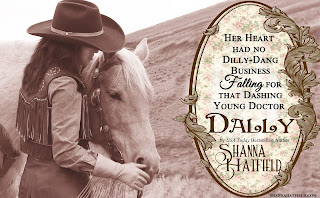
I had a ball incorporating details of  the Round-Up's history into Dally, Pendleton Petticoats Book 8.


She’s ready to spread her wing and fly…
            He’s scrambling to set down roots.

Unconventional, Dally Douglas is as likely to be found wearing her brother’s britches and riding a horse as she is dressed in lace-trimmed finery sipping tea in the parlor. With no plans to wed, she convinces her family to allow her to stay at their ranch in Oregon. Free and unfettered, she plans to remain that way, even when the town’s beloved young doctor returns home and captures both her interest and her heart.

Charismatic, handsome, and dedicated to his work, Doctor Nik Nash finally makes his way back to Pendleton. After years of studying and gaining hands-on experience, Nik is excited to bring his skills and knowledge to the place he calls home. Focused on his career, he has no time for a woman, especially not one as lively, fascinating, and enchanting as Dally Douglas.

When a freak accident brings the two of them together, their stubborn determination may cost them the chance to know true love.


     Dally clenched every muscle in her body and held her breath as her brother eased onto the back of the blindfolded horse in the middle of the arena. In theory, the blindfold would keep the horse calm until the rider gained his seat on the saddle.
     The way the bronc tensed and his ears twitched, Dally had an idea the animal was anything except calm.
     Cautious yet determined, Hunter slid onto the stock saddle and took the rein in his hand. He hunkered down and grinned, then yelled, “Let ’er Buck!” and the man holding the horse tugged off the blindfold.


     The horse bucked and pitched, kicked and reared, putting on quite a show, but so did Hunter.

*****


 USA Today Bestselling Author Shanna Hatfield writes character-driven romances with relatable heroes and heroines. Her historical westerns have been described as “reminiscent of the era captured by Bonanza and The Virginian” while her contemporary works have been called “laugh-out-loud funny, and a little heart-pumping sexy without being explicit in any way.”
Convinced everyone deserves a happy ending, this hopeless romantic is out to make it happen one story at a time. When she isn’t writing or indulging in chocolate (dark and decadent, please), Shanna hangs out with her husband, lovingly known as Captain Cavedweller.


Find Shanna’s books at:

Shanna loves to hear from readers. Follow her online at:

Wednesday, September 12, 2018

The Mercantile of the Old West


As pioneers, cowboys, and businessmen moved west, they built up towns in the places they settled. As towns sprung up, the people running farms or working and living there needed supplies. They needed everything they couldn't grow, kill, or make themselves.

So unlike most of us, they couldn't just skip off down to the grocery store and pick up a loaf of bread and a jar of jam. They weren't able to simply swing by Target to grab a new dress, a broom, and a milk pail. They'd be making the bread and the jam themselves, most likely, but they'd need flour and sugar or bowls and crockery. They made most of their own clothes, but they did need fabric, thread, buttons, and such. Seeds to plant their gardens and boots to wear while doing it were all found in the mercantile.

Most of the larger cities in the east had general stores, but they also had specialty shops. Dress shops, hat shops, haberdasheries for men's clothing, kitchen supply stores, fabric stores, shoe shops. The western towns normally didn't have such luxuries. Most everything they needed was found all in one place. The mercantile.


For those living on ranches and farms outside town, making the trip to the mercantile was a big deal since the tools and materials they needed for every day work were there. Another reason going into town to the mercantile was a big deal was that they couldn't afford to forget anything because it would be an ordeal to come back for what was forgotten.


A mercantile store in the old west was vital. It was their means to get the items they needed, but it also served as a social gathering spot in many of the western towns. People who lived out on the farms, enjoyed catching up with friends they saw when they stopped in to the mercantile to stock up. Many times the mercantile also served as the post office, so pick up mail and dropping off letters was another opportunity to socialize.

The mercantile owner was an entrepreneur. The business was his to run as he saw fit. He could extend credit to people he knew and trusted or he could only accept cash. He could barter with other local businesses, such as the blacksmith or the tailor. He could allow local farms to swap eggs and milk for tools or shoes.

Most mercantile stores in the old western towns were monopolies. The townspeople had no other options - at least none that were practical or desirable. So, the owner made his own rules and his decisions were usually final. More often than not, though, the owner was a benevolent soul who helped out the less fortunate when he could.

The hero in my latest Colorado Matchmakers Series, Cade Jones, was  the mercantile owner in Rocky Ridge, Colorado. A widower with four young children, he was finding it difficult to raise his family and run his store. He needed help. He needed a wife. So, as a savvy business man solves problems, Cade goes to the local matchmaker to get some help.

As luck would have it, the perfect match for Cade drops into his lap with a little help from Susannah Jessup, the local matchmaker.

If you're interested in reading the sweet story of how Cade manages to fall in love and run his thriving mercantile at the same time, you can find it on Amazon.


~~~~~


Annie Boone writes sweet western historical romance with a happy ending guaranteed in every single story. Inspiration comes in many forms and Annie finds more than one way to make her stories entertain and inspire.
 
To connect with Annie, find her on Facebook, Twitter, or her website.

Follow Annie on Amazon, Bookbub and get email updates.

Monday, September 10, 2018

UINTA MOUNTAINS by Zina Abbott


The Uinta Mountains are an east-west mountain range in northeastern Utah extending slightly into southern Wyoming. It is a subrange of the Rocky Mountains. They are the highest mountain range (ranging from 11,000–13,528 feet) in the contiguous United States that runs east to west. They start about 100 miles east of Salt Lake City. The highest point is Kings Peak, which is also the highest point in Utah.
 
Kings Peak from above the Henry's Fork Basin. Taken by Hyrum K. Wright

Most of the high peaks are outcrops of the Uinta Mountain Group. Many of the peaks are ringed with bands of cliffs, rising to form broad or flat tops. The mountains are bounded to the north and south by reverse faults that meet below the range, on the north by the North Flank fault and on the south by the Uinta Basin boundary fault.

Gilbert Peak seen from Lake 151, ctsy Philthy54
The high Uintas were extensively glaciated during the last ice age, and most of the large stream valleys on both the north and south sides of the range held long valley glaciers. Even though some peaks reach as high as over 13,500 feet in elevation, the dry climate of today has resulted in there being no glaciers that have survived. The Uintas are the most poleward mountain range in the world to reach over 13,000 feet without modern glaciers, and are the highest mountain range in the contiguous United States with no glaciers. They do have permafrost at elevations above 10,000 feet. If you wish to know more about the heavy-duty science stuff like which era the rocks were formed and pushed up to where they are today, I’ll refer you to Wikipedia.

Utah Road Map - Uinta Range barely south of Wyoming
Large portions of the mountain range receive over 40 inches of precipitation annually. That's a lot of snow and rain. The highest peaks remain snowcapped most of the year except for late July through early September. 

July Snow in Uintas - NASA Earth Observatory
The Uinta Mountains have more than 400 miles of streams and 1,000 lakes and ponds.  It is part of the Wasatch and Uinta montane forests ecoregion. Nearly the entire range lies within Uinta-Wasatch-Cache National Forest on the north and west and Ashley National Forest on the south and east. Because it does run east to west, it sort of T-bones these other ranges. The highest peaks of the range are protected as part of the High Uintas Wilderness. The forests contain many species of trees plus many species of grasses, shrubs, and flowering plants.

The Bear and Weber rivers, the two largest tributaries of Great Salt Lake, start on the west slope of the range. The Provo River, the largest tributary to Utah Lake, begins on the southern side of the range and flows west to Utah Lake, which itself drains via the Jordan River into Great Salt Lake.
 
Weber River starts on west of Uintas
The south and east sides of the range are largely within the Colorado River watershed, including the Blacks Fork and the Duchesne River, which are tributaries of the Green River. The Green is the major tributary of the Colorado River. All that water means there are about 500 small lakes, one of the most popular being Mirror Lake.
 
Hayden Peak and Mount Agassiz seen from Bald Mountain - ctsy Jeff McGrath from USA
This past June I traveled throughout Wyoming. From Interstate 80, I was able to look to the south and see this mountain range—very impressive with all the snow that time of year. (See my title header.) Little did I know then I would be writing two books for a series set in those mountains. I passed through Evanston, Wyoming (been there several times) which is the biggest town north of the setting of the book. It is where folks then and now caught the trains on the Trans-Continental Railroad.

I recently put my first book in The Widows of Wildcat Ridge series, Nissa, on preorder. To read the book description and access the purchase link, PLEASE CLICK HERE. The book will be released October 15th. My second book, Diantha, will be published in April.

The following is a snippet from the book: