Showing posts with label researching. Show all posts

Monday, October 30, 2017

Working Woman's Corset


Working Woman's Corset
by Sophie Dawson

My new release, Music of Her Heart, is set in 1869. It’s book two in my Stones Creek - Ladies of Sanctuary House series. In writing one of the early scenes, I needed to be sure what sort of corseting the main character, Gema, would be wearing and whether she could easily take it off without help. I realize much has been written about corsets, a lot negative. 


Gema is a Russian immigrant, orphaned at sixteen and taken to live at Sanctuary Place. It’s a woman’s mission set just outside of Dubuque, Iowa, fictional of course, that offers shelter, education, safety, and the Gospel to girls and women who are in need from circumstances beyond their control, or from poor life choices. 


With the opening of the West, and the dearth of women, Sanctuary House is built in Stones Creek, Colorado for the women, Ladies as I call them, and their children to move to and begin new lives, possibly become brides to men in the area. So far, two books have been released concerning these ladies: Chloe’s Sanctuary and Laundry Ladies Love.

Okay, back to Gema and her underpinnings, now that I’ve given you some background. When we think of corsets, we naturally think of the Victorian corsets of the late 1800’s. Post Civil War from about 1870 onward. Actually, we probably think of Madonna’s and Lady Gaga’s corsets worn when they perform. Not what ladies would wear back then, and certainly they would not show. Soiled doves the exception.

Stays and corsets were the foundation garments for centuries before the invention of the bra, girdle, and Spanx, not to mention control top pantyhose. They held up the bosom and created the shape of the torso popular at the time. If you have anything up top, you probably understand why women throughout the ages wore something to keep the girls contained. I’m not going into a detailed history of stays and corsets, or the pros and cons. I was more interested in what Gema, a poor woman, would have worn and whether it had a split busk or not.


A busk is a stiff rod down the center front that keeps the garment from sagging. Think of it as the underwire of the day. Until the 1830’s they were made of one piece. This only allowed the stays to be put on by lacing and removed by unlacing down the back. When the split busk was invented, it allowed a woman to much more easily dress by herself. The innovation took over and by the 1850’s nearly all corsets and stays were made with split busks.


The historic stays and corsets we see in photos and museums were most likely those of wealthy, elite women. My Ladies of Sanctuary House are anything but that. They were poor women hoping to improve their lot in life by moving and possibly marrying men in the West. They probably wouldn’t have had whale-boned corsets made of silk. Theirs, which they may have sewn themselves, would have been cotton or linen, quilted with cording or tightly rolled paper rather than bones simply because of the cost. They would have worn them until they fell apart. Women protected their corsets by wearing a chemise under and corset over over them. Those were easily washed. Corsets were not. Corsets with steel bones couldn't be washed since the rods would rust.


Here's a corded corset from 1855-1865. It would have had cotton cords quilted in for the stays, or possibly rolled paper.
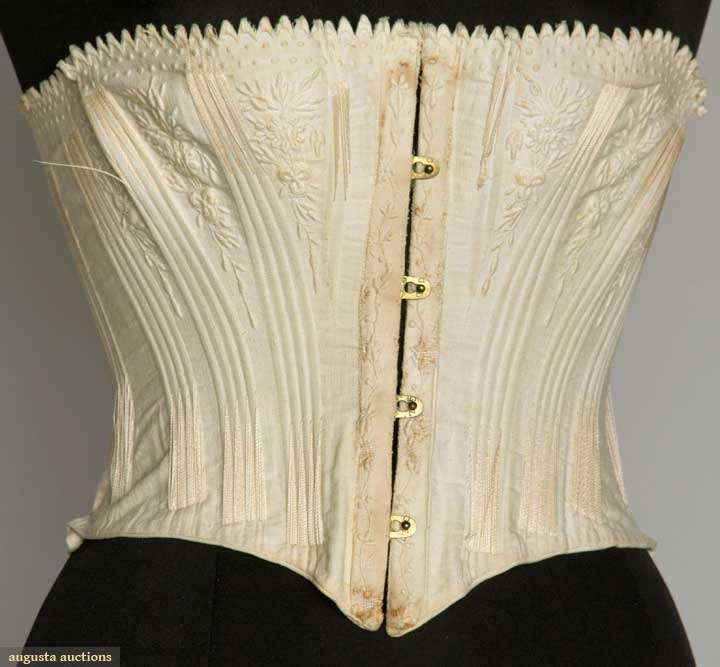
Photos from Augusta Auctions 
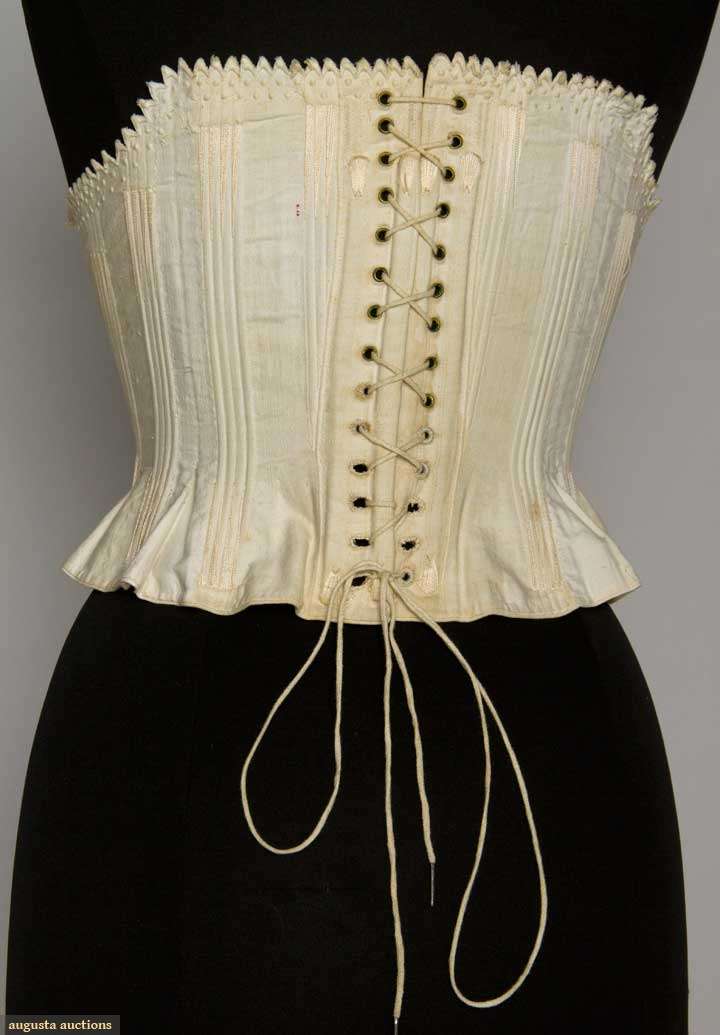
Notice the lacing pulling the sides together. This was not the way a corset would be worn. At least 2-4 inches gap should remain between the edges. The waist size of a corset is the measure that is of the garment without the gap. This one measures 25 inches, the person would have an actual waist measurement of at least 27-30 inches.


The corset ends just below the waist and would have allowed for ease of movement as a woman went about her daily duties. This is the sort of garment Gema, a hotel maid, might have been wearing, although hers would not have had the lovely trapunto quilted floral sprays between the ribs.


So my problem was solved. Gema could get out of her corset, by herself, and flop it over the back of the chair like I wanted her to. 

Friday, May 5, 2017

Wild, Wild West--An Example


by USA Today Bestselling Author Kristin Holt

"A Reign of Terror", published in Manhattan Mercury of Manhattan, Kansas, on May 3, 1890, illustrating the lawlessness and terror in some parts of the Old (Wild, Wild) West, even as the dawn of the Century approached.

By 1890--the date this vintage newspaper article was published, most of the American West was settled, the Indian Wars were over, settlements had become towns, and most of what made the West Wild had been brought to heel.

Obviously not everywhere. As readers, we romanticize the Old West, and love stories set there (I'm guilty as charged). But to live then? I can't imagine how difficult that would be.

I.T. stands for Indian Territory, now known as Oklahoma. Lehigh, this mining town in the Choctaw Nation, where "a reign of terror" kept 'good people' quiet, sent others scurrying for cover, and pressed many into "emigrating"... a.k.a. skedaddlin'.

I can't imagine living in such lawlessness.


Mining towns were among the most wild, most rowdy, least law-abiding places in the American West. Lehigh's history began relatively late--1877, when a man named Davis discovered coal. Five years later, a post office opened, and railroads came through. After all, coal kept those steam engines rolling.

My first mining town setting was The Bride Lottery, a mining camp trying to make things more permanent, and give their little settlement a chance as a town. To make things last, they need women to marry, start families, and help them carve a life out of the high mountain valley (not far from Leadville, Colorado).


I enjoy writing mining camps and towns with significant mining influence. Such settings are icons of the Old West and played key roles in the settling of the American frontier by men and women of various ethnicity. One of my newer releases, Pleasance's First Love, spends a few scenes in historic Leadville, Colorado, smack-dab in the middle of a lawless period much like the one described in this newspaper article. Learn much more about Leadville on my website's page about this title. I'm particularly honored to have been included in the Sweet Americana Sweethearts' group series, Grandma's Wedding Quilts, where this title is book #6.


Hi! I'm Kristin Holt, USA Today Bestselling Author of Sweet Romances Appropriate for All Audiences.

Please follow me on BookBub!

https://www.bookbub.com/authors/kristin-holt


Copyright © 2017 Kristin Holt LC

Friday, July 1, 2016

Victorian America's Sense of Humor


I enjoy researching every detail of Victorian American life--and not only for accuracy in the fiction I write. I find myself fascinated by the history itself. One tidbit brought to my attention of late in newspapers all over the United States is the inclusion of short humorous jokes or puns, sometimes known as quips.

I'll share a few, referencing the newspaper's name and date published. All newspaper clippings are courtesy of newspapers.com (a subscription service). 


The Wilkes-Barre News, Wilkes-Barre, Pennsylvania, on April 30, 1902. (Technically 1 year too late to be considered truly Victorian; Queen Victoria died in January, 1901.)

The Kansas City Gazette on March 11, 1894.

Because the following quip is just too darling to miss, and because the scanned image is difficult to read, I'll provide a transcription:
A young man wrote to a girl: "Your loveliness has inspired me to ask you to become my wife." She read it "loneliness," and got so everlastingly mad that she refused him by return mail.
Las Cruces Sun-News of Las Cruces, New Mexico, on March 31, 1893.


The Times-Picayune of New Orleans, Louisiana on April 21, 1857.

Salt Lake City Tribune of Salt Lake City, Utah, on March 15, 1891.

The following quip listing mocks sentences poorly formed, thus humorous simply for their structure.
Kearney Daily Hub of Kearney, Nebraska on May 28, 1892.

San Francisco Chronicle of San Francisco, California, on December 29, 1888.   
I hope you enjoyed this selection of quips from Victorian American newspapers from California to Pennsylvania, New Mexico to Nebraska. I hope this sampling of humor from days gone by underscores that some things--our enjoyment of a pun, for example--never change.


Hi! I'm Kristin Holt.
I write frequent articles (or view recent posts easily on my Home Page, scroll down to mid to lower) about the nineteenth century American west–every subject of possible interest to readers, amateur historians, authors…as all of these tidbits surfaced while researching for my books. I also blog monthly at Sweet Americana Sweethearts (first Friday of each month) and Romancing the Genres (third Tuesday of each Month).

I love to hear from readers! Please drop me a note. Or find me on Facebook.