Showing posts with label 1800s ladies clothing. Show all posts

Thursday, November 16, 2017

Bloomers--Her Contribution to American Fashion

Suffrage and Temperance? No, no, no. Let’s talk Bloomers!
This was supposed to be better than a dress?
In American history, you have women who spied for this country, loaded cannons during heated battles, fought wild Indians, ventured alone to rowdy frontier towns.
And then there is Amelia Bloomer.
A native of New York, Amelia was the first woman to own, edit, and operate a newspaper in the United States. The Lily was started in 1849 for the reading pleasure of the Seneca Falls Ladies Temperance Society. By 1850, the circulation of 4000 had started to decline and Amelia took over the editorial helm. She had found her groove. She loved espousing her views on suffrage, temperance, morality, and fashion.
Married to an attorney who was apparently patient and supportive, Amelia freely championed the cause of suffrage all over the country. She spoke, attended rallies, organized committees, and hung with the likes of Susan B. Anthony and Elizabeth Cady. If not for her, her newspaper and her enthusiasm, who knows how long it would have been before we women would have attained the right to vote?
But is that why you know the name Bloomer?
Probably not.
In 1851, a few notable women started wearing loose, baggy pants that gathered at the ankles. The style was based on pants women wore in the Middle East. Amelia fell in love with the roomy, flowing pants. She adored that they allowed her to move so freely, climb steps without tripping, and kept her hands free. Never mind that the things are about as attractive as a clown suit.
But Amelia adored the goofy breeches and pushed them every chance she got. They were frequently mentioned in The Lily, to the point the I-Dream-of-Jeannie breeches finally earned the nickname Bloomers.
Ah, the lasting contribution of a Lady in Defiance.
Copyright 2017 Heather Blanton
Follow me on https://www.facebook.com/heatherfreyblanton and check out my own blog at https://ladiesindefiance.com


Monday, October 30, 2017

Working Woman's Corset


Working Woman's Corset
by Sophie Dawson

My new release, Music of Her Heart, is set in 1869. It’s book two in my Stones Creek - Ladies of Sanctuary House series. In writing one of the early scenes, I needed to be sure what sort of corseting the main character, Gema, would be wearing and whether she could easily take it off without help. I realize much has been written about corsets, a lot negative. 


Gema is a Russian immigrant, orphaned at sixteen and taken to live at Sanctuary Place. It’s a woman’s mission set just outside of Dubuque, Iowa, fictional of course, that offers shelter, education, safety, and the Gospel to girls and women who are in need from circumstances beyond their control, or from poor life choices. 


With the opening of the West, and the dearth of women, Sanctuary House is built in Stones Creek, Colorado for the women, Ladies as I call them, and their children to move to and begin new lives, possibly become brides to men in the area. So far, two books have been released concerning these ladies: Chloe’s Sanctuary and Laundry Ladies Love.

Okay, back to Gema and her underpinnings, now that I’ve given you some background. When we think of corsets, we naturally think of the Victorian corsets of the late 1800’s. Post Civil War from about 1870 onward. Actually, we probably think of Madonna’s and Lady Gaga’s corsets worn when they perform. Not what ladies would wear back then, and certainly they would not show. Soiled doves the exception.

Stays and corsets were the foundation garments for centuries before the invention of the bra, girdle, and Spanx, not to mention control top pantyhose. They held up the bosom and created the shape of the torso popular at the time. If you have anything up top, you probably understand why women throughout the ages wore something to keep the girls contained. I’m not going into a detailed history of stays and corsets, or the pros and cons. I was more interested in what Gema, a poor woman, would have worn and whether it had a split busk or not.


A busk is a stiff rod down the center front that keeps the garment from sagging. Think of it as the underwire of the day. Until the 1830’s they were made of one piece. This only allowed the stays to be put on by lacing and removed by unlacing down the back. When the split busk was invented, it allowed a woman to much more easily dress by herself. The innovation took over and by the 1850’s nearly all corsets and stays were made with split busks.


The historic stays and corsets we see in photos and museums were most likely those of wealthy, elite women. My Ladies of Sanctuary House are anything but that. They were poor women hoping to improve their lot in life by moving and possibly marrying men in the West. They probably wouldn’t have had whale-boned corsets made of silk. Theirs, which they may have sewn themselves, would have been cotton or linen, quilted with cording or tightly rolled paper rather than bones simply because of the cost. They would have worn them until they fell apart. Women protected their corsets by wearing a chemise under and corset over over them. Those were easily washed. Corsets were not. Corsets with steel bones couldn't be washed since the rods would rust.


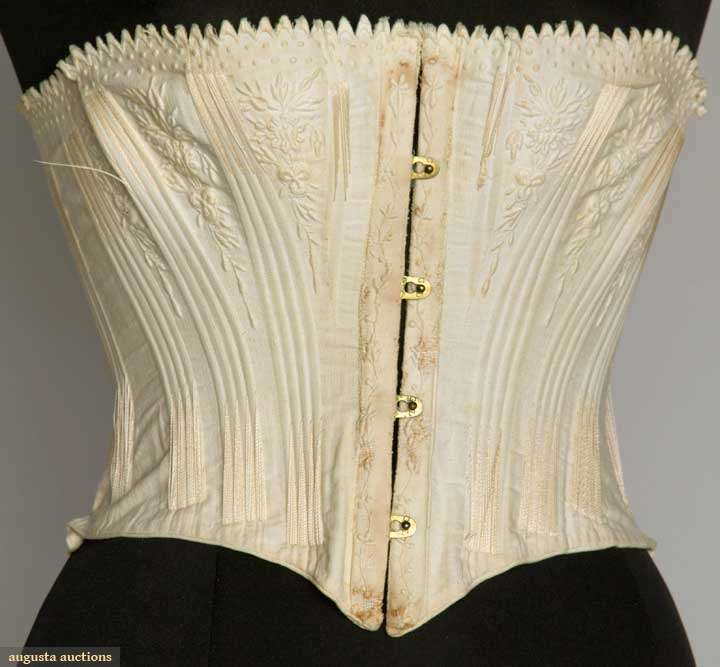
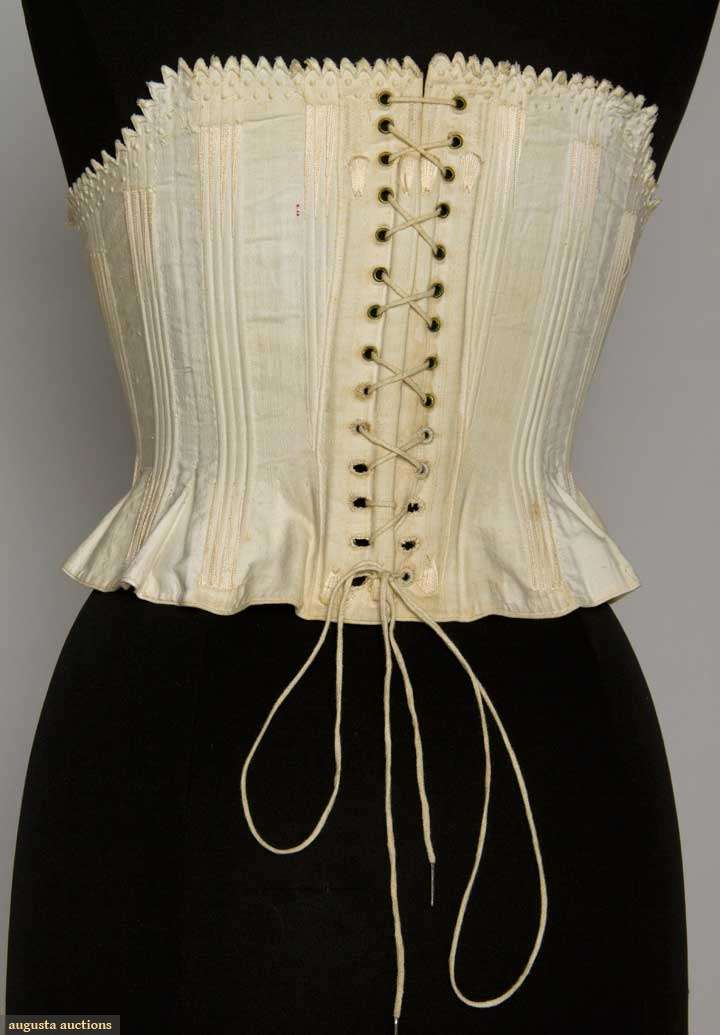
Here's a corded corset from 1855-1865. It would have had cotton cords quilted in for the stays, or possibly rolled paper.

Photos from Augusta Auctions 

Notice the lacing pulling the sides together. This was not the way a corset would be worn. At least 2-4 inches gap should remain between the edges. The waist size of a corset is the measure that is of the garment without the gap. This one measures 25 inches, the person would have an actual waist measurement of at least 27-30 inches.


The corset ends just below the waist and would have allowed for ease of movement as a woman went about her daily duties. This is the sort of garment Gema, a hotel maid, might have been wearing, although hers would not have had the lovely trapunto quilted floral sprays between the ribs.


So my problem was solved. Gema could get out of her corset, by herself, and flop it over the back of the chair like I wanted her to. 

Friday, March 24, 2017

Book Review--Unmentionable: The Victorian Lady’s Guide to Sex, Marriage, and Manners


Doing research is part of the job for a historical author. To create a rich story world of a time when no one currently alive experienced firsthand, we have to dig into books or we go cruising on the Internet.  The reference section of the local library might be intimidating, so we rely on the guidance of the reference clerks who are fonts of information.

Or you snap up the recommendation of a friend who was bopping around Amazon and found a gem. This book is one of those treasure troves of facts and figures. And the contents within were more than I expected from the title. Details about sanitation, hygiene, women’s health, beauty products, bathing, courtship, etc. are shared in an easy-to-read and humorous style that feels like you are sharing a pot of tea with the author on a rainy afternoon.


I always do lots of research for each new setting or time frame when I’m plotting a new story. By reading this title, I learned of products that I hadn’t encountered through other sources. My only complaint is the lack of specific dates on invention or availability of certain items. But once I’m armed with a product name or a manufacturer, I can head off on that new research trail.

I highly recommend Unmentionable: The Victorian Lady’s Guide to Sex, Marriage and Manners by Therese O’Neill mainly because I loved receiving my research details in such an enjoyable read.


Linda’s latest release is Baling Wire Promises, a Montana Sky Kindle Worlds novella.