Showing posts with label Western history. Show all posts

Wednesday, August 21, 2019

ST ELMO - HISTORY OF A GHOST TOWN

Post by Doris McCraw
writing as Angela Raines

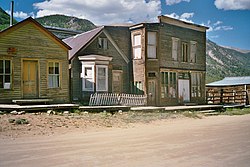
Co goosttown st elmo1.jpg
Image from Wikipedia
For many in Colorado, when you think ghost town it's St. Elmo that comes to mind. It's easy to reach, is nestled in the mountains and most of the buildings are still in pretty good shape. But what of the history of this town in Chaffee County that sits in the Sawatch Range at an elevation of almost 10,000 feet?

Although there were people in the area in 1878, the town officially started in 1880. By the end, they say, according to Colorado.com "... the population rode the last train out of town and never came back." For a brief story, the following link will give you more detail. St. Elmo

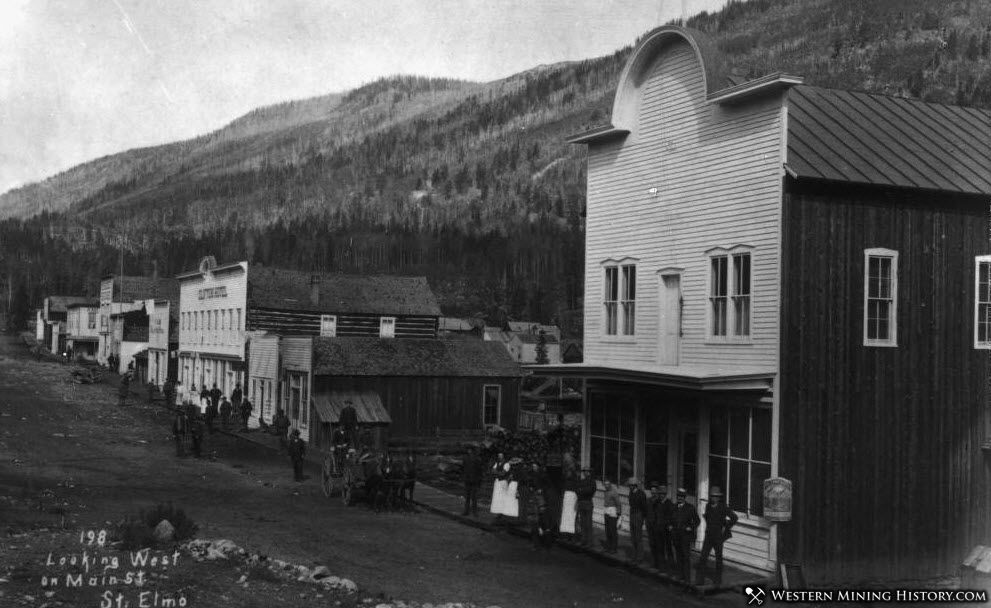
In her book 'Colorado Ghost Towns and Mining Camps", Sandra Dallas has this to say about St. Elmo, "when the Alpine tunnel was under construction, St. Elmo, as the largest town in the area was the scene of raunchy Saturday night sprees. The town was always crowded, and accommodations were scarce. An 1880 traveler recalled he and his companions "put up with the best hotel the place could afford, which was, in fact, the only one, at three dollars per day ... When we ask about a bed and a room by ourselves, the landlord told us the best he could do was to give us a bed and draw a chalk mark around us for a room."
Accommodations were more abundant later in the year when the Denver Tribune reported three hotels, five restaurants, two sawmills, and several stores."

Image result for royalty free historic images of st elmo's colorado
Image from Western Mining History.com
It became big news when a hack line was started between Virginia City (Tin Cup) and St. Elmo.

Block image

Of course, you can't have a town without some controversy and in 1887 they had it when St. Elmo arranged to have the Republican Convention (county) held there.

Block image

Lest you forget, at almost 10,000 the winters could be a challenge as the following article shows.

Block image

I encourage you to learn more about this 'well-preserved' ghost town and its history. In my novel, "The Outlaw's Letter", my hero Grant travels through the area on his way to Virginia City in search of the man who can clear his name. Below is a brief excerpt:

 Even for the noon hour, the town appeared rather boisterous. Grant could hear the roar from where he stood about a half a mile away on the mountainside. "You'd think such a new town would be a bit quieter," he said as he prepared to mount up.
"You might at that mister," came a voice off to Grant's right. "Most folks come in from one of the trails."
Grant stiffened. He cursed himself for not being more vigilant instead of thinking about his wife. But then his wife wasn't like any other woman he'd ever met. "There's a trail from the East?" Grant asked to cover himself. That he was aware of such a trail was true, but he'd hope to get into Virginia City, then out with little notice.
"Mister, there's trails from the east, west, and south. Gettin' so a person can't move through these here mountains without running into some fools looking to get rich quick. You one o' them?"

"No," Grant assured the voice. "Heard of Virginia City and wondered if it was anything like the ones in Nevada and Montana? Plus, it would be the kind of town a man I grew up around would gravitate to."
Purchase from Amazon
Until next time, enjoy the rest of the summer.

Doris Gardner-McCraw -
Author, Speaker, Historian-specializing in
Colorado and Women's History
For a list of Angela Raines Books: Here 
Angela Raines FaceBook: Click Here
Angela's Mountain Angels on FaceBook - would love to have you join us.
  

Thursday, January 18, 2018

The First Female Lawyer in America--Bent the Rules to Take the Bar

By Heather Frey Blanton
Copyright 2013 Heather Blanton
Arabella Mansfield. You’ve probably never heard of her unless you’re from Iowa, but Arabella was the first woman in America to become a lawyer. She passed the Iowa bar in 1869, illegally. Still, Arabella’s milestone proves that behind many a good woman there often stands a supportive man.
A lawyer...AND she could get herself into this outfit.
I am impressed by Arabella's tenacity. 
Arabella was actually born Belle Aurelia Babb in in 1846 in Burlington, IA. Only three years later her father left to hunt gold in the west, leaving Mrs. Babb to raise Arabella and her brother Washington on her own. Her father was kind enough, however, to send home some money, enabling both children to attend college. Perhaps since her mother was such a stalwart example of what a woman could do, Arabella never saw a barrier she couldn’t conquer. John Mansfield, her high school sweetheart, was smart enough to realize that and, instead of trying to hold her back, encouraged her to reach for the stars.
After graduating from Iowa Wesleyan College, Arabella taught at Simpson College but returned home only a year later. She married John and studied law in her brother’s office. Two years later, despite the fact that only white men over the age of 21 were allowed to take the bar, Arabella took the exam and passed it with a high score.
This didn’t sit well with some attorneys in the state and so they did what attorneys do: they challenged Arabella’s status. Fairly quickly, the court ruled women and minorities should not be denied the right to practice law in the state, the first ruling of its kind in the USA. Arabella never used the license she fought so hard to acquire—as she preferred teaching—but she involved herself in the fight for women’s rights till she died in 1911. Not a rabid feminist, she did support the suffragette movement. Arabella resented having her intelligence insulted. Clearly, if women were smart enough to become lawyers, she thought it only reasonable they should have the right to vote.
Thank you, Arabella.

Thursday, November 16, 2017

Bloomers--Her Contribution to American Fashion

Suffrage and Temperance? No, no, no. Let’s talk Bloomers!
This was supposed to be better than a dress?
In American history, you have women who spied for this country, loaded cannons during heated battles, fought wild Indians, ventured alone to rowdy frontier towns.
And then there is Amelia Bloomer.
A native of New York, Amelia was the first woman to own, edit, and operate a newspaper in the United States. The Lily was started in 1849 for the reading pleasure of the Seneca Falls Ladies Temperance Society. By 1850, the circulation of 4000 had started to decline and Amelia took over the editorial helm. She had found her groove. She loved espousing her views on suffrage, temperance, morality, and fashion.
Married to an attorney who was apparently patient and supportive, Amelia freely championed the cause of suffrage all over the country. She spoke, attended rallies, organized committees, and hung with the likes of Susan B. Anthony and Elizabeth Cady. If not for her, her newspaper and her enthusiasm, who knows how long it would have been before we women would have attained the right to vote?
But is that why you know the name Bloomer?
Probably not.
In 1851, a few notable women started wearing loose, baggy pants that gathered at the ankles. The style was based on pants women wore in the Middle East. Amelia fell in love with the roomy, flowing pants. She adored that they allowed her to move so freely, climb steps without tripping, and kept her hands free. Never mind that the things are about as attractive as a clown suit.
But Amelia adored the goofy breeches and pushed them every chance she got. They were frequently mentioned in The Lily, to the point the I-Dream-of-Jeannie breeches finally earned the nickname Bloomers.
Ah, the lasting contribution of a Lady in Defiance.
Copyright 2017 Heather Blanton
Follow me on https://www.facebook.com/heatherfreyblanton and check out my own blog at https://ladiesindefiance.com


Monday, October 3, 2016

The Life of ONE Madam in The Arizona Territory

“Belgian Jennie” Bauters ran a brothel in the young mining town of Jerome. Though she was a successful immigrant entrepreneur, her life as an Old West madam was far from pretty.


 Our ideas of the West are colored by myth. The fast draw. The brave cowboy. The kind and generous madam.

“Belgian Jennie” Bauters was a madam in Jerome. She arrived on the scene when the mining town was young, all tents and shacks and saloons scattered on the hillside. She had a knack for business, buying property, running a brothel, and rebuilding after a series of three fires that struck the mining community between Christmas Eve 1897 and May 1899 and it is said that tents made do for shelters until a new brothel could open. Bauters finally rebuilt with brick facing Hull Road since brothels were not allowed on Main. Jennie's place had 20 rooms. Bauters became known as one of the wealthiest woman in the Arizona Territory with property from Main to Hull Avenue and with a bar and hourly accommodations later in Gold Road.


Little is known about her past. She was born in Belgium. She had a son. She enrolled him in a Catholic school in Chicago and visited from time to time, according to an article by Melanie Sturgeon in The Journal of Arizona History. “Like many other legendary western madams, she was supposedly a generous person, tenderhearted toward down-and-out miners and prospectors,” Sturgeon wrote. The reality is that she was probably more complex.

Prostitutes and madams were generally tolerated, not celebrated, and lived at the edge of society. One reason they were tolerated is that their businesses were taxed. It is a myth that they eventually married well and left their profession behind, Sturgeon writes. Romantic stories about "big-hearted dance hall girls ... trivialize these women's experiences."

"Belgian" Jennie Bauter was a madam of enduring notoriety and love in Jerome and later in Gold Road, another mining hotspot southwest of Kingman in the last century. Jerome would later abolish prostitution in the moderation of the mining town.


Now, 100 years later, "Jennie's Place," the Jerome hotel and one-time "cribs," where she built her fame and fortune in Jerome, has a new lease on life. A new madam is now running the house, but Mary Wills peddles kaleidoscopes, not flesh. Still, she has also kept intact the history of what has became known as the Sullivan Hotel and given it a new backbone to support its four floors into the future.

But after Jennie was killed, an agent sold the Jerome land to John Sullivan in 1907. The new owner expanded the cribs with a second floor, and built out a hotel to Main Street with a total of 60 rooms. The building remained in the Sullivan family through son Jerry and grandson Leo. But Leo had the cribs torn down in 1971 and 1972 as unsafe. "He was not one who was preservation minded," mused Mary Wills.


 The building passed through another ownership in 1986 before being purchased by Mary Wills and Sally Dryer. When Mary and Sally realized their purchase could crumble to earth, they looked at restoring the grand hotel. But the endeavor was to be a monumental undertaking that would drag on for years. It called for architects, engineering and lots of expense. Just this past week, the external structure was finally completed and awaits paint. Then the effort will move inside.

If fire sprinklers are required, there could be more delays. The story goes back to late 2007, when an oversized check was presented to the preservationists from a State Heritage Fund grant to save the historic building. The money passed through the town of Jerome. But that joyous mood didn't last, because the state began the first of its many "sweeps" of State Parks Heritage Funds (in this case) to save the state general fund from the economic collapse as the recession began to sink in. Mary says they learned their grant had been cancelled just after they had issued a contract for the purchase of a ton of steel for $98,000. Today, that steel stands four floors tall to support the building. They had earlier been holding the building in place with steel cables. Eventually, the money was restored. Then it was taken away again before it finally was restored again just over a year ago.


 "We have borrowed from friends, everyone we can think of ... even employees," Mary says. No one is saying the building is finished. There is still plenty to do. The interior of the basement floor is likely to one day provide room for a spacious shop with all those windows that gaze out across the Verde Valley to the San Francisco Peaks.

But, what happened to Jennie?  
The story goes, according to the Museum of History and Art in Kingman, in 1903, Bauters moved to a new location, about 23 miles from Kingman, called the Acme Gold Mine, now known as Gold Road. While there, she took up with a man named C.C. Leigh. It is possible they began their relationship in Jerome.

After a time, Jennie began to feel he was a threat. In September 1905, Leigh needed money to settle a bad debt. With anger and a gun in his hand, he headed to Jennie's place and demanded she hand over her cash. An argument ensued and Jennie tried to flee from the building. He chased after her, firing several shots, which wounded her as she ran into the street.

“Several people heard her express her fear of Leigh, but either did not listen or did not care. Witnesses heard her screams, watched Leigh chase her with a revolver, but did not help. After he shot her the first time and they heard her pleading with him, … no one came to her rescue. Leigh had time to walk back to the saloon, reload his gun, return to the spot where Jennie was lying and shoot her one final time.” He approached the paralyzed woman and fired a fatal shot to her head. He then pointed the gun to his chest and fired again. He lay down beside her to die.

But, instead, Leigh survived the suicide attempt and was carted off to jail. Jennie was mourned by all and laid to rest in the Pioneer Cemetery in Kingman. In 1907, justice was served and Leigh was hanged. He too, was buried in the Kingman Pioneer Cemetery.

“These accounts reveal the stark loneliness and isolation that characterized Jennie’s vocation,” Sturgeon writes. This was not a glamorous life.

But even death wasn't easy for Jennie. Beginning in 1917, the Pioneer Cemetery was moved to make way for a school building. Relatives had to pay a substantial fee (in those days) to move the remains. According to the story, when school children began to dig up bones, an urgent effort was made to remove the last of the remains and place them in a mass grave. For some, it is just not easy.


Most folks who live in Arizona have probably been to Jerome.  It is an amazing place to visit!  It's full of history, artists, restaurants, bars, and shops galore!  For those who have not been there and if you ever have a chance - Don't Miss It!!!

I'm very excited that my next book, Chase's Story, takes place in Arizona.  It's a state full of history AND I happen to live here.  I write all genres from little one's picture books, to time travel adventures for the middle grade kiddos, to romances for adults.  My favorite, at this point, is writing the historical western romance.

Find out more about my books and/or me at the following links.....


https://twitter.com/Pennystale

I have a newsletter that goes out for new releases or sales.  If you would like to be notified, please sign up @ http://eepurl.com/388Xr