
Amelia Jenks Bloomer (b. 1818-d.1894) held a strong belief that alcohol was evil. A governess job at the age of eighteen moved her to Seneca Falls, NY. After marrying law student David Bloomer in 1840, Amelia started volunteering at the local temperance society. Her social activism increased, and David encouraged her to write. She gained a column in the Seneca Falls County Courier, writing about women’s issues. Amelia attended the 1848 Seneca Falls Convention which focused on women’s rights. Although her name isn’t found among the sixty-eight female and thirty-two male signatures on the Declaration of Rights and Sentiments, she drew inspiration from the talks she heard and started a newspaper titled The Lily in 1849 with a strong temperance focus written by and for women. [The Declaration, principally written by Elizabeth Cady Stanton, was modeled on the Declaration of Independence and proclaimed the equal right of women in civil, social, political and religious matters.]
 |
| Courtesy of Wikipedia |
Originally, a committee of women from the Temperance Society wrote articles for The Lily and distribution was to be handled by committee members. By 1850, Amelia’s name was the only one on the masthead. The newspaper changed to biweekly publication, expanding topics to women’s suffrage, expanding circulation to 4,000 subscribers. The Lily continued until 1854 under Amelia’s editorship until she sold it due to a move with David to Iowa. The buyer, Mary Birdsall, with the help of Dr. Mary F. Thomas, continued publication until 1859.
However, Amelia is not most remembered for her women’s
newspaper or for leading women’s suffrage campaigns in Iowa and Nebraska or for
being president of the Iowa Women Suffrage Association from 1871 to 1873. Along
with a strong suffragist conviction came the belief that women should not be
constrained in their clothing. In The
Lily she advocated: “The costume of women should be
suited to her wants and necessities. It should conduce at once to her health,
comfort, and usefulness; and, while it should not fail also to conduce to her
personal adornment, it should make that end of secondary importance.” Some
of Amelia’s articles were picked up by The New York Tribune.
 |
| Amelia wearing bloomers, courtesy of Wikipedia |
Ironically, Amelia did not first introduce the attire of loose-fitting trousers (we would call them harem pants) under a thigh- or knee-length tunic. The costume was first adopted by temperance activist Elizabeth Smith Miller. She showed it to her cousin, Elizabeth Cady Stanton, who adopted it, and she in turn demonstrated it to Amelia, who started wearing it. Because Amelia wrote about the benefits of the less-restrictive clothing, the name “bloomers” became associated with her. Women wearing bloomers in public received almost constant verbal harassment. She’s also credited with being the person who introduced Susan B. Anthony and Elizabeth Cady Stanton. In her quiet way, she was a lifelong supporter of women’s rights.
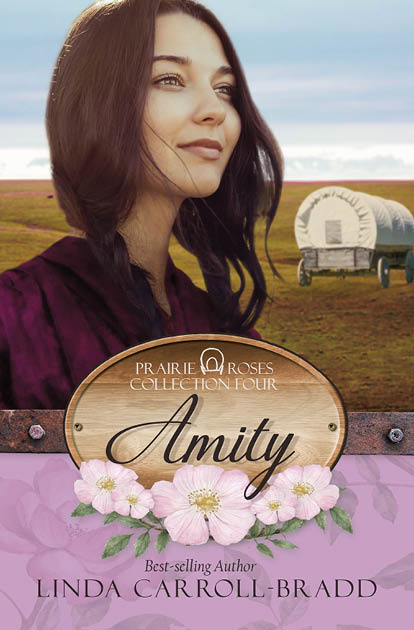
BLURB: Amity Grenville is set on reaching Oregon’s Sweet Home Valley, where her aunt and uncle have a farm. They were part of the Great Migration of 1843, and Amity saved every letter Aunt Beitris wrote, complete with advice on the journey preparations. Amity is eager for a fresh start, in the hopes that her husband, Garvey, will find a new vocation in farming and leave behind his drinking and gambling ways.
Newly finished with his apprenticeship, blacksmith Shawe Creighton can ply his trade just about anywhere so he agrees to throw in with his best friend’s family on the trek to Oregon. With no family ties, he heads west, thinking Oregon is as good as any place to establish a shop. Fun loving by nature, he’s also looking forward to what the adventure will bring.
In St Joseph doing last-minute preparations for the journey, Amity receives the bad news that Garvey was caught cheating and killed over a poker game. Now men are seeking to claim the wagon and team as their recompense. She barely removes her belongings in time but is faced with either marrying a stranger to comply with the wagon train’s rules or remain behind. Taking pity on her plight, Shawe offers marriage and is immediately faced with her two demands--no drinking or gambling. Intrigued by the outspoken woman, he figures the trip won’t be boring. Will a decision made in haste bring disaster, or will the journey forge bonds neither Amity nor Shawe can imagine?
FREE in Kindle Unlimited
Places to find Linda Carroll-Bradd online
http://blog.lindacarroll-bradd.com
https://www.twitter.com/lcarrollbradd
https://www.facebook.com/linda.carrollbradd
http://www.goodreads.com/author/show/1806413.Linda_Carroll_Bradd
https://www.bookbub.com/authors/linda-carroll-bradd
https://www.amazon.com/author/lindacarroll-bradd

