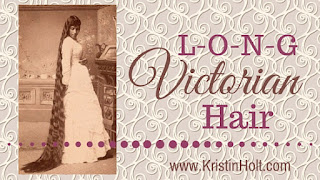
Crown of Glory
 |
| The Seven Sutherland Sisters, from Pinterest. |
Yet most Victorian-era women wore their hair up. Doing so ensures all that length is out of the way. Styles of the day insisted upon such, though cabinet cards (photographs) of the era occasionally show women with hair of lesser lengths, worn partially restrained. Notice all the curly bangs, popular in the last decades of the century. (Yes, they had curling irons.)
Women went so far as to save hairs that collected in brushes and combs (and likely those that fell while styling their tresses) and keep them in hair receivers.
Why?
Fluffy Up-do's
 |
| Victorian-era woman with thick, braided (and padded) up-do. |
Nineteenth century ladies were well-acquainted with the need for more hair.
 |
| Two-thirds of ladies use false hair! (1897) |
Not only did catalogues (such as Sears, Roebuck, & Co. and Montgomery Ward & Co.) offer tantalizing hair swatches, curls, braids, and top pieces (not to forget full wigs), but ladies encountered such market options at their favorite ribbon-and-lace stores. Ladies' magazines published detailed instructions for styling hair in new and fashionable ways, incorporating hair pieces.
Why keep all those fallen, natural hairs?
To make a rat, of course.
Thus the first source of "false" hair is a woman's own head. Or borrowing from a sister, mother, etc.
Where one cannot produce one's own, she buys.
A Product of Import
Wow. That's a lot of importers. This newspaper clipping from Juniata Sentinel and Republican of Milltown, PA (October 6, 1897) claims 2,000 importers, manufacturers, and dealers in human hair (in the United States).
Another stat (The Indiana Weekly Messenger of Indiana, PA, December 6, 1897) claims that "over 12,000,000 pounds of human hair are used annually in the civilized world for adorning the heads of women."
Where in the World?
Where did all that hair originate?
For History Nerds
Humans weren't the only sources of hair.
Let's make that living humans.
Are you curious? A bit of a nineteenth-century history nerd (like me)?
I have two lengthy but wonderful articles to share. In the interest of historical accuracy, modern search-ability, and the ease in reading, I've determined to provide a transcription (as precise to the original as possible). The original image immediately follows each transcription. Enjoy!
A HARVEST OF HUMAN HAIR
Millions of Pounds Every Year Get Tangled Up in Commerce.
Perhaps there is no staple article about which less is known by the average person than human hair as an article of commerce. It will doubtless surprise many when it is stated that the dealers in human hair goods do not depend on chance clippings here and there, but there is a regular hair harvest that can always be relied upon. It is estimated that over 12,000,000 pounds of human hair are used annually in the civilized world for adorning the heads of women. In New York city alone over four tons of this class of goods are imported yearly.
"Not a little of the hair used in this country," said a New York dealer to the writer, "comes from the heads of American women, and it is fully as fine in shade and texture as the imported article. We had a big harvest during the craze that the fair sex had not long ago for having their hair cut short. Many thousands of women who then had their locks sheared have since bitterly regretted it, as in many instances their hair has grown so slowly that they have been compelled to wear a wig or a switch since the fashion changed. After the majority of women reach the age of 30 the hair seems to partially lose its vigor, and if cut it will not grow long again.
"Two-thirds of the ladies nowadays use false hair more or less. The decree of fashion, or the desire to conceal a defect or heighten a charm, is the reason of course. One woman, for instance, has a high forehead and wishes to reduce it in appearance. Another has worn off the front hair by continued frizzing and would like to conceal the fact. Both make use of a front or top piece, with a choice of many styles.
"Ladies' wigs cost from $20 to $200; half wigs, top pieces and switches from $10 to $50, according to quality.
"The largest supply of hair comes from Switzerland, Germany and the French provinces. There is a human hair market in Merlans, in the department of the lower Pyrenees, held every Friday. Hundreds of hair traders walk up and down the one street of the village, their shears dangling from their belts, and inspect the braids which the peasant girls, standing on the steps of the houses, let down for inspection. If a bargain is struck, the hair is cut and the money paid on the spot, the price varying from 60 cents to $5 in our money.
"A woman's hair may grow to the length of 6 feet, and I know a lady who has been offered and refused $500 for her crown of glory, which is over 6 feet long. A single female hair will bear up a weight of four ounces without breaking, but the hair thus heavily weighted must be dark brown, for blond hair breaks under a strain of 2 1/2 ounces. There are some 2,000 importers, manufacturers and dealers in human hair in the United States.--Washington Star.
Source: The Indiana Weekly Messenger of Indiana, Pennsylvania on December 8, 1897.
HUMAN HAIR: Where False Hair is Obtained--Chinese Cow Hair and How it is Used.
New York Mill.
Few Persons have any idea of the amount of human and other hair imported yearly to this country. If one-half of the women knew what they were wearing in the shape of headgear, they would almost be ready to fall into hysterics. A little light on this subject may be interesting to thousands of both sexes. False hair is not as fashionable as it used to be a few years ago, when tons were imported to this country; nevertheless, at the present time an extensive business is being carried on throughout the United States. In London it is computed that fully six tons of human hair are imported every year, and that the trade increases annually. In order to meet the demands of this and other countries, there must be a regular harvest, which can be looked forward to at a particular season; and as there are different markets for black and given tea, for brown or pale brandy, so is there a market for light hair distinct from the market for dark hair.
Light hair is exclusively a German product, and is collected by agents of firms and companies who visit certain parts of Germany and Switzerland. A few years ago light hair was more valuable, and one particular golden tint was so much prized that the dealers only produced it for favorite customers, and sold it at double its weight in silver. The rich and silky texture of this much treasured article had its attractions for poets and artists as well as traders. The immortal Shakespeare delighted in golden hair. Bassanio, in describing Portia, speaks of her "sunny locks," and in the "Two Gentlemen of Verona" Julia says of Sylvia and herself, "Her hair is auburn; mine is perfect yellow." Black is hair only mentioned two or three times in all of his plays, showing that Shakespeare considered light hair to the attribute of soft and delicate women. With painters light brown hair is generally chosen for their subjects, as is clearly demonstrated by a walk through any of our art galleries. It is admitted that the color of the hair of the English people has deepened in tint within the present century, and that this change is owing to the more frequent intermarriage since the Napoleonic wars with nations nearer the sunny South. Whether light or dark, the hair purchased by the dealer is so closely scrutinized that they can discriminate between the German and the French article by the smell alone.
Black hair is mostly imported from Brittany and the south of France, where it is collected once every year by the agents of Parisian houses. In various parts of the motley crowd of a Breton fair may be met several of these hair purchasers, who travel to the country for the purpose of attending fairs and buying the tresses of the peasant girls. In fact, in many instances the girls take their hair to market as regularly as if they were selling some kind of provision. These girls are sheared of their hair just like so many sheep, one after the other. They stand round in a ring ready for the scissors, with their caps in their hands and their long hair combed out and hanging down to their waists. By the side of the operator is a basket, into which every cutting is placed separately, tied up in a wisp. The girls or women of Brittany do not lose much of their personal adornment by having their hair cut off, as they wear close caps, which entirely prevents any part of the chevelure from being seen. The portion of the crop most suitable for perukes is purchased by a particular class of people, by whom it is cleaned, curled, and prepared to a certain stage and then disposed of to wig makers for ten and twenty times more than its original cost. It is then retailed at a big profit; for choice heads of hair, like choice old pictures or choice old china, have no limit to the price they occasionally command. It is only some fifteen years since it was used to any extent in this country, but since that time it has developed itself to a large and almost incredible degree.
A great deal of the hair that is now imported is not, however, human, much of it being "Yak" hair, taken from Chinese cows and other animals. In Europe it has been in use for many years and great attention is paid to its preparation for the different markets.
A reporter for the E...(unreadable)... Mail recently had an interview with one of the largest importers of human hair, and from him learned some interesting facts concerning this peculiar business. In 1859 and 1860 between 100,000 (partially unreadable) and 200,000 pounds of hair was imported into this country, valued at something like $1,000,000. In In 1887 (?) it had increased to nearly three times this amount. Paris sends a large portion to Russia as well as to America, where a ready sale is always to be found. France and Italy give the best quality of hair. It is finer in texture, more even in color and glossy. Its chief value is in its length. After it goes on the market it is assorted, which task is attended with much difficulty. The prices range from $15 to $200 per pound. one dealer in this city was once offered as much as $400 per pound for a parcel of pure white hair, and this sun he refused, selling it subsequently for $450. The hair is shipped to this country prepared and unprepared. That which is prepared undergoes a process of washing, scouring and cleansing, all the oil, dirt and other substances being separated from it, leaving it perfectly free from all unhealthy influences. That which is shipped in a raw or unprepared state is subjected to the same process after its arrival. It is then ready to be made into switches, curls, plaits, fronts, wigs, chignons, and not a small amount is used in the manufacture of hair jewelry. The duty on the raw material is twenty cents per pound, on cleaned and drawn hair it is thirty cents, and on manufactured hair it is forty cents per pound. On other hair, not human, it is ten cents per pound. There are many instances given of hair changing color.
It is said that persons have from excessive grief found their hair changed from a dark brown to almost a perfect white; others from the same cause in the short space of one week discovered their hair streaked with gray, giving them the appearance, although young, of being old. This may be said of the famous elocutionist, the late Dr. Henry Bellow. His hair is said to have changed to a silvery gray in one night, brought about by domestic trouble. Other persons' hair changes color from extreme fright.
A curious case was mentioned of a worker in metals, who had wrought in copper only five months and whose hair which was white, turned to a green color. Chemical analysis showed that the hair contained a quantity of acetate of copper, and it is to this circumstance that the man's hair owed its beautiful green color,which was most singular and remarkable. The practice of wearing false hair is many hundred years old. The Greek and Roman ladies were, in olden times, as active at their toilet for the head as the fashionable ladies of the present day. Most of the hair at that time was obtained from the Germans, and they in turn from their slaves. Powdering the hair is not so much in vogue in this country as it is in Europe. History tells us that the consumption of hair powder by the ladies of George the Second's time was simply enormous. It was calculated that, inasmuch as the military force of England and the colonies was then about 250,000, each man used a pound of flour a week for powdering the hair. This would give 6,500 tons per annum [sic], an amount that would sustain 30,000 persons on bread. Gold and silver powder was also used. Josephus relates that Solomon's horse [sic] guards daily covered their heads with gold dust, which glittered in the sun, and there are several instances recorded in the Bible of silver powder being used. The ancient Greeks were very partial to long hair, considering it very becoming, while the Egyptians regarded it as an incumbrance [sic] and had their heads shaved. They preferred wigs to natural hair. The ancients, generally speaking, strangely considered a fine head of hair so desirable that it became almost sacred with them. They frequently dedicated it to the gods on important occasions, such as marriage, victory or escaping from any great danger, and the burial of particular friends.
Hair contains a very small quantity of water manganese. Iron and various salts of lime have been found by the various methods of amalgamation. It is owing to this that hair is peculiarly indestructible. It has been found on mummies more than twenty centuries old in perfect order and not by any means rotten.
During the past few years there has been a gradual decline of human hair of the finer texture. Now there is a glut in the market of cheap hair, and where at one time the value of human hair imported to this country would amount to $8,000,000, it does not exceed $4,000,000. A large portion of hair comes from Paris direct. It is obtained in various ways, as before stated. It is generally collected by agents, who scour the country towns and villages as peddlars [sic] and exchange their goods for an attractive head of hair. They then sell it to the larger dealers; while the small dealers also collect the hair in parcels, and they in turn sell it to the exporters. White and blonde hair is the most expensive, as it is scarce, particularly if the color of the latter is good. White hair brings from $8 to $100 an ounce, the short hair being used for ladies' and gentlemen's [sic] wigs. The long hair is used for switches and chignons, and is more valuable than gold. The average hair is from 26 to 36 inches long, and is made into curls, coquette and Saratoga waves. Yak hair undergoes a process of refinement, and is sold for human hair. Few persons can tell the difference, although it costs very little. It can be bought for forty or fifty cents per pound, manufactured.
Graveyards and hospitals are made to supply hair, which sells for a moderate price. A large quantity of hair is also collected from various prisons on the continent. Italy and Naples give large quantities of what is known as "combings." This is mixed with Chinese hair, a large portion of which is sent to this country. The Chinese hair is mostly used for switches on account of its length, and after being bleached cannot be told from ordinary women's hair. This is sold from fifty cents to $1 per pound, whereas ordinary hair would sell from $8 to $50 and $100 per pound. A great deal of this cheap hair is worn by ladies who do not care about paying high prices, but they little know where the hair comes from and under what circumstances, or whether it is graveyard or hospital hair.
The amount paid for entry at the custom house on imported hair of different kinds for 1878 was $150,581; for 1879, $223,834, and for this year, up to July last, $163,676.
It is expected that the amount paid for duty this year will be less than last year, although the quantity of hair imported may be larger, by reason of its cheapness and its being imported in a raw state.
From: The Kansas Pilot of Kansas City, Kansas on December 11, 1880.
Invitation
What do you think of the sources of false hair our Victorian great-great grandmothers likely used?
Do you augment your hair today with long ponytail switches? Do you wear a wig or hair piece?
Please scroll down and share your thoughts.
Related Articles
by Kristin Holt
Copyright Ⓒ 2020 Kristin Holt LC