Showing posts with label ghost town. Show all posts

Wednesday, August 21, 2019

ST ELMO - HISTORY OF A GHOST TOWN

Post by Doris McCraw
writing as Angela Raines

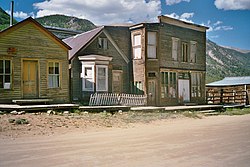
Co goosttown st elmo1.jpg
Image from Wikipedia
For many in Colorado, when you think ghost town it's St. Elmo that comes to mind. It's easy to reach, is nestled in the mountains and most of the buildings are still in pretty good shape. But what of the history of this town in Chaffee County that sits in the Sawatch Range at an elevation of almost 10,000 feet?

Although there were people in the area in 1878, the town officially started in 1880. By the end, they say, according to Colorado.com "... the population rode the last train out of town and never came back." For a brief story, the following link will give you more detail. St. Elmo

In her book 'Colorado Ghost Towns and Mining Camps", Sandra Dallas has this to say about St. Elmo, "when the Alpine tunnel was under construction, St. Elmo, as the largest town in the area was the scene of raunchy Saturday night sprees. The town was always crowded, and accommodations were scarce. An 1880 traveler recalled he and his companions "put up with the best hotel the place could afford, which was, in fact, the only one, at three dollars per day ... When we ask about a bed and a room by ourselves, the landlord told us the best he could do was to give us a bed and draw a chalk mark around us for a room."
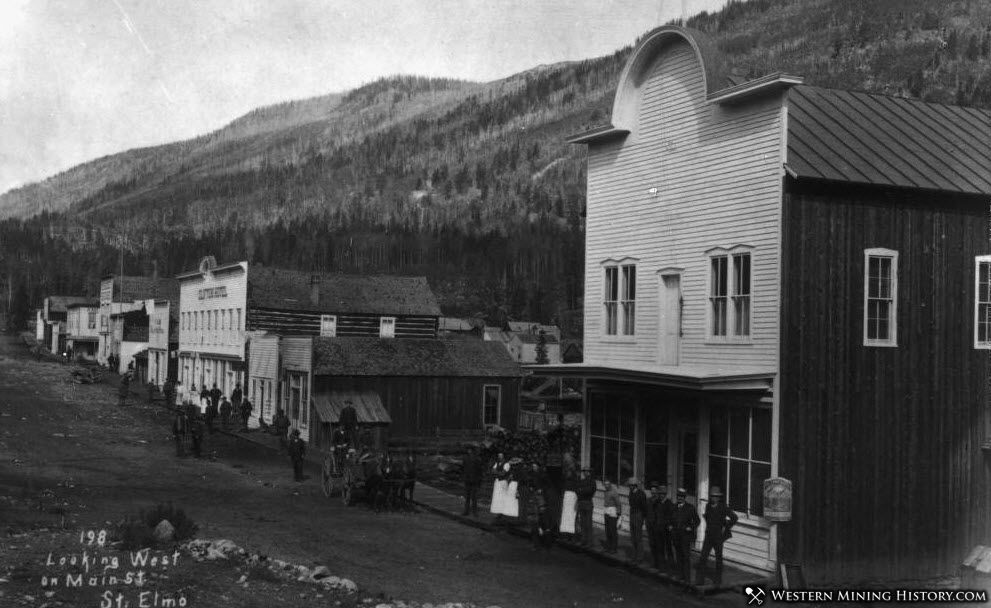
Accommodations were more abundant later in the year when the Denver Tribune reported three hotels, five restaurants, two sawmills, and several stores."

Image result for royalty free historic images of st elmo's colorado
Image from Western Mining History.com
It became big news when a hack line was started between Virginia City (Tin Cup) and St. Elmo.

Block image

Of course, you can't have a town without some controversy and in 1887 they had it when St. Elmo arranged to have the Republican Convention (county) held there.

Block image

Lest you forget, at almost 10,000 the winters could be a challenge as the following article shows.

Block image

I encourage you to learn more about this 'well-preserved' ghost town and its history. In my novel, "The Outlaw's Letter", my hero Grant travels through the area on his way to Virginia City in search of the man who can clear his name. Below is a brief excerpt:

 Even for the noon hour, the town appeared rather boisterous. Grant could hear the roar from where he stood about a half a mile away on the mountainside. "You'd think such a new town would be a bit quieter," he said as he prepared to mount up.
"You might at that mister," came a voice off to Grant's right. "Most folks come in from one of the trails."
Grant stiffened. He cursed himself for not being more vigilant instead of thinking about his wife. But then his wife wasn't like any other woman he'd ever met. "There's a trail from the East?" Grant asked to cover himself. That he was aware of such a trail was true, but he'd hope to get into Virginia City, then out with little notice.
"Mister, there's trails from the east, west, and south. Gettin' so a person can't move through these here mountains without running into some fools looking to get rich quick. You one o' them?"

"No," Grant assured the voice. "Heard of Virginia City and wondered if it was anything like the ones in Nevada and Montana? Plus, it would be the kind of town a man I grew up around would gravitate to."
Purchase from Amazon
Until next time, enjoy the rest of the summer.

Doris Gardner-McCraw -
Author, Speaker, Historian-specializing in
Colorado and Women's History
For a list of Angela Raines Books: Here 
Angela Raines FaceBook: Click Here
Angela's Mountain Angels on FaceBook - would love to have you join us.
  

Monday, March 14, 2016

The May Lundy Mine


I am excited about the upcoming release of my latest novella in the Eastern Sierra Brides 1884 series, due out the end of March. The title is Her Independent Heart. Although not about Independence Day specifically, it is mentioned on the storyline. Mostly, it is about two women who each seek their own brand of independence.

A key event in the book is based on an actual incident involving the May Lundy mine, the biggest producing mine in the Homer Mining District, that happened in Lundy, California on August 21, 1884. So, today I decided to share a little history of the May Lundy mine.

The May Lundy became part of the Homer Mining District in October 1879. William O. Lundy had been operating a sawmill in Lake Canyon near Lundy Lake in 1878. The sawmill was a major timber producer for the nearby town of Bodie, California.  

Mill Creek Canyon west of Lundy Lake & the Town of Lundy
 Reports filtered back to that town of various miners roaming the Eastern Sierras in 1879 discovering gold. One of the most important strikes was made on the south wall of Mill Creek Canyon by C.H. Nye (a relation of Nevada’s Senator Nye) and L.L. Homer. Homer didn’t stay in the area long, but his name was used to establish the Homer Mill and Mining District in October 1879. O. J. Lundy’s son William was chosen as the first recorder of the Homer Mining District in 1879. Founders Nye, Homer and Wasson quickly sold their interests to San Francisco investors who then provided the capital to start mining operations.

The May Lundy Gold Mine was formed at this time. Just as O.J. Lundy who moved to the area named the saw mill after his son William Lundy, he named the mine after his daughter May Lundy.

By the Spring on 1880, the word was out about the gold strike. The Bodie Chronicle warned miners it was too early to head up Mill Creek Canyon because of the heavy snows and lack of accommodations. People went anyway, merchants as well as miners.
May Lundy Dow as an adult

Enthused about the potential for great wealth coming from the May Lundy mine alone, in 1880, in addition to the growing town of Lundy located on the western shore of Lundy Lake, the May Lundy Company in San Francisco ordered construction of a mill on Mill Creek at Lundy. It also erected buildings at the mine site so miners could work during the winter. They built a boarding house, a lodging house, a blacksmith shop and a storehouse. Next to the mill they built a store, largely for their own convenience, but also open to the public.


Many of the miners often left during the winter since the deep snows of region did force the mines to shut down for several months. In the winter of 1883-84, the heavy snow lingered on later on than usual, forcing a later start. By June of 1884, the May Lundy mine employed over 100 men. The ore continued to be of good quality and operations were running smoothly, with regular weekly shipments of bullion being made.

What happened next led to the closure of the May Lundy mine and the rapid decline of the town of Lundy. The mine, owned by San Francisco investors, was advertised for sale in 1883. The local newspaper, the Homer Index, on November 3, 1883 announced that the May Lundy Company, Limited, formed by a number of wealthy English and Scotch gentlemen, was purchased and incorporated in London.

The sale wasn’t finalized until four years later.

In 1884, with the business in limbo waiting for the sale to be finalized, those in charge of the May Lundy Mine and Mill stopped paying their workers in early July. The company businesses charged at the local stores. On August 21, 1884, the mine and mill were attached and closed down to satisfy a claim of over $12,000 by Rosenwald, Coblentz and Company, a local merchant in Lundy. 
Other creditors in Lundy followed their lead. By the end of the day, claims totaling over $20,000 had been submitted.

Under Sheriff Wilcox closed down the mine at noon, and the mill at nine o’clock that night. He assigned men at both the mine and the mill to prevent further work until the debts were satisfied. The total indebtedness was estimated between $35,000 to $40,000, a tremendous sum of money at that time.

That is the incident you will find as part of the story in Her Independent Heart.

May Lundy mine was not worked in 1885 or 1886. It was worked by leasers in 1887 and 1888.

Other companies were formed in Lake Canyon in 1891 and 1900. Cyanide processing began about 1895 which allowed ore to be removed from old tailings. This prompted James Cain to build cyanide plants in both Bodie and Lundy. 

 
Mill Creek Canyon behind Mt. Scowden - Many mines up in those mountains
The Crystal Lake Gold Mining Company bought the May Lundy in 1900. It expanded the mill to twenty stamps and built power houses at the mine and near Lundy. In spite of there still being sufficient gold, due to production costs, what was originally the May Lundy Mine never achieved the success it enjoyed prior to its closure in August, 1884. The company shut down in 1915.

In 1921, Thomas Hanna, son-in-law of naturalist John Muir, gained ownership of the May Lundy mine by paying back taxes. He made the purchase for speculation, but was unable to sell the mine before the 1929 stock market crash. In 1934 he obtained a Reconstruction Finance Corporation loan and rebuilt the mill. He added a two-story bunkhouse and a new power plant. He successfully treated old tailings, but due to the War Powers Act in 1941 passed in response to World War II which prohibited “non-essential activities,” the May Lundy mine close in 1941. Hanna’s loan was foreclosed in 1942.

High development costs discouraged future mining. The May Lundy along with other mines fell into ruins. The old gold mine is now a historic site, much like the nearby Bodie ghost town.

Sources:

Patera, Alan H., Lundy; Western Places; Lake Grove, Oregon: 2000

“Lundy,” Mono County Historical Society 2009 Newsletter; Bridgeport, California: 2009
www.ghosttowns.com/states/ca/lundy.html

“Lundy, California,” Wikipedia

Findagrave.com for Otho Johnson Lundy, William O. Lundy and May Lundy Dow


Zina Abbott is the pen name used by Robyn Echols for her historical novels. Her novel, Family Secrets, was published by Fire Star Press in October 2014 and her novelette, A Christmas Promise, was published by Prairie Rose Publications in November 2014. The first two novellas in the Eastern Sierra Brides 1884 series, Big Meadows Valentine and A Resurrected Heart, are now available. Her Independent Heart is scheduled for release the end of March 2016.


Zina Abbott Author Links:

Website  |  Blog  |  Facebook  |  Pinterest  |  Goodreads  |  Twitter

Please CLICK HERE to tweet this blog post:
A mine full of gold that failed. THE MAY LUNDY MINE @ZinaAbbott bit.ly/1RJ5qqV #SweetAmerSweethearts
 

Friday, September 25, 2015

An Arizona Private Ghost Town called Castle Dome


and how we stumbled upon this hidden gem.
 

Only a four hour drive away from where we live in the southern California mountains is Yuma, Arizona so off my husband and I headed for a much-needed weekend away. I’m the type who travels with paper maps and the AAA travel guide with all the rated attractions marked with sticky labels. My husband has all he needs in his smart phone and a couple of review sites. Because we didn’t leave until after 6PM, he begrudgingly agreed to calling ahead for a motel reservation. I use the term ‘begrudgingly’ because his birth family set out on the road for the entire summer, Suburban hauling a trailer, as soon as school let out, so he’s used to driving until tired and then looking for a place to stay. Me, I like national chains for motels and restaurants.

Our first day was spent at a couple of state museums—the quartermaster depot and the territorial prison. We learned some interesting facts that may come in handy in a book someday. But he wanted someplace different so he started cruising around on his phone. So the next day we took a different route, past the Arizona proving grounds toward Castle Dome, a mining ghost town. Once off the state highway at mile marker 55 for only a couple of miles, the paved road ended and we rolled onto a gravel road. My reaction was concern about our Prius navigating the road unharmed. My adventure-loving spouse told me to go for it. Eight miles later (paralleling a barbed wire fence warning “Danger--unexploded ordnance”--gulp), we reached the ghost town.

A couple ready to retire, Allen and Stephanie Armstrong, bought the site where gold mining occurred in the 1860s and set about creating this village of 40+ buildings out in the middle of nowhere. By nowhere, I mean the ride by stagecoach from Yuma must have taken an entire day, or maybe they camped out for one night. The terrain is desert complete with saguaro and prickly pear cactus and mesquite bushes. And lots of dust and rocks. From a note in one of the buildings—“the first description of Castle Dome City was of a brush house, an adobe under construction, 2 tents, and 2 fenced in lots. Over the years, Castle Dome boasted of a school, 5 bars within a mile, [city stretched along a river] two mercantiles, a church or 2, sheriff’s office and jail, assay and mining offices, entertainment spots, blacksmith shop and numerous dwellings.”

The Armstrongs fixed up what was there, brought buildings from other mining ghost towns or from federal property to this location and recreated what Castle Dome might have looked like in its heyday when its population exceeded 5,000 and was greater than Yuma. But as with a litany of long-forgotten mining towns, when the shiny gold played out, the inhabitants drifted away to their next money-making opportunity.  The Armstrongs are to be commended because each and every building held artifacts of the era. A self-guided tour gave us (and the dozen other visitors we saw) a sense of the people who chose to live there. As I walked among the buildings, I could picture the interactions between the business owners and started imagining the backstories of those long-ago inhabitants.

Here is the exterior of one of the bars and a couple interior shots of the mercantile. Can you imagine a time when what was on the shelves made up the total of your selections?


I guess if you’re a history lover, then what better way to demonstrate that than by creating a living museum? I'm always interested in learning of other living museum sites. Please share where you've been.

Linda Carroll-Bradd’s latest release is A Cowboy Celebration, a western historical anthology from Prairie Rose Publications. Check out her website for other titles www.lindacarroll-bradd.com or sign up for her newsletter to learn of upcoming releases (2 in October).