Tuesday, October 12, 2021

Yellow Fever Pandemics - The Plague of the 19th Century by Kimberly Grist

 Yellow Fever Pandemics- The Plague of Memphis in the 19th Century


Diseases and epidemics of the 19th Century included smallpox, typhus, scarlet fever, cholera, and yellow fever. Yellow fever accounted for the largest number of 19th-century epidemic outbreaks. Yellow fever earned many nicknames, including Yellow Jack, the Yellow Plume of Death, Yellow Terror, and Bronze John, based on its symptoms. 


Nashville Tennessean Magazine, Jan. 22, 1956, Newspapers on Microfilm Collection.


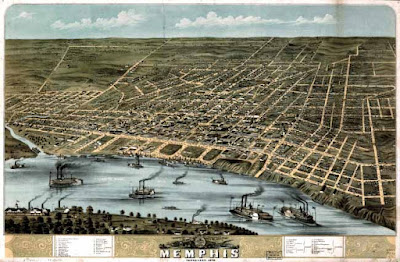
During the 1800s, the city of Memphis was a swampy area and held the reputation as one of the filthiest and most foul-smelling cities on earth. Open sewers, thousands of privies that emptied into the Mississippi River, decaying wooden walkways, and no organized service to dispose of garbage for thousands of residents combined, creating a terrible aroma and the perfect breeding ground for Yellow Fever. 


In 1828, 1855, 1867, and 1873, Yellow Fever was brought north from New Orleans to Memphis, by steamers. In July of 1878, it hit again, after a man who escaped a quarantined steamboat visited a restaurant on the shore of the Mississippi. On August 13th, restaurant owner, Kate Bionda became the first Memphis resident to die of yellow fever and the infection spread rapidly. 
Most of the residents who were able to leave left within a week and approximately twenty-five thousand people fled to other cities and spreading the diseases as far away as Indiana, Illinois, Ohio, and Kentucky.


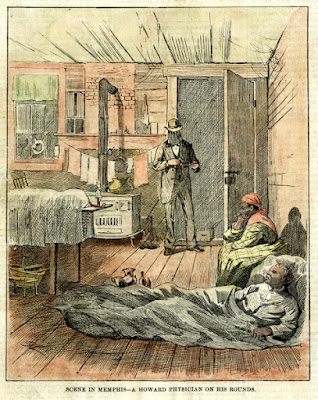
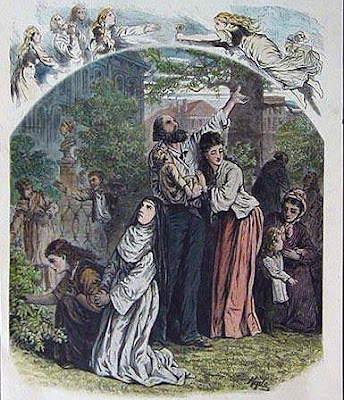
In the heat of the summer, those who were left to take care of the sick believed that the disease was spread by bad air. Even though the temperatures were close to one hundred, residents boarded the windows and kept fires burning. When people died, their clothing and beds were dragged into the streets and burned. An average of two hundred people died every day through September and almost half of the city's doctors perished. 


Dr. John Erskin was one of 110 doctors who tended the sick and dying in 1878 and was one of the thirty-three physicians who died from the disease. 


The epidemic ended with the first frost in October leaving twenty-thousand people in the Southeast dead. In the aftermath, open sewers and privies were cleaned up, which destroyed the breeding grounds for mosquitos thus preventing further epidemics. 


After researching the pandemic of 1878, I was surprised that I had very little recollection from my history lessons about this 19th Century pandemic. My imagination turned to the plight of orphans during this time period, and I was inspired to begin writing about the lives of women and specifically children affected, and left to raised by family members and in orphanages.  

Best Friends Bound by Tragedy

Selah Anderson and Alice Connelly were orphaned as a result of the Yellow Fever Epidemic in 1878 and raised in an orphanage outside Memphis. As adults the prospects for employment of young women are bleak, and between the yellow plague epidemic and gold fever, young men are scarce, even in the surrounding counties. With no other options available, they agree to participate in a new matrimonial venture begun by the matron of the orphanage and local pastors.


Shoo-Fly Pie by Selah - Can this mail-order bride handle the diversity that comes with her husband's dangerous vocation? Together will they blend their 
opposing desires to create a recipe for love?


Apple PanDowdy by Alice - Can an itinerant mail-order bride find her recipe for her happily ever after? 

About Kimberly Grist:

Kim has enjoyed writing since she was a young girl. However, she began writing her first novel in 2017, "
Despite my best efforts, sometimes life just stinks. Bad things happen. I need and want an outlet, an opportunity to relax and escape to a place where obstacles are met and overcome." 
Fans of historical romance set in the late 19th -century will enjoy stories combining, History, Humor, and Romance, emphasizing Faith, Friends, and Good, Clean Fun. 

Connect with Kimberly:

Bookbub: https://www.bookbub.com/profile/kimberly-grist
Facebook:  https://www.facebook.com/FaithFunandFriends/
Twitter: https://twitter.com/GristKimberly
Amazon Author Page: https://www.amazon.com/Kimberly-Grist/e/B07H2NTJ71


Thursday, October 7, 2021

Home Town History!


We don’t often think of writing about where we live. We love to write about history and the old west, but for this month’s blog, it occurred to me that I should write about my hometown of Estacada, Oregon. Not that I haven’t written a little about the area before. I’ve shared Philip Foster’s farm with you as it’s a wonderful historical site. But the old Estacada Park, located south of what was once the Estacada Hotel, was built to attract throngs of streetcar-riding city dwellers to what was considered an amusement resort in the mountain foothills.


The Estacada and Cazadero train would leave from the east approach of the Morrison Bridge in Portland every two hours daily. The distance was 36 miles, and the entire ride gave folks an interesting and excellent idea of the Willamette Valley in the vicinity of Portland. People were whirled through a fine suburb and farm country with grain fields, orchards, stock pastures, berry farms, chicken ranches and stretches of forests. The paper described the line running to “new country” where the land is being cleared for new homes.


Estacada is a spanish word and it means staked out or marked with stakes. It was first suggested by George Kelly as a name for the town site at a meeting of the Oregon Water Power Townsite Company directors on December 27, 1903. Kelly had selected the name at random from a U.S. Map which showed Llano Estacado, in Texas. If Kelly’s suggestion had not been drawn from the hat, the town could have been named Rochester, Lowell or Lynn. The name Estacada is also used in Arizona. Having done a report on the history of Estacada back in high school, we found that some folks said the town was named for Esther Cada, the daughter of one of the more prominent citizens back in the day. Some of the older folks in town still say that’s how it got its name!

The Oregon Water Power Railway Co. began streetcar service from Sellwood to Estacada in 1905. In 1907, the name  changed to the Portland Railway Light and Power Co. Passenger service and continued until 1932.

Other than the park and hotel that had its own restaurant, there was also a Confectionary and the Ice Cream Store along with a grocery, the First State Bank and various other businesses. Some of the buildings are still there today including many original houses and churches. When doing my history report, one of the things that stood out was the number of saloons in the tiny hamlet. Fourteen! And that was back in the early 1900s. Today the population of Estacada is about 3600. That was a lot of watering holes for one tiny little town. But as it was considered a tourist spot, I can see the amount.

 Maybe one day I’ll use Estacada as a setting for a book. Quite a few movies and television shows have been shot around here including Kevin Costner’s The Postman, The Librarians, (I remember when Jonathan Frakes of Star Trek the Next Generation was in town directing and gave a special talk at the library. That was in 2015 as I recall), Without a Paddle, Extraordinary Measures, Behind the Mask, and currently, an Amazon production.  There are parking lots full of trailers, movie equipment and catering trucks. Just another day in town ...

Until next time,

Kit

Tuesday, October 5, 2021

BOSS OF THE PLAINS by Marisa Masterson

 Hats! I struggle with them. 

Withe every novel I write, I research men's hats to try to find just the right look for my hero. After all, the hat needs to fit with whatever time period I'm recreating. I wish it were as easy as plopping a Stetson on the hero's head. Here's where the problem comes in.

This famous photo of Butch Cassidy's Wild Bunch
shows the popular bowler hats.

What you might call the cowboy hat wasn't created until 1865. John Stetson designed the hat for himself while on an expedition in the West. Men at the time typically wore bowler hats. The brim of this was much more narrow than the hat Stetson created. Maybe the sombreros he repeatedly saw inspired the wide brim of his creation.

Stetson created a hat with a high, flat crown. Dents in each side allowed the wearer to remove it by the crown and not the brim. Consider that flat crown. It's not like the cowboy hats we know today. His hat was similar to what an Amish man wears.

Speaking of bowlers and sombreros, those were what cowboys actually wore. While Stetson started manufacturing his hat in the early 1870s, they weren't immediately popular. In fact, the Boss of the Plains (as it was nicknamed) didn't catch on until the late nineteenth century. 

So, do I plop a cowboy hat onto my hero living in 1871. Probably not. Unless of course, he wants to start a whole new fashion trend. 

But, what would the boys in the bunkhouse say?


I've explained the Boss of the Plains. Now, I invite you to consider another "Boss" that's on sale. For the first time, my Proxy Bride novel A Bride for Boss is only $.99!


This miracle child is not Frankie's, so why does she risk her marriage to keep the little girl? Frankie's worry is only about her proxy groom. She has no idea of the danger that follows the child.

What should be a business arrangement quickly becomes a matter of the heart. The three would be a happy family, if only the kidnappers stopped coming at night. 

Who's sending them and how can they keep their adopted child safe?

ON SALE IN OCTOBER. ONLY $.99!


ALSO ENJOY THE SEQUEL TO THIS NOVEL, A BRIDE FOR DUN.


Friday, October 1, 2021

Marvelous Changes Wrought in the Nineteenth Century by Kristin Holt


Kristin Holt | Marvelous Changes Wrought in the Nineteenth Century
 

by Kristin Holt, USA Today Bestselling Author
of Sweet Romance set in the Victorian American West


The Good Old Days


Ah, the good old days! Before common items had even been imagined.

If you watch the news at the close of the year (or decade or century) you'll find reviews highlighting developments or significant events. I suppose its no surprise that folks have been looking back in like manner for ages!

In 1895, an unidentified author published a conversational list of advancements achieved over the past 100 years. The following is a careful transcription of a newspaper article highlighting marvelous changes wrought in the nineteenth century. Original source: Omaha Daily Bee of Omaha, Nebraska, dated July 14, 1895.


Nineteenth Century Advancements, Viewed from 1895


DAYS OF OUR GRANDFATHERS

----

"Say Not that the Former Times Were Far Better Than These."

---

HERE IS EVIDENCE TO THE CONTRARY

---

How the Daddies Managed to Live Without the Conveniences of Our Day--The Marvelous Changes Wrought in a Single Century.

---

It is common with some men, especially those advanced in life, to complain of the present and to contrast it with "the good old times," to the advantage of the latter. The habit of decrying the age in which we live is old; even in the days of Cicero there were croakers who lamented the departure of ancient times and customs, and it may be, so common is this habit to people advanced in years, that even Adam in his old age grumbled to Eve about how the times were changing, and that the world was different from what it was when he and the mother of mankind were young. But nothing is more certain than that the world is wiser, better, happier today than ever before. So rapid has been its progress in all directions that in comparison, the people of even a century ago were savages. It is difficult for us, says the St. Louis Globe-Democrat, accustomed as we are to the conveniences and comforts of modern life, to understand how our grandfathers could have lived without them. The world has moved so fast and gone so far that many things now deemed indispensable and within the means of the poorest, were then regarded as luxuries obtainable only the very wealthy; while by far the greater portion of appliances in everyday use were then absolutely unknown. Their day had not then come. A glance into any history of discoveries and inventions shows that the world has made more progress in the last 100 years than the preceding ten centuries. (emphasis added)


Kristin Holt | Marvelous Changes Wrought in the Nineteenth Century. Heading of article published in Omaha Daily Bee of Omaha, Nebraska on July 14, 1895.

NO RAILROADS.

A hundred years ago there was not a mile of railroad track, not a locomotive, not a railroad car, not a railroad invention, not a telegraph line, not a phonograph, not a typewriter, not even an effective system of shorthand in the world. The steamboat was an experiment whose success was greatly doubted; steam engines were looked upon with grave suspicion. In England the common people regarded Watt as a necromancer; in America there were a few steam engines which had been brought from the old country, but not much was thought of their working power. A hundred years ago there was not an accordion nor an apple-parer in existence. Balloons were in their infancy, blast furnaces unknown. There was not a gas pipe, not a gas jet in the world, nor even an Argand lamp, and coal oil, procured in very small quantities, was sold in little vials as a specific for rheumatism. The poor used a "rush" light, made by dipping a dried rush into the most convenient sort of fat or grease; the middle classes used candles of tallow; the rich burned sperm or wax. Chinaware was not in common use; a few years before 1790 a factory was set up by Wedgewood, and was not at that time a success. The circular saw was in the hands of its inventor. The farmer shelled corn by hand and with the assistance of a cob. Whitney was busy with the idea of a cotton gin, which he was completing in 1793. The features of the people were preserved for future generations by means of oil paintings or crayon portraits, for daguerreotypes and photographs were unknown.

MINES AND LETTERS.

Mines were subject to constant danger from explosions, for there were no safety lamps. People left one page of letter paper blank, folded it over the rest, and sealed it with wax, for envelopes were not made. Letters were not stamped; postage was paid at the time; the letter paper was unruled [sic], for there were no ruling machines. No rubber bands were in existence to hold papers together, for India rubber had not yet been brought from the depths of the Brazilian forest; papers were sewed together in place of being fastened with convenient clamps, and were then tied with the traditional red tape. Handkerchiefs were known only to the wealthy, and seldom made use of by them, being first made popular by the Empress Josephine, who had bad teeth, and concealed the deformity by holding a handkerchief before her lips when she laughed. Linen collars and cuffs were unthought [sic] of, and starch was little used by either rich or poor. The farmers cut grain with a sickle, for the scythe and cradle had not been invented, while harvesters, reapers and mowers and twine-binders were undreamed of. There were no horse railroads in the streets, no stages save for long journeys, no ice machines, no ironclads, no rifled guns. The knitting was all done by hand, for stocking machines were not in existence, nor were lightning rods nor lifeboats. There were no road wagons; musical instruments were scarce and costly. There were a few clavichords and harpsichords, and although some of the greatest composers had finished their work, their compositions had not been heard on the instruments best adapted to them. Bach never heard his compositions played on a piano. Nails were made by hand. There was no straw paper; there were no paper bags, nor skates, nor steel pens. Coal tar was not in existence, so there were no aniline dyes nor flavoring extracts. The power press had not come into being; printing was done by hand; nor was there any stereotyping.

NO REVOLVERS OR BANKS.

There were no revolvers for the use of the criminal classes; highwaymen armed themselves with horse pistols a foot long, giving a report like a young cannon. There were no savings banks, no seed drills, no sewing machines, no machines for making shoes, no steam fire engines, no stem-winding watches, no street sweepers, for sweeping was never done save at crossings. The streets were unpaved; at the corners and on both sides of the way, stepping stones were placed about a foot apart that pedestrians might be kept out of the mire, and these steps, on a rainy day, caused frequent conflicts between citizens anxious to keep their feet out of the mud. There were no tacks, and consequently no jokes about stepping on these instruments of torture. There was no machine-made thread. Vaccination had been in use about ten years, but had not come to America, and in England Jenner sometimes found it necessary to have himself attended by a guard to prevent violence from the common people. There was no wooden pavement, no wood paper; very few rooms in America had carpets on the floors, sand being used instead. There were no factory-made chairs, no water pipes in the streets; there was no water in the houses save what was carried in by hand; nor were there any house furnaces. Cooking in winter was done in iron pots before a mighty hearth, and in the outhouses in summer. The windows would not lift, for window weights had not been invented. The sash sometimes opened outwardly like our shutters, but were not often used in this way, for the importance of ventilation was not understood.

MEDICAL COLLEGES.

A hundred years ago there were no medical colleges worthy of the name in America; a young doctor learned his trade from an old doctor, and in the course of six months' study acquired the art of mixing the big doses which were then in common use. There were no drug stores, with their long array of bottles labeled with unpronounceable names. Most of the chemicals now in use are of the present century. No patent medicines were employed. In the spring of the year people drugged themselves with huge doses of senna and manna, as well as of rhubarb, of brimstone and treacle. Ague fits were common, but there was no quinine for their alleviation; pounded Peruvian bark, at an enormous price, answered the purpose. There was no morphine, no bromide of any kind, no chloral. There was no mercy for the sick man. "Bleed him till he faints," was the favorite precept of more than one physician. In New England, at least, there was no chance to escape the church service. The preacher often preached for four hours at a time, noted his audience very carefully, and any member of the flock absent without sufficient excuse was waited upon the next day by the constable, hauled before the magistrate, admonished, and upon a second offense, was fined and put in the stocks. A wealthy clergyman was unknown; the preacher was paid in kind, and received during the  year a little of everything that his flock ate and wore. Each parishioner deposited at the door of his spiritual adviser a little corn, a few potatoes, a little wood, a little salt pork, a little hominy, some oats, a fowl or two, some fish, a piece or two of corn beef. Rich editors were as scarce as wealthy preachers; their subscribers paid their dues in wood, corn and wheat; the editors were apparently always asking for money and never getting it.

CARRYING THE MAILS.

There were no regular mails, for the mail carrier was never sent out until he had enough matter to pay the expenses of the trip. The mail between New York and Boston, in 1794, was carried in a single pair of saddle-bags, and when its quantity had increased so that two pair were necessary, the carrier rebelled and struck for higher wages. No facilities for traveling existed. A man starting from Massachusetts to Virginia made his will and bade his friends farewell, as though he never was to see them again. Two stage coaches plied between New York and Boston, were from six to nine days on the road, and passed each other on the way. In the cities of 100 years ago there were a few street lamps fed by whale or train oil, but they were seldom lighted, except on gala occasions, for everybody was in bed shortly after dark. A century ago there was no sleep for the boys in the churches of New York or Boston, for a man with a pole stood ready to prod the sleepy youth and thus keep him alive to a sense of the spiritual condition. Nor was there any escape from the collection, for a deacon passed round with a bag at the end of a pole, to which a little bell was attached to call the attention of the drowsy contributors. No organs were used in the churches, and the singing was so slow that one preacher testifies he had time to take a breath twice on one note. Our great-grandfathers had no coal, nor were they fortunate enough to possess matches. When the fire accidentally went out during a long winter's night a boy was dispatched in the morning with a shovel to the nearest neighbors to bring fire. If there were no neighbors an effort was made to kindle a blaze by a handful of whittled shavings, ignited by powder touched off with flint and steel. Stone houses were few, those of brick still fewer. In the country log houses were fashionable, and in cities most of the houses were of frame work. There was not a chromo in America, nor were there any statues; marble cutting was unknown. There were no visiting cards, no engraved invitations, no paper boxes.

THE WAY OF THE TRANSGRESSOR.

Our great-grandfathers had no mercy on prisoners. In Newgate, Conn., an old mine served as a prison. Descent was effected to it by means of a ladder, and, for further security, the prisoner was fastened to the floor by one foot, and to the ceiling by means of a chain passed round his neck. The treadmill, stocks and pillory were in every parish, and hangmen kept knives for cutting off the ears, slitting the lips and trimming the noses of offenders, and also manipulated the branding irons. Counterfeiters were marked with a "C" on the forehead; thieves were marked with "F" for the Latin "fur," or "T" for the English "thief." Swearing in public was not allowed; the oath 'by God,' used in Massachusetts, was punishable by the stocks, ten lashes and a lecture from the preacher. Gradations in profanity were made. "By Christ" was punishable by the stocks and fine, without the lashes; "G-d d--n" by a fine of 10 shillings, and plain, simple "damn" was worth 5 shillings. There was no surgery. The hod carrier today, who falls off a ladder and is carried to a charity hospital, receives better medical and surgical attention than all the money of George III could have purchased, or than all the wheat raised on George Washington's farm could have secured. There were no amusements; the most worldly-minded sinners indulged only in dancing and cards. There were no theaters save in two or three cities, where the play began at 6 o'clock, and the managers stated that they would be obliged for any old plays their patrons did not care to use. In New England, 100 years ago, a bitter controversy was going on as to whether "theater going" should be allowed. Somebody hired a barn in Boston, put up a sing, "Exhibition Room," over the door and sent a bell man up and down the streets to announce that "moral lectures would be given by several performers at one time," but while the "School for Scandal," a moral lecture in several fittes [sic]," was being delivered by a company of lecturers, the players were arrested and the play stopped.

MANUFACTURERS.

There were no manufactures in New England, and New York was of no importance as a port of entry. All the rice, pitch, tar, wheat and corn exported were sent out from southern ports and the New England states were regarded as too poor to feed their own people. There was not a cotton factory in the world, for the fiber could not be separated from the seed save by hand. Linen factories had not yet come into existence; every housewife raised her own flax and made her own linen. Ready-made clothing stores were unknown; every housekeeper made all the clothing used by her entire family, herself spun the thread, wove the linsey woolsey cloth, borrowed a pattern, adjusted it to her own notions and made every article of clothing worn by herself, husband, sons and daughters. There was no unity of language in this country. Dutch was spoken in New York as much as English; German might be heard in many of the Pennsylvania settlements and Scandinavian was common along the Delaware. Gaelic was spoken along the North Carolina mountains, French in South Carolina, Spanish in Florida and English in Georgia, the Central and New England states. No macadamized roads connected the colonies and no galloping horses were allowed in the city streets under penalty of a fine of 3 shillings and 6 pence. The women did no shopping and the the store keeper sent out no flaming advertisements. Normal schools were yet in the future; Sunday schools with their millions of scholars were unknown. The teacher of the district school boarded around among his neighbors and patrons and impressed ideas on the youthful minds by means of a stick. Educational appliances were of the simplest possible description, consisting of a spelling book and a manuscript arithmetic owned by the teacher. There were no slates, no paper pads, no lead pencils; a copy book was made from half a quire of paper. The copy was sent by the preceptor and the writing done with the pupil's own pen manufactured from the quill of a home-grown goose. There were no base ball games and no boating. Gymnasiums were unknown  and sawing wood was considered appropriate exercise for young men. There were no dude college graduates; the Yale student had no privileges and no dainty dishes were set on his table. In the college boarding house his rations consisted, for breakfast of a pint of coffee, a biscuit and some butter. Mondays and Thursdays were "boiling days," the others were "roasting days." On "roasting days" he had for dinner two potatoes and bread in addition to his roast. On "boiling days" there was cabbage, potatoes and pudding, usually plum duff, boiled dough with a few raisins scattered through it. For supper he had a slice of bread and a bowl of milk. If he wanted more he had to buy it for himself.

FLOWERS AND VEGETABLES.

Our great grandmothers had few flowers, save such as grew wild. They knew nothing of the hydrangea, which did not come from China until 1840; nor were they familiar with the maurandia vine, the salvia or the tiger flower, which came together from Mexico about 1822. They did not have the thumbergia, which was not brought from the East Indies until 1823; nor the "Wandering Jew," which reached North America from South America at the same date; nor the bleeding heart, which came from Siberia in 1810; nor the coleus, which emigrated from Java in 1861; nor the lemon verbena, which came from Chili [sic] in 1794. The calla lily was not known in America, and was rare in England, though it had come from the Cape of Good Hope in 1731; thes [sic] milax [sic] [Smilax?] was scarcely more familiar, though it had come from the same party of Africa in 1732, and the heliotrope, little better known, though it emigrated in 1757 from Peru. The strawberry geranium was just beginning to attract attention, having come from China in 1771, and the mignonette was unfamiliar though brought from Italy in 1752. The cyclamen had come from Cyprus in 1731, but was not widely diffused, while the dew plant had not yet come from the Cape of Good Hope, nor the dahlia from Mexico, and the petunia had just arrived from South America. The vegetable gardens were hardly better cared from than the flower plats. The tables of our great-grandfathers of 1794 were well supplied with fresh food and groaned under the weight of salt pork, salt beef, dried or jerked beef and venison, bear meat, buffalo, moose and elk beef and salt fish. Their meats  were mostly salt or dried, for no ice was put up and there were no butcher shops. "Killing a beef" was an event; all the neighborhood was invited; each family took a part. For vegetables they had cabbages, onions, leeks, potatoes, dried beans and a few peas. Indian corn was plentiful, but turnips were scarce and little eaten, for they were thought to be bad for the eyes. The egg plant and cauliflower were unknown, although the latter had come to England from Cyprus in 1603, but they had not yet reached America. Tomatoes were grown among the flowers, called "love apples," and thought to be poisonous. Radishes were known, but little used. Lettuce and cucumbers were used in England, but not in America. There was no sweet corn; the succulent snapbean was not yet developed, and asparagus was not in favor. Parsnips were occasionally grown, but not liked.

FRUITS.

For fruits they had apples dried for winter use, pears used fresh, and a few trees of peaches. The grape, the strawberry, the raspberry, the dewberry and blackberry grew wild, and were sometimes picked for use, but the fruit was small, sour and inferior, and there was no thought of cultivating these plants. The watermelon, cantaloupe and muskmelon were unknown, while oranges, bananas, pineapples and other tropical fruits would not bear the long ocean voyage, and consequently were not seen once in a decade. A hundred years ago there was not talk about political parties, for, aside from Whig, understood to mean a man in favor of American independence, and Tory, a man in favor of the continuance of British rule, political parties had no existence. Slaves were held in all the states and slave trading was considered a legitimate form of business enterprise in which the pious New Englanders engaged as earnestly and zealously as did the natives of the south. Human beings were openly bought and sold, and kidnaping [sic] Indian children for slaves was a lucrative business. The multiplicity of religious denominations was yet a thing of the future. The faiths of the colonists were few and simple. The New Englanders were Congregationalists, the Virginians were Church of England members, the Catholics were most numerous in the Carolinas and the Methodists were just making a start. The morning papers were yet in the future. Boston had the News-Letter, founded in 1704; the Boston Gazette, established in 1719; the New England Courant, 1721, and the Columbian Sentinal, 1775. Philadelphia had the American Weekly Mercurie, 1719. New York had the Gazette, 1773, and the Royal Gazette, founded in the same year, and Worcester, Mass., had The Spy, established in 1775. All were weekly, had consisted of shipping news, local matters and an occasional very cautious expression of opinion on matters of public interest. There were no telegrams, of course, and the news letters, when dealing with political matters, rarely ventured on publishing names, but darkly hinted at the persons alluded to. The advertisements consisted mostly of legal notices and rewards offered for lost animals and runaway slaves. The printing press was manipulated by hand, for steam was not applied to printing until 1814. The editor was called the printer and was liable, civilly and criminally, for everything that appeared in his paper, and was held to an accountability so strict that a few years of the business generally made him anxious to find another job. Such were the good old days--days when every man raised his own tobacco in his front  yard and smoked it in a pipe, the cob of which grew in his own field; when every woman made her own soap with lye from the ash hopper, mixed with vile smelling grease saved for a year in her "fat barrel;" kept her butter in a bucket hung in the well and her milk in the spring house; days when the young gentlemen had neither cigarettes nor canes, and the young lady neither her candy nor chewing gum, and the small boy could not make the immortal Fourth hideous with firecrackers, because he had none. Men may praise the good old times for their simplicity, but not even the veriest croaker would be willing to see them return.


Related Articles

Kristin Holt | Victorian Era: The American West

Kristin Holt | Victorian-American Boot Jacks


Kristin Holt | How to Conduct a Victorian Sleigh Ride
 

Kristin Holt | Victorian Americans and Vulgar Language
 
 
 Kristin Holt | Indoor Plumbing in Victorian America


Kristin Holt | Book Review: The Victorian Internet
 

Kristin Holt | Old West Mason Jars


Kristin Holt | Luxury Travel 1890-Style


Kristin Holt | Modern Lovers Have New Ways: Twentieth Century System is Bizarre and Usually Hurries Matters 1902
 

Kristin Holt | Telephones for Sale by Sears Roebuck


Kristin Holt | Five Things I learned From Writing THE MENACE TAKES A BRIDE
 

Kristin Holt | Victorian Lawn Mowers


Kristin Holt | Victorian America's Oleomargarie: Fake Butter


Kristin Holt | Late Victorian Dentistry: Ultra Modern


Copyright Ⓒ 2021 Kristin Holt LC

Thursday, September 30, 2021

Look what our authors published in September!


Our authors have been busy writing and publishing books. Here is what we published in September:


A Match for Althia: Marianne's Mail Order Brides book 7

By Linda Carroll-Bradd

Chicago socialite Althia Heathley feels pushed out of her life by her father’s new wife. Convinced all she needs to write a great novel are a few more life experiences, she agrees to become a mail-order bride. But once she arrives in Denver, she’s not so sure she’s cut out to live in such a wild and less-than-civilized city.

Released September 5, 2021

https://www.amazon.com/Match-Althia-Mariannes-Order-Brides-ebook/dp/B09FJQBKPJ


A Bride for Devlin: The Sheriff's Mail Order Bride Book 6

By Zina Abbott

Searching for her sister, Dolly, who left behind a letter stating she was traveling to Wyoming to marry a rancher, Carrie Watson travels to Baggs Station. She learns, except for a few items of clothing she packed in a tow sack, Dolly left her trunk behind at the station for safe-keeping and departed with a man who claimed he was sent to bring her to her intended.

Carrie asks to be directed to the sheriff, only to learn the Carbon County sheriff is seventy-eight miles away in Rawlins. However, the Little Snake River Valley ranchers, frustrated by the increase in cattle rustling, pooled their funds and hired their own local sheriff, Devlin Anders, to track down the culprits.

Devlin Anders, frustrated over his lack of success in locating the rustlers, is ready to quit and stick to running his own ranch. Then, his friend, Jesse Hardin, begs him to help search for Jesse’s missing bride. They travel to Baggs Station, the last place she was spotted.

The last thing Devlin needs is an upset, headstrong woman from the East demanding help to find her sister. However, when he learns Dolly left on the back of a horse behind a man Devlin has been trying to catch up with for months, he knows it is time to raise a posse and go after both Lem Coker, suspected cattle rustler, and Jesse’s missing bride.

If only Carrie did not insist on trailing behind them…

Released September 10, 2021

https://www.amazon.com/gp/product/B097QGBC93/


Ace’s Tenacious Bride: (Matchmaker's Mix-Up Book 13)

By Kimberly Grist

Can a spirited pastor’s daughter up the ante, causing a card-playing, cigar-smoking workaholic to wager his heart?

Mercy Fairchild, a sheltered pastor’s daughter, is ready for adventure. She’ll comply with her late father’s last wish—to obtain the help of a matchmaking service and find her a young pastor out west to marry. Yes, she wants God’s perfect plan for her future, but she hopes it will be an exciting plan. Perhaps a missionary in a new territory?

Widower Ace Caldwell’s unruly children make keeping a housekeeper impossible. The last one left in less than a week! If he could only be as good a father as he is a card player! But with his job as a railroad detective, he can’t be home more than a day or two each week. At least a wife would be legally and morally vested to remain. Wouldn’t she?

Released September 15, 2021

https://www.amazon.com/gp/product/B0952D79QX


Hearts of the Sierra Nevada: A Sweet Historical Romance Set in the Sierra Nevadas

By Kit Morgan

Three sisters in danger.
Three men willing to help ...


When the Barrett sisters inherit their aunt's small hotel in Nevada City, California, they quickly discover others in town not only want it, but will do almost anything to get it. The question is, why?

Out of work, Bram Forsyth and his cousins Sterling and Wellington travel to Nevada City looking for work. Lucky for them the new owners of the Barrett Hotel are looking to hire. But the three men didn't expect such lovely employers or the fact someone was trying to run them out of town. They were cowboys, not guns for hire. Could they resist the Barrett sisters, now in danger, from capturing their hearts? A better question was, could they afford such a distraction while trying to protect them? Find out in these sweet historical romances full of hope, love and a little danger!

Released September 17

https://www.amazon.com/gp/product/B098R8PQPR


Romance at Rinehart's Crossing: A Sweet Historical Romance Set on the Oregon Trail

by Shanna Hatfield

Life on the Oregon Trail will never be the same . . .

Tenner King is determined to make his own way in the world far from the overbearing presence of his father and the ranch where he was raised in Rinehart’s Crossing, Oregon. Reluctantly, he returns home after his father’s death to find the ranch on its way to ruin, his siblings antsy to leave, and the women in town completely infatuated with a mysterious poet. Prepared to do whatever is necessary to save the ranch, Tenner isn’t about to let a little thing like love get in his way.

♥ Austen – After spending her entire life ruled by her father, Austen Rose King certainly isn’t going to allow her bossy older brother to take on the job....

Claire – Two thousand miles of travel. Two thousand miles of listening to her parents bicker about the best place in Oregon to settle.

Kendall – Anxious to escape her mother’s meddling interference, Kendall Arrington leaves her society life behind, intent on experiencing a Wild West adventure.

Released September 17

https://www.amazon.com/gp/product/B098RFJMM3


Mr. Charming's Orphans: Charming Tales

By Kit Morgan

A woman not looking for love. 

A man not looking for a wife.

And seven mischeivous orphans ...

Wynter Snow had the arduous task of escorting seven orphans from New York to Charming, Texas. After all, it’s not easy to get seven mischievous orphans to behave. But dealing with what awaited them in Charming was worse. There was no sign of the Tuckers, the couple that sent for them, and a storm was coming. A big one. Thankfully the woman who ran the inn got them a ride to the Tucker’s farm. Once there all would be well. Or so Wynter thought. Imagine her surprise when she found a handsome rancher living on the farm instead of the Tuckers! Now what was she to do? Other than wait out a nasty snow storm with seven orphans and a handsome cowboy …

Released September 22, 2021

https://www.amazon.com/gp/product/B098N9VH19


Madeline: Cowboys and Cupids Book Book 14

By Zina Abbott

Madeline Denham realizes something doesn’t add up. More than with her siblings, her parents are very careful about who they allow to socialize with her. After graduating from normal college, she accepts a teaching position close to Knights Ferry. Much to her dismay, during a community social, a well-dressed man she's never met before asks her to dance and then forces a kiss upon her. Rather than being flattered, she feels ruined.

After purchasing land east of Oakdale, James Hennessy, like his Italian mother’s side of the family, finds growing fruit trees and a small table grape vineyard competes with his love of practicing law. At a dance, he meets a delightful woman who reminds him of his Italian heritage. When he realizes she is the object of unwanted attention, the fiery Irish from his father’s side comes to the fore. He steps forward to rescue her. He soon finds himself representing members of her family in a cause important to his own interests—stopping the hydraulic mining that is clogging the Valley’s rivers and streams that provide the water the farmers need to irrigate their crops.

Madeline hires James to uncover the secrets that plague her. However, will what they learn drive him away? Fortunately, she has two young twin brothers, who, like their oldest brother, want to become cowboys. For now, they’ll settle for corralling a good husband for their big sister, even if they have to rope and hogtie Madeline and James to get them to the altar.

Released September 23, 2021

https://www.amazon.com/gp/product/B096WNPH59/


Pumpkin Pie by Patience: Old Timey Holiday Kitchen Book 5

By Annee Jones

    1890, Baltimore.
19-year-old Patience Sutton has never been praised for her cooking – in fact, she burnt the pumpkin pie at her family’s last Christmas celebration. As the youngest of 10 children, she’s tired of always being the baby and longs to grow up. When she spies an ad in the paper from Oregon banker Jefferson Cooke seeking a mail-order bride willing to travel out west and who “must love children,” Patience jumps at the chance for a new life. With children of her own to take care of, maybe she’ll finally get some respect! Right?

Released September 27, 2021

https://www.amazon.com/gp/product/B0965W2PCJ


 Not all our authors put their books up on preorder. For those who do, advance sales go a long way to help their rankings on Amazon. Please consider buying before the book is releases.


Preorders for October Releases:


A Bride for Dun: The Sheriff's Mail Order Bride Book 9

By Marisa Masterson

If you read A Bride for Boss, you'll want to find out the rest of Dun's story--

Dun, a former Pinkerton agent settles into a sleepy Wyoming town. Danger should be far behind him now. The worst he faces is drunken cowhands on Saturday night.

He finally has what he considers a hometown. All that is missing is a bride. Easy to fix! He simply writes away for one.

There's no way he could know the wild adventure she brings with her. And will he believe what he learns about his own birth?

Releases October 1

https://www.amazon.com/gp/product/B098B7X5ZD


A Match for Lilah Jo: Marianne’s Mail Order Bride Book 9

By Marisa Masterson

Roland Devers vowed to stay a bachelor after his fiancée broke off their engagement. He never expected to raise a child, especially not a girl. His brother’s death lands the four-year-old at his livery and into his care.

Lilah Jo Henry struggles through life. Her husband’s death only adds to those struggles. Her sixteen-year-old daughter’s scandalous behavior gives Lilah the push she needs to move the two of them away.

A matchmaker’s advertisement and the promise of marriage to a stranger seem the only way to make that happen.
Will two forty-year-olds find the will start over and risk love?

Releases October 8, 2021

https://www.amazon.com/gp/product/B09C3X23N7


Cranberry Cake by Cora: Old Timey Holiday Kitchen Book 6

By P. Creeden

When Cora Sullivan's father moved out west to Kansas City in order to help his bank start a new branch in a different state, she hadn't realized just how much she would miss her old home. Now Christmas is coming, and what she misses more than anything else is her dearly departed mother's cranberry cake. But out west of the Mississippi, cranberries are almost as impossible to find as friends. At least she has is Jonas, the one man who travelled all the way to Kansas City with her and her father to remind her of home, but he still thinks of her as a child, when she really wants him to notice her as something more. And when Jonas is accused of stealing money from the bank, she needs to put her own needs aside to help Jonas and clear his name before Christmas.

Releases October 11, 2021

https://www.amazon.com/gp/product/B096RJP36T


Ginger Cake by Glynna (Old Time Holiday Kitchen book 7)

By Linda Carroll-Bradd

              Astoria, Oregon--Fall, 1876
Baker Glynna Shaughnessy wants to bolster sales for her struggling bakery almost as much as she wants to revive her drab personal life. A baking competition in commemoration of the city’s incorporation offers a chance at making the shop’s name known…until she’s accused of cheating. According to the competition’s sponsor—a roguish man who sets her heart aflutter—Glynna can only remain a contestant if she invents a brand-new recipe…something she’s never done before.

Hotel manager Ritter Anton has six months to boost patronage at his grandfather’s Anton Grand Hotel. He accomplished success with the family’s Cheyenne hotel and he’ll succeed here then move to the next. The baking contest he invented sparks controversy with the entry of a baker who others claim has an unfair advantage. Ready to reject her, he can’t say no when the auburn-haired beauty pleads her case. How will he remain neutral as a judge when all he can think about is Glynna?

Releases October 25. 2021

https://www.amazon.com/gp/product/B0964XJ1PN/

-=-=-=-=-=-=-


Preorders for November Releases:


Apple Pandowdy by Alice: Old Timey Holiday Kitchen Book 8

By Kimberly Grist

Alice Connelly agrees to participate in a new matchmaking project organized by her pastor and the orphanage's matron. She can find no peace accepting a role as a mail-order bride and instead becomes the first volunteer to accept a job in a local restaurant and relocate to Carrie Town, Texas.
She hopes the experience will help her to discover what she wants in life. But in a town where single men outnumber women thirty to one, she’s more confused than ever. Determined to put her skills as a baker to use, she plans a holiday dinner for the diner featuring a crowd pleasing deep-dished spiced apple dessert

Can an itinerant mail-order bride find her recipe for her happily ever after?

Releases November 8, 2021

https://www.amazon.com/gp/product/B09646YNT2


Wren's Wooer : (Westward Home & Hearts Book 24)

by Marisa Masterson

Wren Donaldson rejects her wooer, wanting him to only be her good friend. When Mildred Crenshaw, her mother's cousin, sends "the perfect groom" to Wren, she begins to realize her dream man already proposed. Too bad she rejected him. Her rejected wooer has moved on to another girl--or has he?
And what about the man sent by the matchmaking cousin? What desperate and dangerous measures will her mail-order groom do so he marries Wren?

Releases November 9, 2021

https://www.amazon.com/gp/product/B091ZK78JV


A Child's Faith : Keepers of the Light Book 16

by Annee Jones

1892, Tacoma, Washington

Elin Kristiansen has her hands full as a single mother following the tragic death of her husband in a shipwreck off the rocky coast of the Pacific Northwest. Thankfully, the U.S. government has recognized the need for a lighthouse at Brown’s Point, and Elin couldn’t be more pleased when her father accepts the position of Keeper. However, she just can’t seem to bring herself to accompany him on his weekly rowboat trips to the station to tend the lamp – and what’s more, the mere thought of Finn, her son, setting foot on board sets her insides churning.

Elin knows her father keeps hoping she’ll get over the terror that washes over her every time she considers braving the waters, but she's starting to have doubts. When she gets into an argument with Finn over his adamant wish to learn how to swim, she can’t possibly trust the handsome captain who offers to instruct him and vows to keep him safe – or can she?

Releases November 9

 https://www.amazon.com/gp/product/B0992Y9M7M


A Christmas Wish for Clara: Mail-Order Brides' First Christmas Book 7

by P. Creeden

Clara Gibbs has wanted nothing more than a husband and family her whole life, but not one bachelor in Norcross Georgia had ever shown any interest in her until now. She had spent most of her youth taking care of her ailing father, only to find out upon his death that he was the very reason that every suitor had kept a distance from her. Now that she was well over twenty-five years old, the only one who shows her interest is an older bachelor with a known penchant for vice but somehow promises the holidays have made him a better man. Regardless, he's not exactly the prince she's been wishing for, and her only escape is to trust a family friend who knows of a younger man out west in need of a bride.

Clyde Wheeler has just inherited a ranch... or rather, debt. And the bank has come to call. His only way to get his loan approved is to marry the banker's daughter. But part of him would rather die than give the man the satisfaction....

Releases November 10

https://www.amazon.com/gp/product/B098C49LQP/


Figgy Pudding by Francine: Old Timey Holiday Kitchen Book 9

By Zina Abbott

Francine Munsen’s life in 1878 had been a series of ups and downs—all because she allowed one of the benefactors of the Albany Elite Academy for Girls to raise a hope that she could attract a man willing to marry her, a spinster math and science teacher.

Jason Sewell, a full professor of science and astronomy at the University of Iowa, was a widower with no interest in marrying again. Then, during a trip to Rawlins, Wyoming to view a total solar eclipse, in the weeks of hunting and exploring that followed, his friend—from whom his mother extracted a promise that a letter from a girls’ academy teacher would be answered before the end of the summer—handed him the letter. As a wedding gift for his friend, he promised to respond. Months later, he invited Francine to spend her Christmas break in Iowa City.

Before Francine could travel to Iowa to meet Jason in person, she must keep a promise. Serving the girls who could not return to their homes for the Christmas holiday a figgy pudding made using a centuries-old recipe had become a school tradition.

Releases November 22, 2021

https://www.amazon.com/gp/product/B0968WFFJV/


A Christmas Tree for Trudel: Mail-Order Brides' First Christmas Book 12

By Linda Carroll-Bradd

Rancher Gibson Bainbridge travels to Pine Knot to investigate how his younger brother was swindled out of his mining claim. He finds the suspect, businessman Bernard Heinrik, at a poker table and squares off opposite him. Gib goads the man into betting big, staking the mining claim and then ends up with the winning hand and retrieves the deed. Goal achieved, he heads back to the hotel, planning how he’ll leave in the morning and arrive triumphant in Redlands at the family home in time for holiday festivities.

Mail-order bride Trudel Andersen traveled from Los Angeles to Pine Knot to meet up with her fiancé, Mister Heinrik, with whom she’s been corresponding for several months. But he’s a day overdue in meeting her. She waits in the hotel lobby with her lace-making materials and her little dog, Butterscotch. Released from the orphanage two months earlier, Trudel has been on her own and terrified she will always be so.

When Gibson realizes he’s the cause for the lovely lady’s misfortune, he’s stuck with a dilemma. If he confesses what he did, he’ll have to offer the woman a ride back to where she came from. Propriety demands they marry, and both agree it’s only for the duration of the trip. But will forced proximity deepen the relationship into something more?

Releases November 30, 2021

https://www.amazon.com/dp/B0988V1F85/


-=-=-=-=-=-=-

Preorders for December Releases:


A Christmas Dream for Destiny: Mail-Order Brides' First Christmas Book 16

by Annee Jones

1890. Destiny Price works in the sewing room of the Cleveland orphanage where she lives but longs for a better life. Even though she knows she’ll never be able to bear children and has never celebrated a real Christmas of her own, she is plagued by a recurring dream of sitting in a rocking chair next to a beautifully decorated Christmas tree, singing an infant to sleep. Desperate to escape her dreary and monotonous life, Destiny answers an ad for a mail-order bride out west. But when she meets Stuart “Stormy” Holling, a former miner turned woodworker with a peg leg, is she prepared to handle the passionate temper that earned him his nickname?


Releases December 16


https://www.amazon.com/gp/product/B098HGYN66


-=-=-=-=-=-=-