Showing posts with label romance. Show all posts

Thursday, October 28, 2021

Halloween...A Time for Romance?! - by Jo-Ann Roberts


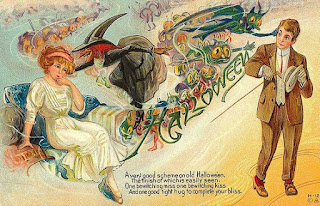
Up until I did research for a Halloween scene in an upcoming book, I never knew that the perennial holiday wasn't always so scary. In fact, it was once less about fright and more about flirtation and romance. Romance?!  How did I live all these years without knowing this?


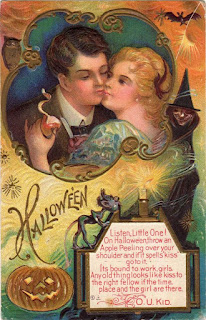
More than one hundred fifty years ago, rituals and superstitions about Halloween celebrations emphasized love. Newspaper reports from states and territories in the mid-19th and early 20th century recommended parlor games and traditions that promised to reveal romantic fortunes, with many offering a peek at what the future held.

According to Daniel Gifford, a former Smithsonian National Museum History director,

 "Halloween in the early 20th century had far less emphasis on blood, gore, and scary monsters, and much more emphasis on courtship, romance, and the opportunity for love. In fact, the image of Cupid was often interspersed among the more familiar black cats, witches, and jack-o-lanterns."

Games of Love

As in modern times, apples played an important role in many Halloween romantic traditions. One game, Snap Apple, challenged guests to use only their teeth to bite an apple suspended from the ceiling by a string. The first to succeed would be the first to marry. But modern Americans may be more familiar with a similar activity...bobbing for apples!

Oddly, cabbages also figured in the world of Halloween romance. A news story from Ironton, Montana in 1888 noted, "just what occult power a cabbage possesses is not known. Yet, it is found that these innocuous cruciferous plants have a rough time of it at Halloween". The article went on to describe a Halloween pastime where a young woman would pull up a cabbage. If copious amounts of earth came up with the roots, she took it as a sign that she would be married to a wealthy man with a year!


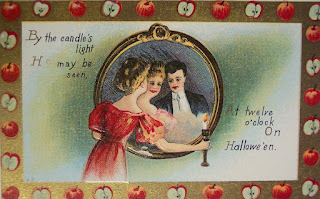
Accounts of a Halloween ball, gatherings with cards and dancing, or a "candy" pull in which party guests competed to grab apples or candy suspended from the ceiling with their teeth would show who would have a successful year. A Los Angeles newspaper printed an account of mirror gazing, burning of chestnuts, and carrying the candle. Most of these activities involved young women attempting to divine their future husbands or arranged marriages.


Another old custom called for cutting a long strip of apple skin and tossing it over one's shoulder. The shape of the peel was said to resemble the first initial of a suitor.

In 1905, at a party in New York's East Side Settlement House, young women blew out lines of candles, with the idea that the flames that remained lit signified the number of years she'd remain "unhitched".


Another party game involved a young woman throwing a ball of yarn out the window, watching it unroll while repeating the Lord's Prayer, at which she would then be rewarded by the sight of her future husband.

An article featured in a Philadelphia newspaper called for a participant to walk backward in bright moonlight while staring into a hand mirror and reciting a chant. If done correctly, the face of his or her future spouse would materialize in the mirror. 


Another game involved burying a ring, a dime, and a thimble in mashed potatoes. The food was then served to guests at a party. The guest who received the ring would marry in the near future; the one who received a thimble would remain a spinster or bachelor; and the guest who got the dime would reap riches and fame. 

Nut Crack Night

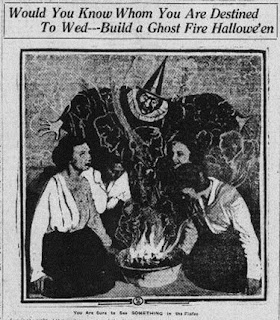
By far, the most common Halloween premonition involved nuts or chestnuts. In the Arizona Territory, young women were encouraged to build a "ghost fire" to find out who they were destined to wed. Chestnuts thrown into the fire would pop, and the girl's whose chestnut popped first would see her future husband's face rise up from the flames. A variation on this custom stated that a man and a woman would place two nuts in the stove. If the man's jumped or cracked, he would prove fickle, but if the two nuts "cuddled up to each and burned brightly", the couple would marry and live happily ever after.


Another superstition featured a walnut tree. According to a 1914 article in the Evening Public Ledger in Philadelphia, the rules were rather clear. On a moonlit Halloween night, circle the tree three times while chanting "Let him that is to be my true love bring me some walnuts."  Following the chant, the participant would see his or her future spouse picking walnuts in the tree.  

Though romantic, these Halloween customs began to fade and lose their appeal to the public by the 1920s.

Women, the traditional party hosts and targets of such games, were becoming more confident in their roles both in society, at work, and at home. About the same time, a figure emerged in popular lore: the powerful witch. And unlike commercial depictions, she was alluring.

As Mr. Gifford noted:

"The beautiful witch possessed power and beauty...she could use both to make her own decisions about...the future of her love life."

Like the strong heroines we create, and the women of today, the witch needed no fortune-telling skills; she would create her own destiny.


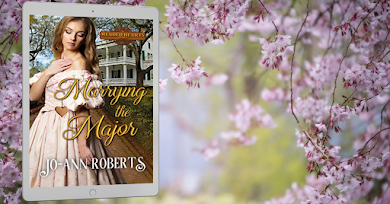
Marrying the Major


October 31st Release Date

The War Between the States has ended…but for Kit and Will their battle had just begun.

As the daughter of a prominent judge and well-bred mother whose roots could be traced back to before the War of Independence, Katherine Lambert had been the belle of Adams Mill. Her upbringing her schooling and her privileged world had revolved around the latest fashions, picnics, parties, and a host of beaus and friends.

She was expected to raise children; not her voice.

Until she defied her family and the Rebel cause by doing the unthinkable...falling in love with a Union cavalry officer.

The moment the very elegant very beautiful Katherine Lambert turned around to look at U.S. Major William Chandler was the moment she marched off with his heart. Though he always planned to carve out his own destiny, to marry and raise a family, he never expected love to find him in a small Southern town

Encountering opposition at every turn, he remains undaunted, determined to court and marry Kit and see who took serious objection.

They'd hoped their love would mend and heal the wounds of a splintered family, but someone else had other ideas.


Wednesday, August 28, 2019

Heroes of the West? The Pinkertons


Heroes of the West?

The Pinkertons


Allan Pinkerton, the founder of the Pinkerton Detective Agency started off as a barrel maker, or a cooper. He liked working for himself instead of for someone else. He had a knack for investigating and while looking for raw material for his business, helped the police bring a bunch of counterfeiters to justice. After the locals heard what he did, they came to him for other things as well. Thus, it started him on opening his own detective agency.


The civil war boosted his reputation even more when he headed the organization that spied on the confederacy. After that, he went back to his agency but he was now known far and wide and the reputation of the agency was well known by the end of the war.


 After becoming quite famous as an agency, a woman named Kate Warne wanted to work for the agency. Allan Pinkerton was hesitant, he didn't quite believe a woman would do as good of a job as a man. Except she convinced him to let her try. She told him that a woman would be able to 'worm' out secrets that a man could not do.

She proved herself many times over. She dressed up as a fortune teller and talked the suspect into revealing crucial information which helped their case. Once, she even got friendly with the wife of a thief and convinced the thief's wife to tell her the exact location where the money was hidden. Pinkerton actually made a statement that she was one of his best agents ever. 


As one of the authors in a multi-author series, the Pinkerton Matchmakers, stories and tales of women sleuths is the main ingredient in these stories. In my story An Agent for Cari, we find the heroine on her very first assignment. The premise of these books are a bit different than real life, with the women having to team up with a male partner and marrying them in name only while they are out in the field. This idea was for propriety sake to save the women's reputation. 


Here is my contribution to the stories of women who were not only brave but helped to carve a place for others to be independent and part of American history:
  
 A woman who breaks all the rules - A man who lives by them - Can opposites attract while bringing down a notorious swindler before he kills again?


Cari Kyllikki won't allow her disability to hinder her dream of becoming a Pinkerton Detective. She has become a master of hiding her daily struggles. What she didn't count on was the Pinkerton Agent who is determined to uncover her secrets. All of them!

Michael Durango works strictly by the book; there is no deviating even a little bit. When he finds out what his new wife is hiding, he has a decision to make -- tell the agency and risk her losing her job or keep her secret and complete the case. If only he could tear his thoughts away from her long enough to decide.

What does Michael do to protect his partner and solve the case? Will their suspect kill again, or turn his attention to the Pinkertons on his trail? Will Michael and Cari find love along the way, or will her secret tear apart everything they believe?


Tuesday, January 30, 2018

WRITING A SERIES & The Release of "CHASING A CHANCE"


One of the joys of writing a series with other authors is the chance to get to know them. This is true not only for the reader, but the author as well. This latest series, "Lockets and Lace" or  "Lockets & Lace" gave me a chance to connect with authors I'd only heard of, or in some cases, completely new authors. 

Comanche Grasslands near La Junta,CO

We all had a chance to tell the stories that were in our hearts within the framework of a theme. For myself, the story "Chasing A Chance" had been nudging me for some time. The idea of an older couple, who had known each other as children, demanded to be told. When my friends and fellow actors agreed to do the cover shoot, it all fell into place.

The book design was agreed upon and the lovely lady, Evelyne, from Carpe Librum Book Design, turned the photo shoot into the beautiful cover you see here. I will tell you, Mike, the gentleman on the cover posted on facebook: "Always wanted to be like one of those models on the cover of a romance novel. Never thought I'd be one. In my old age, no less..." 


I will share with you a couple of photos that did not make the cover. As you can see, we had a lot of fun. I also need to give credit to my photographer, Nadine Keaney of NKDesign. She's done the photos for the covers of most of my books.


Make sure you head over to the FaceBook launch event, and check out no only my day, but the posts of the other authors in the series. We've each had a day that we've spent with you, letting you get to know us and our work. You can access it here: Book Launch

Now for a short excerpt from "Chasing A Chance":


 The store was in shadow as the sun started over the horizon. Slowly, the light drove the darkness further back. Mary came from her living quarters, feeling rested for the first time in days. She moved to the front, intent on checking for any damage that might have occurred during the night.
A slight breeze blew puffs of dust down the street. Mary enjoyed the early mornings as the sun shone on a new day. Perhaps it was just wishful thinking, but mornings gave her hope. She was surprised to see Edwin coming up the street. A picture of him doing the same thing all those years ago overlay the present. She started to frown, followed quickly by a smile. Edwin had only been in town for two days, and here she was acting like the young girl she’d been before life got in the way.
The ringing of the bell above the door brought a grinning Edwin inside. At the sight of Mary his eyes glowed. "You're just like the picture I've kept in my head of you," he said, reaching to pull her close.

Mary relaxed into the safety Edwin’s arms offered. The years fell away, and she was the young girl who had believed in happy ever after, and the gift of friends. A weight lifted from her heart and mind, if only for a brief time.

Join the Lockets & Lace authors on Facebook for our 
There you find information on how you may have a chance to win one of three great prices: a special book locket, a lace handkerchief, or a $40 Amazon gift card.

Please CLICK HERE.

Chasing A Chance is available for $.99 until midnight January 30, 2018 at which time it will then be for sale at $2.99.

You can connect with me at the following places:

Angela Raines on Amazon

Angela Raines on FaceBook

Renawomyn.blogspot.com


Wednesday, June 1, 2016

Stagecoaches & Steamships


In 1865, my heroine in AT LIBERTY TO LOVE (book seven in the Texas Romance series) wanted to go from northeast Texas (Red River County) to San Francisco. Her trip began in downtown Clarksville, the county seat, where the Donoho Hotel served as the station.  
Work a jigsaw PUZZLE  !!


The coach took the Jefferson Trace, about one hundred miles south and east. It could travel about ten miles before changing teams, so they made about ten stops along the way including at Cuthand, Mount Pleasant, and Daingerfield to name a few. It took about twelve hours.    Work another PUZZLE  !!


The same trip thirty-three years earlier in 1832, when the widow Sue Baylor made a valiant effort to get her cotton crop to market in book one, VOW UNBROKEN, lasted ten days with no setbacks. It took her lots longer.
Work a jigsaw PUZZLE  !!

From Jefferson, my AT LIBERTY TO LOVE heroine took a short steamboat ride down the Red River to the Mississippi for five days to get down to New Orleans.

Those river steamboats were a lower draft where they could also go upriver farther. They were older and smaller. The steamships built to navigate the Gulf and Pacific were larger and drew more water (the draft is how much the boat set into the water. These ship’s bread and butter were the U.S. mail contracts. Freight and passengers were the gravy.
In New Orleans, my lady steamed across the Gulf to reach Caracus, a new city thrown up for the crossing of the Isthmus. There she purchased a seat on the train across the Isthmus to the City of Panama, built in the 1500s with a Spanish influence...a lot like New Orleans, but on the Pacific side of the Isthmus the city enjoyed a good trade. It quite impressed!

The cost from New Orleans to Caracas—which took five or six days depending on weather—cost less than the one day train fare. Prior to the railroad being built in the early 1850s, travelers crossed in barges or canoes part of the way and wagons the rest. That normally took three days with tropical heat and humidity and many insect un-pleasantries. So the train ride, though more expensive, was deemed well worth the price and a necessity rather than a luxury. In Panama City, she again boarded a steamship for the Pacific Ocean leg of her journey.

Those steamships stayed relatively close to the coast, not veering too far out into the ocean waters. First class passengers dined on linen-covered tables with fine, matching china. Uniformed servants attended to their every need as at the finest big city establishments.

Bands played, and gaming rooms presented a diversion for those inclined to take a chance. This all filled the top deck; those passengers’ lavish suites offered private balconies to enjoy the ocean breezes and magnificent water sunsets and rises.

Steerage, two decks down, could be as inexpensive as fifteen dollars while first class might set the traveler back over fifty. The floor in between cost less than first class and offered fewer amenities; leaving off most all of the elegant accommodations, the middle deck gave the business man and his wife—perhaps traveling with their children—a more affordable fare.

The next floor down, steerage, got no meals included with passage. They were purchased separately, and there could be as many as six packed into a single room. Of course, tickets didn’t cost as much as above, and the decks never mixed. Cheapest passage was on the lowest level, underwater—space in the boiler room or cargo hold as you could find it. This is where the ‘wooders’ rode.

On the Pacific side, from Panama City, my heroine boarded yet another steamship up to San Francisco with possible stops in Acapulco or San Diego before arriving in City by the Bay, depending on how much coal or firewood they carried on board. The bigger, newer ships routinely made the trip with no stops. This leg of the journey took fifteen days, making the trip from Texas to the golden shores a month to thirty-five days.

Travelers could opt to go cross county by stage and arrive in as few as twenty-two, but the ride proved rough and the warring tribe of Indians always posed a danger. Most thought nice accommodations and safety outweighed the time factor.

As Marcus Ford, my hero in AT LIBERTY TO LOVE discovered, one could work his way on a steamship serving as a wooder. Spending four hours of every twelve shoveling coal to feed the boiler was grueling, monotonous work. And dangerous, too, considering if the boiler did blow, those men were goners for sure. And shirkers could be summarily tossed overboard. The captain was king.
AT LIBERTY TO LOVE, book seven in the highly successful Texas Romance historical series, has just debuted May 27th and is now available in print or digital formats.

JACKET COPY: Obedience is better than sacrifice…and trumps romance, no matter how sweet.
   Profound loneliness propels a childless widow west with the idea of choosing an orphan to share her life. On the way, a fellow traveler takes her by surprise. She never dreams, is unprepared, doesn’t need another man, but can’t get him out of her head…or heart. He’s so perfect—every bit the one she’d searched for as a young woman—except his mistrust of God has erected a wall she cannot breach.
    Marcus Ford blames God and struggles for peace after losing his wife and baby. Not once has he considered another woman could be the answer, but the widow is like none other he’s ever met. He falls hard, but plans are taking him east. Hope dashed sends two hearts into the pit. If only Ford could forgive God or the widow ease up on her adamant resolve.
   Will God’s mercy shine a beacon in the fog of despair and prove sufficient to heal their souls?
   
EXCERPT: 
    Stepping off the last stair, she approached. He inhaled deeply then shook his head. “Oh my.” He drew in another long breath, closing his eyes. “You smell better than you look. I mean, you look outstanding, but your fragrance is even better. Not that you didn’t smell good before… I mean…” He finally just shrugged. “Your appearance shames me. I should have brought my dress blues.”
    She grinned. “I understand, but here.” She handed him her door key. “On my couch, you’ll some new threads…the least Henry Buckmeyer could do.”
    At first, he didn’t take it, then scooped it up like a kid in a candy store and took the stairs two at a time.
    “I’ll wait on the deck, just outside the dining room.”
    He waved one hand but didn’t look back.
    Might do the man a bit of good to have his pride pricked. She chuckled, so enjoying the highly pleasant distraction he afforded.
    Took the man longer than expected, but the wait worth it, the readymade suit fit perfect, she loved the shirt’s high collar and how it seemed to choke him.
He grinned then extended his arm. “Thank you.”
    She slipped her hand under then over his offering. “You’re welcome.” She glanced down. He’d shined his boots. Per chance that accounted for the extra time.

REVIEWS:  At Liberty To Love shows how God can speak through dreams, visions and small children. As God spoke in biblical times, so He can still speak that way today. There are some wonderful exchanges of dialogue with four year old Michael. Caryl McAdoo demonstrates the power of trust and faith. "Nothing was too hard for God" Who shows that He loves to step in and make the seemingly impossible, possible.  Another great offering from Caryl McAdoo.     --Julia Wilson, Worchester, England reader


I’ve followed Henry Buckmeyer and his family since the first book, "Vow Unbroken" and couldn't wait for this one. Could this be the true love the widow has never known before? At Liberty To Love as always, gives glory to God. All Caryl McAdoo’s stories are uplifting and truly enjoyable. I highly recommend this one and all of the stories in the Texas Romance series.     --Michelle Beach, Clinton, New York reader

With characters that charm, and scenes that tug at our heart strings, Caryl McAdoo keeps us reading well past our bedtimes. Mrs. McAdoo has woven yet another Texas tall tale to keep us flipping pages. The mistress of the Texas yarn, her Texas dialect tantalizes from start to finish. At Liberty to Love made this reviewer fall in love with fictional people who seem so real that they almost breathe. This character-driven, well-crafted novel is a keeper. I’m adding it to my collection of Texas Romances by Caryl McAdoo.     --Cassandra Wessel, Tionesta, Pennsylvania multi-published author of devotionals


TWEETS: (Help spread the word! :)
#NewRelease AT LIBERTY TO LOVE #ChristianFiction Family saga #HistoricalRomance http://amzn.to/1T1vcYL

AT LIBERTY TO LOVE #NewRelease 5-Star TX Romance bk 7 #ChristianFiction http://amzn.to/1T1vcYL

@CarylMcAdoo #NewRelease AT LIBERTY TO LOVE #ChristianFiction Family saga bk 6 http://amzn.to/1T1vcYL

Another PUZZLE !! Woo Hoo!

Bio: Caryl McAdoo is all about loving God! She currently writes four series: the historical Christian ‘Texas Romance’; a contemporary ‘Red River Romance’; The Generations, her Biblical fiction, and the newest Days of Dread Trilogy for mid-grade readers. Known as the Singing Pray-er, she loves praising with new songs the Lord gives her and prays her story gives God glory! In 2008, she and her high school sweetheart-husband Ron moved from the DFW area—home for fifty-plus years—to the woods of Red River County. Caryl counts four children and sixteen grandsugars life’s biggest blessings believing all good things come from God. Besides glorifying Him, she hopes each title will also minister His love, mercy, and grace to its readers. Caryl and Ron live in Clarksville, the county seat, in the far northeast corner of the Lone Star State with two grandsons.

LINKS:  All Books   At Liberty to Love    BookBub   Website    Newsletter Facebook    Blog    GoodReads   Google+   LinkedIn   Twitter   Pinterest   Hear me sing on  YouTube !!


Monday, February 8, 2016

WESTERNS: The All-American Genre


In historical romance writing, the genres tend to be divided in eras. What I find most interesting is that many of those eras from the birth of the United States of American to before World War One (the Great War) are based on what was happening in Great Britain, and in a lesser part, Europe as a whole. There is a reason for this. In spite of the American Revolutionary War (a lesser genre that includes Colonial America) and that unpleasantness between the United States and England between 1812-1814, the monarchy and nobility of England still strongly influenced the legal system, attitudes, fashions and culture of American society. Canada, still part of the Commonwealth, was more closely tied to England that it is now. Many United States citizens had ancestors or even living family in England. Frequent trade and travel occurred between the two nations.  

Let’s look at some of these Great Britain-inspired romance genres:

Regency Era Genre:
 
George IV while Regent

The Regency in the United Kingdom took place from 1811 to 1820 when King George III was deemed unfit to rule and his son, the Prince of Wales, became his proxy and ruled as Prince Regent. The Regency era  sometimes refers to a longer period from 1795 (about the time the United States was getting its act together and the founders wrote the current constitution) to 1837 which included the latter part of the reign of George III and the reigns of his sons George IV, as Prince Regent and King, and William IV. It was characterized by distinctive trends in British architecture, literature, fashions, politics, and culture, notably a more divided society fraught with excess and decadence among the small top elite and poverty, squalor and lack of opportunity among the masses at the bottom. This is also the time of the Napoleonic wars.

The Duchess of Richmond's society ball before the Battle of Waterloo


If you would enjoy learning more about the fashions and trends of this era, please click HERE.

 Victorian Era Genre:

The era of Queen Victoria started about 1837 and lasted until her death in 1901. Her tastes greatly influenced society both in Great Britain and in the Americas.
1816 Princess Charlotte's Wedding Gown
As far as fashion goes, her influence started with her wedding dress. Before Victoria wedding dresses fir the royalty were usually made of cloth of silver. For those who did not enjoy the abundance and excesses of the nobility, wedding dresses were usually of any color the bride enjoyed, with yellow being a favorite. Many chose darker colors for the dress that, after the wedding, would become their best dress. However, the wedding of Queen Victoria started a new trend when instead of the traditional royal silver bridal gown, she chose a simple white wedding gown made of white satin, trimmed with Honiton lace, with Honiton long veil and a wreath of orange blossoms to represent purity. It was then that white became the dominant, traditional choice, symbolizing purity and maidenhood.
 
Queen Victoria in her white wedding dress
Another fashion trend that can be attributed to Queen Victoria is the popularity of plaid in women’s clothing during this era.


The era was generally characterized mostly by peace and prosperity in England. There were no great wars. Britain reached the zenith of its economic, political, diplomatic and cultural power. The Victorian era is famous for the Victorian standards of personal morality. Historians generally agree that the middle classes held high personal moral standards, but have debated whether the working classes followed suit. The situation for the lower classes, although still not good, had improved somewhat from what had existed during the Regency period, although child labor became a big issue in Great Britain. The era saw Industrial Revolution and the development of the Railroad on both sides of the Atlantic.
1877 London
Edwardian Era Genre:


The Edwardian era in Great Britain is the period covering the reign of King Edward VII, 1901 to 1910, and is sometimes extended beyond Edward's death to include the four years leading up to World War I. This era was a transitional period from the horse-and-carriage way of life to modern times leading up to World War I.  A break from the staid attitudes of the Victorian era led to experimentation in culture, literature, and theater.  The development of more sophisticated machines, technology and industrialization led to a faster pace of life.  Women’s suffrage began.  Various labor movements greatly influenced the political landscape.  Moral standards, while they were still important, became looser than they were in Victorian times.


You might enjoy reading more about the Edwardian era by clicking HERE.
 
Edwardian era shooting party

Western – The All-American Genre:

The aforementioned eras, which all became well established genres, especially in romance, originated in Great Britain. These eras influenced the culture found on the American continent to a greater or lesser degree, depending on whether people lived in the eastern half of the continent or west of the Mississippi/Great Lakes region. 
 
1840 Territorial Map - United States
But, there is one genre that it totally all-American: Western. As in, those who traveled and lived west of the Mississippi River or Great Lakes. The genre includes among others cowboys, settlers, ranchers, Native Americans, soldiers fighting in the Indian wars, miners, prospectors, and any number of pioneers traveling west to develop the great open regions of the plains, the Rocky Mountains and all the way to the Pacific Ocean. This movement involved the entire North American continent, all the way from the western movement in Canada, the border dispute between the United States and Canada in the general territory of British Columbia and Washington/Oregon down to the Mexican-American war and Mexico, a haven for Western desperadoes escaping the law in the West.
 
Mormon pioneers


Another American genre which only covers about five years is the American Civil War genre. For romance novel purposes, it is often lumped into the Western category although this war mostly took place east of the Mississippi. Ways the Civil War did influence the Western experience include the following: 1) many men, often from the South, disgruntled over the Civil War moved west during the war years, often taking up mining or ranching. 2) After the Civil War and its disruptions to commerce, its destruction of land and the defeat of the South, many men chose to emigrate to the West to start over.
 
Civil War Patriots
In the western movement, women became more valued. They often were seen more as an asset and less of an expensive burden than often perceived back East. Wise pioneer men often made it a point to marry before traveling west. Women became so prized in the gold fields of California that men would walk miles just to look at one. Western states such as Wyoming, Kansas and Utah led the nation in granting suffrage and other rights to women in order to attract women into moving west. Men living in the west where there were not as many available women to choose from and who were ready to start a family often sent for mail-order brides to fill the need.


Women who moved west found they were often called on to do the work associated with men. For some, it was a preferred choice, such as those women who chose to come west to homestead. This affected their attitudes about everyday dress leading to more practical solutions in clothing. You might enjoy reading more about cowgirl fashions by clicking HERE.


The above reason may explain why many of our monthly contributors write Westerns—stories that take place in the all-American genre. For another example of a strong woman living in the West, click HERE.
 
Sadie Austin wore a split skirt topped by a short overskirt when riding her father's range

Zina Abbott is the pen name used by Robyn Echols for her historical novels. You might enjoy reading the first book in my Eastern Sierra Brides 1884 series, Big Meadows Valentine.


Please visit and follow the Zina Abbott’s Amazon Author Page by clicking HERE.

Zina Abbott Author Links:

Website  |  Blog  |  Facebook  |  Pinterest  |  Goodreads  |  Google+  |  Twitter 

Click HERE to tweet this blog Post:  
Romance genres WESTERNS: THE ALL-AMERICAN GENRE @ZinaAbbott
http://bit.ly/1KBqMt1 #SweetAmerSweethearts