Showing posts with label life in the 1890s. Show all posts

Friday, December 16, 2022

How Bicycles Influenced 1890s Fashions by Zina Abbott


The 1890’s were known as the “Gay Nineties” for more than one reason. One was the direction taken in women’s fashions that allowed them greater freedom of movement. As the new decade approached, the stiffness and fussiness typical of the Victorian Era eased. Much of this was due to the technologies that developed, as well as women’s involvement in those technologies.

1895 Women on bicycles- Victoria and Albert Museum, the Ashton Collection

Perhaps the innovation that had the greatest influence on the change in women’s fashions was the drop-frame safety bicycle. The 1890s became an era of great dress reforms which allowed women the opportunity to ride bicycles more comfortably, and therefore, created the need for appropriate clothing.


Keep in mind, in the late 1860s, after the end of the Civil War, fabric was in shorter supply, so the hoop skirts wider than the Mississippi River became narrower, with a slight protrusion in back. That protrusion developed into the bustle, which, by the mid-1880s, often stuck out on a woman's rear like a small mountain. All during this, the ladies were contained in a stiff corset that squeezed their inner organs and often prevented breathing easily. It definitely restricted movement.

Big-wheeler bicycles 1887

Although horses and horse-driven conveyances still dominated in the more rustic West, t
oward the end of the 1880s, bicycles and—for the ladies with their more restrictive clothing—tricycles became available. 


These were probably seen more in the East and possibly the around the larger cities (read: roads that weren’t a dust bowl in the summer and a muddy swamp in the rainy season) in the West.

Photographer unknown. Staff of the Mechanics Institute Reference Library, 1895. Photograph. Toronto: Toronto Public Library

However, Western society in Europe and North America began to move away from the stiff, moralistic, Victorian Era. Women were enjoying new levels of independence as opposed to the Victorian Era (and back through time) belief that they should restrict their interests and activities to those involved in being a homemaker. During the decade, the number of women employed outside of the home almost doubled. The “New Woman” was an intellectual, young female. 


1898 Women in bathing costumes--ooh! Look at those bare legs!

As more and more began working outside the home, they began to pursue interests in cycling and participating in sports (as opposed to always being the admiring audience to the wonderfulness of men’s sporting activities).

1895-1900 students Atlanta Univ. George


In order to do this effectively, women needed clothing that was less restrictive. The introduction of electricity in clothing manufacturing produced a boon in the ready-to-wear market.


Less restrictive it did become, as heavily boned corsets so stiff and tightly laced they were strapless gave way to straight front corsets, also known as health corsets, athletic corsets, hygienic corsets, and sanitary corsets. They did not have the heavy boning, but were buttoned in the front and held in place with shoulder straps.
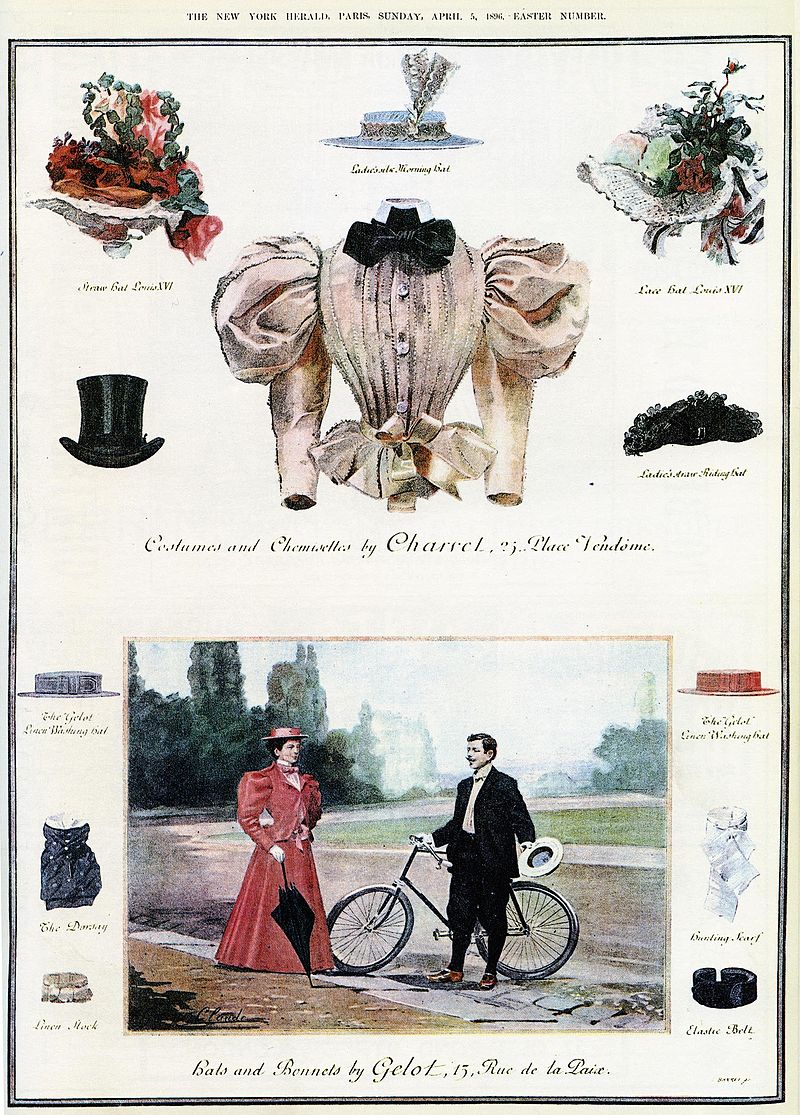
1896 Charvet Avertisement


Dresses focused more on mobility, with free-flowing skirts and leg-o-mutton sleeves. The “mutton sleeve”—the vertical puff at the shoulders—developed to allow greater freedom of movement in the arms. This style reached its peak in 1895. By the end of the century, it gradually diminished.

Skirts were bell-shaped, gored to fit smoothly over the hips. Gone were the multitude of heavy petticoats. This allowed for more self-expression and a more natural silhouette for women’s bodies.

These skirts also allowed for greater mobility. They made it possible for women to ride the drop-frame safety bicycle instead of being restricted to the tricycle of the previous decade.


Along with the floor-length that used for everyday wear, to appeal to the athletic woman, a “walking skirt”—a skirt that fell to just above the ankles—also came into style. For younger girls, the walking skirt fell to just below the knees.


On occasion, such as bicycle riding, women set their skirts aside and wore what were formerly referred to as bloomers. This was a bold move, and it was not universally approved due to the controversy surrounding women wearing pants.

1895 Bicycle Suit
Text on image:

Gertrude. "My dear Jessie, what on earth is that bicycle suit for!"

Jessie. "Why, to wear, of course."

Gertrude. "But you haven't got a bicycle!"

Jessie. "No, but I've got a sewing machine!"
 

In this era, they were also known as "rationals" or "knickerbockers." The entire outfit, including the jacket, was known as a “bicycle suit.”


So, hail, hail to the 1890s new woman with her greater freedom of movement, her greater selection of choices, and her greater health—all largely made possible by the adaptions made in clothing styles so she could more comfortably ride the humble drop-frame safety bicycle.

~o0o~

One of my two 2022 romances set in the 1890s was Joshua's Bride, set during the 1893 Cherokee Land Run. Although neither Rose Calloway nor her sister, Marigold, wore bicycle suits or rode bicycles during the land run, there were those who did. The sisters, who rode the train to where they wished to claim land, wore walking skirts.

To find the book description and purchase options for Joshua's Bride

please CLICK HERE.


Marigold Calloway has her romance in 1894 after she is already on the two city residential lots she claimed during the land run. Having spent her life as a schoolteacher, she definitely fits the description of the modern woman who works outside the home. The streamline skirts and looser clothing of the era suit her just fine.

To find the book description and purchase options for Marigold

please  CLICK HERE.


Sources:

https://www.familysearch.org/en/blog/1890s-fashion-changes

https://fashionhistory.fitnyc.edu/1890-1899/

https://recollections.biz/blog/achieving-the-gibson-girl-s-silhouette/

https://en.wikipedia.org/wiki/1890s_in_Western_fashion

https://en.wikipedia.org/wiki/Aestheticism

Wikimedia Commons

Friday, January 1, 2016

Victorian New Year Celebrations


Happy New Year!

As we all say goodbye to 2015 and welcome 2016 on this day, I can't help but reflect on the tidbits of historical fact I've gathered about how our great-great-grandparents and their contemporaries marked the holiday.


Traditions during the American Victorian Era at the holiday of New Year's were most different than today. Contemporary Americans enjoy a federal holiday, time off work (for many but not all), and many holiday parties are held on New Year's Eve, not on New Year's Day (at least when it comes to starting time). Anyone who attended a New Year's Party last night probably had a celebratory drink... or several. Alcohol, in 2016, is a big part of New Year's. Not so in the Victorian period.


"In the late 1880's the great New Year's rite was not a big party the night before, but quieter customs on the day itself. During the '70s single gentlemen armed with fancy calling cards went on a round of visits to ladies of their acquaintance, aided by local newspapers, which printed long lists of damsels who would be "at home" to such callers. But by 1880, bachelors had so abused the custom ("This is my 47th call!" shouted one swain on the run) that it died of social disapproval. married men, however, continued to observe the day, either by taking their families to fancy restaurants or going calling en famille-- a practice that, like bachelor calling, did not always fall within the bounds of etiquette."


In the mid- to late-Victorian American Era, it was fashionable for the ladies and children of the families-- including young males under age ten-- to remain at home to receive callers. The men (especially eligible bachelors) were expected, at least by social niceties, to make calls on the families who had marriageable daughters. These New Year's calls were considered good luck and a favorable portent for young women hoping to make a love match in the New Year. Most calls would last from noon 'til six only so the evening could be reserved for family dinner celebrations and dinner parties. Yet, this quote originating in Godey's Lady's Book suggests calls didn't necessarily end by six in the evening. In fact, it appeared that local customs dictated when the insanity of a constant stream of well-wishers could end.


PROPER CALLING

"Ladies expecting calls on New Year's should be in readiness to receive from 10 a.m. to 9 p.m. Upon calling, the gentlemen are invited to remove overcoat and hat, which invitation is accepted unless it is the design to make the call very brief. Gloves are sometimes retained upon the hand during the call, but this is optional. The call should not exceed ten or fifteen minutes, unless it is mutually agreeable to prolong the stay. The ladies should have a bright, cheerful fire and a table, conveniently located in the room, with refreshments, consisting of fruits, cakes, bread and other food, such as may be deemed desirable. No intoxicating drinks should be allowed."

IMPROPER CALLING 

"Disagreeable callers are the husband and wife who come with a child and a small dog; the husband making himself familiar with the hostess, the dog barking at the cat, the child taking free run of the house, while the wife, passes around the room, handling and examining the ornaments.

Some evening callers make themselves odious by continuing their visit too long, and even when they have risen to depart they lack decision to go but will stand several minutes before taking final leave, and then when wraps are on, will tell one more story while the hostess protects herself as best she can from the incoming gusts of wind and storm, sometimes thus taking a cold that ends in death. When the guest is ready to go-- go."


Bachelors did not need an invitation to call on a young lady on New Year's Day. A calling card would do. Well-to-do gentlemen would commission unique and special holiday calling cards, sometimes with best wishes for New Year's emblazoned across them and occasionally with the man's portrait behind a peek-a-boo flap. This image is of a standard Victorian-Era calling card.
Image of Victorian Calling Card compliments of Old Design Shop
If you've ever toured a museum-house, you'll know entry halls would often situate a silver tray on a credenza for calling cards on "At Home" days, including occasions such as New Year's.

Unfortunately, not all dinner party guests were invited. Prior to the late 1880's, it was most common for fashionable families to post in the newspaper that they would be receiving guests. A buffet would be laid out so their visitors might enjoy a bite to eat (a full meal). In the late 1880's party crashers (for lack of a better term) would see the notice in the paper and pay a call to the hostesses-- strangers, uninvited, and hungry. By 1890 this pattern of announcing one's Open House had drastically changed.

No wonder so many well-to-do husbands took their wives and families out to supper. Restaurants often provided special fare specific to the holiday.
Palmer Restaurant (Chicago) Dinner Menu, New Year's Day (January 1st) year 1885

I'm sure plenty of families dined at home, whether by tradition, expectation, financial capacity, to avoid the weather or avoid crowds. This menu for New Year's was posted in the Pittsburg [sic] Dispatch, Pittsburgh, PA, December 25, 1892:


Looks like a LOT of work to me. In fact, the menu offered in Pittsburg Dispatch includes instructions that run two and one-half columns. Despite my love for all things Victorian, my family will dine in 2016 style. Our traditional favorites are pizza, cheese ball and crackers, favorite holiday treats and goodies, etc.

What about you?
What part of a Victorian New Year's Celebration intrigues you?
How have you (or will you) celebrate the New Year? 

Happy New Year!
Thank you for spending a few minutes with me today.
Wishing you and yours a most joyful and healthy 2016.


Related Blog Posts by Kristin Holt:
 
Kristin Holt | Victorian-American New Year's Etiquette


Kristin Holt is the author of ten Sweet (clean) Victorian American West Romances, including 3 soon-to-be-released titles. 
Coming tomorrow (1-2-16) and Monday (1-4-16) [LESSIE: BRIDE OF UTAH and JOSIE: BRIDE OF NEW MEXICO, two books within the American Mail-Order Brides Series]. Book #10 [WANTED: Midwife Bride] arrives on 2-9-16 but it's available for preorder NOW.

Website | Email | Newsletter | Blog Articles | Twitter | Pinterest | g+ | Goodreads | Facebook | Amazon
  

Copyright © 2015-2016 Kristin Holt, LC