Showing posts with label 1890. Show all posts

Friday, December 16, 2022

How Bicycles Influenced 1890s Fashions by Zina Abbott


The 1890’s were known as the “Gay Nineties” for more than one reason. One was the direction taken in women’s fashions that allowed them greater freedom of movement. As the new decade approached, the stiffness and fussiness typical of the Victorian Era eased. Much of this was due to the technologies that developed, as well as women’s involvement in those technologies.

1895 Women on bicycles- Victoria and Albert Museum, the Ashton Collection

Perhaps the innovation that had the greatest influence on the change in women’s fashions was the drop-frame safety bicycle. The 1890s became an era of great dress reforms which allowed women the opportunity to ride bicycles more comfortably, and therefore, created the need for appropriate clothing.


Keep in mind, in the late 1860s, after the end of the Civil War, fabric was in shorter supply, so the hoop skirts wider than the Mississippi River became narrower, with a slight protrusion in back. That protrusion developed into the bustle, which, by the mid-1880s, often stuck out on a woman's rear like a small mountain. All during this, the ladies were contained in a stiff corset that squeezed their inner organs and often prevented breathing easily. It definitely restricted movement.

Big-wheeler bicycles 1887

Although horses and horse-driven conveyances still dominated in the more rustic West, t
oward the end of the 1880s, bicycles and—for the ladies with their more restrictive clothing—tricycles became available. 


These were probably seen more in the East and possibly the around the larger cities (read: roads that weren’t a dust bowl in the summer and a muddy swamp in the rainy season) in the West.

Photographer unknown. Staff of the Mechanics Institute Reference Library, 1895. Photograph. Toronto: Toronto Public Library

However, Western society in Europe and North America began to move away from the stiff, moralistic, Victorian Era. Women were enjoying new levels of independence as opposed to the Victorian Era (and back through time) belief that they should restrict their interests and activities to those involved in being a homemaker. During the decade, the number of women employed outside of the home almost doubled. The “New Woman” was an intellectual, young female. 


1898 Women in bathing costumes--ooh! Look at those bare legs!

As more and more began working outside the home, they began to pursue interests in cycling and participating in sports (as opposed to always being the admiring audience to the wonderfulness of men’s sporting activities).

1895-1900 students Atlanta Univ. George


In order to do this effectively, women needed clothing that was less restrictive. The introduction of electricity in clothing manufacturing produced a boon in the ready-to-wear market.


Less restrictive it did become, as heavily boned corsets so stiff and tightly laced they were strapless gave way to straight front corsets, also known as health corsets, athletic corsets, hygienic corsets, and sanitary corsets. They did not have the heavy boning, but were buttoned in the front and held in place with shoulder straps.
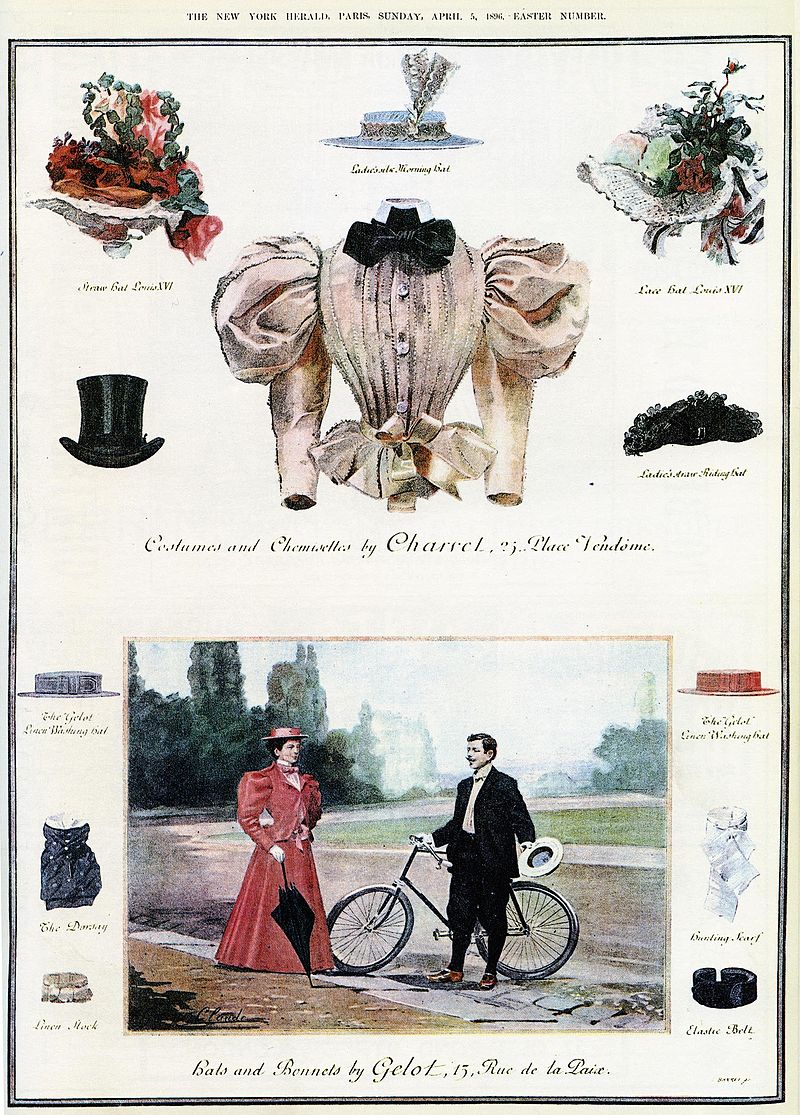
1896 Charvet Avertisement


Dresses focused more on mobility, with free-flowing skirts and leg-o-mutton sleeves. The “mutton sleeve”—the vertical puff at the shoulders—developed to allow greater freedom of movement in the arms. This style reached its peak in 1895. By the end of the century, it gradually diminished.

Skirts were bell-shaped, gored to fit smoothly over the hips. Gone were the multitude of heavy petticoats. This allowed for more self-expression and a more natural silhouette for women’s bodies.

These skirts also allowed for greater mobility. They made it possible for women to ride the drop-frame safety bicycle instead of being restricted to the tricycle of the previous decade.


Along with the floor-length that used for everyday wear, to appeal to the athletic woman, a “walking skirt”—a skirt that fell to just above the ankles—also came into style. For younger girls, the walking skirt fell to just below the knees.


On occasion, such as bicycle riding, women set their skirts aside and wore what were formerly referred to as bloomers. This was a bold move, and it was not universally approved due to the controversy surrounding women wearing pants.

1895 Bicycle Suit
Text on image:

Gertrude. "My dear Jessie, what on earth is that bicycle suit for!"

Jessie. "Why, to wear, of course."

Gertrude. "But you haven't got a bicycle!"

Jessie. "No, but I've got a sewing machine!"
 

In this era, they were also known as "rationals" or "knickerbockers." The entire outfit, including the jacket, was known as a “bicycle suit.”


So, hail, hail to the 1890s new woman with her greater freedom of movement, her greater selection of choices, and her greater health—all largely made possible by the adaptions made in clothing styles so she could more comfortably ride the humble drop-frame safety bicycle.

~o0o~

One of my two 2022 romances set in the 1890s was Joshua's Bride, set during the 1893 Cherokee Land Run. Although neither Rose Calloway nor her sister, Marigold, wore bicycle suits or rode bicycles during the land run, there were those who did. The sisters, who rode the train to where they wished to claim land, wore walking skirts.

To find the book description and purchase options for Joshua's Bride

please CLICK HERE.


Marigold Calloway has her romance in 1894 after she is already on the two city residential lots she claimed during the land run. Having spent her life as a schoolteacher, she definitely fits the description of the modern woman who works outside the home. The streamline skirts and looser clothing of the era suit her just fine.

To find the book description and purchase options for Marigold

please  CLICK HERE.


Sources:

https://www.familysearch.org/en/blog/1890s-fashion-changes

https://fashionhistory.fitnyc.edu/1890-1899/

https://recollections.biz/blog/achieving-the-gibson-girl-s-silhouette/

https://en.wikipedia.org/wiki/1890s_in_Western_fashion

https://en.wikipedia.org/wiki/Aestheticism

Wikimedia Commons

Friday, July 6, 2018

Introducing Dr. Henry Merritt & Dr. Isabella Pattison, Leading Characters in Isabella's Calico Groom (New Release!)


Please allow me to introduce the Leading Characters of Isabella's Calico Groom, Henry Merritt and Isabella Pattison. This couple quickly became one of my favorites. (Shh! Don't tell the others.)


Vintage Cabinet Cards, taken in 1889 to 1890 (novella is set in 1890), used to visualize my characters in the writing process.
Like many other authors, I use images of real people to help me visualize my characters as I write. (See Photographic Inspiration) Physical appearance is only one component of a character, but it’s valuable, especially for those moments when the hero and heroine first meet. How does one see the other in that first impression? Is she reminded of someone else (that she loves or despises)? Is he instantly enamored of her? (Or perhaps he’s instantly put off.)

I selected vintage cabinet cards (late Victorian-era photographs) that had luckily been dated within a year of my book’s setting. Yes! I could envision correct styles, hair, “flowerpot” hat, and corset-enhanced lady’s figure.

I’ve used modern pictures, at times, but these two simply fit. I knew the moment I located each of these two vintage images, I’d found Henry and Isabella.


Dr. Henry Merritt, DDS


Henry’s portrait: Cabinet Card offered for sale on ebay. [Unnamed man] Photographed in Butte, Montana, 1889 to 1890. [Source]

Ladies and gentlemen [Henry stands immediately and removes his hat, keeping the lining toward himself], allow me to introduce Dr. Henry Merritt, DDS. [Henry responds with excellent manners.] Henry’s mama made sure he learned every bit of decorum she could teach him. But Henry’s so much more than a handsome face and gentlemanly comportment.

Anyone in 1890 notices Henry is clean-shaven at a time when heavy mustaches are popular. [Note: both his newly shaved face and the gold watch chain sparked elements of his personality.] As the image shows, Henry is tall (six feet, 1/2-inch, and 190 pounds of lean muscle due to his work during college).

As usual, much of the “back story”—who he is, where he was born, the big events in his life that make him see the world differently—never surfaced in Isabella’s Calico Groom, yet much of it does. We learn he graduated from Pennsylvania College of Dental Surgery in 1886. He graduated at age 24, about 4 years before the book opens. As the story begins in the early months of 1890, Henry is 28.

Why would a handsome, well-mannered dentist, at the advanced age of 28, be unattached?

A necessary question even though they’re living in 1890 Wyoming Territory where men significantly outnumber women—because that’s just too easy. In this time and place, the majority of men and women prize marriage as the ideal, and the majority make choices leading them to that eventuality. Henry would've been married if he'd wanted to.

So, Henry, why?

Henry knows precisely the kind of woman for him. Once his income stabilizes so he might support a family, he’ll find that right kind of woman and marry her. (I had a bit too much fun chuckling at Henry’s delusions. I mean, really—can anyone schedule when they’ll fall in love? If not love, then can anyone pinpoint when the “One” will enter stage left?) Henry had better learn flexibility, and to see things as they really are, before he loses his one chance at happiness.


Dr. Isabella Pattison, DDS

 Isabella’s portrait: Mary Deviln, a Canadian woman photographed in 1890, in Ottawa. [Source]

Now, allow me to introduce the story’s heroine. Dr. Isabaella M. Pattison, DDS. Try not to show surprise as she shakes your hand like any businessman would do. Not entirely ladylike, but then she’s been accused of her lack of ladylike charms. At five feet and 1/2-inch (don’t forget the half-inch, if you please!), and 105 pounds, she’s nearly elfin—even in her very stylish 1890 high heeled boots [history shorted women both before and after this narrow window when high heels had been tolerated (pun intended)]. Her small, nimble hands have much dexterity (a lovely thing given her chosen career). Her gracious warmth pulls others to her. Children trust her easily, as do their mothers. She makes friends easily... but that doesn’t mean her professional education was easy, nor that she’s found dentistry easy for a female.

Isabella may have had a difficult time finding a place where she belonged, but once she visited her “Lady Professional” pen pals in Evanston, Wyoming, she knew she’d found home. Medical doctor Naomi Chandler (series book 1) and attorney Sophia Hughes (series book 2) have become the closest of friends. The ladies and their husbands have welcomed Isabella into their tight circle of friendship, and she’s nearly contented.

Isabella knew what she was doing—choosing to set aside marriage and family—when she chose to pursue dentistry as a career. Now at age 30, she’s at last stumbled across a man who piques her interest. As a dentist, Henry proves a brilliant conversationalist. He introduces perspectives she’s not considered before. He’s charming, kind, and most insistent that he’ll wed a woman who makes their home her castle and life's work.

Henry and Isabella discover they can work together, but do they, a woefully mismatched pair, have a chance at love?

Character Development is Key to Writing Romantic Fiction


Ultimately, the romance—no matter what else is going on—is about the development of attraction, affection, and commitment between the main characters. “Other stuff going on” could be the mystery, the suspense and danger, or the situation that brought the characters together.

As the romance is all about the romance, that means writers must know what makes the characters hesitant to fall in love and live happily ever after. Because a story that progresses like: meet, fall in love, commit-- is the most boring story ever. Readers (and authors) know conflict is key. The romantic couple must face obstacles that challenge their innermost beliefs, rattle their cages, and force them to address the “baggage” that’s holding them back from living in full sunlight and happiness.

A man who’d been jilted the day of his wedding by a non-committal fiancée would be hesitant to put himself in the same situation again. Why set himself up for more pain?

Sometimes “life experiences” that cause the character to carry around heavy “baggage” are caused with or by someone else—that non-committal fiancée, for example. Sometimes those false beliefs are caused by what a character witnesses, such as parents who fought all the time and were miserable, hence the destructive belief that “marriage is pain-filled and dreadful.” We’ve all read books where something like either of these examples occurs, and the hero (or heroine) promises themselves they’ll never allow anyone too close, ever again.

I imagine we’ve all read more subtle circumstances that lead to the same destructive thinking. For example, “You should fix your teeth, Kate. You’re lovely when you smile.” The “lie” Kate carries around, that prevents her from forming attachments, could be as simple as “I’m not attractive. My teeth are crooked. Men do not find me appealing.” Damage to someone’s self-image can occur in one brief statement from someone who is believed (or desired to be) trustworthy.

Magical things happen in fiction when the right Hero is brought into contact with the right Heroine. Like interconnecting pieces of a puzzle, their back stories, their experiences, their heartaches, and their lies fit together perfectly. This doesn’t mean he’s the one many who sees beyond her need for braces. Instead, this is the man worth fighting for, whose presence forces her to face her fear, over and over again until she strikes out or triumphs (and in a romance, we know which ending... we just don't know how, or what she will experience before she earns that reward). Likewise, she’s the girl most prepared to show him that all he believes are fundamental truths are actually lies. He’s learned the hard way that women don’t say what they mean until it’s too late. He witnesses her intention to leave him in everything she says and does—even though she has no such intention.


Are you interested in writing? You’re invited to browse my “For Writers” Page.

http://www.kristinholt.com/for-writers


What have you noticed about the personalities of compelling couples?

How do they ensure the other person’s eyes are opened, and they see the truth?

How do they bring out the best in each other (perhaps after the unveiling of the worst)?


Please scroll down and comment. We’d love to hear your insights!
Please visit my website’s page about Isabella’s Calico Groom (within Calico Ball: Timeless Western Collection). You’ll find easy links to a dozen additional articles about true-to-history details: calico balls, dentistry in 1890, women in men’s professions, and much more.
Calico Ball: Timeless Western Collection publishes in 4 days! (7-10-18) This ebook will also be available on Kobo, Google, Nook... This Collection contains THREE 100-page novellas--and I'm thrilled to be published alongside Sarah M. Eden and Carla Kelly.

Note: Book 2 is currently on sale for just 99-cents. I'm honored that this title, Sophia's Leap-Year Courtship is a RONE Awards 2018 Finalist.
Hurry! The sale will end this Sunday!
http://www.kristinholt.com/book-description-isabellas-calico-groom


http://www.kristinholt.com/professional-women-of-wyoming-territory-trilogy


Related Articles:

http://www.KristinHolt.com/

Kristin Holt, USA Today Bestselling Author, writes Sweet Victorian Romance set in the American West. She writes frequently about Old West history and contributes monthly to Sweet Americana Sweethearts.
Sweet Romance Appropriate for All Audiences


Copyright © 2018 Kristin Holt LC