Showing posts with label grooming. Show all posts

Friday, August 7, 2020

Late Victorian-Era Beauty Secrets by Kristin Holt


Kristin Holt | Late Victorian-era Beauty Secrets

Late Victorian-Era Beauty Secrets
by USA-Today Bestselling Author
Kristin Holt

19th Century Woman's Toilette

I continue in fascination as I discover more and more history of real life among average, working Victorian-American women. The wealthy may have bought pots and tubes from the burgeoning beauty industry, but what advice or methods circulated among the average Mary?
(Note: I've shared numerous links to related articles, below.) 
Kristin Holt | Late Victorian-Era Beauty Secrets. Cover image: Dr. Sloan's Cook Book and Advice to Housekeepers
Cover image: Dr. Sloan's Cook Book and Advice to Housekeepers

The following image contains a snippet from Dr. Sloan's Cook Book and Advice to Housekeepers, published 1905.

Kristin Holt | Late Victorian-Era Beauty Secrets - How To Keep Your Beauty (1905), a one-page snippet from Dr. Sloan's Cook Book and Advice to Housekeepers.


Because reading from this image is difficult, I've carefully transcribed the content for you. Read on!

HOW TO KEEP YOUR BEAUTY.


The best way to keep the face free from wrinkles is to cultivate a serene disposition, take plenty of sleep, eat food that will digest easily, and when a wrinkle does appear erase it promptly by massaging well with a good skin food. Rub all the lines of the face upward as much as possible, as the face has a tendency to sag.

To have a good clear skin, the face must be kept free from dirt.

Cleanse the skin thoroughly with hot water, into which a little borax has been dissolved, and use a good pure soap.

Lather the face well with the soap and wash off with the hot water. Dry thoroughly and anoint with cold cream.

To whiten the complexion, take one-half pint new milk, one-quarter of an ounce lemon juice, and one-half an ounce of white brandy. Boil the whole, skin, and use night and morning.

If one's face is too red, be careful of the diet. Take no hot drinks, but cooling ones. Do not wash the face with cold water -- lukewarm water is better -- and try hot foot-baths before retiring at night.

To  keep your hands soft, rub them two or three times a day, after washing, with equal parts of glycerine and lemon juice. Let it stay on ten or fifteen minutes, then wash the hands quickly in lukewarm water, using a good soap, and dry thoroughly. If your hands are inclined to be moist, rub a very little lemon juice after drying.

For discolored or stained finger nails a teaspoon of lemon juice in a cup of warm water is invaluable. This is one of the best manicure aids. It will loosen the cuticle from the finger nails as well as remove discolorations.

Brittle nails may be cured by soaking them daily for a few minutes in blood-warm sweet oil. Polish the nails daily with the chamois-skin polisher to improve the circulation and make them clean and pink. No paste is needed.


Invitation

What do you think of Dr. Sloan's solutions and beauty regimen? Please scroll down and comment. The "conversation" part is extra valuable, especially now!

Related Articles
Kristin Holt | Freckles, Complexions, Cosmetics and Victorian Beauty Concoctions
Kristin Holt | Lady Victorian's Secret
Kristin Holt | Oatmeal in the Victorian Toilette
Kristin Holt | Old West Bath Tubs
Kristin Holt | Celebrities Endorse Pears' Soap in 1880's Magazines
Kristin Holt | Victorian Hair Receiver
Kristin Holt | Styling Ladies' Hair: American 19th Century
Kristin Holt | Beauty Penalized: Victorian United States
Kristin Holt | When are Women Most Lovely? Henry Ward Beecher, 1879.
Kristin Holt | False Beauty Spots
Kristin Holt | Victorian Curling Irons
Kristin Holt | Victorian Hair Augmentation
Kristin Holt | Victorian Era Feminine Hygiene
Kristin Holt | Curing Colds: 1881 to 1901
Kristin Holt | Vaseline: A Victorian Product?


By Kristin Holt

Kristin Holt - USA Today Bestselling Author of Sweet Romance set in the American Old West... and an abundance of fun, informative Articles about nineteenth century LIFE

Copyright © 2020 Kristin Holt LC

Friday, April 3, 2020

Victorian Hair Receiver

Kristin Holt | Victorian Hair Receiver


What is a hair receiver?

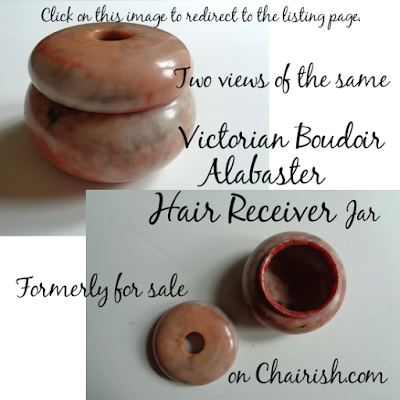
Kristin Holt | Victorian Hair Receiver: two photograph images of a singular Victorian Boudoir Alabaster Hair Receiver Jar. Formerly for sale on Chariish.com.


As with all "Dressing Table" accoutrements, Victorians gave family members and close friends items like hair receivers or brush-and-comb sets for their morning toilette.

Kristin Holt | Victorian Hair Receiver: Advertisement from The Boston Globe of Boston, Mass on December 3, 1899. Advertising "Comb and Brush Trays" for 49 cents, Hair Receivers (388 real China Hair Receivers, decorated by hand in choice patterns and traced with gold, at only.... 24 cents. 240 Royal Cobalt Thuringen Hair Receivers, beautiful underglaze, blue decoration and illuminated with best coin gold. Regular vaule $1.00. Special price 49c."
Hair Receivers Advertised in The Boston Globe (of Boston, Mass.), Dec 3, 1899.


Quick Price Comparison:  
49c in 1889 is approximately $15 in 2019 (latest date available).
24c in 1889 is approximately $7.50 in 2019 (latest date available).


Our nineteenth century ancestors had their own ideas about a lady’s toilette. (All the “getting pretty” one does in the morning.) You might be familiar with the old-fashioned “one-hundred strokes” of a hairbrush through one’s ankle-length, excruciatingly long 19th century hair. You might know all about the intricate hairstyles Victorian-American ladies twisted and braided and pinned. Oh, and curled. With 19th century curling irons. And augmented with hair that was never theirs to begin with. Let's just say Victorian ladies augmented and padded all sorts of things.

But what to do with the loose hairs in the hairbrush, comb, and clinging like a pestilence to one’s bustle? (If you have long hair like many of our 19th century ancestors before us, you know much HAIR is found by the vacuum and broom... it’s everywhere!)

Hence, ladies needed a place to stash all those loose hairs. Under the carpet won’t count, not even for lazy housekeepers or rich upper-crust Missus who have hired help to sweep up the mess later, Yes, including beneath the boudoir carpet. A lady requires a hair receiver.


Make Your Own, Like a 19th Century Gal

Kristin Holt | Victorian Hair Receiver. An 1876 set of craft instructions to create a lady's hair-receiver and hairpin cushion from a can, oiled silk, cardboard, ribbon, and more. From Perrysburg Journal of Perrysburg, Ohio on July 7, 1876.
Hair Receiver Craft Instructions from Perrysburg Journal, July 7, 1876.


If that style doesn’t appeal to you, here’s another! The writer’s descriptive words makes it possible to visualize the craft without requiring a photograph.

Kristin Holt | Victorian Hair Receiver (1 of 3). Uses of Paper-- an article from The Shosho Falls Post of Neosho Falls, KS (June 25, 1886), using paper to recover used containers and cardboard to decorate a lovely hair-receiver on very few pennies.

Kristin Holt | Victorian Hair Receiver (2 of 3). Uses of Paper-- an article from The Shosho Falls Post of Neosho Falls, KS (June 25, 1886), using paper to recover used containers and cardboard to decorate a lovely hair-receiver on very few pennies.

Kristin Holt | Victorian Hair Receiver (3 of 3). Uses of Paper-- an article from The Shosho Falls Post of Neosho Falls, KS (June 25, 1886), using paper to recover used containers and cardboard to decorate a lovely hair-receiver on very few pennies.


Why stash hair (of all things)?

To use it, of course.


Important 19th century uses of saved human hair:

1.      To fill a hair net (or twenty) [known in the day as a ratt or a rat], sewn closed, to fill out one’s own upd0. “It’s mine, naturally. All that luxurious fullness, all mine.”
2.    Specifically to stuff pin cushions—why? Because the oils on the hairs within would lubricate the pins each time they’re stored in the cushion, thus helping the pin slide through fabric.
3.    To stuff pillows, furniture upholstery, and padded clothing (like football pants)—as human hair was infinitely softer than other substances like straw. More importantly, hair is FREE. And it’s everywhere.
4.    Treasured artworkHair Embroidery is 3D in appearance and is often framed in a shadow box. Many Victorian fanciful artists won the equivalent of a blue ribbon (then known as PREMIUMS).
5.     Hair is so intimate, so personal, that women embroidered handkerchiefs for their soldier sweethearts or husbands to carry over their hearts. (I’m not kidding.) The embroidery would be in his lady’s hair—not ribbon, not dyed thread, but her hair. No matter the shade.
6.    When desperate, a beautiful head of hair could be sold. A market for human hair was alive and well throughout the Victorian era, around the world.
7.     To stuff mattresses, quilts, sugans, and anything else life might require.


A Unique Occupation

Kristin Holt | Victorian Hair Receiver. A Unique Occupation- Gray Hair Pullers. From The Dispatch of Moline, Illinois on August 31, 1895.
Do you recall the blog article I shared with you about the surprisingly LONG list of occupations in the Old American West? Let's add Gray Hair Puller.


Kristin Holt | Old West Employment, Well Beyond Sheriff, Livery Owner, Saloon Keeper, Cowboy and Rancher.


Invitation


Surprised? Do you know more about this fascinating subject?
Please scroll down and comment.


Related Articles

Kristin Holt writes articles about everything nineteenth century American West, and adores inter-connected ideas. This post scratches the surface of Victorian Hair and nineteenth-century grooming practices. Come explore!

Kristin Holt | Victorian Hair Augmentation
Kristin Holt | L-O-N-G Victorian Hair
Kristin Holt | Victorian Curling Irons

Kristin Holt | Styling Ladies' Hair: American 19th Century

Kristin Holt | Victorian Ladies' Hairdressers

Kristin Holt | Oatmeal in the Victorian Toilette
Kristin Holt | Freckles, Complexions, Cosmetics and Victorian Beauty Concoctions
Kristin Holt | False Beauty Spots
Kristin Holt | Lady Victorian's SecretKristin Holt | Victorian Hair: Indicative of Character
Kristin Holt | Old West Barber Shop
Kristin Holt | Old West Barber Shop Haircuts
Kristin Holt | Victorian Era Men's Hairstyles
Kristin Holt | Victorian Shaving, Part 1
Kristin Holt | What Did Pioneers Use for Quilt Batt?
Kristin Holt | Cowboy Quilts: Sugans
Kristin Holt | A Double-Topped Quilt: Remembering a Love of a Livetime
Kristin Holt | Victorian Era: The American West


Copyright © 2020 Kristin Holt LC

Wednesday, February 17, 2016

GROOMING THE CAT


Watch this blog for the upcoming Facebook Event you don't want to miss!

Post Copyright 2016 by Doris McCraw/Angela Raines


 I thought I'd take a break and investigate a different topic, grooming the cat. If anyone has tried this exercise, you know it is filled with challenges, frustrations and maybe a bit of laughter. Okay a lot of laughter; after the scars have healed. And how does this relate? Read on.

I can hear you saying, the cat grooms itself. Yes, they do, but sometimes they can use a bit of help. Just ask the cat owner who cleans up after a hairball has landed on the floor, bed cover or your shoes. Because the cat is used to grooming itself, they don’t like their owners manhandling them, unless of course you started when they were really young. How many people have done that?


Just like grooming a cat, anytime you try something new or challenging, there is that learning curve. The pain of getting scratched or worse, being disliked. Like the cat, you will get over it. No, you may not like it but once it’s done you do feel better.


When I started researching ‘my’ doctors, I ran into a lot of stuff, much of it did not even contribute to the overall information I was looking for. I had to clear the excess away and get to the basics. Even as I worked through the ‘women had a hard time’ scenario to get to the actual information, I found myself worrying about whether I would ever find the truth. I’m not saying women didn’t have a difficult time, but back then everyone had a difficult time compared to our lives. When we try to put our lifestyle against another it will always fall short of the other persons truth. The fiction writer can get away with some of those comparisons, but for historians it can cause problems.
LEAVING


So as I groom my cat, and he starts purring, then wanting to play with the comb, I find pleasure in his response. As I groom away the excess in my research, I also find a great deal of pleasure. But lest you think that excess fur, and excess information are a total waste, you can use the excess to create something new. No, I don’t usually use cat fur, but it would be fun to glue onto something creative. The excess information I don’t use, well it can end up in a story, as it has over the course of my short fiction writing career.


So you see, even grooming the cat has rewards. Until next time, here is to your own joy in grooming your ‘cat’.

Angela Raines is the pen name for Doris McCraw. Originally from the mid-west, Doris now calls the Rocky Mountains her home. Doris is a writer, historian, actor,and teacher. An avid reader Doris loves to spend time in history archives looking for the small, unknown pieces of history. Many times these pieces end up in her stories or poems.  Like her author page to stay on top of her work: http://amzn.to/1I0YoeL , and make sure to check out her haiku and photographs at http://fivesevenfivepage.blogspot.com.
“One Christmas Knight” Medieval Anthology
http://amzn.com/B017Z2BLH6
“Angel of Salvation Valley”
http://amzn.to/1P4JVV8
“A COWBOY CELEBRATION”
http://amzn.to/1GzwJhw
HOME FOR HIS HEART
http://amzn.to/1GJhpSu