Showing posts with label Godey's Ladies Magazine. Show all posts

Thursday, November 24, 2022

It's Not All About the Turkey! - Side Dishes Served at the First Thanksgiving by Jo-Ann Roberts


Happy Thanksgiving! 

No holiday is so completely defined by its food as Thanksgiving. No matter what part of the country you're in, it's safe to say at least some of the foods listed in this blog will be served on your table today. Read on to discover the sometimes-surprising history behind your favorite holiday dishes.

While we don't know the exact menu of the first Plymouth (or Plimouth - an alternative spelling that got my husband in trouble during elementary school!) feast, there was evidence of wild turkeys. In addition, boiled duck with onions, geese, and even passenger pigeons were the more prominent and available fowls. And given their proximity to the ocean, oysters, lobsters, clams, and eel were likely on the menu.

However, stuffing was quite different from what we're used to. Plymouth colonists didn't have white flour or butter so traditional bread stuffing wouldn't have been possible. Instead, they used chestnuts, herbs, and chunks of onions to flavor the meat.

Like local fowl, cranberries were widely available in the area along with Concord grapes, blueberries, and pawpaws (its taste compares to pineapple, mango, or
banana). The cranberries grew in such abundance, they were mashed with lard and dried venison to create pemmican.

Potatoes weren't yet cultivated in Plymouth prior to the first Thanksgiving, so how did mashed potatoes become a holiday staple?  Thank Sarah Josepha Hale, editor of Godey's Lady's Book. Her frequent appeals to officials and President Lincoln were compelling enough for him to declare Thanksgiving a national day of celebration in 1863. Her writings included recipes and descriptions of idealized Thanksgiving meals, which often featured--you guessed it--mashed potatoes!

Despite the lack of potatoes, it's likely a gravy of some sort accompanied the meats. Cooking meat in sauces dates back hundreds of years, and the word "gravy" was found in a cookbook from 1390.


To make the gravy, the remains of the roasted meat were put in a pot to make a broth. That broth would be thickened with grains to create a gravy to liven day-old meat...a precursor to today's leftovers!!!

Corn was a staple of the Native American diet and would have been nearly as plentiful then as it is today. But it was prepared either as a cornmeal bread or mashed or boiled into a thick porridge-like consistency. Sometimes it was sweetened with molasses.


Like cranberries, pumpkin pie does have ties to the original Thanksgiving but not in the way you might think. The Pilgrims knew how to make pie pastry but couldn't make it without flour. In addition, they were perplexed by pumpkins which were larger than the gourds they knew in England. Especially when they noticed the Native Americans using pumpkin as a dessert meal. They baked the pumpkin and squash in the ashes of a dying fire and sweetened with honey or maple syrup. It was likely that Sarah Josepha Hale was inspired by those stories when pumpkin pie appeared in her column!


As you gather with family, friends, loved ones, or neighbors today, remember it's not what's on the table but who's around the table that make us truly grateful for the blessings and bounty we have received.


My newest release, Noelle - Christmas Quilt Brides, goes live tomorrow, November 25th!!!!! Give yourself or your favorite reader an early Christmas present!

A widow reluctant to love again...
A deputy determined to win her heart...


Two years ago, Noelle Prentiss lost her husband to an outlaw's bullet. With two children to raise, a small farm to tend, and a job making quilts to sell at the mercantile, she's doing her best to keep her property and life intact...until a man claiming to be the new deputy rides into her life captivating her children with his dog, his smile, and his easy-going charm.

When Coleman West agrees to stop by the Widow Prentiss's home on his first day as a deputy in a small Kansas town, he has no way of knowing obeying the sheriff's order will change his life. Spurned by love years before, he became a lawman, dedicated to protect and serve. Yet, he has no idea the widow and her children would call to his heart in a way he never expected.

With Christmas looming, will the growing attraction between Noelle and the deputy reveal the gift of a second chance?

Or could a stranger from the deputy's past threaten the man who captured her heart?


Thursday, May 26, 2022

Practical and Pretty - A Short History of Hair Combs by Jo-Ann Roberts


I've discovered a few trends in my writing over the past five years. The majority of my tropes are second-chance romances; I write mostly as a pantster (loosely translated means I'm a person who writes by "the seat of her pants' as opposed to a plotter, or one who outlines her writing); and my heroes always, always insist on courting their ladies. So, when my hero--Lucas Harmon--in my Love Train release, 'Ainsley' sees a pair of hair combs with blue-colored stones reminding him of Ainsely's eyes, he knows they'd make the perfect courting gift.


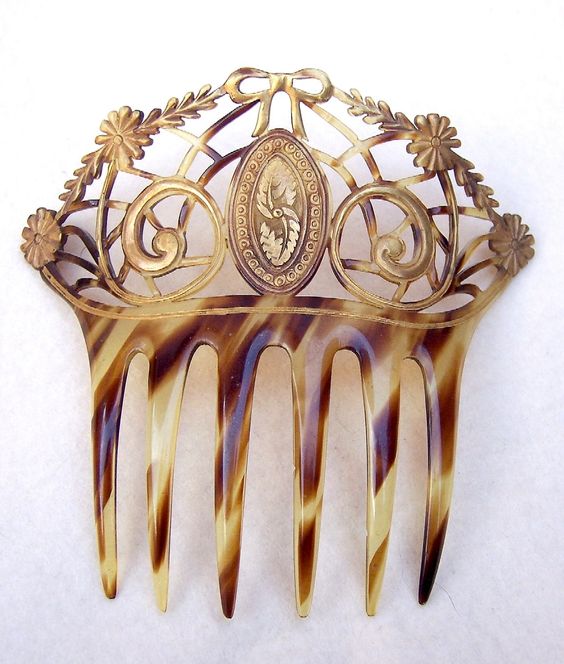
While researching hair combs, I learned these fashion accessories date from earliest times and were created from wood, bones, ivory, feathers, and other natural materials. Sometimes they were embellished with gems or painted with designs. At first, they were flat in construction, but over time they evolved into curved pieces to better fit the shape of women's heads.

During the Victorian era, decorative combs came in handy for pinning into place the false hair needed to achieve the illusion of abundant tresses. By the Civil War, mass manufacturing meant the combs were often adorned with paste jewels, making them within the reach of almost every pocketbook. Large, straight combs, many in graceful fan shapes were the centerpiece, accompanied by smaller side and curved back combs. In coiffure lingo, four teeth or more made a comb a comb. Three teeth qualified as a "hair ornament", while two marked it as a "hair pin".  
Hair combs were one of the key items used to adorn women's coiffures and helped them achieve the popular upswept hairdos of the times. Their importance was noted in the 1862 edition of Godey's Lady's Book and Magazine.

"The hair is rolled over a cushion in front, and arranged in a waterfall at the back, round which is twisted a heavy plait. The comb is of black velvet and gilt. The coiffure is composed of a black barbe and lilies of the valley. 

Plaits and puffs are also arranged with these combs in endless variety. When worn in the daytime, these small combs are made of light tortoise shell, with a row of small pearls. For the evening they are made of gold, either plain or studded with pearls, coral, steel, gilt, or even precious stones..."


Yet, the same publication encouraged readers to make their own.

"Fancy combs are still the rage, and very economical ones may be made by cutting a fancy design out of cardboard, such as knots, bows, linked rings, etc., and covering them with gilt, steel, or jet beads, and fastening them on a small plain comb." 

Types of Hair Combs

Initially, combs were widely made of steel, gilt metal, brass, and other types of metals. 


Tortoise shell has been used since ancient times. Its popularity began with the trend of the Spanish mantilla and would remain until it became scarce, being replaced by gutta-percha.


Although tortoiseshell and gutta-percha were popular, the most plentiful and popular material for hair combs throughout the 19th century was probably horn--partly because it was easy to find and cheaper than tortoiseshell. It was also extremely flexible, acting almost like plastic that could be easily cut, bent, stretched, pierced, or carved. Horn also easily lent itself to imitating the popular tortoiseshell pattern.
 

Decorative hair combs of the 19th century ranged from Gothic and Renaissance styles to Napoleonic and Oriental designs. Materials used to create combs also changed so quickly as the styles and what was popular one day was out of fashion the next.

Still...I'd like to believe that Ainsley will love the set of hair combs not only because they are beautiful but because Lucas gave them to her along with his love.


Ainsley - Book 8
Available for Pre-Order June 1st