In celebration of the 2022 Women's History Month theme, "Providing Healing, Promoting Hope," Elizabeth Blackwell championed the participation of women in the medical profession and ultimately opened her own medical college for women.
The third daughter in a family of five girls and four boys, Elizabeth was born in England and moved to America with her family at age 11. Her father, who was a social reformer, saw to it that his daughters as well as his sons were well-educated and developed their talents.
The Blackwell Family 1905
It wasn't an interest in science or anatomy that motivated Elizabeth Blackwell to become the first woman in America to earn a medical degree. Sitting by the bedside of a dying friend suffering from ovarian cancer, the woman said, "If I could have been treated by a lady doctor, my worst suffering would have been spared me." She then went on to encourage Elizabeth to study medicine. At the time, Blackwell was working as a teacher in Kentucky and dismissed the idea.
"I hated everything connected with the body and could not bear the sight of a medical book." Elizabeth Blackwell
However, within a couple of years after that conversation, Elizabeth began to pursue a medical degree.
After a year of teaching and studying in North Carolina, she moved to Philadelphia, then considered the foremost seat of medical learning in America. Though she applied and was turned down by four medical colleges, a professor at the most prestigious of them told her she could enter if she disguised herself as man. Another professor advised her to go to Paris for training.
"...neither the advice to go to Paris nor the suggestion of disguise tempted me for a moment." Elizabeth Blackwell
Elizabeth broadened her search to include smaller schools of the northern states---"country schools'--as they were called. When she applied to Geneva Medical College in western New York, the faculty decided to let their students make the call. Assuming the measure could not possibly pass, administrators stipulated that a single "no" vote would end her bid. Some students thought her application was a prank from a rival school, while others were simply amused. Unanimously, they voted "yes".
Blackwell was admitted.
During her two years at Geneva, the male students accepted her and treated her well. But she slowly realized that many women in the small town considered her odd, so she kept to herself.
"I never walked abroad but hastened daily to my college as to a sure refuge...I shut out all unkindly criticism and soon felt perfectly at home amongst my fellow students." Elizabeth Blackwell
At graduation, Elizabeth found herself at the top of--and respected--by her peers.
Hobart & William Smith College (formerly Geneva College)
The news of her accomplishment as the first woman doctor in the United States traveled fast and far. The editor of a weekly newspaper in Washington, D.C. wrote a long article about her.
"She is one of those who cannot be hedged up, or turned aside, or defeated...She is a woman, not of words, but deeds; and all those who only want to talk about it, may as well give up." The National Era Newspaper
She continued her training at London and Paris hospitals, though doctors there relegated her to midwifery or nursing. She began to emphasize preventative care and personal hygiene, recognizing that male doctors caused infections by failing to wash their hands between patients.
Along with her sister, Emily--a doctor in her own right--the two doctors founded the New York Infirmary for Women and Children. And when the Civil War broke out, they trained women nurses for the Union Army, despite meeting resistance from male army doctors. Though Elizabeth left after two years, her sister stayed on to manage the facility for the next 40 years, staffing it with women and caring for more than 7,000 patients per year.
Initially, Elizabeth planned to become a surgeon. But after a medical accident that left her blind in one eye, she was forced to take a different path. Following the Civil War, she launched a women-only medical college in 1868. The Women's Medical College of the New York Infirmary quickly gained a reputation for its rigorous standards and was eventually absorbed by Cornell University.

The Women's Medical College of the New York Infirmary
Though she never married, Elizabeth did adopt a daughter, an Irish orphan named Kitty Barry in 1856. Treating the domestic helper as much as a member of her family, she ensured Kitty was educated. For her part, Kitty stayed by her adopted mother for the remainder of her life.
Elizabeth and Kitty circa 1906
In 1875 she returned permanently to London where she became a professor of Gynecology at the new London School of Medicine for Women. She also helped found the National Health Society and published several books, including an autobiography, Pioner Work in Opening the Medical Profession to Women in 1895.
Elizabeth Blackwell's tenacity and trailblazing achievements helped expand women's success in the medical field in the United States and beyond.

Sources:


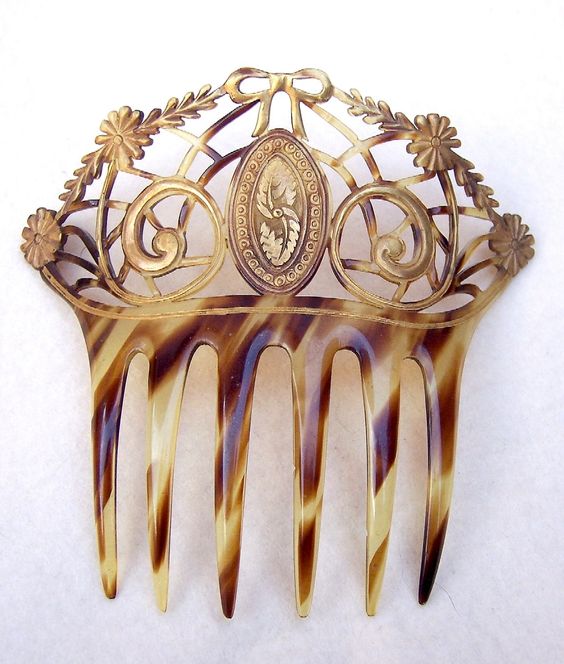
 Hair combs were one of the key items used to adorn women's coiffures and helped them achieve the popular upswept hairdos of the times. Their importance was noted in the 1862 edition of Godey's Lady's Book and Magazine.