Showing posts with label turkey. Show all posts

Tuesday, November 4, 2025

Gobble! Gobble! Thanksgiving Feasts by Marisa Masterson

 Ah! The turkey. I can easily conjure up the smell of it roasting in the oven. Does it bring to mind Thanksgiving for you, also?

Consider the sound we associate with it. Gobble! Gobble! Have you noticed the double meaning of that in connection with the holiday meal?

We think of it as a sound, true. Also, it is what happens at the meal. And that is one reason turkeys became the food of choice for the special day.

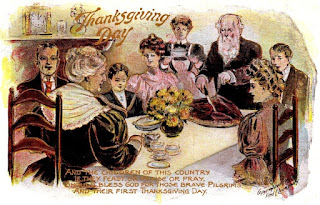
Homer Winslow's view of Thanksgiving

In the nineteenth century, Thanksgiving went from being a regional celebration to a national holiday. Communities would come together to celebrate. Turkeys provided enough meat--much more than chickens--to feed many people. And since it had been an early symbol of the feast, it became the choice for the holiday.

I remember my grandfather speaking about raising turkeys on his farm in the 1930s and 1940s. He would ship them to Chicago. Because of the appetite for the bird, his children received Christmas presents.

So, gobble, gobble up the meal this year and Happy Thanksgiving!

https://www.amazon.com/dp/B0CKCTCKJC


Thursday, November 24, 2022

It's Not All About the Turkey! - Side Dishes Served at the First Thanksgiving by Jo-Ann Roberts


Happy Thanksgiving! 
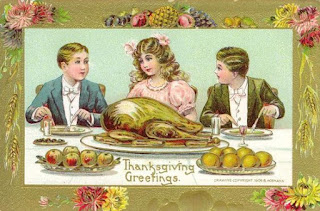
No holiday is so completely defined by its food as Thanksgiving. No matter what part of the country you're in, it's safe to say at least some of the foods listed in this blog will be served on your table today. Read on to discover the sometimes-surprising history behind your favorite holiday dishes.

While we don't know the exact menu of the first Plymouth (or Plimouth - an alternative spelling that got my husband in trouble during elementary school!) feast, there was evidence of wild turkeys. In addition, boiled duck with onions, geese, and even passenger pigeons were the more prominent and available fowls. And given their proximity to the ocean, oysters, lobsters, clams, and eel were likely on the menu.

However, stuffing was quite different from what we're used to. Plymouth colonists didn't have white flour or butter so traditional bread stuffing wouldn't have been possible. Instead, they used chestnuts, herbs, and chunks of onions to flavor the meat.

Like local fowl, cranberries were widely available in the area along with Concord grapes, blueberries, and pawpaws (its taste compares to pineapple, mango, or
banana). The cranberries grew in such abundance, they were mashed with lard and dried venison to create pemmican.

Potatoes weren't yet cultivated in Plymouth prior to the first Thanksgiving, so how did mashed potatoes become a holiday staple?  Thank Sarah Josepha Hale, editor of Godey's Lady's Book. Her frequent appeals to officials and President Lincoln were compelling enough for him to declare Thanksgiving a national day of celebration in 1863. Her writings included recipes and descriptions of idealized Thanksgiving meals, which often featured--you guessed it--mashed potatoes!

Despite the lack of potatoes, it's likely a gravy of some sort accompanied the meats. Cooking meat in sauces dates back hundreds of years, and the word "gravy" was found in a cookbook from 1390.


To make the gravy, the remains of the roasted meat were put in a pot to make a broth. That broth would be thickened with grains to create a gravy to liven day-old meat...a precursor to today's leftovers!!!

Corn was a staple of the Native American diet and would have been nearly as plentiful then as it is today. But it was prepared either as a cornmeal bread or mashed or boiled into a thick porridge-like consistency. Sometimes it was sweetened with molasses.


Like cranberries, pumpkin pie does have ties to the original Thanksgiving but not in the way you might think. The Pilgrims knew how to make pie pastry but couldn't make it without flour. In addition, they were perplexed by pumpkins which were larger than the gourds they knew in England. Especially when they noticed the Native Americans using pumpkin as a dessert meal. They baked the pumpkin and squash in the ashes of a dying fire and sweetened with honey or maple syrup. It was likely that Sarah Josepha Hale was inspired by those stories when pumpkin pie appeared in her column!


As you gather with family, friends, loved ones, or neighbors today, remember it's not what's on the table but who's around the table that make us truly grateful for the blessings and bounty we have received.


My newest release, Noelle - Christmas Quilt Brides, goes live tomorrow, November 25th!!!!! Give yourself or your favorite reader an early Christmas present!

A widow reluctant to love again...
A deputy determined to win her heart...


Two years ago, Noelle Prentiss lost her husband to an outlaw's bullet. With two children to raise, a small farm to tend, and a job making quilts to sell at the mercantile, she's doing her best to keep her property and life intact...until a man claiming to be the new deputy rides into her life captivating her children with his dog, his smile, and his easy-going charm.

When Coleman West agrees to stop by the Widow Prentiss's home on his first day as a deputy in a small Kansas town, he has no way of knowing obeying the sheriff's order will change his life. Spurned by love years before, he became a lawman, dedicated to protect and serve. Yet, he has no idea the widow and her children would call to his heart in a way he never expected.

With Christmas looming, will the growing attraction between Noelle and the deputy reveal the gift of a second chance?

Or could a stranger from the deputy's past threaten the man who captured her heart?


Thursday, November 25, 2021

Thanksgiving A la Carte - by Jo-Ann Roberts


Although Thanksgiving has been celebrated in America in some form or another since the first day of giving thanks at Plymouth Plantation in October, 1621, the holiday didn't become an annual tradition in this country until 1863.


While the Thanksgiving turkey is a nod to the early Pilgrims and settlers who relied on wild turkey among other fowls found in the New World, cooks during the Victorian era became more creative. Instead of using ingredients like stale bread and corn meal, turkeys might be stuffed with chestnuts, cranberries, oysters or various fruits, and tended to vary depending upon what was locally fresh and available.

In early America there were taverns, inns, and boarding houses that offered supper, but there were no restaurants. Delmonico's, the first American restaurant, opened in 1831 in New York City. Along with a growing population, the number of restaurants grew with the patrons exclusively male! 


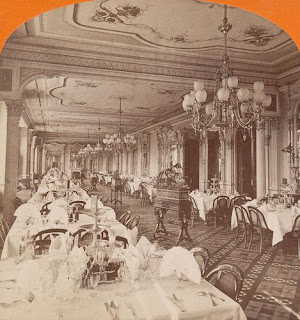
Soon, from the Waldorf-Astoria in New York to the Palmer House in Chicago, fine dining was the rage for the affluent, socially elite.

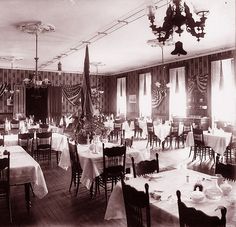
After the Civil War--with the expansion of the railroads and settlers moving westward--the number of restaurants expanded from north to south, east to west.  Though some restaurants served Thanksgiving dinner--mostly to lonely bachelors--the holiday was still a "home" occasion. 

By the 1880s, women had begun to join their husbands and brothers at restaurants--no lady would be caught dining out unless she had a male escort. Consequently, Thanksgiving dinner at restaurants soon became acceptable, if not attractive.

During America's gilded age (1890s - World War I), many restaurants were in grand new "palace" hotels. This was a time of over-abundance with an amazing volume of food prepared for the Thanksgiving menu. 


Hotels in Kansas City, Missouri, outdid themselves in 1888. Items on the Thanksgiving menu included Blue Point oysters, little neck clams, calf's brains, buffalo tongue, red snapper, salmon, turkey, duck, squirrel, asparagus, artichokes, puddings, pies, ice cream, macaroons, and a host of imported cheeses.

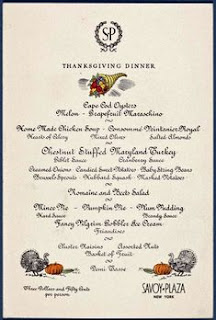
Menus, whether written on wooden planks with pieces of coal or on slates with chalk, or later, on paper, were the earliest bills of fare telling patrons what foods were offered for that particular day as well as prices. For special occasions, such as Thanksgiving, hotels designed fancy menus, using wonderful colors and images.


Menu's could be fringed, embossed or textured. Using silk ribbons, many showed great imagination and originality in terms of layout, illustrations and typeface.


In the early 20th century, the growing female workforce and the scarcity of household help led to foods that were practical and easy for everyday consumption, and especially for the holidays.

The 1925 Thanksgiving Day menu from the Hotel Brunswick..."the fare was "all American," from grapefruit with maraschino through pumpkin pie and sweet cider. The entrees were turkey, goose and scallops."

Fine dining, fueled by wine and liquor, met its demise by Prohibition. While Delmonico's closed, other restaurants housed inside hotels survived because its guests needed to be fed.

Soon, a new type of restaurant--the family restaurant--appeared in the 1930s. They served basic, simple wholesome "American" food. A 1935 Thanksgiving Day menu from the Governor Clinton Hotel featured..."for $2 patrons could feast on celery, American cheese with saltines, and condiments. Entrees were turkey, ham, and crab Newburgh."

Following World War II, refugees from war-torn Europe opened restaurants, featuring ethnic cuisine on Thanksgiving menus. Ethnic restaurants were not a new phenomenon in America. German immigrants came in 1850s, followed by the Chinese in 1870s, the Italians in 1880s, the Russians in the 1920s, and the Mexicans in the 1950s. 

Today, falafel, chicken shawarma, stuffed grape leaves, pho, and lasagna are just as likely to be featured on Thanksgiving Day menus as turkey, stuffing, and pumpkin pie.

Whether you rise early on Thanksgiving morning to pop that bird in the oven, cook the side dishes, and set the table for four, eight, or twelve or sleep in, watch the parade, then meet family and friends at a restaurant for a holiday feast, from our home to yours,

Happy Thanksgiving!