Showing posts with label "Ainsley". Show all posts

Thursday, August 25, 2022

The Wiggins Ferry - A Connecting Point Over the Mississippi River


When I was plotting out the details of Ainsley - Book 8 in the Love Train Series, I knew Ainsley MacKenzie was from Boston. Therefore, she'd need to travel as far as the Mississippi River on regional train lines until she arrived in East St. Louis, Illinois. However, in 1872 there were no railroad bridges spanning the river in that area. 

So, how would she get across to the Union Pacific Train 1216 to get to New Hope, Kansas?

Through my research, I discovered the Wiggins Ferry Company. In 1797, Captain James Piggott was granted the right to operate a ferry between St. Louis and the opposite shore of the Mississippi River. Passengers loaded into small hollowed-out tree trunks at Piggott's ferry house just below Market Street and were shuffled across the river by poles or paddles with long sweeps. After a few changes in ownership, Piggott's ferry ended up in the hands of Samuel Wiggins, whose name would be tied to it for than a century to come.

Like the one in this painting, Wiggins ferries had one platform on each side of the pilothouse. Typically, new passengers and cargo loaded onto one side, and outgoing passengers and cargo disembarked on the other.   Missouri Historical Society Collection

Crossing the river in the earliest years of the Wiggins Ferry was a gargantuan task. John Darby, who became the mayor of St. Louis in 1835, moved his family and their belongings across to St. Louis in 1818 over a three-day period and for the fee of $50--no small sum of money at the time.


"The ferry consisted of a small keel-boat, which was managed entirely by Frenchmen. Every portion of the body--every muscle, in fact--was brought into play...the vessel rocked so that the trace-chains at the end of the tongue often dipped into the river...so that the enterprise seemed a dangerous and hazardous undertaking."

Mr. Wiggins soon acquired some 900 acres of land along the Illinois banks of the river directly across from present day St. Louis, Missouri. Not only did the ferry company operate a service for individuals wanting to cross the river, but it also developed boat yards, depots, warehouses, railroad tracks, and elevators. Soon, the Wiggins Ferry Company became a major connecting point for the many railroads terminating at East St. Louis, Illinois and St. Louis, Missouri.


Through the haze of early 1900s St. Louis, the Eads Bridge looms over the icy Mississippi River. Murphy Library Special Connections, University of Wisconsin-LaCrosse.

Winter river crossings in 1839 became easier thanks to the Iceland and its pointed, ice-smashing iron hull. Despite some setbacks--including an 1851 ferry explosion and the loss of four boats to an ice field in 1864--the Wiggins Ferry company kept expanding as did St. Louis.


From those small beginnings and makeshift rafts, the Wiggins Ferry Company built an empire transporting people to and from St. Louis. By the 1820s, Wiggins had a fleet of ferryboats with names fit for battleships, such as the Sea Serpent, Rhinoceros, and Antelope. He even experimented with ferries by horses on treadmills. In 1830, the company upgraded to steam power, with the St. Clair and the Ibez ferries making two regular daily river crossings. By the early 1870s, the company was averaging river crossings of 1,500 people, 10,000 bushels of coal, and 750 wagons each day.

The company's stock reached $1 million just as the Eads Bridge, St. Louis's first bridge across the Mississippi was rising in the middle of the river. As the bridge would not be completed until 1874, I had my answer!

The Love Train series is now complete! Penned by ten best-selling and award-winning authors, each book is a stand-alone romance that you don't want to miss!


If you'd like to read an excerpt of Ainsley, CLICK HERE


Thursday, May 26, 2022

Practical and Pretty - A Short History of Hair Combs by Jo-Ann Roberts


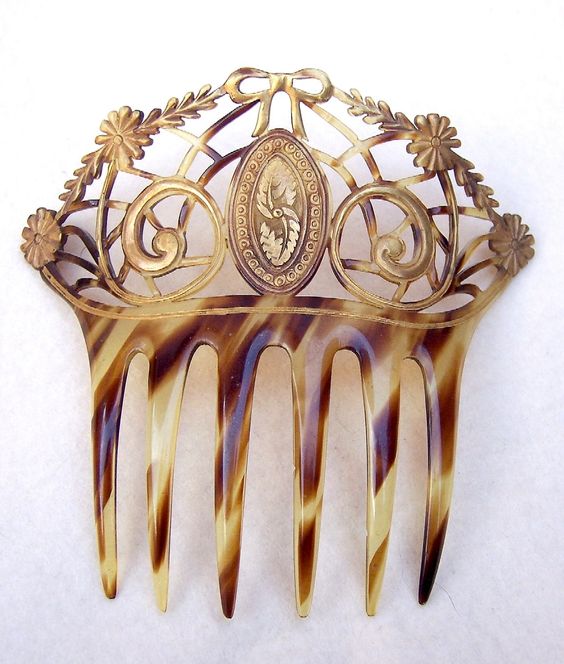
I've discovered a few trends in my writing over the past five years. The majority of my tropes are second-chance romances; I write mostly as a pantster (loosely translated means I'm a person who writes by "the seat of her pants' as opposed to a plotter, or one who outlines her writing); and my heroes always, always insist on courting their ladies. So, when my hero--Lucas Harmon--in my Love Train release, 'Ainsley' sees a pair of hair combs with blue-colored stones reminding him of Ainsely's eyes, he knows they'd make the perfect courting gift.


While researching hair combs, I learned these fashion accessories date from earliest times and were created from wood, bones, ivory, feathers, and other natural materials. Sometimes they were embellished with gems or painted with designs. At first, they were flat in construction, but over time they evolved into curved pieces to better fit the shape of women's heads.

During the Victorian era, decorative combs came in handy for pinning into place the false hair needed to achieve the illusion of abundant tresses. By the Civil War, mass manufacturing meant the combs were often adorned with paste jewels, making them within the reach of almost every pocketbook. Large, straight combs, many in graceful fan shapes were the centerpiece, accompanied by smaller side and curved back combs. In coiffure lingo, four teeth or more made a comb a comb. Three teeth qualified as a "hair ornament", while two marked it as a "hair pin".  
Hair combs were one of the key items used to adorn women's coiffures and helped them achieve the popular upswept hairdos of the times. Their importance was noted in the 1862 edition of Godey's Lady's Book and Magazine.

"The hair is rolled over a cushion in front, and arranged in a waterfall at the back, round which is twisted a heavy plait. The comb is of black velvet and gilt. The coiffure is composed of a black barbe and lilies of the valley. 

Plaits and puffs are also arranged with these combs in endless variety. When worn in the daytime, these small combs are made of light tortoise shell, with a row of small pearls. For the evening they are made of gold, either plain or studded with pearls, coral, steel, gilt, or even precious stones..."


Yet, the same publication encouraged readers to make their own.

"Fancy combs are still the rage, and very economical ones may be made by cutting a fancy design out of cardboard, such as knots, bows, linked rings, etc., and covering them with gilt, steel, or jet beads, and fastening them on a small plain comb." 

Types of Hair Combs

Initially, combs were widely made of steel, gilt metal, brass, and other types of metals. 


Tortoise shell has been used since ancient times. Its popularity began with the trend of the Spanish mantilla and would remain until it became scarce, being replaced by gutta-percha.


Although tortoiseshell and gutta-percha were popular, the most plentiful and popular material for hair combs throughout the 19th century was probably horn--partly because it was easy to find and cheaper than tortoiseshell. It was also extremely flexible, acting almost like plastic that could be easily cut, bent, stretched, pierced, or carved. Horn also easily lent itself to imitating the popular tortoiseshell pattern.
 

Decorative hair combs of the 19th century ranged from Gothic and Renaissance styles to Napoleonic and Oriental designs. Materials used to create combs also changed so quickly as the styles and what was popular one day was out of fashion the next.

Still...I'd like to believe that Ainsley will love the set of hair combs not only because they are beautiful but because Lucas gave them to her along with his love.


Ainsley - Book 8
Available for Pre-Order June 1st


Thursday, February 24, 2022

Unpacking History - Steamer Trunks by Jo-Ann Roberts


Some months ago, author Pam Crooks invited me to be part of a multi-author project, "The Love Train" with nine other talented authors. All sweet western historicals, the couples meet on the Union Pacific, their fledging romance aided by a matchmaking conductor, a baggage handler, and a dog named Scruffy. Their stories would then move to a town, city, or ranch.

Never having been part of a project of this sort, I agreed...whole heartedly!

It's 1872, and my heroine, Ainsley MacKenzie, is traveling aboard the Union Pacific from Boston to New Hope, Kansas to visit her brother and his family for the Christmas holiday. If you read Brides of New Hope, you'll recall that Eli and Lessie MacKenzie play an integral part in the series. 

Raised in a gracious, aristocratic Bostonian family and accustomed to the finer things in life, Ainsley needed a trunk or two or maybe six to hold all her necessities.  

Thus, let the research begin...


History of the Steamer Trunk

From 1870 to 1925, steamer trunks rose in popularity initially because of the railroad's expansion in the United States that created the notion of fast, modern travel. But steam ships quickly came to the forefront because of the speed with which they could cross the Atlantic. Consequently, the steamer trunk was created to carry those all-important personal belongings onboard the ship for long voyages.   

By the 1920s, steamer trunks had started to go out of fashion. They were replaced with larger trunk models that would act as a wardrobe and more modern luggage choices.

Construction

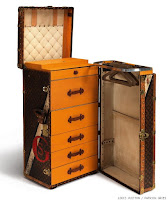
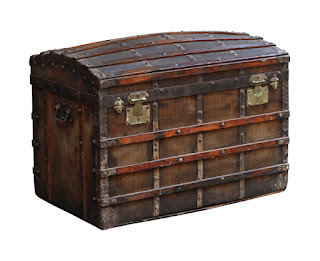
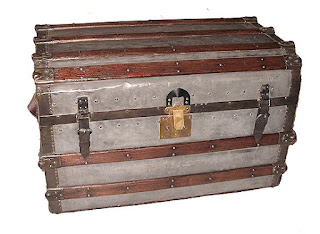
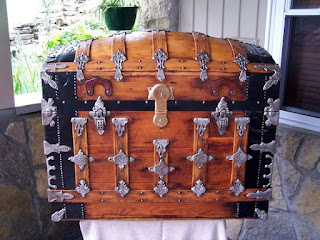
Trunks were generally made of a pine or metal box and covered with leather, vellum, waterproof paper, wood slats, canvas or animal hides. Some were bound by metal bands for strength, while other had detachable leather straps with buckles. Most trunks had a sturdy handle at each end for easy transportation.  

High-end steamer trunks--similar to the variety Ainsley MacKenzie might have used--had unique designs blended into the material. Most of these trunks had inside trays, hangers, or compartments making them more functional for storage or placement of personal items, such as parasols or jewelry. Considerably more expensive, these trunks needed more craftmanship.


Popular Styles

Like most things during the Victorian period, trunks began with a simple construction but soon featured a variety of different designs

The Dome Top

Because of its ornate design and cost, the dome top trunks were mainly owned by the wealthy. It would have been purchased for a bride on her wedding day or used in the home to store valuable items.

The Bevel Top

The bevel top trunk could have been either flat or domed, but it had more ornate beveling on the top. These would have been practical for traveling, because you could stack them if they were flat. While still expensive, they were used by more middle-class travelers who could afford a little bit extra ornamentation.


Monitor Top

A monitor top trunk is flat but with rounded edges. Some were very ornate, while others were plain. They varied both in hardware and in price. They provided more space than the flat top trunk, but still would have been practical.


Saratoga Trunk 

Named after Saratoga, New York, these trunks were larger with numerous decorative touches in their design. They were covered in metal detailing or decorative leather. Plus, they had large compartments for personal belongings. One of the fancier options, they were the reflection of wealth and affluence of their owners.


Steam Trunk Manufacturers

Most trunk manufacturers didn't inscribe their trunks with a mark, and those that did, the simple paper marking did not last.

However, some of the more reputable manufacturers designed and installed proprietary hardware. Martin Maier of Detroit, Michigan was one such manufacturer. He used cast iron hardware, hinges, and decorative tin corner pieces. On most of his trunks, two M's were stamped into the metal hardware. His trunks were easily identified by their rounded oak slats, each specially fitted, and hand turned.


Other popular, high-end trunk manufacturers of the time were M.M. Secor, Goyard, and Louis Vuitton...yes, that Louis Vuitton!
  

Many of the middle- and lower-class travelers opted for more affordable trunks manufactured by Moynat, Malloy, Oshkosh, and the Shwayder Trunk Company.


An Interesting Steamer Trunk Fact

Steamer trunks were recovered from the wreckage of the Titanic and documents were found intact inside their oxygen starved compartments!

Presently, antique steamer trunks are a high sought-after find in thrift stores or antique shops. You can often find these "resting travelers adorning the center of a living room or housing antique quilts in a bedroom.

Can you imagine the adventurous, wondrous tales they could tell?

******************************

Books by Jo-Ann Roberts


Releasing July 15, 2022