Showing posts with label Early Colorado Forts. Show all posts

Wednesday, August 19, 2020

LESSON PLANS- EARLY COLORADO

Photo property of the author


Lesson Plans - Early Colorado

 Post by Doris McCraw writing as Angela Raines

I was talking with a friend the other day about the richness of the history that surrounds us here in Colorado, as well as other parts of this country. Not the major events, we all know those, but the stories of the smaller, yet important events. To that end, I'll be sharing history, the history that our stories are born from.

I started the series on another blog with 'Acting lessons for Writers' which you can read here. Acting Lessons for Writers

This post will cover the early days of what later became the state of Colorado.

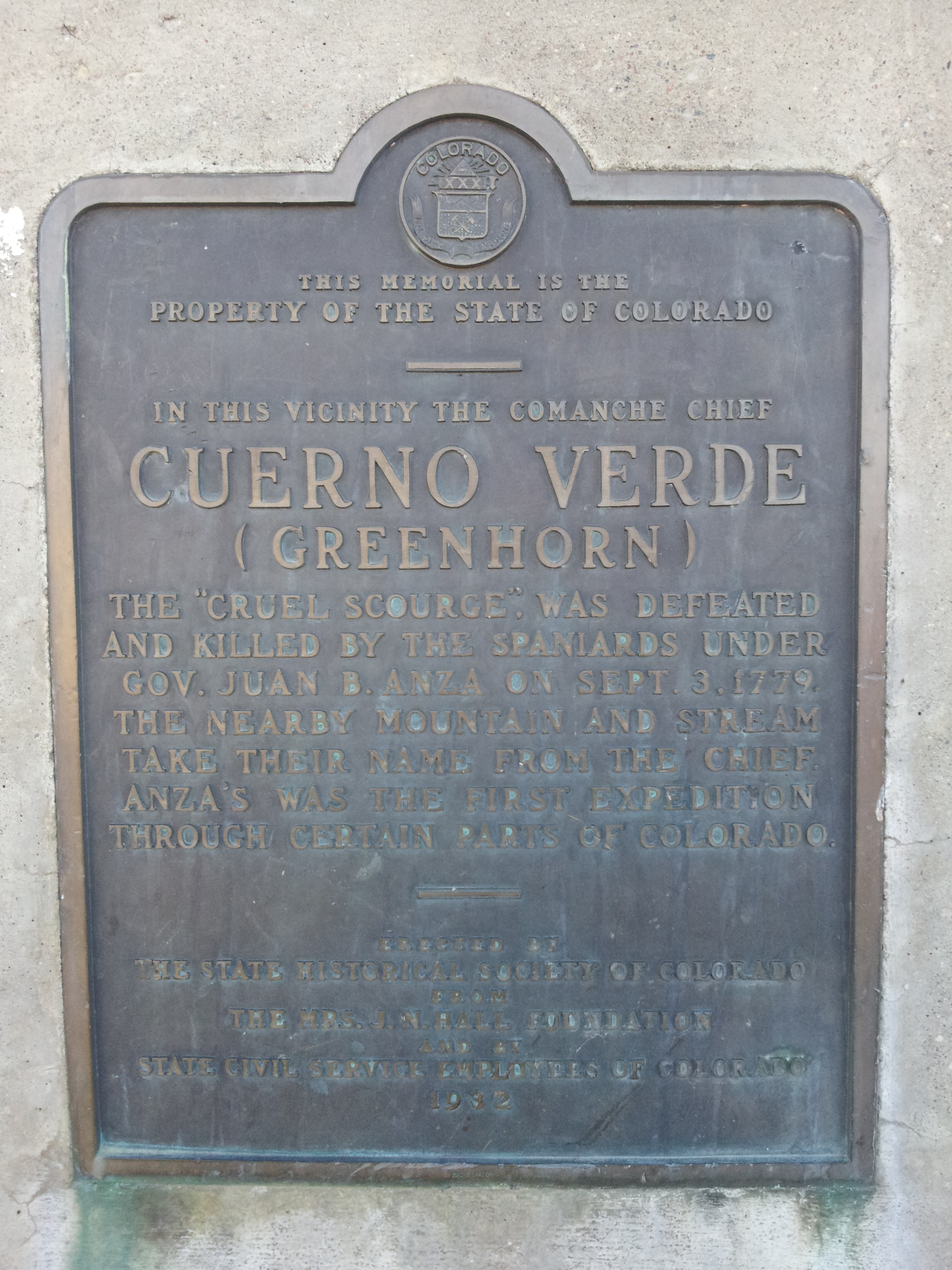
One of the first things I learned about early Colorado was the conflict between General DeAnza and Cuerno Verde. Cuerno Verde had been harassing the settlers in far Southern Colorado near what is now the New Mexico border. In 1779 De Anza traveled up from New Mexico probably through South Park and down Ute Pass. He had running battles along the front range and eventually caught up with Cuerno Verde near the Greenhorn Mountains. Cuerno Verde died Sept. 3, 1779. You can find the marker along near Highway 166. For more on this story: 

Juan Bautista de Anza: The King's Governor in New Mexico

Cuerno Verde - Wikipedia
Photo from en.wikipedia.org

Of course, Colorado was also known for its Fur Trading Forts. The most famous and well known is Bent's Fort, which was located near the Arkansas River near La Junta, Colorado. The current building is a reconstruction of the second fort and well worth a trip to visit. (While there be sure to take in the museums and the Comanche Grasslands, including Picketwire Canyon where you can still see dinosaur footprints.) This is a rich and deep history of the early days of Colorado when the Mountain Men and businessmen such as the Bents, Vazquez, and Rubidoux made their mark on the development of the territory. For more information: 

Colorado Forts: Historic Outposts on the Wild Frontier

The Fur Trade in Colorado


Bent's Old Fort view from the North
Photo from the National Park Service

Of course, no early history would be complete without the journey of Zebulon Pike, who traversed the central and southern part of the Front Range of Colorado. There is even a mountain that bears his name, although he never made it to the top. There is a reconstructed stockade about seventeen miles southeast of Alamosa on the Rio Conejos. You can also visit Pueblo, Colorado where Pike built another stockade during in 1806-07 expedition. An edited version of his diary is available for those who would like to read more. 

The Southwestern Journals of Zebulon Pike, 1806-1807

by Stephen Harding HartArcher Butler Hulbert, et al.


      Pike Stockade
From Colorado Encyclopedia.org

So for those of you who wish to learn more about the rich early history of Colorado here is a start. More lesson plans will be forthcoming.

The book "The Outlaw's Letter" contains later Colorado History. Here is just a small sample:

 "I'd like to check the train schedule when we get into town," Hetty said. "Without Odysseus, train travel would probably be the safest way to head back to Kiowa Wells."

"Station's near the edge o' town," Clover added from the front seat.

"You know you can visit me any time," Hetty offered to Maude and Clover.

Maude gave Hetty a sad smile. Hetty knew Maude didn't think she'd be welcomed, but Hetty knew everyone would love the woman. Before Maude could reply, Hetty saw a new three-story brick building going up.

"What's that?" Hetty asked.

A passerby hearing the question, shouting the answer, pride in his voice, "That's the new school, and we have a military academy being built also."

"It looks beautiful," Hetty called back, "you have a right to be proud." Looking over at Maude, Hetty caught a look of want and sadness. It gave her an idea.


The Outlaw's Letter (Lockets and Lace Book 15)
Amazon


Doris Gardner-McCraw -
Author, Speaker, Historian-specializing in
Colorado and Women's History
Angela Raines - author: Telling Stories Where Love & History Meet


Wednesday, November 15, 2017

FORT LUPTON

Post by Angela Raines

Fort Lupton, is the fourth post that was located within fifteen miles of each other east of Longs Peak in the Rocky Mountains in the Platte River Valley.  The other three were Fort Vasquez, Fort Jackson, Fort St. Vrain.

What is interesting about this location, there is actually a town, Fort Lupton, near the site of the original fort. The fort and also the town named after him was founded by Lnacaser P. Lupton. He had been a lieutenant with Col. Henry Dodge when Dodge headed an expedition into the Rocky Mountains. Lupton saw that the fur trade was a going concern in the area. He took a leave of absence from the service and came back to the area around 1836-37 and established a trading post. The original name was Fort Lancaster but was changed to Fort Lupton. The fort itself was abandoned in the early 1840s. The fort building was later used as a stage station on the mail route from Missouri to Colorado, specifically Denver. It was also used as a refuge during the Indian uprisings of 1864. The town of Fort Lupton was incorporated in 1890 and still exists today, although the original fort no longer exists, like Fort Vasquez, a replica has been build.

Dedication of 'New Fort Lupton'

An excerpt from the journey of  E. Williard Smith, who traveled from Missouri in August of 1839, he speaks of meeting Lupton on the journey westward. Here from the 30th of August, "We still travel as usual. We have been expecting to overtake Lupton every day. He is a mountain-trader, on his way to the trading-post, on the river Platte. We overtook him to-day about noon. His party had stopped to eat dinner, and allow their annuals to feed. He had six wagons drawn by oxen. They had started about twelve days before us. He mistook us for Indians as we were approaching and was somewhat alarmed." (Colorado Magazine, July 1950)  What is even more interesting, Smith was in the company of Vasquez and Sublette, from Fort Vazquez, the competition for the fur trade in the area.

As history points out, these post, including Fort Lupton, contracted for trade goods to be brought from the East by wagon or pack-horse trains,for the Indians/ In turn the Indians brought their buffalo robes and pelts to trade for said goods. Fort Lupton became a rendezvous for the independent trappers of the mountain region west of there. They also bartered their furs for equipment and supplies. 

As you can see, during a brief, but intense time, these four forts vied for the trade, both with Indians and Trappers in this small region along the Platte River. Time and space have limited the amount of information shared. Still this brief time is full of so many stories and people. It was a time of expansion for the United States and these adventurous men were in the forefront of that expansion.


Doris Gardner-McCraw -
Author, Speaker, Historian-specializing in
Colorado and Women's History

Angela Raines - author: Where Love & History Meet
For a list of Angela Raines Books: Here 
Photo and Poem: Click Here 
Angela Raines FaceBook: Click Here


Wednesday, August 16, 2017

EARLY FORTS: FORT VASQUEZ

Post (c) Angela Raines

Fort Vasquez:


I have a passion for history, and the early history of my adopted state is a strong passion. I hope you will join me as I take a journey through the early forts in Colorado over the next few posts. One such place I visited was the site of Fort Vasquez. This one is located between Greeley and Ft. Lupton in Platteville on Highway 85. This site is not only a reconstruction of the original fort, but is also a welcome center and museum. The museum may be small, but fascinating. The staff is extremely knowledgeable about the fort and the era when this type of business/trading post was important in what was to become the state of Colorado.

With the growth and change in the fur trade industry came the business forts.  Originally the trappers, mountain men, would take their furs to St. Louis and other Eastern cities.  Then there came the rendezvous where the furs were brought to areas closer to the mountains.  Finally the forts, such as Bent's fort began to play a bigger role in the fur trade. Soon there were forts populating the eastern plains of Colorado. Ft. Vasquez was one to these.


Built by Louis Vasquez and Andrew Sublette in 1835 it remained in use, with different 'managers' and owners until 1842 when the structure was abandoned. Over the years it was probably shelter for travelers and other uses we may never know about. The license to operate the fort was obtained in St. Louis, MO. from William Clark, of the Lewis and Clark expedition.

These business forts traded not only with the fur trappers, but the local tribes in the area. In this case Ft. Vasquez it was the Arapaho and Cheyenne. Unfortunately for the owners of this fort, it never was able to gain prominence due to the competition with other such forts along the eastern side of the Rocky Mountains.


During the 1960's college students spent time at the fort on an archaeological dig, It was during this time that more information about the fort came to life.
If you are ever up that way, stop by. You may see a mountain man in the fort along with some of the other people who stopped by while in the area during those early days.

Here is a link to the current site and its offerings: http://www.historycolorado.org/museums/fort-vasquez


Until next time. 

 
Doris Gardner-McCraw -
also writing as Angela Raines
Author, Speaker, Historian-specializing in
Colorado and Women's History

For a list of Angela Raines Books: Here 

Photo and Poem: Click Here 
Angela Raines FaceBook: Click Here

Every step you take should be a prayer.
And if every step you take is a prayer then you will always be walking in a sacred manner. 
Oglala Lakota Holyman.


Wednesday, November 16, 2016

REALLY? IS THAT TRUE?

Post by Angela Raines author

When we write, it's the story that matters as we strive to get words on paper. The characters are running around in our heads, each clamouring to be heard. We don't usually stop to consider the periphery events or common day things that may or may not be time appropriate. There have been some amazing posts on the subject. Here is a few others that some may not have thought of in Colorado. So, really? Is that True?

Telluride Colorado had an AC power plant (Ames Plant) run by water built in 1891. It supplied the electricity to the Gold King Mine 2.5 miles away. The success of this plant helped the company win the Niagra Falls Power Plant in 1895. (This plant is still in service today) For more on this subject: http://www.edisontechcenter.org/Telluride.html

February 24, 1879 the Denver Telephone Dispatch Company opened for business. This was the seventeenth such company in the nation. Its initial base was 161 customers.
 https://en.wikipedia.org/wiki/Qwest_Corporation#Denver_Telephone_Dispatch_Company

There were thirteen forts built in Colorado between 1833 and 1887. The earliest was Bent's Fort along the Santa Fe Trail and the latest was Fort Logan 1887. Many of these were non-military such as Bent's, Pueblo, Vasquez. Of the thirteen Bent's fort is listed twice, there being two sites, Bent's Old Fort and Bent's New Fort. Fort Garland was the first military fort, built in 1858 and commanded by Kit Carson. http://www.legendsofamerica.com/co-forts.html
Corner of rebuilt Fort Vasquez
Between 1870 and 1932, Colorado Springs had seven railways systems either in town or was a terminus for the rail lines. Colorado Springs was also the location of Tesla's Experimental Station which operated in 1899. It is said during one experiment Tesla blew the power grid for a major portion of the town. http://www.pbs.org/tesla/ll/ll_colspr.html

Pikes Peak as seen from Colorado Springs
Both Colorado College and the Colorado School for the Deaf and Blind began in 1874, two years before Colorado achieved statehood. The Deaf and Blind school was begun by Jonathan R Kennedy, the maternal grandfather of actor Lon Chaney, who was from Colorado Springs, Colorado. http://lonchaney.com/lon-chaney/   https://en.wikipedia.org/wiki/Lon_Chaney

Grand Mesa is the largest flat top mountain in the world. Located near Grand Junction, Colorado, the mesa is 11,333 above sea level. http://www.visitgrandjunction.com/areas/grand-mesa

Colfax Avenue in Denver is the longest continuous street in America. It's history goes back to the gold rush of 1859. https://en.wikipedia.org/wiki/Colfax_Avenue 

Watch for the release of my novella, "Gift of Forgiveness" coming this Holiday Season

Angela Raines is the pen name for Doris McCraw. Doris also writes haiku posted five days a week at – http://fivesevenfivepage.blogspot.com and has now passed one thousand haiku and photos posted on this blog. Check out her other work or like her Amazon author page:  http://amzn.to/1I0YoeL

http://amzn.to/2bHg1Wq