Friday, December 22, 2017

Stay Safe this Holiday Weekend

Many of us are traveling to see family and friends,
Or are participating in giving service to those who otherwise would not have a good Christmas.
Please stay safe, and enjoy this wonderful season!


Wednesday, December 20, 2017

CHRISTMAS IN EARLY COLORADO

post (c) Angela Raines-author

Christmas and the mad Holiday season is upon us. Many of us are hurrying to get last minute presents, planning the meal and preparing for family. In the 1800s many people were away from loved ones, or had lost them to disease or disaster. How was the Christmas celebrated back then. We've had post on the subject. So I thought I'd add a bit of Colorado's story to the mix.

Imagine it is 1858 and you've followed the siren's call to Colorado in search of the 'golden fleese' of gold and silver. The one thing about life on the high plains, it doesn't often snow and the temperatures stay fairly warm for December. If you don't have a calendar, how do you know when December 25th is? Or perhaps you've been on the trail or traveling by train and you find yourself in the middle of nowhere. What would you do to celebrate? Over the years of research a few stories have stood out. I share them with you.

According to some of the the records, what is now the Denver 'metro' area had around 200 men and 5 women (four of whom were married) and assorted children. The two 'towns' that made up the area were only about sixty days old.  Each camp made plans for a festive meal. One camp planned candles for a tree that they'd cut in the foothills. A German couple where trees were a part of the home country festivities were instrumental in this plan. The other camp planned a meal of buffalo, rabbit, wild turkey, rice pudding and peach and apple pie,  which is just a part of the food on that menu.

USGS Topographic Mapping Field Camp

On that Christmas morning of 1858 the weather was 'soft and genial as a May day...'. Into this lovely mix "Uncle Dick" Wootton (sp) brought his gifts to the camps. That gift, "Taos Lightening". With such a gift the day was one to be remembered, that is if you hadn't taken in too much of the free gift Uncle Dick brought to the party. (For some fun and interesting research, you can't go wrong with Uncle Dick!)

In 1863, one family on the Arkansas river, up close to the cut off to what is now Monarch pass, had been cut off from others and the towns due to heavy fall snow storms that year. They'd been working their claim, even in the heart of winter. Again remember, Colorado weather has always been tricky. When Christmas arrived, they had plenty of food, but not much variety. One daughter, with the help of her siblings, decided to bring out the good china, brought from their home in Nebraska and served up a feast. That feast, mock turkey, from beef and beans, and substitute coffee, made from browned bran. The parents were the guest of honor. 

. Harding sandstone on gneiss and schists 1.5 miles northwest of Canyon [City]/USGS. “

Of course no story of early Colorado Christmas would not be complete without a story from the early trapper days. Around 1842, in the Northeast corner on the border of Colorado and Utah a holiday took shape with the help of the Indians who were in the area. The trappers and their Indian friends had a Holiday meal that consisted of appalost, which is a type of shish kabob with lean meat and fat roasted over a low fire.  There was also buffalo cider, a liquid found in the stomach of buffalo, which was supplemented with washena, marrow fat and pomme blanc.

By the time 1888 rolled around, the state had grown. Leadville was booming thanks to the silver strike. In Dick Berryman's Saloon the following was offered for the Christmas day: Possum, Turkey, Roast Pig, Sweet Potatoes and Corn Dodgers.

Leadville, Colorado, mining district, subject of an early mining-geology study, 1879.

It seems, no matter what the time, people did what they could to celebrate the day and season. The following passage is from Isabella Bird's book, "A Lady's Life in the Rocky Mountains", a compilations of letters Isabella wrote to her sister back in England.. As Isabella traveled the Rocky Mountains, alone, she wrote letters back to her sister in England. "...I think I never saw such a brilliant atmosphere.That curious phenomena called frost-fall was occurring in which, whatever moisture may exist in the air, somehow aggregates into feather and fern leaves, the loveliest of creations, only seen in rarefied air and intense cold. One breath and they vanish. The air was filled with diamond sparks quite intangible. They seemed just glitter and no more. It was still and cloudless, and the shapes of violet mountains were softened by a veil of the tenderest blue." The above passage is from 1873 as she traveled alone with her horse Birdie through the fir covered mountains near the the Estes Park area of Colorado. 


I wish each and everyone of you a joyous Christmas and Holiday season and that the New Year brings you all that your heart desires.

snowfall - by the author
Doris Gardner-McCraw -
Author, Speaker, Historian-specializing in
Colorado and Women's History

Angela Raines - author: Where Love & History Meet
For a list of Angela Raines Books: Here 
Photo and Poem: Click Here 
Angela Raines FaceBook: Click Here

Every step you take should be a prayer.
And if every step you take is a prayer then you will always be walking in a sacred manner. 
Oglala Lakota Holyman.


Tuesday, December 19, 2017

Blog Tour Tuesday: THE PRAIRIE DOCTOR'S BRIDE by Kathryn Albright


Oak Grove is Growing!


TODAY is the release of my newest story ~ The Prairie Doctor's Bride!

The Prairie Doctor's Bride takes place in Kansas in the spring of 1879 and the good doctor is in need of a nurse. Nelson Graham figures that by marrying a smart, resourceful woman, he'll get both - a nurse and a wife. It's a win/win situation - or so he thinks. The first train-load of women have come and married men in the town and he sees that they are all quite happy. (You can read their stories in Mail-Order Brides of Oak Grove.) With the second train-load of women, he is set to make a play for the perfect woman for him.

* * * * * * * *
Raising her son alone, penniless Sylvia Marks has had enough of being the subject of town gossip.  But when her son is seriously injured, she'll do anything to save him...even kidnap handsome Dr. Nelson Graham!

Nelson knows what he wants in a a wife, she's to be amiable, biddable and skilled in domestic chores. Gun-toting Sylvia isn't what he had in mind, but as the two are forced together, he realizes she's exactly what he needs!

* * * * * * * *
Here's a short excerpt ~

Left to himself, Nelson considered the notes he'd made earlier that day and withdrew the paper from his vest pocket. It was a "wish list" of sorts. Likely, no woman would meet all his expectations, but perhaps it would help him stay on course as he considered each of them.

  • Amiable
  • Biddable
  • Able to take constructive criticsm
  • Skilled in domestic chores:  Cooking, laundry, cleaning, sewing, and gardening
  • Willing to work by his side as his nurse
  • Quiet. He didn't want a woman who disrupted his research or his daily habits
  • Willing to put another's needs ahead of her own
He'd added the last as a cautionary point, remembering his fiancee. He'd thought they were compatible in all things, but then suddenly she had broken off the engagement, unable to accept the numerous times he'd been called away to help someone who was ailing.

He wouldn't let that happen again. What he needed was a practical woman as his wife. She didn't need to be a raging beauty, but like any man, he wouldn't mind if she was pleasant to look upon. 

He tucked the paper back into his pocket and headed to his office. Now, all he had to do was interview the ladies, one at a time, and see which one came closest to fulfilling his wish list.

* * * * * * * *
The Prairie Doctor's Bride is a new story in the Oak Grove Series that I share with Lauri Robinson. From the first book, we have delighted in the people that make up the town. (Personally, I would love to stroll down the main street and meet them all!)


To ready the entire review, visit HERE.

To find out more about The Prairie Doctor's Bride, visit my website HERE.

For a complete listing of  all the books in The Oak Grove Series, visit HERE.

To purchase this story, visit


Friday, December 15, 2017

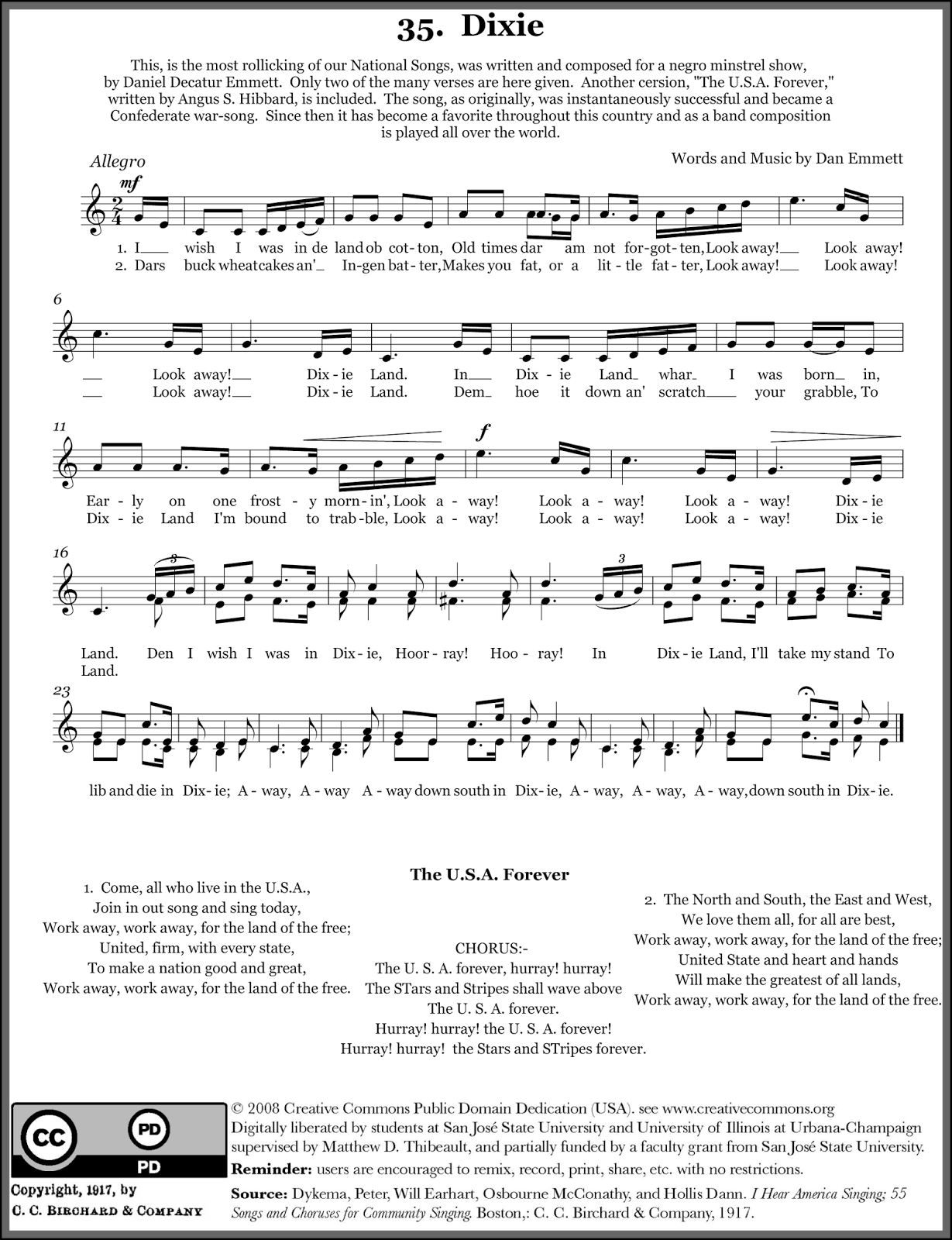
Dixie Land: A Song of the South?


The song “Dixie Land” has often come under attack, especially in recent times. It’s usually considered a song that divides the races and the north from the south. Surprisingly, however, the song did not originate in the south.

And perhaps the term Dixie, within this context, does not refer to the southern states at all. Actually, the origin of the word Dixie is in dispute. Many believe it derives from Dixon of the Mason-Dixon line fame. Because of a border dispute between Maryland, Pennsylvania, and Delaware, Charles Mason and Jeremiah Dixon surveyed the area between 1763 and 1767 and thus divided northern and southern states. This purported origin of Dixie is questioned by some who point to the fact that those north of the line are not referred to as Masons. 

Another theory is that the term Dixie comes from the word Dix once printed on ten-dollar notes in New Orleans. Dixie appears to have referred to that area and then spread to include all of the south.

Wikipedia
And still others claim the “Dixie” of the song refers not to the south at all, but to the John Dixie farm once located at Long Island, New York.

Whatever the origin of the term Dixie, Dan Emmett, of Mount Vernon, Ohio, is credited with the song’s authorship. 

Wikipedia

Over 37 others claim to have written the song, and some appear to have validity, such as the claim made on behalf of Thomas Snowden. The Snowdens were an African-American musical family. The grandparents of Thomas Snowden owned a neighboring farm to the Emmetts, and although evidence remains circumstantial, local lore claims Thomas Snowden taught the song to Dan Emmett. (see Snowden Family Band

The first performance by Dan Emmett was on April 4, 1859 in a minstrel show at Mechanic’s Hall on Broadway. The song’s popularity soon grew, in the north as well as the south.

However, on February 18, 1861, less than two years after its first performance, it became forever interwoven into the Rebel cause. At Jefferson Davis’s inauguration in Montgomery, Alabama, musicians played “Dixie,” and it inspired Confederate armies, becoming their battle song and unofficial National Anthem.

Courtesy of Alabama Department of Archives and History

After General Lee’s surrender at Appomattox, Lincoln requested the band to play the song, declaring it “one of the best tunes I ever heard.” Some view Lincoln’s request as a wish to reunite the nation.

And in view of that, a united nation, let’s notice the extra stanzas, copyrighted in 1917, “The U.S.A. Forever” by Angus S. Hibbard.

Come, all who live in the U.S.A.,
Join in our song and sing today,
Work away, work away for the land of the free;
United, firm, with every state,
To make a nation good and great,
Work away, work away, for the land of the free.

The North and South, the East and West,
We love them all, for all are best,
Work away, work away, for the land of the free;
United States in hearts and hands
Will make the greatest of all lands,
Work away, work away, for the land of the free.

Chorus:
The U.S.A. forever, hurray! Hurray!
The Stars and Stripes shall wave above
The U.S.A. forever.
Hurray! hurray! The U.S.A. forever!

Hurray! hurray! The Stars and Stripes forever.


It’s ironic that the song, perhaps written by an African-American, Thomas Snowden, in the northern state of Ohio, and perhaps referring to a farm in New York, later became strongly associated with the Confederacy.

May we, as a nation, never let a song divide us when we can add the stanzas to unite us.

Hurray! Hurray! The U.S.A. forever!
May we forever stand!

*Information gathered from 
Encyclopedia of Alabama, 
Michael F. Edwards (Historical News of Alabama), 
and Dixie, Wikipedia page

Thursday, December 14, 2017

Sugar plums and Sugar Beets


by Shanna Hatfield

While I was researching some historical tidbits to include in my current release, I happened upon an article about sugar beets in an issue of the Heppner newspaper from the autumn of 1901. 

It surprised me to read the article, because I had no idea sugar beet production had begun so early in the century in the Eastern Oregon area. According to that article, 35,000 tons of sugar beets were harvested that autumn in nearby La Grande, Oregon.  

Sugar beets derived from many years of breeding domesticated beets. During the 1700s, a German chemist discovered beetroots contained a form of sucrose that couldn’t be distinguished from the sweetener produced from cane. Production could take place in temperate climates, but a method of extraction had yet to be developed. Once extraction procedures were established, factories began to pop up and eventually made their way to America.  

Today, more than half of the sugar produced in the United States is derived from sugar beets. My uncle grew sugar beets and my cousin proudly carries on the tradition. And I’m always more than happy to eat the fruits of their labors.

It seemed fitting to include a little mention of sugar beets in a story that features a baker who creates any number of delicious, decadent, sweet treats.

Treats the hero of my story is incapable of ignoring, especially her oatmeal cookies.

Confection long

The Christmas Confection

Hardman Holidays Book 6
 Born to an outlaw father and a shrewish mother, Fred Decker feels obligated to atone for the past without much hope for his future. If he possessed a lick of sense, he’d pack up and leave the town where he was born and raised, but something… someone… unknowingly holds him there. Captivated by Hardman’s beautiful baker, Fred fights the undeniable attraction. He buries himself in his work, refusing to let his heart dream.
Elsa Lindstrom adores the life she’s carved out for herself in a small Eastern Oregon town. She and her twin brother, Ethan, run their own bakery where she delights in creating delicious treats. Then Ethan comes home unexpectedly married, the drunks in town mistakenly identify her as a missing harlot, and a mishap in the bakery leaves her at the mercy of the most gossiped-about man in Hardman.
Mix in the arrival of three fairy-like aunts, blend with a criminal bent on dastardly schemes, and sprinkle in a hidden cache of gold for a sweet Victorian romance brimming with laughter and heartwarming holiday cheer.


Excerpt:
“Well…” Fred gave her an odd look as he stood in the doorway with autumn sunshine spilling all around him.  “There are two other things I’d like.”
“Two?” Elsa asked, wiping her hands on her apron and facing him. “What might those two things be?” She anticipated him asking for a batch of rolls or perhaps a chocolate cake.
“My first request is simple. Please call me Fred. I’d like to think, after all this, we’re friends and all my friends call me Fred.”
Elsa nodded in agreement. “We are friends, Mr. Deck… er, I mean Fred. If you want me to call you Fred then you best refer to me as Elsa.”
The pleased grin on his face broadened. “Very well, Elsa.”
Her knees wobbled at the sound of his deep voice saying her name, but she resisted the urge to grip the counter for support. “You said there were two things you wanted, in addition to cookies. What is the second?”
“It’s a tiny little thing really,” Fred said, tightly gripping his hat in both hands.
“A tiny little thing? Then I shall take great honor in bestowing whatever it is.” Her gaze roved over the kitchen, trying to imagine what in the world Fred could want. She kept a jar full of assorted candy. Sometimes, she used the sweets to decorate cakes and cookies. Perhaps he wanted one. “A piece of candy?” she asked.
Fred shook his head. “No, Elsa. It’s sweeter than candy and far, far better.”
Intrigued, she took a step closer to him. “What is it?”
He waggled his index finger back and forth, indicating she should step closer. When she stood so her skirts brushed against the toes of his boots, he tapped his cheek with the same finger. “A little sugar right here would be even better than ten batches of cookies.”

Wednesday, December 13, 2017

Christmas in the Old West


American Christmas traditions in the mid to late nineteenth century were very similar to what we enjoy today. Obviously, technology has advanced our gift giving and decorating traditions, but the concepts are the same.

Larger cities and warmer climates made for Christmas seasons full of cheer. Traditions were easier to follow and people were more mobile because the weather wasn’t quite so harsh, even in the northern cities. Goods were more plentiful – for gift giving and for cooking. 

Pioneers and those who lived off the land in the Old West, had more difficulty during the winter months. Blizzards and icy cold winds were just part of a regular winter on the plains and in the mountains. Celebrating the Christmas season wasn’t necessarily without joy. Difficult, yes, but not impossible as there were many ways the pioneers found to be festive and happy.

Much of society in the Old West revolved around church and community. Sleigh rides and snowball fights. Decorating a tree and draping the mantle with evergreen boughs. Greeting cards and warm holiday wishes. Stockings hanging on the fireplace and gifts. Feasting with family and friends. 

The holiday traditions from the more civilized areas of the country and the pioneer regions of the west were similar, indeed. Though the pioneer way of life with limitations and more hazards was simpler. 

Pioneers were strong people. They made it through nearly impossible weather conditions – blizzards, droughts, wind and rain storms. But no matter how difficult life was for them, they found ways to celebrate the happiest time of the year. The Christmas holiday represented hope and love for mankind in those days, just as it does today.

Bringing in an evergreen from the woods was a joyful event for the entire family. They’d gather to decorate with ribbons, yarn, berries, or whatever they had. Carved toys and dolls were often hung on the tree as those were prized possessions of the children and worthy of a special place on the tree. Even a small home would accommodate a tree, though it might look more like an evergreen bouquet rather than the grand trees we normally think of.

Even if the family didn’t do much to decorate their home, the holiday feast was a vital part of the celebration. Preserves and pickles were saved for this special meal. The best meats were brought home to be roasted in the open hearth for the celebration feast. The women started baking early to be sure to have all the pies, cakes, puddings, and cookies ready for the family and visitors they would host. The children were often treated to small hard candies if parents could afford such luxuries. Of course, only the good little boys and girls were given these much wished for treats.


Gift giving was modest according to the standards of the larger cities. Most gifts were home made. Family members would start working on special surprises for parents, children, and siblings months in advance of the season. Knitted items, embroidered delicates, dolls made of corn husks or rags, carved toys, or even furniture were special items that would be cherished and treasured.

And finally, Christmas Eve would arrive. Most families would sing carols together and read the Christmas story in their well-worn Bible. Maybe they’d tell some fairy tales. They may enjoy visits from neighbors who were welcomed to join their family traditions. 

On Christmas morning, most of the community would be present for the Christmas service where the children would be absolutely wild with wonder and happiness. Praising God for His most perfect gift, each family would return home to enjoy a traditional holiday meal. A feast that had been prepared with care and love for all who would join around the table on that day.

Yes, the spirit of Christmas was alive and well in the Old West. Simple. Humble. Sincere. Filled with love.


~~~~~
 
Remember Cutter's Creek, Montana? Christmas in Cutter's Creek was a joyful time. If you want to find out what happened at the annual Christmas festival in 1882, here's the best place to read all about it. Christmas Spirit is available on Amazon.
~~~~~

Annie Boone writes sweet western historical romance with a happy ending guaranteed in every single story. Inspiration comes in many forms and Annie finds more than one way to make her stories entertain and inspire.

To connect with Annie, find her on Facebook, Twitter, or her website.

Follow Annie on Amazon, Bookbub and get email updates.