Showing posts with label #confederate. Show all posts

Friday, December 15, 2017

Dixie Land: A Song of the South?


The song “Dixie Land” has often come under attack, especially in recent times. It’s usually considered a song that divides the races and the north from the south. Surprisingly, however, the song did not originate in the south.

And perhaps the term Dixie, within this context, does not refer to the southern states at all. Actually, the origin of the word Dixie is in dispute. Many believe it derives from Dixon of the Mason-Dixon line fame. Because of a border dispute between Maryland, Pennsylvania, and Delaware, Charles Mason and Jeremiah Dixon surveyed the area between 1763 and 1767 and thus divided northern and southern states. This purported origin of Dixie is questioned by some who point to the fact that those north of the line are not referred to as Masons. 

Another theory is that the term Dixie comes from the word Dix once printed on ten-dollar notes in New Orleans. Dixie appears to have referred to that area and then spread to include all of the south.

Wikipedia
And still others claim the “Dixie” of the song refers not to the south at all, but to the John Dixie farm once located at Long Island, New York.

Whatever the origin of the term Dixie, Dan Emmett, of Mount Vernon, Ohio, is credited with the song’s authorship. 

Wikipedia

Over 37 others claim to have written the song, and some appear to have validity, such as the claim made on behalf of Thomas Snowden. The Snowdens were an African-American musical family. The grandparents of Thomas Snowden owned a neighboring farm to the Emmetts, and although evidence remains circumstantial, local lore claims Thomas Snowden taught the song to Dan Emmett. (see Snowden Family Band

The first performance by Dan Emmett was on April 4, 1859 in a minstrel show at Mechanic’s Hall on Broadway. The song’s popularity soon grew, in the north as well as the south.

However, on February 18, 1861, less than two years after its first performance, it became forever interwoven into the Rebel cause. At Jefferson Davis’s inauguration in Montgomery, Alabama, musicians played “Dixie,” and it inspired Confederate armies, becoming their battle song and unofficial National Anthem.

Courtesy of Alabama Department of Archives and History

After General Lee’s surrender at Appomattox, Lincoln requested the band to play the song, declaring it “one of the best tunes I ever heard.” Some view Lincoln’s request as a wish to reunite the nation.

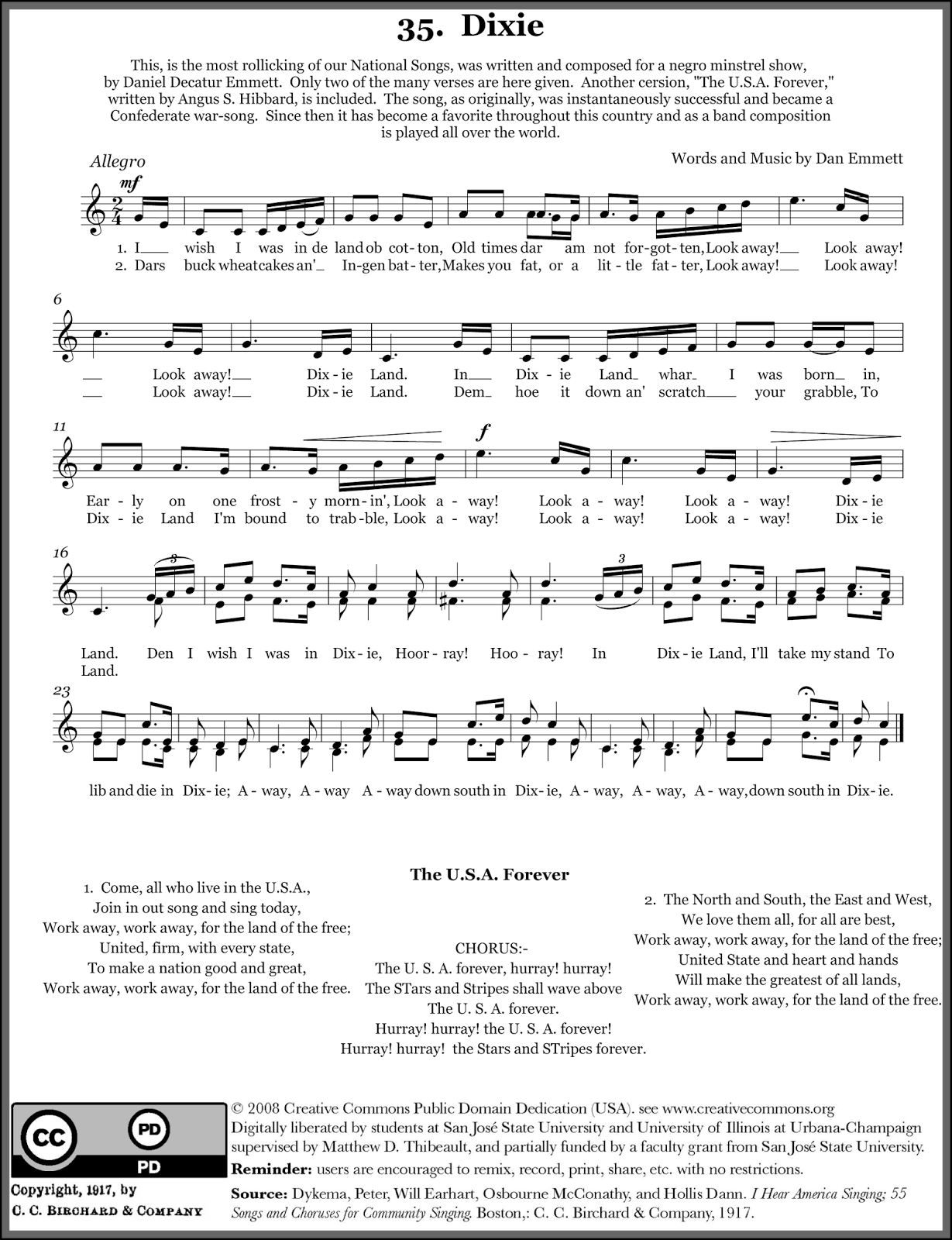
And in view of that, a united nation, let’s notice the extra stanzas, copyrighted in 1917, “The U.S.A. Forever” by Angus S. Hibbard.

Come, all who live in the U.S.A.,
Join in our song and sing today,
Work away, work away for the land of the free;
United, firm, with every state,
To make a nation good and great,
Work away, work away, for the land of the free.

The North and South, the East and West,
We love them all, for all are best,
Work away, work away, for the land of the free;
United States in hearts and hands
Will make the greatest of all lands,
Work away, work away, for the land of the free.

Chorus:
The U.S.A. forever, hurray! Hurray!
The Stars and Stripes shall wave above
The U.S.A. forever.
Hurray! hurray! The U.S.A. forever!

Hurray! hurray! The Stars and Stripes forever.


It’s ironic that the song, perhaps written by an African-American, Thomas Snowden, in the northern state of Ohio, and perhaps referring to a farm in New York, later became strongly associated with the Confederacy.

May we, as a nation, never let a song divide us when we can add the stanzas to unite us.

Hurray! Hurray! The U.S.A. forever!
May we forever stand!

*Information gathered from 
Encyclopedia of Alabama, 
Michael F. Edwards (Historical News of Alabama), 
and Dixie, Wikipedia page

Wednesday, February 22, 2017

Postage and Mailing Instruments - later 1800's


Aloha all! This is my first post on Sweet Americana Sweethearts! Thanks for having me!! I think I'm going to 'name' my Wednesday column... but I'm not sure 'what' to name it. Western Women - Women of the West - Wild West Women? Hmmm I'll have to think about it.  If you have an idea, or a favorite option from my list, please comment here on this post or message me at reinatorresauthor{at}gmail.com


Now for today's column - 

I'm a bit of a Civil War buff... and strangely enough I have some friends with similar or complimentary interests. So I'm going to share with you some information about American postage and mail in the Civil War era of American History (1860s and forward)

When setting a story in a period of history other than our own, there are so many things to consider. Everything has a history of its own. Not all of it will end up in the story, but research of any kind can helpd to make the setting feel real to the writer and hopefully the reader.

Something as simple as the stamp on an envelope had a detailed history of its own.
My friend, Gannon, is a philatelist of the highest order and someone I've known since kindergarten. And this information comes from his research. I am truly grateful to have such an amazing friend.
“So this cover is an “adversity” cover. Commercially made envelopes were available in the South prior to 1861, but they became less available as the war progressed for a variety of reasons. People would make envelopes out of whatever they had on hand. Letters sent in envelopes hand made from sheet music, wallpaper, or (as in this case) old ledger paper. Sometimes, people would also “turn” the envelope by steaming open all the sealed edges and resealing them so that the original stamp and address were now on the inside of the envelope. That particular practice is not limited to wartime. Poorer people did this throughout the 19th century and sometimes even today.
“The stamps on this letter are referred to by collectors in the United States as “CSA Scott #7” (The Confederacy printed 14 stamps, of which 13 were actually issued.) This printing plate for this stamp was created in England by Thomas de la Rue & Co., which is still in operation as a security printer. They filled the order for however many stamps they were contracted to print, and then sent the stamps and the copper printing plates to the Confederacy. The stamps printed in England are referred to as “CSA Scott #6” (England) as are a different shade from #7 (CSA).
“About half of the English printed stamps and half of the printing plates were seized by Union forces as they tried to run the blockage. The other half got through. The Confederacy then used the plates to print new stamps until the plates wore out.
“This letter was sent from Richmond, VA, to Cheraw SC on January 11, 1863. Cheraw is a pretty small town, which had less than 1000 people in the 19th century. I am researching the addressee. It may be the sender was someone in her family who was at the Battle of Fredericksburg, but I am not sure.”

The second cover –
“This one has CSA #11 on it, the stamp most commonly seen on CSA mail. It was issued in 1863. Not sure what information I can get from it with an unclear postmark. I think it was sent from Fayetteville, GA to Augusta GA. It could also have been sent from Milledgeville. Either way, the letter is postmarked June 11. It is likely to have been mailed in 1864, because of the way the postmark is worn down. June 11 1863 is a possibility, but June 11 1865 would have been after the war.”
Another Interesting Fact –“When you get an unused stamp from the CSA–other than the English printed ones–the gum on the back is really uneven. They were manually applying it with a paintbrush. Neat detail!”
Thanks for taking the time to read this post -

Reina Torres - Big Hearted Small Town Romance
www.reinatorres.net
www.twitter.com/rtorresauthor
www.facebook.com/ReinaTorresRomance/