Showing posts with label women doctors. Show all posts

Wednesday, September 18, 2024

There's More To the Story

Post (C) Doris McCraw

aka Angela Raines


Image (C) Doris McCraw

This post will not surprise those who know me and my passion for history, especially the Women Doctors. Many know of Elizabeth Blackwell and her admittance and graduation from Geneva Medical College. But there is more to her story and the story of women doctors. 

Dr. Elizabeth Blackwell
Image from Wikipedia

At one time, Blackwell had found the idea of studying medicine abhorrent as related in her book "Pioneer Work in Opening the Medical Profession to Women" published in 1895. A dear friend, who suffered greatly during her treatments, told Elizabeth, “You are fond of study, have health and leisure; why not study medicine? If I could’ve been treated by a lady doctor, my worst sufferings would have been spared me.” 

Dr. Hariot K. Hunt
photo from the National Park Service site.

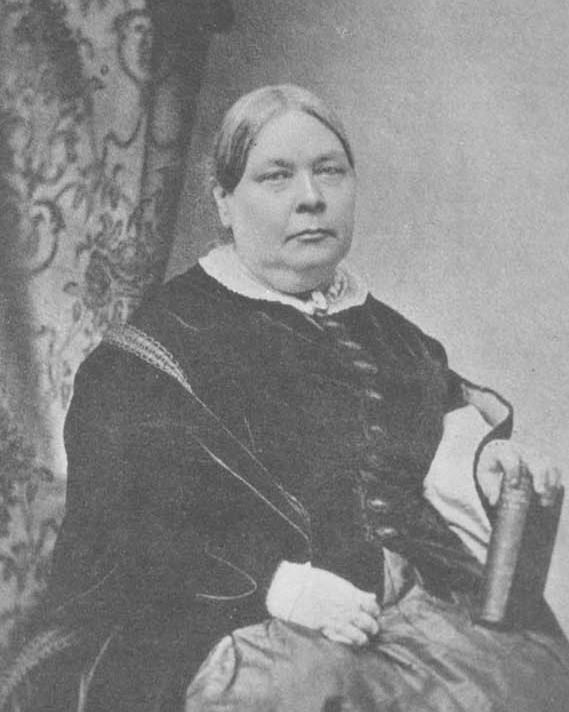
Did you know, that before Blackwell even thought of medical school, a woman in Boston was a practicing physician? Harriot Kezia Hunt, in her book "Glances and Glimpses" published in 1856 tells her story of what led her to the practice of medicine and the social climate at that time. She began practicing medicine in Boston in 1835 and was well-known in her lifetime for her work to help empower women.

Dr, Sarah Hackett Stevenson
image from Northwestern Univeristy site.

In 1876 Dr Sarah Hackett Stevenson was the first woman to join the American Medical Association. She was a delegate from the Illinois Medical Society. She graduated from the Woman's Medical College in the class of 1874 and later was on staff at Cook County Hospital a first for a woman. She also wrote several books, which focused on educating the public on health.

There are so many more early women doctors whose stories are being found and told. Many of these early physicians were also involved in the suffrage movement. 

You can find Blackwell and Hnnt's autobiographies on Google Books. I personally found Hunt's the most fascinating read, but both contain rich history and personal thoughts.

Dr. Stevenson has many references to her in many of the publications of the late 1800s and early 1900s also on Google Books.

Make sure to watch for the upcoming "Christmas Quilt Brides" stories and my book in that series "Mack"

Until Next Time: Stay safe, Stay happy, and Stay healthy. 

Doris


Wednesday, August 16, 2023

An Inspiration for Those Who Followed

Post by Dois McCraw

aka Angela Raines

Photo (C) Doris McCraw

"As the upheaving island carries up the waters of the ocean around it, even so will woman in her moral and intellectual elevation, carry up the tone of public morals, and of professional and political life in our country and the world. And as the natural philosopher, by unfolding to us the laws of light and vision, has enabled the optician to prepare the finest and truest mediums of sight; so the spiritual philosopher, by exploring the great principles of humanity, will yet enable the philanthropist to understand the necessities of the present age, and provide for its wants intellectually, morally, and spiritually." Harriot  Kesia Hunt, "Glances and Glimpses" published in 1856.

So who was Harriott Kesia Hunt?  

Dr. Harriot Kesia Hunt
Photo from the MA. Historical Society


Harriot was born November 9, 1805, in Boston, MA., and died January 2, 1875. It's the time between those two dates that help define not only her but the future for women's suffrage, and the medical profession.

In 1827 she started a classroom, but in 1833 when her sister became seriously ill she turned her attention to medicine. When her sister recovered due to the treatment of Dr. Richard Dixon Mott and his wife Elizabeth Mott, who hailed from England, she changed her focus to the study of medicine. She and her sister Sarah studied under Mott. When he returned to England, Harriot continued to study medicine.

In 1835, She and her sister started a practice in Boston. Although her sister married and moved on, Harriot continued to practice and study. It was this desire to continue to learn that led her to apply to Harvard Medical School in 1847. Although turned down she reapplied in 1850 and was initially accepted.

Dr. Hunt also was a strong proponent of women doctors treating women patients. She was involved with the women's suffrage movement attending and speaking at the first National Women's Rights Convention in Worchester, MA. in 1850.

Throughout her lifetime she was a strong advocate for women's representation, women's rights, and mental health services. 

In 1853, the Female Medical College of Philadelphia gave her an honorary degree for her years of service as a physician. Many of her contemporaries, despite no 'formal' education, although she did study under a physician as many men did then, identified her as the first woman physician in the country. The following quote from Lucy Stone says it all, "It was said women could not be doctors. Well, Harriet [sic] Hunt has proved by practice that a woman can be, and is, a successful physician."

Thanks to women like Dr. Harriot K. Hunt, and Dr. Elizabeth Blackwell, the women who traveled West had role models to help them find their own place in the world.

Amazon

Until Next Time: Stay safe, Stay happy, and Stay healthy.

Doris


Wednesday, April 19, 2023

Doc Susie's Colorado Contemporaries


Post by Doris McCraw/Angela Raines-author


Photo property of the author

I've spent more time looking at the larger picture of the women doctors who received their license to practice medicine around the same time as Susan, Doc Susie, Anderson, who started her practice in Cripple Creek, Colorado in 1897. She did not move to Fraser, Colorado until 1907 where she earned her 'fame'.

While the list is fairly long, I thought I would share some additional names and their contributions to Colorado and medicine from the latter part of the nineteenth century and the beginning of the twentieth. 

Dr. Josepha Williams and Dr. Madeline Marquette opened a private hospital and sanatorium in Denver in 1889. In 1892 they added a nursing school to the Hospital/ Sanatorium. Dr. Williams was the superintendent of the facility. On a side note,  Dr. Williams married Canon Charles Winfred Douglas a musician and Episcopal priest in 1896.

Dr.Genevieve M Tucker wrote "Mother, Baby, and Nursery: A Manuel for Mothers" published by Roberts Brothers, copyright 1896. She practiced in Pueblo, Colorado. Around 1898 she was elected president of the Colorado Homeopathic Medical Society.

Dr. Ida Putnam began her practice in Chicago, but in 1898 she received her Colorado license and began a practice in Telluride, Colorado.

Dr. Florence Sabin was a research doctor who did much to advance the area of medical research. Her accomplishments are too numerous to list here. If you wish to know more: https://en.wikipedia.org/wiki/Florence_R._Sabin 

Dr. Rose Kidd Beere was written up in the “History of Colorado” edited by Wilber Fiske Stone. She participated in the Philippine War of 1898-99 and WWI. She was unable to travel to the Philippines as a doctor so she gathered women to go there as nurses. 

From Find a Grave Website

Dr. Mary Elizabeth Bates, whom I have spoken of before. As you know she was the first woman intern at Cook County Hospital in Chicago, Illinois. In the book “A History of Surgery at Cook County Hospital” by Patrick D. Guinan, Kenneth J. Printen, James L. Stone, and James S.T. Yao, we find in the nineteen months she worked as an intern she worked in the morgue, took part in fourteen amputations. Of her time there she later said “...the first six months were hell, the second six months were purgatory, the next six months were heaven; when it came time for me to leave, I wept bitter tears.”

These are just a few of Doc Susie's contemporaries. The stories of these women along with those who preceded them have given amazing gifts to this researcher.

Until Next Time: Stay safe, Stay happy, and Stay healthy.

Doris

Wednesday, June 17, 2020

PUEBLO COLORADO AND THOSE WOMEN DOCTORS


Post by Doris McCraw
writing as Angela Raines


A look at early medicine and women doctors in Colorado, specifically Pueblo, Colorado.

Pueblo is one of the early towns in Colorado. It had its beginnings as a business fort called Fort Pueblo. The town as we know it was originally composed of separate areas.  One area was South Pueblo the town that grew due to the manufacturing of steel for the rails of William Jackson Palmer‘s Denver & Rio Grande railroad. The company became CF&I (Colorado Fuel & Iron) a major employer in the early days of the town and a great history read. 

Home
http://www.cmhipmuseum.org/
Pueblo also became the home of the Colorado State Insane Asylum, later known as the Colorado State Hospital. On October 23, 1879 it opened its doors to eleven patients, nine men, and two women, from the counties around the state.


The town, due to the growth and opportunities, was a draw for women doctors. Mary Alice Lake, born in 1865 attended the University of Colorado School of Medicine and received her state license in 1896. She was an assistant physician  State Asylum but had a practice in Cripple Creek, Colorado in 1896. 

Lizzie E. Jones born in Iowa in 1854 and graduated from the State University of Iowa in 1881. She was also one of the early female doctors to receive a license on January 3, 1882, # 343, and had a  practiced in Pueblo although there is no record so far of her at the state asylum. In June of 1882, she married Reuben F. Eldridge.

Mary F. Barry was born in 1859 in Illinois and attended Northwestern University Women’s Medical College where she graduated in 1887. She received her license to practice medicine in Colorado in 1895 and had her practice in Pueblo.  During her career, she was the secretary of the Pueblo County Medical Society.


There is also a Genevieve M. Tucker who was born in Wisconsin in 1859 who received her Colorado license in 1893 and is listed as also practicing in Pueblo. 

CF&I Hospital
 run by Dr. Richard Corwain
Photo from Wikipedia
The one woman whose story is somewhat funny, yet telling in its own way. Jean Clow, born Jean Bailey, who was a graduate of Goss Medical School in Denver in 1898 applied for a job at Corwin Hospital in Pueblo. The officials at the hospital assumed, due to her name, that she was male. When they found out otherwise, they still hired her as an intern on the assumption she could do the job as well as a male. On a side note, it is said that Jean told of carrying a gun in the early days of her career for safety. 

There are many others who began their careers in Pueblo. Some stayed, others moved on to areas that better suited their talents. 

My first novel "Josie's Dream" and the heroine were born of my research and love of these early pioneering women. Below is a short excerpt: 

 “Can I help you?” The voice behind her asked, a hand reaching around to grab her bags.

Turning to face the speaker, Josie took in the disheveled appearance, the look of cunning in the eyes.
I can manage, thank you,” Josie replied, taking a firmer hold on her belongings.
Now, there is no need to be rude. I was just tryin’ to be helpful,” the man said as he tugged at her bag.
Stiffening, Josie sternly repeated, “I can manage.”
With a hard yank, the man managed to pull her doctor bag loose, and without a thought, Josie swung her large bag at the man, striking him on the legs as he turned to run off. Instead, he found himself flat on the ground.
Calmly, Josie bent, retrieved her property, and knowing he was just stunned, started down the street. She had only gone a few steps when she heard a bellow behind her.
Let me get to the point quickly,” she said as she turned to her tormentor, who stopped so quickly he almost fell. “I have nothing of value you could use. So, unless you are in need of medical care, I suggest you stop while you are ahead.” Now, standing close, she could smell the liquor on him. Her eye took in his inability to stand upright without swaying. But to be fair, his fall might have had something do to with that.
Doctorin’?” he questioned, “you’re lying.”
The two of them were drawing a crowd. Not the best way to start, Josie thought, but not a bad one either.
Yes, as you say doctorin’, I am a Doctor.”
Well, I’ll be — a lady doctor,” he said. “You sure you’re not just…”

Josie's Dream (Grandma's Wedding Quilts Book 9) by [Angela Raines, Grandma's Wedding Quilts, Sweet Americana]
Amazon

Doris Gardner-McCraw -
Author, Speaker, Historian-specializing in
Colorado and Women's History
Member of Western Writers of America,
Colorado Author League,
Women Writing the West


Angela Raines - author: Telling Stories Where Love & History Meet
Angela Raines FaceBook: Click Here
www.angelaraines.net 

Wednesday, July 18, 2018

A D CHAMBERLAIN - WOMAN DENTIST


Kristin Holt's recent post on her new book, "Isabella's Calico Groom" brought back such great memories of my research on Colorado's woman doctors. In that research, I also located a woman dentist who had graduated dental school. I decided use this post to let you know about her. Of course, you must read Kristin's post, Kristin's Post: Click Here to understand why I loved what she wrote and why it inspired me. Perhaps Anna's story will remind you how important dreams are.

Anna D (Shaw) Chamberlain and her husband Frank C. Chamberlain, according to the city directory, had dental offices in Colorado Springs in 1896. They lived at 1451 N Nevada Ave with offices in one of the bank building in the center part of town. Frank, in addition to being a dentist, also could add M.D. to his name.

Anna was born in 1866 to John and Helen B. Shaw in Harlan, Page County, Iowa. Her father was from Ireland and her mother from Ohio. She married Frank in 1887 and lived in Colorado from that time. The couple had three children by 1900. 


View of Colorado Springs in 1885 

She deserves admiration, not only for being a professional woman, but raising three children while doing so. She and her husband were associated with dentistry from at least 1888, having an office in the Pikes Peak region from that date. She was also the first woman to graduate from the University in Denver with a degree in dentistry. 

By 1911, the couple had moved to 2016 N Cascade Ave., still in Colorado Springs. They celebrated their twenty-fifth wedding anniversary at this address. It was interesting, despite her credentials as a dentist, the paper listed the event as Dr. F.C. and Mrs. Chamberlain. 

In addition to all her other duties, Anna was also active in the church and the Women's Christian Temperance Union. In the late 1890s was the president of the local chapter of the WCTU. Anna and her husband, with Wm. H Dewey and Oscar J. Fullerton created the Fullerton Consumption Cure Company. The initial investment for the company was $30,000.

As an interesting side note, Frank's brother Fred, who was also a dentist in the Cripple Creek mining district, married a woman by the name of Anna also. The difference, Fred's wife had the middle initial B.


 Anna <I>Shaw</I> Chamberlain
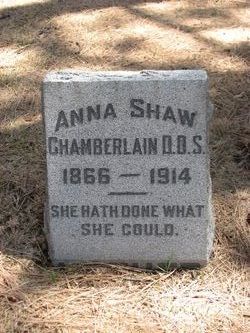
Anna's headstone in Evergreen Cemetery (photo by Ron West)

Anna died in 1914 at the age of forty-eight. According to the death records the cause of death was pernicious anemia. After her death her husband Frank moved to California and remarried. Records show his second wife had worked in his office there. Upon his death, this second wife returned his body to Colorado Springs, Colorado, where he was buried next to Anna in Evergreen Cemetery.

In the book "Josie's Dream", part of the Grandma's Wedding Quilt series, Josie has the dream of being a doctor in a small town in Colorado. She pursues this dream and get more than she expected.


Since corresponding with Dr. Harriett Leonard, a past student of her medical school and dear friend, despite the difference in age, Josie had been dreaming of coming to Colorado. Dr. Leonard had offered to let her work at the Spa in Manitou Springs where Harriett was the proprietor, but Josie wanted to create a practice in a smaller town, where people really needed her.
Now here she was in Kiowa Wells, on the eastern plains of Colorado just a few miles from the railhead at Kit Carson. Her biggest obstacle now was finding a place to set up her medical practice.
Despite his reservations, her father gave her a medical bag, equipped with the basics. “Something to remind you of this commitment, your Hippocratic oath,” were his parting words.
Her parents, though still in Iowa, were in her heart. Still, she knew it had been time to leave. While others of her friends were getting married, she had gone to medical school, her path clear to her.
Can I help you?” The voice behind her asked, a hand reaching around to grab her bags.
Turning to face the speaker, Josie took in the disheveled appearance, the look of cunning in the eyes.
I can manage, thank you,” Josie replied, taking a firmer hold on her belongings.
Now, there is no need to be rude. I was just tryin’ to be helpful,” the man said as he tugged at her bag.
Stiffening, Josie sternly repeated, “I can manage.”
With a hard yank, the man managed to pull her doctor bag loose and without a thought, Josie swung her large bag at the man, striking him on the legs as he turned to run off. Instead, he found himself flat on the ground.
Calmly, Josie bent, retrieved her property, and knowing he was just stunned, started down the street. She had only gone a few steps when she heard a bellow behind her.
Let me get to the point quickly,” she said as she turned to her tormentor, who stopped so quickly he almost fell. “I have nothing of value you could use. So, unless you are in need of medical care, I suggest you stop while you are ahead.” Now, standing close, she could smell the liquor on him. Her eye took in his inability to stand upright without swaying. But to be fair, his fall might have had something do to with that.
Doctorin’?” he questioned, “you’re lying.”
The two of them were drawing a crowd. Not the best way to start, Josie thought, but not a bad one either.

Yes, as you say doctorin’, I am a Doctor.”

Purchase a Copy Here


Doris Gardner-McCraw -
Author, Speaker, Historian-specializing in
Colorado and Women's History
Member of National League of American Pen Women,
Women Writing the West,
Pikes Peak Posse of the Westerners

Angela Raines - author: Where Love & History Meet
For a list of Angela Raines Books: Here 
Photo and Poem: Click Here 
Angela Raines FaceBook: Click Here


Wednesday, March 21, 2018

A FASCINATION WITH WOMEN DOCTORS

In both "Josie's Dream" and "Chasing A Chance" I mention women doctors. It is not necessarily the medical aspect I am interested in, although that is fascinating, but the stories of the women and their time in history. So in honor of National Women's History month, I'm sharing my fascination and some research on women doctors.

The medical school, The Keokuk School of Physicians and Surgeons, was a real college. It has also been called the College of Physicians and Surgeons of Keokuk. It began in La Porte, Indiana in 1846 before moving to Madison, Wisconsin in 1847 then to Rock Island, Illinois in 1848. The school had a year long session in Davenport, Iowa before its permanent home in Keokuk in 1850. As part of the University of Iowa it was technically co-ed from the beginning.  

Josephine, the Josie of "Josie's Dream", was a graduate of the Keokuk school as was the real life doctor Harriet Leonard of Manitou Springs, Colorado. Dr. Leonard was the proprietor of the Bath house, an unusual position for a woman. Her ad in the July 1878 local paper read: Mrs. H. A. Leonard M.D. ELECTRICIAN. Special attention given to nervous and chronic diseases. Office in the Mineral Bath House, Manitou.  Although many women physicians were homeopaths, the medical treatment of choice during that time, Harriet was an allopath. Dr. Harriet Leonard

The other woman physician mentions is Dr. Alida Avery. Dr. Avery arrived in Colorado in 1874 after leaving Vassar College where she had been on staff for six years. In fact she was one of the early members of that faculty. Much has been written about this early Colorado physician, her work on women's suffrage, and her years at Vassar. Dr. Alida Avery


One of my enduring passions is researching the early Colorado Women Physicians and documenting their lives. When possible, I try to include these women or their stories in my fiction and well as non-fiction writing. So as you read "Josie's Dream" or the mention of Josie in "Chasing A Chance", know that it comes from a place of love and fascination with these early pioneering doctors of Colorado.


Doris Gardner-McCraw -
Author, Speaker, Historian-specializing in
Colorado and Women's History
Member of National League of American Pen Women,
Women Writing the West,
Pikes Peak Posse of the Westerners

Angela Raines - author: Where Love & History Meet
For a list of Angela Raines Books: Here 
Photo and Poem: Click Here 
Angela Raines FaceBook: Click Here

Wednesday, March 15, 2017

Earliest Women Doctors in the United States?

Post (c) Doris McCraw/writing as Angela Raines

Hygeia, the Greek goddess of health, carved by Edmonia Lewis c. 1871-1872 for Harriot Hunt's grave, from Wikipedia.org

In studying the women doctors of the 19th century you wonder, where did the idea of women struggling to be accepted start and who were the women whot took up the challenge? A look at early medical societies and education may help.

In 1846 the American Medical Association was formed to bring a higher level of competence from doctors. Prior to the AMAs formation various states’ medical societies fulfilled that purpose. The Massachusetts Medical Society stated it well when it wrote “A person who is engaged in the practice of medicine or surgery in this commonwealth, not being a fellow or licensate of this society, nor a Doctor of Medicine of Harvard University, shall be deemed by the fellows of this society an irregular practitioner, likewise anyone who has been expelled from this society, or who after being permitted to resign his fellowship has been denied his privileges.” As noted, there is no mention of women and in the case of Massachusetts, a graduate of Medicine from Harvard. It wasn’t that women hadn’t attempted to attend medical school. They were simply denied entrance. Things started to change with the admittance of Elizabeth Blackwell to Geneva medical college and her subsequent graduation.

Dr. Blackwell, graduated in 1849 from Geneva Medical College in New York, which made her the first women in the United States to do so. What makes her graduation even more interesting is that Dr. Blackwell at one time found the idea of studying medicine abhorrent. A dear friend, who suffered greatly during her treatments, told Elizabeth that “you are fond of study, have health and leisure; why not study medicine? If I could’ve been treated by a lady doctor, my worst sufferings would have been spared me.” At the time Elizabeth told her it was an impossible suggestion and that she could not stand the sight of a medical book. The idea however began to take root and soon Elizabeth was considering that very thing. She methodically set about finding out all she needed to know to pursue that course of education. Upon finding the costs to attend college would be around $3000 she took a job teaching music at a school in Ashville North Carolina. It was at this school, where the principal, Rev. John Dickinson, was a former medical doctor that she took up a trial study of medicine. When she had accumulated the needed funds she returned to Philadelphia. At this time Philadelphia was considered the major medical learning center. Still Elizabeth was unable to secure admittance to any of the medical schools there. She eventually broadened her search applying to and being accepted at Geneva Medical College after a vote of the student body agreed to admit her. In her autobiography she speaks fondly of classes, the school and the professors, but makes mention of the fact that the women of the town felt she shocked Geneva propriety, that they felt she was either a bad woman, or insane. It after her graduation that she learned her admittance may have been a lark, but she does not give much credence to it being a problem for her.

While Elizabeth Blackwell may have been the first woman to graduate from medical school, she was not the first woman doctor. There were some like Dr. Harriot Kezia Hunt, who practiced in Massachusetts in the 1830s. Although she is noted as the first woman to apply to Harvard Medical School, as a doctor, she was self-taught, having been denied admittance to that institution. Dr. Hunt began her studies when her sister Sarah became ill. Out of desperation for her sister’s health, Harriot had the English couple, Elizabeth and Richard Mott, take on her sister’s treatment. As she says in her autobiography ‘the doubt, uncertainty, and inefficacy of medical practice had been our portion; and the best physicians had given up an only sister!’ She continued studying with and working beside the Mott’s until Richard’s death and Elizabeth’s removal to New York. From that point on Harriot continued to build her practice, focusing on women and children. Hunt also was involved in social reform, specifically abolition of slavery and women’s rights, attending the 1850 women’s rights convention in Massachusetts. Dr. Hunt also corresponded with Dr. Blackwell on at least one occasion. Again from her biography Dr. Hunt states ‘after my experiences with Harvard College, first the professors, then the students who played the same game with different men, it was truly encouraging to hear that Elizabeth Blackwell had graduated at another college, had been to Europe to perfect herself in her profession, and returned to the New York to commence her practice. My soul rejoiced – I poured out my feelings in a letter, and gave her the right hand of fellowship; it was acknowledged in an answer worthy of the writer.’ Later Hunt was awarded an honorary degree from the Female Medical College of Philadelphia in 1853.


 Justin, “Elizabeth Blackwell. The Entry of Women into Medicine in America: Education and
Obstacles 1847-1910.”

Blackwell, Elizabeth. Pioneer Work in Opening the Medical Profession to Women: Autobiographical Sketches. Longmans, Green, and Company, 1895.

Hunt, Harriot Kesia. Glances and Glimpses: Or, Fifty Years Social, Including Twenty Years Professional Life. J. P. Jewett and Company, 1856.


Doris McCraw - writing as Angela Raines 
Author, Speaker, Historian-specializing in
Colorado and Women's History

For a list of Angela Raines Books: Here 

Photo and Poem: Click Here 
Angela Raines FaceBook: Click Here