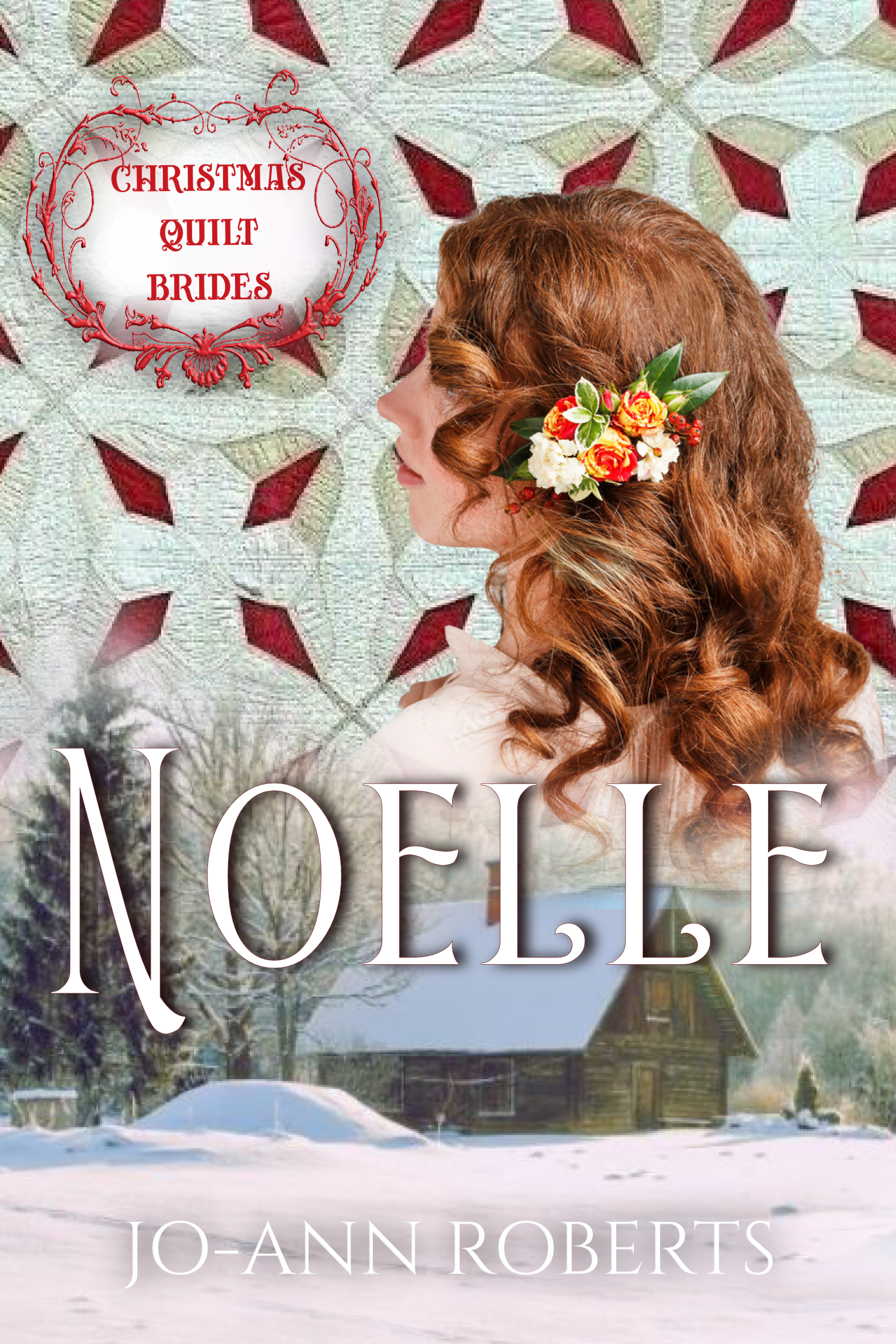
Showing posts with label Christmas Quilt Brides. Show all posts

Friday, December 22, 2023

Christmas Carols From Germany We Enjoy

 While researching this year’s Christmas novella, Rose, in the Christmas Quilt multi-author series, I wanted one of the characters to teach the other about the holiday.

Rose is Scottish. Because of a proclamation made in the Reformation by Oliver Cromwell, celebrating Christ’s Mass was banned in England and Scotland starting in 1647. (The ban was lifted in the UK 15 years later, but remained in Scotland for another 300 years.) The day was spent like any other and most people worked the regular jobs. So all that Berrin shows her is new and exciting.

In this Beauty-and-the-Beast-themed story, I wanted the hero, Berrin, to expose Rose to new traditions as their friendship advanced. He is of German heritage and found a robust community of his folk when he bought the blacksmith shop in Butte City, Montana. He’s part of the Liederkrantz Society (a wreath of songs), formed in 1876, and the group performed at community events and visited the historical equivalent of rest homes in the city to bring holiday cheer. The tree, laden with miners’ candles and other decorations, was first decorated in 1876 in a hall where the German community met.

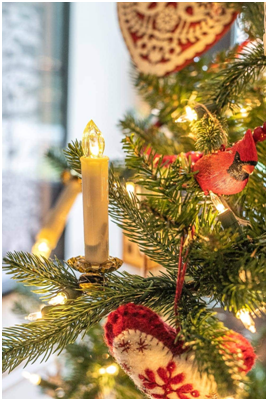
an illusion of what real candles look like on a tree

 Here’s a little background on two famous carols of German origin.
Stille Nacht (Silent Night), was first a poem written in 1816 by Father Joseph Mohr. His friend, Franz Gruber, set the poem to music and the pair performed it with a simple guitar accompaniment at a midnight Christmas Mass two years later in Austria. The song became instantly popular and was translated into many languages (300 at last count) but the name of the author was lost to history. Then, in 1995, Mohr’s original manuscript of the poem resurfaced, and the proper credit was given to the carol.


O Tannenbaum (O Christmas Tree), was written in 1824 by Ernst Anschütz, a schoolteacher in Liepzig, who based it on a 16th century folk song by Melchior Franck. By the middle of the 19th century, the song was tied to the Christmas tree and much loved in many other countries.

Spinster Rose MacEwen is the shy daughter in the large family of a prominent banker. All her life, her stutter has kept her from experiencing a normal social life like her sisters have. Although she’s the oldest daughter, Rose rarely talks with anyone outside her large family. Her mother believes no man will ever want her because a woman who can’t act serve as hostess won’t aid a husband’s career. Rather than argue, she keeps her thoughts bottled up inside. For years, she has sat at her grandmother’s side and learned the art of quilting. Rose pours her emotions into making quilts that she donates for charitable causes. But what she yearns for is the chance to converse with others in the community about what’s in her heart.

Blacksmith Berrin Harimann is most at ease in his world of heat and toil. No one bothers him while he’s wresting useful objects from blocks of metal. Those who come to his dark shop don’t linger after transacting their business. A disfiguring injury five years earlier robbed him of his fiancée. Rather than make excuses for a family who couldn’t look him in the eye, he moved west and set up shop in the Silver Bow Creek Valley. The pain from his burn scar now resides in his lonely heart and festers because of what’s missing from his life.

When the pulley on her quilt frame breaks, Rose ventures outside the family mansion in search of a blacksmith. Berrin looks up from his forge and sees an elegant lady in his shop doorway. Their gazes meet, and she steps into his world, bringing light. They connect instantly, and their fate seems set. But what chance does this pair have when everyone tells them they are not suited? Can their budding love withstand the expectations of her family and society’s standards?


Amazon  

and in KU

Best wishes to all for a happy holiday season

subscribe here to my newsletter 

OR

follow where you’re most active

https://www.twitter.com/lcarrollbradd

https://www.facebook.com/linda.carrollbradd

http://www.goodreads.com/author/show/1806413.Linda_Carroll_Bradd

https://www.bookbub.com/authors/linda-carroll-bradd

https://www.amazon.com/author/lindacarroll-bradd

Looking forward to a fantastic 2024


Friday, January 27, 2023

Brief History of Quilting, part 1

 When we think of quilts, we most often picture bed coverings comprised of cut pieces of colorful fabric stitched together in pleasing patterns. But possibly the two oldest quilts are from 14th century Sicily and are of white whole cloth, not pieced, and contain both intricate quilting and trapunto, a technique where cording is used to increase and define the raised surface.  The craftsmanship denotes skilled workers who designed and stitched scenes from the legend of Tristan and Isolde. Both quilts are in museums—one in Bargello Museum in Florence, and the other in the Victoria and Albert Museum in London.

photo credit Geta's Quilt Studio

During the Crusades, Europeans discovered Turkish soldiers wore quilted garments under their armor. Multiple layers of fabric with a lining provided both warmth and padding. The fashion soon migrated to Europe, especially the northern countries. Able seamstresses easily saw the benefit of using the technique for bed coverings. Although only the rich could have bought fabric with the intention of sewing a quilt, resourceful and thrifty housewives would have saved fabric wherever it could be found.

credit Pinterest

The practice crossed the ocean with the colonists, especially from countries like England, France, Holland, and Italy. The earliest surviving American quilts were calamancos made of whole cloth, usually a wool top (often imported) layered with wool batting and a home-woven linen or linsey-woolsey backing. The most common quilting pattern was large plumes. Cloth was most commonly imported from England and France until the early 19th century when American mills started producing cheap printed cotton fabric. Quilts of this time were often medallion style with a patchwork center surrounded by multiple borders.


The heroine of my latest release, Holle, is a quilter and a quilt needing repair is the way the hero and heroine meet.

Blurb for Holle, book 4 in Christmas Quilt Brides multi-author series.

Holle Berthold thinks love is a curse. Her first fiancé died, and the second one jilted her two days before the wedding. Then the man who funded her train ticket to Montana as a mail-order bride rejected her because of her partial deafness. Abandoned, she must find a job.

Widower Eduard Lambrecht discovers his late wife’s Christmas quilt is damaged. At the seamstress shop, he learns the woman to repair it is also the mail-order bride his cousin rejected. Can their bruised hearts dare to try again?

Amazon link

This novella is featured in N.N. Light’s Wintertime Reading Bookish Event. Click here to learn about all the books and enter to win a $10 Amazon gift card. 

Thursday, October 27, 2022

Sunshine & Shadows - A Brief History of Log Cabin Quilts by Jo-Ann Roberts


"The best kind of sleep beneath heaven above
is under a quilt made with love."

Some of you may not know that next to writing sweet historical romance, quilting is my passion. So, when I was invited to be part of a MAPs with a quilting theme, I enthusiastically said, "Yes!"  The Christmas Quilt Brides series will run beginning November 11th through December 16th.

The Log Cabin quilt, one of my all-time favorite patterns, plays a small role at the start and at the end of the romance between a widowed mother and a new-to-town deputy. 


                                                   Here's my Christmas Log Cabin quilt

The history of quilting, the stitching together of layers of batting and fabric, may date back as far as 3400 B.C. For much of its history, quilting was primarily a practical way to provide warmth. However, decorative stitches were often added, and many quilts are now art pieces.


The Log Cabin quilt pattern is one of the most beloved and recognized of quilt designs. Some fabric art historians believe it may be both older and newer than you might think. While it's natural to assume that this traditional block originated in the United States during the pioneer days, the origins of the block seem to go back much further in time and location. Similar designs have been found on ancient Egyptian mummies and in an English quilt predating 1830.

It was during the Civil War that the Log Cabin pattern first made a wide-spread appearance in the United States. The block name may very well have had a connection to the presidency of Abraham Lincoln. Soon, it became widely popular and was identified with the pioneer spirit and values of America.

Early Log Cabin blocks were hand-pieced using strips of fabrics around a central square. In traditional Log Cabin blocks, one half is made of dark fabrics and the other half light. A red center symbolized the hearth of home, and a yellow (or light) center represented a welcoming light in the window. Evidence, based on oral folklore, suggests that during the Civil War, a Log Cabin quilt with a dark center hanging on a clothesline was meant to signal a safe stop in the Underground Railroad.


In the latter part of the 19th century, many Log Cabin quilts were made by the foundation method with a muslin base. Wools, velvets, satins, and other nontraditional fabrics were used. Log Cabins of this period often had strips that were folded and laid down creating a three-dim emotional effect. For this reason, many late 19th century Log Cabin quilts do not have batting but are back and tied like Crazy Quilts.

Soon, variations of settings appeared with names reflecting the themes of the times. The White House Steps, Court House Steps, eight-sided Pineapple, Barn Raising and Sunshine and Shadows are some of the hundreds of name and pattern variations.

 
                                      Court House Steps                            Eight-Sided Pineapple

As Victorian quilts of wool and silk fell out of style in the 20th century, Log Cabins were often made of cotton prints and pieced with a running-stitch seam either by hand or machine.

Today, the Log Cabin pattern is still a favorite choice for scrap quilts and there is even a resurgence of Crazy Quilts made using Log Cabin blocks.

In my book, the heroine, Noelle Prentiss, belongs to the Circle of Friends. Each Christmas, the members make quilts for the new families who moved to Harmony, Kansas. The quilters are given the name of a family, and at the Christmas Eve Cotillion present the quilts to the new members of their community. I don't want to give away the ending but below is the quilt pattern I envision Deputy Cole West receives.


The Christmas Quilt Brides series is now up for pre-order. Here's the series link: CLICK HERE


A widow reluctant to love again…

A deputy determined to win her heart…

Two years ago, Noelle Prentiss lost her husband to an outlaw’s bullet. With two children to raise, a small farm to tend, and a job making quilts to sell at the mercantile, she’s doing her best to keep her property and life intact…until a man claiming to be the new deputy rides into her life captivating her children with his dog, his smile, and his easy-going charm.

When Coleman West agrees to stop by the Widow Prentiss’ home on his first day as a deputy in a small Kansas town, he has no way of knowing obeying the sheriff’s order will change his life. Spurned by love years before, he became a lawman, dedicated to protect and serve. Yet, he had no idea the widow and her children would call to his heart like no one before.

With Christmas looming, will the growing attraction between Noelle and the deputy reveal the gift of a second chance?

Or could a stranger from the deputy’s past threaten the man who captured her heart?


 ...And here's my current work in progress. Winning the Widow's Heart is Book Two in my Mended Hearts series. It releases in March 2023.