Showing posts with label Bakery. Show all posts

Friday, October 22, 2021

Were Cooks More Instinctual in the Past?


For the story I finished this week, Ginger Cake by Glynna, I showed my character in the kitchen a lot--after all, she owns a bakery in 1876 Astoria, Oregon. She’s also the third generation in the family to run it, so the business has been around a while. One facet of cooking and baking that we in our current time take for granted is standard utensils for measuring.

From reading cookbooks of the era, I knew teacups and thimbles were listed in recipes. But think of teacups you’ve seen or might have in your cupboard. They are not a standard size. My paternal grandmother cooked by feel and sight. She always used the same mixing bowl and had been making certain recipes long enough that she just knew what the right amount of flour was supposed to look like in the bottom of that bowl. One time I asked to be taught to make her from-scratch egg noodles. She talked me through scooping out enough flour, using a big spoon, and measuring the salt in the palm of my hand. But after I broke the eggs into the bowl and was ready to add the water, I was nudged aside because she said the amount of water varied and it was based on the feel of the dough while mixing. Needless to say, I did not learn to make Grandma Mary’s noodles. In later years, when I attempted a recipe from a cookbook, they didn’t taste the same.

image from wikimedia

But I did learn that utensils used as a standard for measured ingredients weren’t “invented” until 1896 by Fannie Farmer. As director of The Boston Cook School and author of The Boston Cooking-School Cook Book, she saw a standardized measure for dry ingredients as an essential tool in the kitchen.  She is credited with inventing measuring cups and spoons.  (Although interesting this fact didn’t help me in my 1876 story)  A standard measurement for liquid was even more distant from my setting because Pyrex wasn’t invented until 1910. My solution came from another field altogether.:)

image from wikimedia

My conclusion is that all those 19th-century women cooking meals and baking bread in sodhouses or on farms, ranches, or in city row houses had a good instinct for the ratio between dry and wet ingredients to produce the desired dish. I also think a lot of experimentation went on. So go pull out the drawer that holds your measuring implements and take a moment to appreciate Miss Fannie Farmer and what she devised that makes preparing our meals easier.

BLURB for Ginger Cake by Glynna, book 7, Old Timey Holiday Kitchen releases 10/25/21

Baker Glynna Shaughnessy wants to bolster sales for her struggling bakery almost as much as she wants to revive her drab personal life. A baking competition in commemoration of the city’s incorporation offers a chance at making the shop’s name known…until she’s accused of cheating. According to the competition’s sponsor—a roguish man who sets her heart aflutter—Glynna can only remain a contestant if she invents a brand-new recipe…something she’s never done before.

Hotel manager Ritter Anton has six months to boost patronage at his grandfather’s Anton Grand Hotel. He accomplished success with the family’s Cheyenne hotel and he’ll succeed here then move to the next. The baking contest he invented sparks controversy with the entry of a baker who others claim has an unfair advantage. Ready to reject her, he can’t say no when the auburn-haired beauty pleads her case. How will he remain neutral as a judge when all he can think about is Glynna?

Stay in touch

My Amazon Page

My Facebook Page

My Goodreads Page

Or subscribe to my occasional newsletter


Friday, October 2, 2015

Yeast, Bread, & Bakeries, Old West Style


Baxter, Perry, Burns Bakery in Dresden, Ontario in 1890s

I can only imagine the difficulty in trying to bake bread on the frontier.
Whether in a Dutch oven in campfire coals, or in the belly of a cast-iron cookstove, bread-making must've been a risky business. Who could afford to waste loaves charred on the outside and doughy on the inside?

No wonder bakeries sprang up almost as quickly as liveries and blacksmiths, mercantiles and grocers, jailhouses and hotels. 

Enterprising settlers saw a need, met it, and earned their living baking bread, rolls, pies, cakes, pastries, doughnuts, and more.

Joseph Henry Walk worked as a baker in Brighton, Utah. Pictured here with his sons and Globe Bakery delivery wagon in late 1890s.


This photo of Fort Larned National Historic Site is courtesy of TripAdvisor 
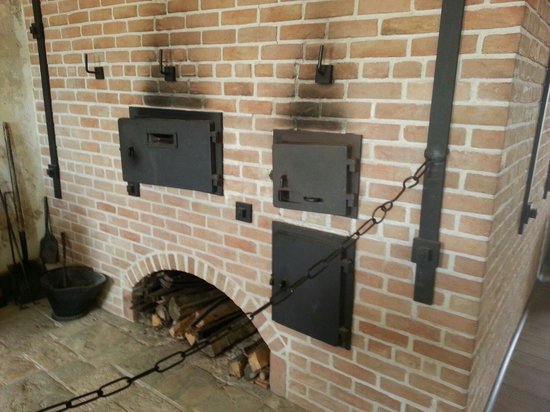
Fort Larned operated from 1859 to 1878
This image shows the Brick Oven in the Bakery

Before yeast was commercially available, bakers skimmed the foam from beer, a sourdough starter, or made "quick" breads with saleratus (a precursor of baking soda).

Commercial yeast was first marketed at the Centennial Exposition in 1876, where Charles L. Fleischmann exhibited the product and a process to use it. In the decade preceding the Centennial Exposition, a method was developed to remove liquid so yeast (grown in cream) could be sold in block form, and a different manufacturing process created granulated yeast.
Antique Bakery Display Case
For a look into history and baking, I recommend the 1913 edition of Things Mother Used to Make: A Collection of Old Time Recipes, Some Nearly One Hundred Years Old and Never Published Before. The Kindle version is FREE ($0.00) and sheds much light on old-time baking of bread, pies, cakes and so much more. This title has been published with a dozen or more different covers, but if any similar (shortened?) title is by Lydia Maria Gurney, you have the right book.


My love for baking makes an appearance in my soon-to-be-released title The Drifter's Proposal, set in my fictitious town of Mountain Home, Colorado in mid-December, 1900.

The baker’s man is home for Christmas…

Spinster Adaline Whipple runs the family’s business, Whipple Bakery, since her father’s demise almost four months ago. She’s stunned by a surprise mortgage her father made with a bank in Denver City six months before he died. Now that the loan is sixty days overdue, the big-town banker wants his money. If the Whipples can’t pay, he’ll evict them. Little does he care Christmas is one week away and the widow and daughters have nowhere to go. Adaline’s sure the handsome drifter Malloy’s proposal of… marriage?... won’t do her any good. But his mere offer to help feeds the attraction she’s felt for him, and before she knows it, she trusts the one man who can break her heart.


The Drifter's Proposal is available NOW in the Western Christmas Romance Anthology, Silver Belles and Stetsons. Preorder now for the introductory price of 99-cents. Release date November 2, 2015.

10 Authors. 10 Novellas.
Silver Belles and Stetsons
Cowboys of the Past and the Women Who Loved them.

Kristin Holt | Photograph of Kristin Holt, USA Today Bestselling Sweet Romance


Kristin Holt | Book Review- Things Mother Used to Make: A Collection of Old Time Recipes, Some Nearly One Hundred Years Old and Never Published Before


Kristin Holt | DIY Yeast in Victorian America


Copyright © 2015 Kristin Holt, LC