Showing posts with label suffrage. Show all posts

Saturday, March 14, 2026

Notable Early Women of Wyoming Territory by Zina Abbott

With this being Women’s History month, I wish to draw attention to the women of early Wyoming Territory. Although many claim they were granted suffrage—something positive—for the wrong reasons, the truth is, in 1869, the Wyoming Territorial legislature did give Wyoming Territory women the right to vote. In spite of opposition from those who still believed a woman’s place was limited to her home, the following women were among the forerunners who proved this was a wise decision.


The suffrage bill was passed through an all-male legislature with help from women of influence behind the scenes. William Bright introduced the suffrage bill. It is believed that his wife, Julia Bright, was the driving force behind his decision. Since the bill also granted suffrage to all males regardless of race, he is known to have given the reason that, if black and Chinese men could vote, his wife should be able to as well.

In 1902, while attending a national convention on women’s rights, Mr. Bright was asked to speak about what had happened in Wyoming. He stated that the bill regarding women’s suffrage was not introduced “in fun.” He supported women’s suffrage because he believed “his wife was as good as any man and better than convicts and idiots.”


Louisa Swain
of Laramie City, about age seventy, is on record as being the first woman to have voted in a general election in Wyoming Territory on September 6, 1870. According to the Laramie and Cheyenne newspapers, Swain beat Augusta C. Howe, the 27-year-old wife of the U.S. Marshall Church Howe of Cheyenne, to the polls by 30 minutes.

About 600 women were eligible to vote in the 1870 election. Unfortunately, there is no record of exactly how many women took advantage of this privilege. It is believed at least 289 total voted. According to the newspapers, 171 women voted in Cheyenne, 93 in Laramie, eight in South Pass City, eight in Atlantic City and nine in Miner's Delight—the last three being the gold-mining towns near South Pass. This would suggest that women voted in these towns at approximately the same rate as men in Cheyenne and Laramie.

The notion that women would follow their husbands’ leads and vote the same way they did was dispelled. According to the Laramie and Cheyenne papers in 1870, the women's vote skewed heavily in favor of Republican candidates—much to the disgust of the Democrats, who brought about the right for women to vote. Louisa Swain of Laramie, the first documented woman voter in Wyoming, reportedly voted a straight Republican ticket.  


Esther Hobart Morris
became the first woman to hold the office of justice of the peace in the United States. This came about when, to protest the Wyoming Territorial Legislature granting women suffrage in December 1869, James W. Stillman resigned from his role as justice of the peace in Sweetwater County.

In 1870, Esther Hobart Morris, then age 55 and an imposing six feet tall in stature, was appointed by the Sweetwater County Board. During that era, justices of the peace held more power than modern-day judges since their courts covered every type of case. She presided over everything from assault cases to debt disputes.

Morris commanded her courtroom and, according to the American Journal of Legal History, spoke in a manner that was more “candid than diplomatic.” As a working woman in the late 1800s, she lacked both legal experience and formal education. She judged legal issues “on the broad principles of justice and right without regard to technicalities or quibbles of law.”

By the end of her eight-and-a-half-month tenure, Morris had a solid grasp on sophisticated legal proceedings. Out of her forty rulings, none were overturned upon appeal. 


In March 1870, six women in Laramie City, Wyoming Territory, were the first to be called to sit on a formal grand jury, to be composed of up to nine men and six women, presided over by Judge John Howe. The women were Eliza Stewart, Elizabeth (Amelia) Hatcher, Sarah Pease, Mary Jane Mackle, Annie Monaghan, and Mary Hilton. Another woman, Martha Boies, was selected as a bailiff. For more about this jury, please read my post on a different blog by clicking HERE


1880s recreation of first women serving on a jury, Laramie City

A grand jury has the power to investigate potentially criminal conduct and decides whether criminal charges should be brought against a defendant or group of defendants. Women had never served on grand juries or trial juries before.


Amalia Post
grew up believing that women were supposed to be the center of the household, and limited to that position. Her life did not allow her the luxury of pursuing that course. After her husband deserted her twice without funds—the second time with another woman—she filed for divorce and moved far from family. She became financially independent by raising chickens and loaning money to be repaid with interest. She remarried and moved with her husband to Cheyenne, Wyoming Territory, but—as was allowed by the married woman’s property laws in Colorado and Wyoming Territories—kept her personal property separate from his. She showed no signs of interest in the women’s suffrage movement until after she was selected as the foreman of the first female jury in the United States.

When women in Wyoming were granted suffrage, the question of jury duty was brought up. If juries were selected from voter rolls, then women ought to participate. And so Post was selected as the foreman of the jury for a murder trial in Cheyenne in 1871.

Men of the time thought that women didn’t have the capacity to justly rule on cases involving such high emotions. Some historians say allowing women on juries was an attempt to discredit suffrage or prove that it was a joke.

Nevertheless, Post, along with other female jurors, sat in the courtroom to hear pleas. In the end, they sentenced the murderer to be hung. In reality, the women of the time reportedly dished out higher fines and stricter rulings.


In my upcoming release, The Bride Who Step Dances, My heroine and her brother arrived in Laramie City after the women in Wyoming Territory were no longer being called for jury duty. This book is not on pre-order, but is scheduled for release on March 20, 2026.

The best way to be notified of the release is by following me by newsletter HERE


Sources:

https://www.wyohistory.org/encyclopedia/who-cast-first-vote

https://www.wyohistory.org/encyclopedia/women-jury-wyoming-makes-history-again

https://www.wyomingnews.com/news/suffrage/the-forces-behind-the-suffrage-movement-in-wyoming/article_1ca0a678-88a9-5f9d-9f97-0cb9a7b6bdfe.html

https://www.wyohistory.org/encyclopedia/amalia-post-defender-womens-rights

https://www.wyohistory.org/encyclopedia/right-choice-wrong-reasons-wyoming-women-win-right-vote

https://www.wyomingnews.com/news/suffrage/the-forces-behind-the-suffrage-movement-in-wyoming/article_1ca0a678-88a9-5f9d-9f97-0cb9a7b6bdfe.html


Wednesday, May 17, 2023

Struggle - These Women Doctors Didn't Let That Stop Them

 Post (c) Doris McCraw

aka Angela Raines


Photo property of the Author 


There is a history of women struggling to be accepted in the early part of the 1800s. It began with Elizabeth Blackwell and her efforts for acceptance into Geneva medical college.

Dr. Blackwell, who graduated in 1849 from Geneva was not the only woman who made the effort to attend medical school or practice medicine openly. Dr. Harriot Kezia Hunt practiced in Massachusetts in the 1830s and had applied to Harvard Medical School, at the same time Blackwell applied to Geneva, but was denied acceptance. (It should be noted, the faculty agreed to let Dr. Hunt and men of color audit classes, but the student body objected.) Dr. Hunt was later given an honorary degree from the Female Medical College of Philadelphia in 1853.

In 1864 Dr. Rebecca Lee Crumpler was the first woman of color in the United States to earn a medical degree. Dr. Sarah Hackett Stevenson, a physician in Illinois was admitted to the American Medical Association in 1876.

On January 8, 1873, the Denver Rocky Mountain News, carried the following advertisement. “Mrs. E. A. Gillett,M.D. Office and residence: Curtis Street between I and K. Special attention given to Obstetrics and diseases of women and children. References: John Major, M.D., Dr. C. Wakefield, Bloomington, Illinois: R.A. Gunn M.D., H.D. Garrison M.D., L.S. Major M.D., Prof. Bennet, Medical College, Chicago.” Dr. Gillett remained in Denver for approximately two years before continuing further west.

The idea of a female doctor in Colorado does not seem to be one of fighting prejudice. At least not overtly. Dr. Gillett had supporters, most of whom are male. There were women doctors in the 1870s in Colorado who did not fit any of the parameters we've seen in the television shows.

Dr. Alida Avery came to Denver in 1874 as the director of hygiene. Dr. Avery's credentials were impressive. She graduated from the New England Female Medical College in 1862 and then Boston University of Medicine in 1863. Prior to Colorado, Dr. Avery was a professor at Vassar from 1865 to 1874. Matthew Vassar in 1864 wanted to use all female professors, but in the 1860s there were few who would qualify. He did locate two, astronomer Maria Mitchell and Dr. Alida C. Avery, physician, and physiology professor. Dr. Avery, along with Miss Lyman and Dr. Raymond, were called by some of the students ' The Trinity' for their power in the institution. A case for fighting prejudice might be made for Dr. Avery if you include her work on behalf of women and the suffrage movement. By the time Dr. Avery arrived in Colorado, two years prior to statehood, she was involved in and was the president of “The Organization for Women's rights”. The Rocky Mountain News announced her arrival in style. The June 11, 1874 edition of the paper included the following: “the well-known professor of physiology and hygiene, at Vassar College, Alida C. Avery, M. D., has arrived in Denver and taken up residence on 20th St., corner of Champa. She has been the resident physician of that institution from its opening in 1865, having usually under her care the health and habits of some 400 young women from every part of our country. The Poughkeepsie news, in announcing her resignation, makes mention of the remarkable fact, that not a single death occurred among the pupils under her charge, during her eight years of administration....”

While Dr. Avery may have been the first female physician to remain in Colorado for more than two years, she was not the only one. Dr. Rilla G Hay, one of the first to be licensed in California when they began in 1876, regardless of where the physician had a practice, spent time in active practice and furthered her education, taking additional medical courses over the years she was active.

Dr. Edith Root was the first woman to receive a license in the state of Colorado when the state began the process in 1881.

While women had to work to achieve their dreams, so did many others. What we can take from their journey is the determination to follow through and just do it.

If you would like to know more about the women doctors who practiced in the Colorado Springs area the book: "Under the Stone: Early Women Doctors in Evergreen Cemetery" is available as an ebook. Amazon Purchase Link

My novel “Josie’s Dream” was inspired by these women that I not only admire but use as role models for following one's dreams Josie's Dream - Amazon Link.


Until Next Time: Stay safe, Stay happy, and Stay healthy.

Doris


Friday, September 23, 2016

How Setting Affects Character Building


When I chose Wyoming for the setting of Dreams of Gold, a western historical novella, I did so because WY is known as the equality state. Even before the territory gained admission to the United States, legislation was passed in 1869 that granted women the right to vote, serve on juries, and hold elected office. The territorial document was the first time a government had granted “female suffrage” and became law upon Governor A.J. Campbell’s signature on December 10, 1869.

Within three months, Esther Hobart Morris had been appointed justice of the peace in South Pass City (a site of gold strikes) to fill out a term for a man who’d been ousted. Her “courtroom” consisted of a wooden slab bench in her log cabin. Although she had no legal training, she had been the owner of a successful millinery business in her prior home state of New York. In her first case, she arrested J.W. Stillman, the man who had served in the position but refused to relinquish his court docket. She served for nine months and gave decision on 27 cases, 9 of which were criminal in nature. Her appointment as a judge garnered national attention, and she’s credited with encouraging (perhaps even co-authoring) the woman’s suffrage bill put before the legislation.
Esther courtesy of Wikipedia

Also noteworthy was that on September 6, 1870 in Laramie, Mrs. Louisa Swain was the first woman to cast a vote in a general election. She was 69 years old and described as “a gentle white-haired housewife.”

These facts were important because such events would have appeared in newspapers across the nation, establishing Wyoming as an area with a progressive attitude toward women’s rights. My heroine, Ciara Morrissey, grew to adulthood in the east, Massachusetts in particular. Living in an area of higher population gave her access to a wider number of opportunities—ways to support herself, as well as gatherings, colleges, and public meetings that educated and informed. Raised by a liberal-minded mother, Ciara had attended both anti-slavery and suffrage meetings since she was a child. Therefore, she arrived in Wyoming Territory in 1871 with expectations on how to conduct her business that were a bit more open-minded than the hometown sheriff, Quinn Riley, was used to. And the sparks flew…

BLURB: Sheriff Quinn Riley is tracking an Irish swindler and sticking close to the opinionated woman from the runaway stagecoach. Within hours, easterner Ciara Morrissey puts the town in an uproar by inquiring about his prime suspect.  He’s duty-bound to keep her safe, even when being close to the green-eyed beauty sets off a stampede in his heart.

BUY LINKS


Find Linda here on the web


Twitter  @lcarrollbradd


Or subscribe to her quarterly newsletter to stay updated on news and releases

Friday, June 17, 2016

What Makes Cheyenne So Special?

Cheyenne, Wyoming is beautiful, and the destination for the most recent Mail-Order Brides series with the Sweet and Clean Book Club author collaboration!  Why Cheyenne? What makes it so special?

cheyenne-wyoming-mail-order-bride-series-kate-cambridge-author


Truthfully, covering everything would make this article far too long, so I'll start with what inspired me to select Cheyenne for Maud's Devotion, and the second book in this series, Helen's Promise, and the remaining two books that are yet to be announced, and provide a high-level view.

Cheyenne is located on the southeast corner of Wyoming, and close to the Colorado border. Historians believe the original inhabitants of this area were large game hunters, and in the mid-1970's archaeologists discovered evidence of human habitation. Mammoth remains were found in the same location as ancient implements that appear to be designed to kill animals; consisting of agate, quartzite, and even jasper artifacts. How incredible is that?

cheyenne-wyoming-map-kate-cambridge-author-historical-romance


It is possible that French fur hunters penetrated this area of Wyoming in the mid-18th century, but historical records tell us that exploration of the area began closer to the 19th century.

Gold was discovered in the 1860's and 1970's, and that led to all kinds of migration west, and unfortunate conflicts between Native Americans and the people moving into the area.

In 1867, the Pacific Railroad entered southern Wyoming, coal mines were built, and many towns sprouted up in the surrounding areas, and by 1968 the area ballooned to a population of 11,000!

Cattle ranches were established in ernest around this time, and Cheyenne was declared the temporary capital in 1868.

Here comes the main reason for choosing Cheyenne, Wyoming as the destination for this series (and if you've read any of my books, this will make perfect sense to you),  the territorial legislature granted women the RIGHT TO VOTE, hold office, and serve on juries in 1869. Wow! This was the first law of its kind in the country, and Cheyenne should be very proud of this!

Of course, part of the reasoning behind this law was to attract more women to the area, but regardless, I think it's wonderful and progressive of this new territory.

The women in my new baby-focused series, and part of my collaboration with the Sweet Clean Book Club, are women to whom this new law mattered, and many of them were active in the Suffrage Movement.

Thank you for joining me on this high-level brief of Wyoming's history, and in particular Cheyenne. Join me next month as we explore more interesting facts about this influential and beautiful area!

~Kate Cambridge

Visit KateCambridge.com for more information, or KateCambridge.com/Choice to join the Choice Readers group for special launch-day pricing, contest, and more. Be one of the first to know what happens next...

Kate loves to connect with readers:


Wednesday, May 25, 2016

Did You Know? The Suffrage Movement and Mail-Order Brides

The Suffragette movement takes center stage in The Suffragettes Choice Brides Agency series, which combines the amazing sacrifice and dedication of the suffragettes with sweet and clean historical romance.

Each story begins in Boston, (one of my favorite cities), and therefore it makes perfect sense that it would become the center of each mail-order bride’s origin in the series! The fact that the 1850 National Women’s Rights Convention was held a Brinley Hall in Worcester, MA, and 186 of the 268 attendees were from Massachusetts has a little something to do with it, too.

Here's some history...

In 1869, a joint special committee on Woman Suffrage was formed by the Massachusetts State Legislature; when the State House of Representatives voted on the question of municipal suffrage for women, there were 68 “Yeas” and 133 “Nays”.  This is what prompted the American Equal Rights Association to change the name of their organization to the National Women Suffrage Association. 

On July 4, 1876, Susan B. Anthony, Matilda Joslyn Gage, Sara Andrews Spencer, Lillie Devereux presented the “Declaration of Rights of the Women of the United States” and on September 12th they endorsed John I. Baker for Governor of Massachusetts. 


Once again, we find Massachusetts and Boston pivotal in the movement.


Historically, even women with the ‘highest standing’ in Boston (and other cities and states) struggled to find men who would take them as brides if they were a known suffragette. That is not to say that there were no men in Boston, MA who supported the Suffrage Movement, however, there were not many.

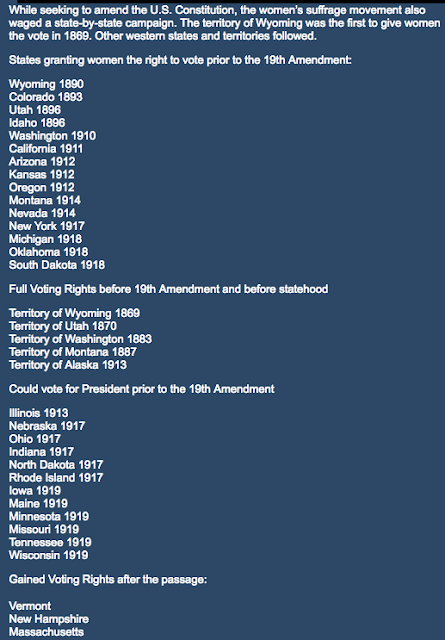
The territory of Wyoming was the first to give women the right to vote in 1869 (Go Wyoming!).  The West tended to give women this right on a much broader scale and earlier adoption than did the East, and we have a list below showing the chronological adoption of this right, by state. You can click the image to see the full list, as we cut it off when Massachusetts finally voted to allow women the right to vote!

suffragette-voting-rights-by-state-kate-cambridge-author

I'm passionate about this, and grateful to all the women (and men) who sacrificed more than we'll ever know to pursue this right, and in some cases committed their entire adult lives to this cause. As a result, women today have the right to vote, own property, run their own businesses, and much more.

Although it may seem counterintuitive that a mail-order brides series would focus on Suffragettes, for this series it makes perfect sense.

Reading about the history of the Suffragettes is what prompted me to create the Suffragettes Choice Brides Agency series, and book one, BEGINNINGS, tells the story of one woman who decided to begin a mail-order bride agency to find husbands who supported the Suffrage Movement for her Suffragette friends.

I trust this brief synopsis has been interesting to you, and may even spur you on to learn more about the sacrifices and dedication of the suffragettes. 

It is my hope that as women we'll not take our rights for granted, but rather say a prayer of gratitude as we work, run our businesses, vote for the candidates we support, and teach our children the importance of this each and every day. 

It has not always been our right, but it is now. May we never lose sight of this fact, or become complacent. 

Maya Angelou is one of my absolutely favorite women in history, and so I leave you with her words, spoken at former President Bill Clinton's Inaugural address: 


"... give birth again to the dream... "

With love,
Kate Cambridge

***

Consistently an Amazon top 100 bestselling author in Literature & Fiction Short Reads, Westerns, and Christian categories, Kate Cambridge writes always sweet historical and contemporary romances with strong characters, and a thread of faith and love interwoven throughout. She has loved writing since she was a child, and could not be more grateful to be an indie author! Her first Western Historical Series is The Suffragettes Choice Brides Agency series, and she also writes in collaboration with the Sweet Clean Book Club authors. Visit Kate's Amazon Author page here: Kate Cambridge on Amazon. Visit her website at KateCambridge.com and let's connect on Instagram! @KateCambridgeAuthor