Showing posts with label Canning. Show all posts

Wednesday, July 23, 2025

The Art of "Putting Up" Summer's Bounty


Early in our marriage, my husband’s former girlfriend (who has since become my BFF…another story for another time!) took me strawberry picking. She then offered to help me make strawberry preserves, a task I’ve joyfully embraced for the past fifty-plus years.

Back in May (while I was at my annual Quilt Week retreat!!!), my husband bought two flats of strawberries in anticipation of making preserves. Since he had done it the year before (under my supervision, I must add!), he thought it couldn't be that hard! What's that saying...if anything can go wrong, it will? Thankfully, nothing did!!!


Canning is a relatively recent development in the long history of food preservation. Humans have dried, salted, and fermented foods since before recorded history. But preserving food by heat-treating and then sealing it in airtight containers didn't come along until the late 18th century.

In the mid-19th century, housewives harvested their gardens from late spring through the fall, until a killing frost descended on their particular part of the country. With different fruits and vegetables coming in abundance, and sometimes overlapping, the women would often find themselves overwhelmed by the endless bounty to “put up”.  But if they wanted their harvest to sustain them during the winter months, they had to tackle the seemingly never-ending process.

Primitive Canning

When Nicolas Appert, a French inventor, first put food in glass jars in 1795, he believed it was the exclusion of air that preserved it. He was half right; the other half was his method of placing food in jars and then boiling the sealed jars. Until 1858, canning jars used a glass jar, a tin flat lid, and sealing wax, which was not reusable and messy!

Mason Jars

But in 1858, John L Mason, an inventor and tin smith from New York City, invented the mason jar. His machine cut threads into the lids, making it practical to manufacture a jar with a reusable, screw-on lid. His design, a glass container with a thread molded into its top and a zinc lid with a rubber ring, greatly improved the design of his predecessors. The rubber created the seal, and the threaded lid maintained it. The jar included his patent: “Mason’s Patent November 30th. 1858.”


Molds for blowing bottles, Patented by John L. Mason, November 23, 1858.

1873
 

With this simple invention, Mason revolutionized home canning, bringing with it the reliability of consistently made canning jars, lids, and rings into the public realm for the first time.

Figure 1. Courtesy of Jo-Ann Roberts

The photo above is part of my antique collection of canning jars passed down to me by my late mother-in-law.


Clamped Glass-Lid Jars (Lightning Jars)

Another type of canning jar was the “Lightning” or wire ball jar. Invented in 1882 by Henry William Putnam of Bennington, Vermont, these fruit jars used a glass lid and a metal clamp to hold the lid in place. These “Lightning jars” became popular because no metal (which could rust or break the seal) came in contact with the food, and the metal clamps made the lids easier to seal and remove (hence, the “Lightning” name).

Basically, a wire loop and levers operated to clamp down securely onto the lid and close the jar.  The “Putnam” jars were made by at least 11 glass companies, some of which made them into the early 1900s.  Aqua is the most commonly seen color, as was typical of utilitarian glass of the period.

It’s likely that “White Lightning” derived its name from the fact that bootleggers used these jars to store their product!


Atlas Jars

The Atlas E-Z Seal is a type of Lightning jar. The difference is a raised lip to help keep the jar from cracking. This was called the “Strong Shoulder” and was similar to the mason jar. Cracking was a common problem with the shoulder seal jars. Hazel-Atlas Glass Company was in operation from the late 1800s until 1964.


    Figure 2. Courtesy of Jo-Ann Roberts.

Ball Jars

Meanwhile, in 1880, in Buffalo, NY, William Ball and his brothers, Lucius, Lorenzo, Frank, Edmund, and George, borrowed $200 from their uncle and were soon in the business of manufacturing wood-jacketed tin cans for the storage of oil, lard, kerosene, and paint. Four years later, the brothers began making glass home-canning jars, the product that established Ball as a household name. The brothers moved the company from Buffalo, New York, to Muncie, Indiana, in 1887 to take advantage of abundant natural gas reserves essential to making glass.


Figure 3. The Ball Brothers of Buffalo, NY. Courtesy of Ball State University Archive


Kerr Jars

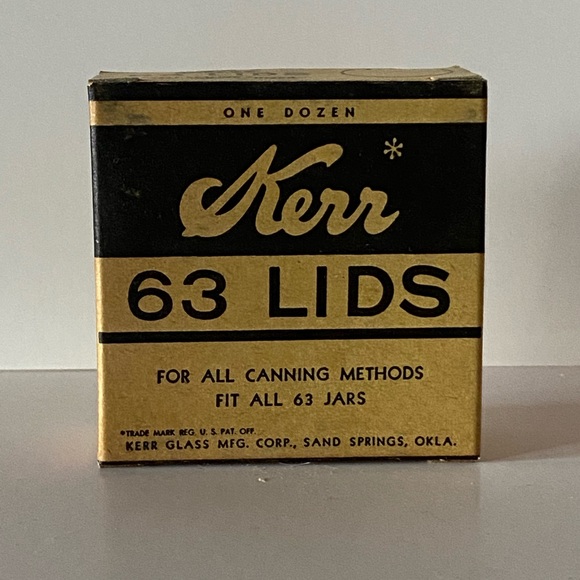
At the turn of the 20th century, Alexander Kerr founded the Hermetic Fruit Jar Company, featuring the Economy and Self-Sealing jars. The Economy jars were among the first wide-mouth jars, and thus, were easy to fill. They also incorporated elements from two 1903 patents held by another inventor, Julius Landsberger…a metal lid with a permanently attached gasket. This made the lids easy to use and inexpensive.


In 1915, Kerr invented a smaller, flat metal disk with the same permanent composition gasket. The lid sealed the top of a mason jar; a threaded metal ring held the lid in place during the hot water process. This allowed reusable old canning jars to be used with inexpensive and easy-to-use disposable lids. This two-part system transformed home canning safety and remains in use today.


Eco-Friendly Uses in the Modern World

As one of the most useful containers on the planet, the mason jar has skyrocketed in recent years for its huge range of uses, and it all started with canning.

Pinterest and DIY users have discovered the lure and nostalgia of vintage mason jars, turning them into solar lights, pantry organizers, kitchen and/or bathroom decor, Christmas luminaries, and centerpieces for a rustic country-style wedding.


Figure 4 Photo Courtesy of Jo-Ann Roberts

A resurgence in canning is largely tied to the 2020 global pandemic, which led many Americans to explore home gardening. “Pandemic hobbies” became highly popular activities as life with the coronavirus extended into its second year. With a new wave of gardeners emerging, the desire to grow food without pesticides and chemicals has increased the interest in and popularity of glass mason jars.

Besides, what could be more satisfying than tasting a hint of summer on lightly buttered toast on a cold February morning? Here’s to a job well done, Papa Bob!


Figure 5 Photo by Jo-Ann Roberts.

********************************************************

My Current Release....


Ash “Shotgun” McCrae can never make up for all the wrong he’s done. After leaving a notorious outlaw gang, he thought he’d discovered the peaceful existence he’d been looking for when he found work laying tracks for the railroad in Rivers Bend. Yet, when trouble shows up in town, he fears he may never free himself from the burden of his past.

Schoolteacher Kate Cummings stands as the one bright light in contrast to the curious looks and behind-the-glove whispers blowing through the town. The arrival of Padraic “Patch” Rooney and his gang challenges the small-town serenity she holds dear. Still, her steadfast trust in Ash awakens the strength of courage within them all, giving rise to the collective defiance against the approaching danger.

In a deadly game of dangerous outlaws and secret schemes, Kate and Ash must decide whether they are willing to risk everything for their love, including their lives
.


Thursday, June 22, 2023

Preserving History - A Look at Canning Jars


Back in early May, Papa Bob came home with a flat of strawberries. I'd like to report that he toiled in the nearby farm to pick them, but I can't tell a lie. Still, a flat of strawberries is a lot of strawberries!

I offered to make a Strawberry Pie (my first ever!) Yet an over-abundance of berries remained.


I knew I had a jar of Sure-Jell (pectin), jelly jars, and sugar. After making sure the Sure-Jell hadn't expired, I set to work making preserves. A little more than an hour later, 8 jars of ruby-red preserves were cooling on my island.


Every time I make preserves, or receive a gift of homemade pickles, my thoughts turn to pioneer women and food preservation. With different fruits and vegetables coming in abundance, and sometimes overlapping, the women would often find themselves overwhelmed by the endless bounty to "put up". But if they wanted their harvest to sustain them during the winter months, they had to tackle the seemingly never-endless process.

Primitive Canning

When Nicolas Appert, a French inventor, first put up food in glass jars in 1795, he thought it was the exclusion of air that preserved food. He was half right; the other half was his method of placing food in jars, then boiling the sealed jar. Until 1858, canning jars used a glass jar, a tin flat lid, and sealing wax, which was not reusable and messy!

Mason Jars

But in 1858, John L. Mason, an inventor and tin smith from New York City, invented the mason jar. His machine cut threads into the lids making it practical to manufacture a jar with a reusable, screw-on lid. His design, a glass container with a thread molded into its top and a zinc lid with a rubber ring greatly improved the design of his predecessor. The rubber created the seal, and the thread lid maintained it. The jar included his patent: 'Mason's Patent November 30th. 1858'.


Clamped Glass-Lid Jars (Lightning Jars)

Another type of canning jar was the 'Lightning' or wire ball jar. Invented in 1882 by Henry Putnam of Bennington, Vermont, these fruit jars used a glass lid and a metal clamp to hold the lid in place. These 'lightning jars' became popular because no metal (which could rust or break the seal) came in contact with the food and the metal clamps made the lids easier to seal and remove (hence, the 'lightning' name).
Basically, a wire loop and levers operated to clamp down securely onto the lid and close the jar. The 'Putnam' jars were made by at least 11 glass companies, some being made into the early 1900s. Aqua was the most commonly seen color, as was typical of utilitarian glass of the time period.

Fun Fact:  It's likely that 'White Lightning' derived its name from the fact that bootleggers used these jars to store their product!

Atlas Jars

The Atlas E-Z Seal is a type of lightning jar. The difference is a raised lip to help keep the jar from cracking. This was called the "strong Shoulder" and was similar to the mason jar. Hazel-Atlas Glass Company was in operation from the late 1800s until 1964.

 
                                                                                    Photo courtesy of Jo-Ann Roberts

Ball Jars

Meanwhile, in 1880 in Buffalo, NY, William Ball and his five brothers borrowed $200 from their uncle and were soon in the business of manufacturing wood-jacketed tin cans for the storage of oil, lard, kerosene, and paint. Four years later, the brothers began making glass home-canning jars, the product that established
Ball as a household name. The brothers moved the company from Buffalo to Muncie, Indiana, in 1887 to take advantage of abundant natural gas reserves essential to making glass.


Kerr Jars

At the turn of the 20th century, Alxander Kerr found the Hermetic Fruit Jar Company, featuring the Economy and Self-Sealing jars. The Economy jars were among the first wide-mouth jars and were easy to fill. They also incorporated elements from two 1923 patents held by another inventor, Julius Landsberger...a metal lid with a permanently attached gasket. This made the lids easy to use and inexpensive.


In 1915, Kerr invented a smaller, flat metal disk with the same permanent composition gasket. The lid sealed the top of a mason jar; a threaded metal ring held the lid down during the hot water process. This allowed re-use of old canning jars together with inexpensive and easy to use disposable lids. This two-part system transformed home canning safety and is still in use today.

Eco-Friendly Uses in the Modern World

As one of the most useful containers on the planet, the mason jar has skyrocketed in recent years for its huge range of uses, and it all started with canning.

Pinterest and DIY users have discovered the lure and nostalgia of vintage mason jars, turning them into solar lights, pantry organizers, kitchen and/or bathroom decor, Christmas luminaries, and centerpieces for a rustic country-style wedding.

 
                  Photo courtesy of Jo-Ann Roberts                             Photo courtesy of Jo-Ann Roberts


Friday, September 3, 2021

Victorian-America's Crabapple Jelly and Preserves by Kristin Holt


Kristin Holt | Victorian-America's Crabapple Jelly and Preserves

by Kristin Holt, USA Today Bestselling Author of
Sweet Romance set in the American Old West


September is Jelly and Preserves Season!


Crabapples

Gorgeous, flowering crabapple trees can be found in temperate climates. Blossom-laden boughs herald the warming days of late spring. The sour fruit is enjoyed in jellies and preserves.

Victorian housekeepers (wives) bottled preserves (whole fruit in syrup) and jellies. Their recipes illustrate 19th century cooking methods differing from the modern.

Kristin Holt | Victorian America's Crabapple Jelly and Preserves. Photo: blossoming crabapple tree branch, courtesy of Pinterest.
Flowering crabapple tree, courtesy of Pinterest.

Crabapples are smaller and much more sour than typical apples.

Kristin Holt | Victorian America's Crabapple Jelly and Preserves. Photo: many crabapples in a person's cupped hands, courtesy of Pinterest.
Crabapples, courtesy of Pinterest.

Vintage Crabapple Recipes, 1898

"Making Crabapple Jelly," original to New York Tribune, was reprinted in The Washington Standard of Olympia, Washington on November 11, 1898. This newspaper column provides much more information than appeared in recipe books of the era, thus an ideal example of Victorian-era preserving. I've taken great care to transcribe the article's text precisely, including vintage spelling, odd plurals, and punctuation.

Kristin Holt | Victorian American Crabapple Jelly and Preserves. "The Crabapple is on eof the most important fruits that are put up by the housekeeper in the fall." The Washington Standard of Olympia, Washington, November 11, 1898.

Crabapple Wisdom, 1898

The crabapple is one of the most important fruits that are put up by the house-keeper in the Fall. It makes delicious preserves, and is a most valuable jelly. The tartness and fine, rich flavor of crabapple jelly render it second only to currant. For preserving the fruit the large, red-checked Siberian crabapple should be used, and may be obtained in market at about 40 cents a peck. For jelly, a cheap variety, the little wild crabapple, may be used with the best results and may often be purchased at 20 cents a peck, thus making it one of the cheapest of jellies.

~ The Washington Standard of Olympia, Washington, November 11, 1898

Kristin Holt | Victorian America's Crabapple Jelly and Preserves. "Crabapple Jelly."

Crabapple Jelly Instructions, 1898

To make crabapple jelly look the fruit over carefully, cut out the stems and the blossom ends, and cut every apples [sic] in halves. Put the fruit in a large double boiler or in a stone jar sit [sic] in a large pot of water, and let the water come gradually to the boiling point around the jar. Be sure that the water reaches up to the fruit. The water must boil around the jar for eight or nine hours, and must be replenished as it boils away. At the end of this time the juice will be drawn out of the fruit and the jar may be removed from the water and left to cool over night. (emphasis added)

~ The Washington Standard of Olympia, Washington, November 11, 1898

Compared to modern crabapple jelly recipes, this Victorian method takes forever.

Read on!

Then strain them through a strong muslin cloth, squeezing out all the juice possible. Measure the juice and allow a pound of sugar to every pint. Boil the juice for 20 minutes before adding the sugar. Then put in the sugar and let it come to a boil for a few minutes longer, until it is firm jelly. Then strain it into jelly-bowls, and when cold cover it with papers and seal it up. Many delicious desserts are made with crabapple jelly, and it is excellent to use for cake.

~ The Washington Standard of Olympia, Washington, November 11, 1898

 Note the reference to papers, which were brandy-soaked (or not), cut to the proper size to fully cover the jelly surface, and set directly upon the contents. "Seal it up," in reference to jelly, meant either papers pasted over the top of open jars, glass caps (screw on or clamp), or tin lids which had no threads. Note that none of these methods hamper spoilage (by sterilization and vacuum) the way today's jelly- and jam-bottling methods do.

Kristin Holt | Victorian America's Crabapple Jelly and Preserves. "Crabapple Preserves."

Crabapple Preserves Instructions, 1898

To make a crabapple preserve, use the whole fruit: after carefully looking it over, put into a preserving kettle with enough water to prevent burning. Let the water come gradually to the boiling point, and simmer until the skins crack. Remove the apples, skin them, and with a thin-bladed French knife take out the cores from the blossom ends, leaving the stems on. Weigh the fruit and allow a pound and a quarter of sugar and a scant cup of water to every pound. Let the water and sugar first boil together until clear, then add the fruit and let it simmer until the crabapples are transparent and tender. Remove the apples with a skimmer and spread them out on platters in the sun to cool and harden. Add a syrup of lemon juice in the proportion of the juice of one lemon to three pounds of the fruit, and let it boil until it is clear. When the fruit is cold and hardened, fill quart jars about three-quarters full and strain the syrup over them, filling the jars on the top. Screw on the covers and when cold tighten down.

~ The Washington Standard of Olympia, Washington, November 11, 1898

Did you notice this vintage crabapple preserve is not processed in a water bath? Even after the fruit sat out in the sun?

How did these preserves keep? Our Victorian ancestors understood that adequate sugar in jams, jellies, and preserves acted as a preservative by inhibiting microbial activity.

Kristin Holt | Victorian America's Crabapple Jelly and Preserves. Photo: Crabapple tree bough, laden with fruit. Photo: Piinterest.
Crabapple bough, laden with fruit. Image: Pinterest.

Invitation

Do you make jam and jellies or bottle preserves? What insights can you share about the differences between Victorian jellies (or preserves) and today's?

Have you other thoughts to share? Please scroll down and comment.

Related Articles

Kristin Holt | Victorian Jelly: Fruit Jellies

Kristin Holt | Old West Mason Jars

Kristin Holt | Victorian America's Strawberries
 

Kristin Holt | Housekeeping: Women's Work
 

Kristin Holt | Economical Victorian Housekeeping


Kristin Holt | DIY Yeast in Victorian America


Kristin Holt | Victorian Era: The American West

Copyright Ⓒ 2021 Kristin Holt LC