Many of us are aware
of the great Irish immigration to North America, particularly in the 1840s when
the potato famine raged in Ireland. Gauging by the number of Irish who were
recruited by both the Union and Confederacy as they stepped off boats from Europe,
a large number were still coming then. What many Americans, including readers
of American historic fiction, are not aware of is that there was another group
of immigrants which, from about the 1830s through the end of the century, came
to America in even larger numbers than the Irish: Germans.
A Brief (brief for me) History of
Germany
 |
Western Europe 1700- Holy Roman Empire in Yellow
|
Julius Caesar was the
first to give the German people their name as a separate group from the Guals
(France). He referred to the unconquered area east of the Rhine River as
Germania. The victory of the Germanic tribes in the Battle of the Teutoburg
Forest in 9 AD prevented the Roman Empire from annexing this region. Following
the fall of the Western Roman Empire, the Franks conquered the West Germanic
tribes. When the Frankish Empire was divided up among Charles the Great’s heirs
in 843, the eastern part became East Francia. In 962, Otto I became the first
Holy Roman Emperor of the Holy Roman Empire, which lasted until 1806, about the
time Napoleon rose to power. A lot happened in that area during that time, but
that is not the topic of this post.
As if Napoleon’s march through the German states on his way
to Russia was not disruptive enough, the old feudal system fell away due to the
clash with the growing movement for liberalism and nationalism.
 |
Prussia (Preusen) in 1806 when Holy Roman Empire dissolved
|
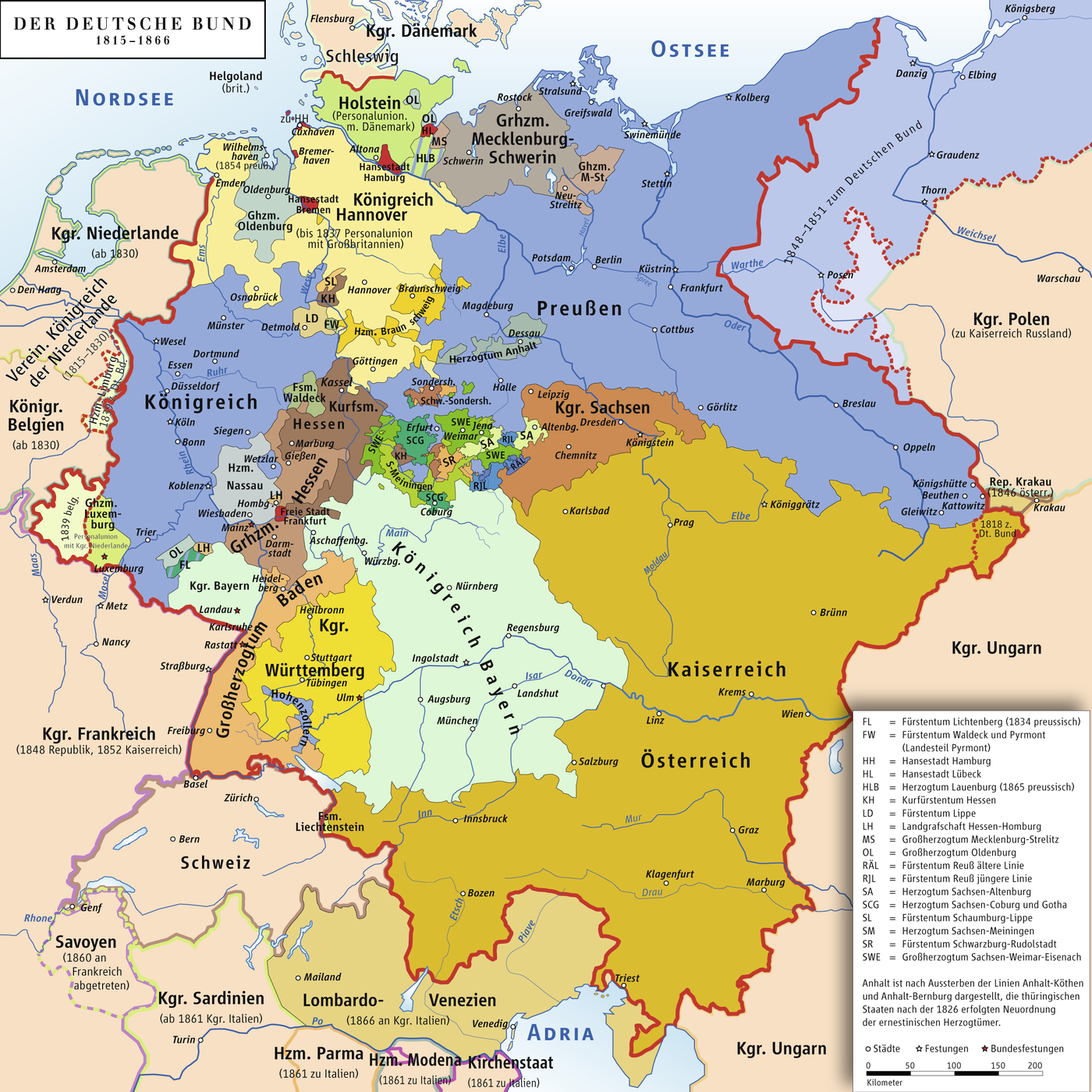
Prussia, originally a small nation land-wise, grew in power
as it exerted its governance over more and more German states. In 1815, it formed the deutscher Bund, or German Confederation.
 |
(deutscher Bund) German Confederation 1815-1866
|
As the population grew, there was not enough land to provide
a living for many of the working class. The young men, without a means of
supporting a family, were unable to marry. With much of the northern part of
Germany being Lutheran or one of the other Protestant faiths, and Bavaria, Austria,
and a few other states being Roman Catholic, there were also religious
conflicts. Due to frequent conflicts, many men were forced into the armies of
their local states. Many Germans looked to the United States as a place where
they might obtain land, avoid the military draft, and practice their religion
as they chose.
The German revolutions of 1848-49 failed. Many who supported
the cause of unification of
German-speaking people, were discontent with traditional, autocratic rule, sought liberal
principles, better living and working conditions, and greater freedom, fled to
the United States. A large number of those Germans were middle-class and
well-educated.
1864 saw the Second Schleswig War, also known as the
Prusso-Danish War.
In 1866, a seven weeks war was fought between the Kingdom of
Prussia and its German allies and the Austrian Empire and its German allies.
When Prussia prevailed, it established its dominance over the other German
states.
In 1870, after France sought to regain its dominance in
continental Europe, Germany and its southern German allies found themselves
engaged in the Franco-Prussian War, resulting in more disruption and forced
military service.
-en.png) |
(deutscher Reich) German Empire 1871-1918
|
In 1871, Chancellor Otto von Bismarck succeeded with the
unification of the German Empire which included almost all the German-speaking
states excluding Austria and the German-speaking areas of Switzerland. With
Berlin as its capitol city, Wilhelm 1, King of Prussia became the first German
Emperor.
All these factors drove many Germans to seek new homes—the
vast majority choosing the United States as their destination.
Germans
coming to the United States
Germans
have been in North America since Colonial times, most of them settling primarily
in Pennsylvania, New York, and Virginia. Immigration slowed in the 1770s due to
war both in North America and the European continent.
Starting
in the 1830s, German immigration to the Americas began in increase. Once German
settlers were established in their new home, they wrote to family and friends
in Europe describing the opportunities available in the United States. These
letters were circulated in German newspapers and books, prompting "chain
migrations." By 1832, more than 10,000 immigrants arrived in the U.S. from
Germany. By 1854, about 200,000 German immigrants arrived.
In
the last half of the nineteenth century, several factors aided and encouraged
immigration. Part was due to conditions at home. In addition to those already
mentioned, including the failed German Revolution of 1848, typical working
people in Germany were forced to endure land seizures, unemployment was high,
and there was increased competition from British goods.
Coupled
with that, as restrictions on emigration were eased, it became easier to leave
Germany. Steamships replaced sailing ships, so the transatlantic journey became,
not only more accessible, but more tolerable.
Also,
as steamships delivered their cotton, tobacco, and other raw goods from America
to European ports, including Hamburg and Bremerhaven, their owners sought a profitable “cargo” for the return
trip. They hired agents to aggressively solicit sales to those interested in emigrating from Germany. Many steamship had cabins for those who chose to travel first or second
class. However, those who traveled steerage rode in the cargo space to America.
 |
German passenger ticket
|
Between 1820 and 1870, almost a third of all immigrants to
the United States came from Germany—about the same number as from Ireland. During
the peak period from roughly 1860-90, there were only three years in which
Germans were not the largest nationality among new arrivals in America. All
told, five million Germans came to the United States in the nineteenth century.
Today, more Americans consider themselves of German ancestry than any other
group.
I am one person who, with my Prussian maiden name,
appreciates her German ancestry. My other German ancestors came from
Württemberg and Bern, Switzerland.
 |
1872 map showing distribution of German immigrants in America
|
In the decade from 1845 to 1855 alone, more than a million
Germans fled to the United States to escape economic hardship and the political
unrest caused by riots, rebellion, and eventually the 1849 Revolution in 1848.
The Germans had few choices other than the United States since very few nations
allowed German immigration. In one respect the Germans differed from the Irish
was that many of them came with enough money to journey away from the
port-of-entry cities either to search for farmland in the Midwest or work in
one of the large cities with large German settlements. Some cities with large
German populations were New York City, Baltimore, Cincinnati, St. Louis, Omaha,
and Milwaukee.

Although New York was a popular port of entry for German
immigrants, many arrived in New Orleans. Because most Germans chose to live
within German communities where they were able to continue speaking their
native language, practice their customs, and take pride in their “Germanism,”
they often lived in German neighborhoods within cities or predominantly German
townships on Midwestern farms. Due to the locality of many German communities,
after disembarking from the ocean steamship, the trip was continued up the Mississippi River system on a river steamboat.
Part of the opposition was political. Most immigrants living
in cities became Democrats because the party focused on the needs of commoners.
 |
German emigrants boarding ship in Hamburg - 1874
|
Like with the Irish, German immigrants arriving in the mid
and late 1800s were not welcome by all Americans whose families had established
themselves here earlier. Most Americans of English descent were Protestant.
Like the Irish, a large portion of the German population were Roman Catholic.
Many German Jews, who suffered persecution in former
homelands, including Austria-Hungary and Russia as well as Germany, also
arrived on North American shores. Interestingly enough, once in the United
States, German Jews, proud of their German heritage, usually spoke German
rather than Yiddish. They preferred to live together with Catholics and
Lutherans within existing German American communities rather than form their
own.
 |
Milwaukee, Wisconsin - home to many ethnic Germans
|
Many German communities continued to stay close-knit,
speaking German, with German language schools, and continuing their German
traditions. Much of that changed with the onset of World War I. At that time,
because of the anti-German sentiment, many Germans chose to Anglicize their
names and adopt English as their primary language.
 |
Americans with German Ancestry by State - 2019
|
Today, more people have German ancestry than many probably
realize. A 2019 U.S. Census Bureau's American Community Survey shows the
distribution of Americans with German ancestry.
My next book to be published is Bee Sting Cake by Brunhilde,
Old Timey Holiday Kitchen series, Book 12. Most of my characters are Germans,
some to came to the United States in 1849 after the failed revolution in
Germany, and Brunhilde’s immediate family who immigrates in 1873, shortly after
the unification of Germany—the same year my great-great grandmother immigrated
to the United States.
To find the book description and pre-order link,
please CLICK HERE
Sources:
https://en.wikipedia.org/wiki/History_of_Germany
https://www.ushistory.org/us/25f.asp
https://en.wikipedia.org/wiki/German_revolutions_of_1848
https://www.loc.gov/classroom-materials/immigration/german/new-surge-of-growth/
https://en.wikipedia.org/wiki/German_Americans
https://www.pbs.org/destinationamerica/usim_wn_noflash_2.html


.png)


-en.png)


