Tuesday, May 28, 2024

"Let the Ladies Not Be Idle" - The Victorian Home Workout by Jo-Ann Roberts


Lately, my daily exercise routine has taken a back seat to severe leg pain brought on by a problem in my spine. I've had MRIs, medication, hot and cold packs, and now, physical therapy.

All of which led me to wonder as I go through my exercise routine at home, did women in the 19th century engage in any type of exercise at home? I mean in addition to the myriads of chores they had to perform every day just to keep themselves and their families functioning.

To my surprise, after digging and uncovering several early exercise manuals, women were, indeed, encouraged to exercise at home, petticoats and all. They revealed a lot about 19th-century culture and attitudes on health and women.

The 19th century saw an evolution in attitudes and opinions on how middle and upper-class women should be spending their time. On the one hand, parents, preachers, public figures, and newspapers of the day were quick to criticize women for anything perceived as silly or idle. And on the other hand, pastimes were highly prized.
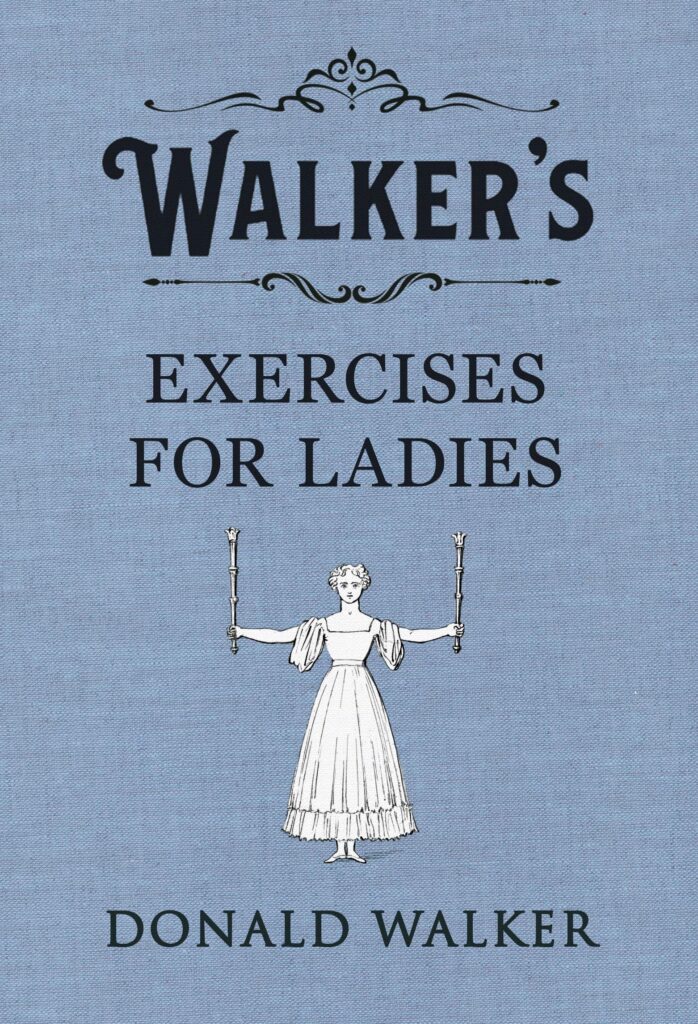
    

Walkers Exercises for Ladies is one of the earlier exercise manuals from the 19th century. Published in the 1830s, Donald Walker sought to rid the world of sedentary ladies and present options for exercise that were both intentional and appealing to women. One of the reasons is that when left to their own devices, they could hardly be trusted to pursue activities with any health benefits!

"The only exercises, indeed, to which, in their hours of relaxation, young ladies have access, are in general only a few insignificant games, or amusements extremely limited...for exercise indulged in without any regulation might produce real inconveniences, which a system composed of select exercises, suited to the age and strength of the pupil, does not produce.” 


The American Woman’s Home, published in 1869, shows exactly the type of double-bind women could be put in, for it criticized exercise for exercise's sake at the same time that it encouraged women to get plenty of movement and be mindful of their physical health: 

“…it is far better to trust useful domestic exercises at home than to send a young person out to walk for the mere purpose of exercise. Young girls can seldom be made to realize the value of health, and the need for exercise to secure it, to feel much interest in walking abroad when they have no other object." 

There were also many references to dancing in the 19th-century manuals on exercise. Again, opinions varied.  We may think today that dancing in the 19th century was an innocent activity that people, couldn’t get enough of, yet there were actually a lot of skeptics. 

A treatise written in 1868 by Catherine Beecher, included long chapters on proper exercise and looking after one’s health. But one activity Miss Beecher would not provide her stamp of approval to was dancing: 

“The writer was once inclined to the common opinion, that dancing was harmless, and might be properly regulated; and she allowed a fair trial to be made, under her auspices, by its advocates. The result was, a full conviction, that it secured no good effect, which could not be better gained another way..."

However, it seems that all experts of the time could agree on one thing: calisthenics was where it was at. Derived from two Greek words meaning “strength” and “beauty,” the stationary strength exercises would dominate the fitness world for over a hundred years and still remain present today. 


Catherine Beecher herself is credited with being one of the first influencers to popularize calisthenics. And while Walker’s book pre-dates her 1856 Physiology and Calisthenics, the latter appears to have taken off much more with the general public. 

Here are a few examples of 19th-century ideas on calisthenics: 

  1. They bring every part of the system into action. 
  2. Expand the chest.
  3. Bring down the shoulders. 
  4. Make the form erect.
  5. Give grace to motion. 
  6. Increase muscular strength. 
  7. Give a light elastic step in walking. 
  8. Restore the distorted or weakened members of the system. 
  9. Prevent tight lacing. 
  10. Promote cheerfulness.
  11. Render the mind more active. 
  12. They are conducive to general health. 

Sounds like the same reasons we exercise to stay fit. However, I'm not sure about #9...tight lacing? Every day I give thanks to whoever invented elastic waist pants!
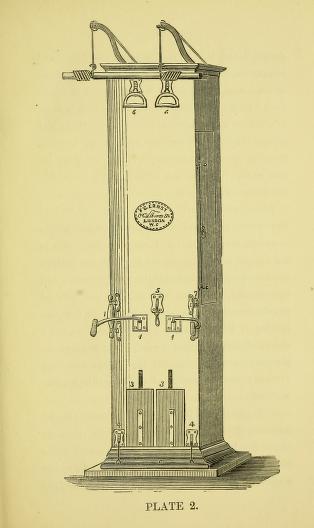

Published in 1861, The Portable Gymnasium was about how to use an exercise machine that actually looks quite a bit like the ones still used today, and certainly with the same functionality. 

The author, Gustav Ernst, openly and enthusiastically states in the intro that the machine is meant to be used just as much by women as by men. He also states that while it may be an expense, the machine is a practical investment considering the cost of public gyms (this also surprised me) and the inconvenience of leaving the house: 

 “In an economical point of view, where there are several members in a family, repay itself in less than six months, if the expenses incurred by using a public Gymnasium are considered...such salutary amusement as may rank with the useful occupation when unfavorable weather or other circumstances preclude out-door exercise.”


Still, those in favor of calisthenics and more strenuous exercise for women faced detractors

To gentle and proper exercise for youthful females at school, no objection can be urged…. But when you come to teach grown-up women – wives, mothers, and aught we know grandmothers…how to handle a pike and jump over a dinner table – it is possible that the gymnastical part of education may be carried too far.… For our parts, we would rather that their ‘muscular powers’ were never brought into ‘full action’…. They are so delightful as they are, that we would not for the world run any risk of spoiling, or even altering them. (12)

By the late 19th century, other forms of exercise, including tennis and bicycling, became open to women, although there continued to be people who regarded vigorous physical activity as unsuitable for ladies.

My Upcoming Release!


  https://www.amazon.com/Olivias-Odyssey-Westward-Hearts-Mail-Orders-ebook/dp/B0D488ZQPF


Amazon: https://www.amazon.com/author/jo-annroberts

Website: https://www.jo-annrobertsauthor.com/

Newsletter:  https://www.jo-annrobertsauthor.com/newslettersignup

            FB Pagehttps://www.facebook.com/jrobertsauthor/

Tuesday, May 21, 2024

Cowboy Saying - “The Cream Always Rises to the Top.”


Photo generated by Canva

“Just keep doing what you’re doing. The cream always rises to the top.”

Back in the days when it was common to milk your own cow and make your own cream and butter, people knew that if you let milk sit still for very long fresh from the cow, eventually, the cream would float to the top where it could be gently scooped away from the milk to be used for other things. This is because the fat in that part was denser and therefore would rise upward. And of course the cream was the sweeter, best part of the milk.

When a cowboy would use this back in the 19th century, it was a common phrase, even used in literature at the time, such as “Tom Brown’s School Days,” published in 1857. The purpose of the phrase is to give someone who isn’t receiving recognition for their hard work reason to keep persisting. It’s a reminder to stay the course, because eventually the recognition or rewards for your steadfastness would come.

How about you? Have you ever heard this saying before? Used it yourself? Could you see yourself using it now? Let me know in a comment!

Subscribe to my newsletter: https://www.subscribepage.com/pcreedenbooks

Or Check out my latest Release:


Wednesday, May 15, 2024

Writing Immersion?

Post (C) Doris McCraw\

aka Angela Raines

How many of you immerse yourself in your story, your characters, and your setting?  Sometimes I do and sometimes not so much.

I do write about the physical area I live in with my historical westerns. I also will write about areas of research I am involved in.

Yes, I do write non-fiction but there are times when the story I'm telling was inspired by a piece of research. My first story "Josie's Dream" with this group was inspired by the research I was and am still doing on early women doctors in Colorado.


Photo (C) Doris McCraw

My first novella "Home for His Heart" was inspired by my many trips up into Colorado's high country and the history of the people who built towns, ranches, and so much more against the backdrop of storms, fights over land, and finding the place you were meant to be in.

Sometimes music plays a part. If I have to write a fight scene I will almost always play Saint-Saens. Here is a link if you want to hear it.Danse Macbre

Additionally, photographs and paintings also help give a sense of place. Many times I will take photos to remind me of where I have been. When describing an area, the photo helps fill in the details I want to include.

When you read, do you see what the author is describing? Do you hear the music that inspired them? Let me know.

Amazon Author Page

Until Next Time: Stay safe, Stay happy, and Stay healthy. 

Doris

Tuesday, May 14, 2024

Hiding Behind the Veil and other Bridal Traditions

By Kimberly Grist


I suppose we’ve all heard that it’s bad luck to see your fiancé on the wedding day before your ceremony, but the reason dates back to a time when marriages were often arranged, and the bride and groom frequently did not meet until the ceremony.


https://patch.com/connecticut/bethel/bethel-historical-society-seeking-vintage-wedding-dresses

Fear that the groom would not find his bride attractive and call off the match was real. As a precaution, the bride was covered in a veil to prevent the groom from seeing what she looked like until it was too late to call the marriage off.

Other Wedding Traditions of the 19th Century
During the 19th century, most weddings took place on weekdays. There was even a rhyme to help the happy couple pick a date.


"Mondays were for wealth, Tuesdays for health, and Wednesday's the best day of all. Thursdays for crosses, Fridays for losses, and Saturdays for no luck at all."

Why Marry in June

The name June is derived from the Roman goddess of marriage. Perhaps that is where the old wives' tale originated, saying that if you marry in June, you will be blessed with a lifetime of happiness and prosperity.


The 1954 musical, "Seven Brides for Seven Brothers," features a song declaring the same special promise for June Brides. (Photos are from the 1954 musical, "Seven Brides for Seven Brothers.")

JUNE BRIDE From "Seven Brides for Seven Brothers." (Music: Gene DePaul / Lyrics: Johnny Mercer)

Lyrics

Oh, they say when you marry in June,
You're a bride all your life.
And the bridegroom who marries in June
Gets a sweetheart for a wife.

Winter weddings can be gay
Like a Christmas holiday.
But the June bride hears the song
Of the spring that lasts all summer long.

By the light of the silvery moon
Home you ride, side by side
With the echo of Mendelssohn's tune
In your hearts as you ride

For they say when you marry in June,
You will always be a bride.


So Much for Romance

A more practical reason is that in Western culture, if a bride married in June, she could likely give birth to her first child in early spring, giving her time to recover before the fall harvest.


In my new release, Annabelle's Wedding Dilemma: The Matchmaker and the Mother-in-law, our heroine's Mother-in-law is a stickler for etiquette. She insists on following the guidelines written in the American Etiquette and Rules of Politeness.

"A full bridal costume should be white from head to foot. The dress may be of silk, heavily corded satin, or plain silk, merino, alpaca, crape, lawn or muslin. The veil may be of lace, tulle or illusion, but it must be long and full. It may or may not cover the face. Orange blossoms or other white flowers and maiden-blush roses should form the bridal wreaths and bouquets. The dress is high, and the arms covered. Slippers of white satin and white kid gloves complete the dress.”

Houghton, Walter R. American Etiquette Rules of Politeness, New York: Standard Publishing House, 1883.

New Release


An overworked rancher weighed down by the responsibilities of his family, A teacher of Cherokee descent longing for acceptance and love. Could her sunny disposition be the spark of hope that melts his stubborn resolve, ignites their love, and brings the acceptance Annabelle longs for? Or will their budding relationship be sabotaged by his meddling mother and her snobbish ways?


Connect With Kimberly
Fans of historical romance set in the late 19th century will enjoy stories combining, History, Humor, and Romance with an emphasis on Faith, Friends, and Good Clean Fun,


Links:
Website: https://kimberlygrist.com/
FB: https://www.facebook.com/FaithFunandFriends/
Sign up for my newsletter: https://mailchi.mp/a920c145512a/kimberlygrist
Amazon: Author Page: https://www.amazon.com/Kimberly-Grist/e/B07H2NTJ71
Bookbub: https://www.bookbub.com/authors/kimberly-grist

Friday, May 10, 2024

Chicago Wagons by Zina Abbott


In my second chapter of the first wagon train book I wrote for the Prairie Roses Collection,  I introduced my hero as a trader who had purchased three Chicago wagons for transporting freight to California. He chose them over the larger, heavier Murphy wagons often used for hauling cargo. However, at the time, I did not do a lot of research into exactly what constituted a Chicago wagon.

Last month, I came across information about Chicago wagons in a Daughters of Utah Pioneers lesson I taught titled “Down and Back Church Trains.”

Mormon Trail ctsy U.S. National Park Service

To set the stage, between 1847 and 1860, thousands of members of the Church of Jesus Christ of Latter-day Saints traveled the Mormon Trail to the Great Salt Lake Valley. As time passed, fewer of these immigrants came from other regions of North America and more (like many of my ancestors) came from Europe. With no means to purchase fully-outfitted wagons to make the overland journey, increasingly the church began to send wagons and supplies from Utah Territory to the departure point which, for many years, was Florence (now part of Omaha), Nebraska Territory.

By 1860, on the cusp of the American Civil War, a concerted effort on the part of the church to send wagons and supplies back to Florence to collect the immigrants was put into place. During the years of 1861 through 1865, the American Civil War years when there was such a great demand of wagons (and replacement wagons) for the war effort, the church found it necessary to provide greater aid for those immigrants of their faith to reach their destination.

The following are excerpts from the circular sent from the church president, Brigham Young, to the bishops throughout Utah Territory to introduce this program:

…There were only twenty-nine wagons sent to Florence last season; this year we wish to send two hundred wagons with four yoke of oxen to each wagon. In addition to said teams we also wish to forward as many loose oxen to Florence as our this year’s immigration may wish to purchase, as that will give us the use of their money before it goes into the hands of strangers [translation: many of them enemies, who overcharged the Mormons], thus saving for our use from about $10 to 30,000 which are yearly paid out in cash for cattle and wagons….

“The wagons sent should be the best Chicago make, 2 inch iron axletree, and be in such condition…Wooden axle Chicago wagons can be sent if there are not enough iron axle wagons of that make. Other good wagons, of similar make, can also be sent, if there are not enough Chicago wagons…. 

Overall, Chicago wagons is not a brand name. Rather, it is a type, and the designation indicates where the wagons were made. The reason Chicago wagons became a generic term was because some of the most legendary wagon makers were originally based in Chicago, Illinois. 


 By the mid 1850’s, the city of Chicago was a little less than twenty years old. The population was almost 80,000. Wagon makers numbered less than one hundred, most of them being Germans who did not speak much English. However, they produced quality wagons. In areas not served by a railroad, wagons were the primary means of transporting goods and people. As buyers saw the craftsmanship, attention to detail, and dependability of certain makes of wagons that came from Chicago, those became the wagons of choice—for farm use, travel, and hauling freight (particularly where the long-distance hauling did not require the heavier Murphy freight wagons). They were given the generic name of Chicago wagons. 

Eventually, Chicago claimed more than two hundred wagon and carriage makers during the heyday of horse-drawn vehicle making. Among the more notable brands besides Peter Schuttler were Weber, Louis Palm, and Columbus. Henry Mitchell, who eventually moved his home to Racine, Wisconsin his home, started his wagon construction business in Chicago.


An example: Weber Wagon Company, after a decade in business, employed eighteen people and produced two hundred wagons a year. (They eventually became the International Harvester Company.) In comparison, by about 1850, after approximately a decade in business, Peter Schuttler employed about one hundred men and produced about one thousand, eight hundred wagons a year. Keep in mind, at this time, wagons were largely hand-built.

In a different article, I learned in the case of Brigham Young’s statement, he referred to Peter Schuttler Company wagons, based in Chicago. Many wagons were sold to Mormons moving west. Because it was such a large company, for many, “Chicago” wagons also became synonymous with Peter Schuttler Company wagons.

Schuttler wagon

Chicago wagons were used for travel across the Great Plains and the western mountain ranges. Although many of the Chicago wagons built for hauling freight had about the same dimensions (3-1/2 to 4 feet wide by 10 feet long) as pioneer travel/prairie schooner wagons, the wooden parts needed to be built sturdier, with metal axles, and more metal reinforcements on the moving parts.


Murphy freight wagon. Note where driver sits

All three of the books I have written for the Prairie Roses Collection include freight haulers—private traders rather than regularly employed freighters—along with pioneers traveling the established trails of the day. I first mentioned the distinction between the larger Murphy freight wagons (12 feet in length) and the smaller Chicago freight wagons in the first book I wrote for the Prairie Roses Collection, Pearl. In it, my hero chose Chicago wagons over Murphy wagons. However, after giving the lesson, mentioned above, I decided it was time learn more about Chicago wagons.

In my third book, Lucy, set in 1863, this same trader sent his employees, including my hero in the second book, Clara, as trail boss—back to the Missouri River region of Kansas. The purpose was not only to purchase goods difficult to be found in the West, but to buy four new Chicago wagons to transport them west. The wagons would then to be used to haul trade goods to the gold and silver towns of Virginia City and Gold Hill in Nevada Territory.


To find the book description and purchase options for Lucy, Book 46 in the Prairie Roses Collection, please CLICK HERE


Sources:

https://wheelsthatwonthewest.com/blog/chicago-wagons/

https://alchetron.com/Peter-Schuttler

http://www.wyomingtalesandtrails.com/bridgerd.html

Jeppson, Ellen Taylor, “’Down and Back’ Church Trains”; Tales of Triumph, Volume 6 (Salt Lake City, Utah: International Daughters of Utah Pioneers, 2023), Pages 288-289.  

https://westernmininghistory.com/4127/heavy-freight-wagons-of-the-american-west/


Thursday, May 9, 2024

Fashions from 1918


I've been existing the past month down a rabbit hole of research into World War I.
One of the things I've particularly enjoyed was studying the fashions from 1918.


Gone are the restrictive corsets. (I bet those ladies were thrilled!)


The skirts, unlike the hobble skirts so popular earlier in the decade are much fuller and practical for moving around.


The skirts are also shorter, above the ankle. I love all three of these outfits and would excitedly wear any of them.


While the clothes are still lovely, they seem much more sensible and wearable than some of the past fashions. 


Yet, they are still feminine and so pretty.


I would totally wear this outfit, if I could get my hands on that pattern!


As for the men, they were as stylish as ever, even if they weren't in uniform.

What is your favorite era for fashions?


USA Today
Bestselling Author Shanna Hatfield grew up on a farm where her childhood brimmed with sunshine, hay fever, and an ongoing supply of learning experiences.

Shanna creates character-driven romances with realistic heroes and heroines. Her historical westerns have been described as “reminiscent of the era captured by Bonanza and The Virginian” while her contemporary works have been called “laugh-out-loud funny, and a little heart-pumping sexy without being explicit in any way.”

When this award-winning author isn’t writing or testing out new recipes (she loves to bake!), Shanna hangs out at home in the Pacific Northwest with her beloved husband, better known as Captain Cavedweller.

Tuesday, May 7, 2024

HAIR UP AND SKIRTS DOWN. by Marisa Masterson

Imagine with me a country miss. She is living in the very modern time of the 1870s with its wonderful new inventions like the telephone, phonograph, the typewriter, and the lightbulb.

This young lady has finished eighth grade and is graduating. She is done with school since no high school is close enough to attend and there is no reason for her to continue on. She knows plenty, as her pa told her.

Oh that exciting day. The girl can finally put her hair in a bun. No more hair to her shoulders, though she still has the bangs that became popular for girls to wear in the 1870s. 

Yes, now she is a grown up. School days are done. Her short hems are a thing of the past as well.

A girl in the nineteenth century would wear skirts that eneded at mid-calf or slightly shorter. When she was considered an adult, those hems dropped to cover tempting ankles.

Of course, a farm woman or someone expected to work wore slightly shorter hems. Those would brush the tops of her shoes, still long enough to show her as an adult. But these were for around home. When she went to town or to church our miss puts on a shirtwaist and a skirt that brushes the top of her shiny boots.

Women on the Prairie and especially those traveling with a wagon train were known also to wore their skirts shorter. Often these were almost as high as a child's. This was done to avoid tangling them in the grass or setting the hem on fire when cooking over an open fire.

But not our miss. She will stay on the farm until her beau proposes. Then she will move to his place, probably another farm. 
Typical of the time, our young lady will not move far in her lifetime. She is not one of the adventurers who seek free land. No, she is happy in her community.\

Others are not so fortunate to live out their lives amongst people they have always known. Take Christiana for example. She is forced to travel the Santa Fe Trail--


A grumpy man meets a strong-minded woman. You bet the sparks are flying!

Christiana Mallory has no choice but to become Moody Dutton's cook. Her sister insists they find a way to join a wagon train headed south. Patience is determined to retrieve a map showing where their pa buried gold coins. To do that, they must reach Colorado.

When Patience immediately marries Moody's cousin, Christiana is determined not to become a wife. She holds Moody at a distance, fighting with him so that she will not give in to her growing attraction.

Only, when danger threatens her sister's life does Christiana recognize her growing desire to stay with Moody. He shows her how deeply he desires them to be a couple. Can she commit to living her life in isolation on a ranch?