Tuesday, July 14, 2020

Mail Order Bees by Kimberly Grist

While researching vocations during the 19th century, I became intrigued by beekeeping. The honeybee is not native to the United States. Records show that honey bees were shipped from England and landed in the Colony of Virginia in 1622.

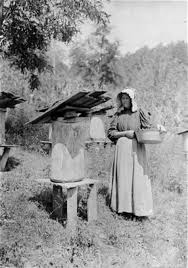
Prior to the middle of the 19th century, most beehives were simple shelters for bees.
circa. 1830 - Scenes of Industry; Displayed in The Bee-Hive and the Ant-Hill
Skeps were made from grass straw with sticks placed inside to provide support fo the honeycombs. A healthy colony could yield approximately 10-15 lbs of honey each year.


Log gums were made from hollow logs then fitted with a roof. Sometimes a box or container was added on top of a log gum for the bees to store honey. Beekeepers inspected skep hives from the bottom.

Just as they do in the wild, bees attached their wax combs to the hive's roof and walls. Today we refer to these types of hives as fixed-comb hives. In these types of hives, the beekeeper could not inspect the hives. Therefore, it was difficult to know when the bees had a problem, rather from disease or when they became queenless. 
In 1851, Lorenzo Langstroth created a new hive design with frames that hung from the top ends of the hive, leaving what we refer to as "bee-s[ace", a 3/8 inch space between all sides of the frames and hive body. This allowed the frames to be handled without breaking the comb. 


Langstroth's frames were easily handled without breaking the comb.  Today we refer to the 3/8 inch passageways as a "bee-space." 


By the year 1900, most beekeepers were using variants of this design, much like the ones used today. 


Although the frames are similar in structure, please note, since I'm new to beekeeping, I have not developed the skills to handle bees without protective gear. So far no stings.😎 But I confess the suit is extremely warm. Maybe I'll appreciate it this winter?


Mail-order Bees

In the May 1879 issue of Gleanings in Bee Culture, A.I. Root proposed what would become a revolutionary idea - the sale of bees by the pound. Finding himself short on bees but with an abundance of honey just right for building up new colonies of bees, 
By counting and weighing a hundred bees, he came to the conclusion that a quart of bees would weigh approximately one pound and proposed to pay a dollar a pound for live bees delivered to him at the shipper's risk. He even went so far as to devise a cage in which they might be shipped. 


New Release

Available on July 21st 

In my upcoming release, A Beekeeper for Christmas, Bethany Brady loves assisting her grandfather with his bee farm and volunteering at the Counting Stars Children's Home. A tall woman, she's always felt awkward and has given up on her dream of a family of her own. 

Encouraged by his brother's success with his mail-order bride, Moses Montgomery is ready to take a chance. After all, he orders things from a catalog all the time, why not a wife? She should be sensible and take an interest in his business at the livery stable. 

She's whimsical and fun-loving, he's gruff and likes to keep things simple. Has the matchmaking agency made an error in judgment? Can affection soften tow stubborn, opinionated individuals and help them find common ground?

About Kimberly Grist:


Kim has enjoyed writing since she was a young girl. However, she began writing her first novel in 2017, "I wear so many hats working inside and outside the home. I work hard, try harder, and then begin again the next day. Despite my best efforts, sometimes life just stinks. Bad things happen. I need and want an outlet, an opportunity to relax and escape to a place where obstacles are met and overcome." 

Fans of historical romance set in the late 19th -century will enjoy stories combining, History, Humor, and Romance with an emphasis on Faith, Friends, and Good Clean Fun. 

Connect with Kimberly:


Monday, July 13, 2020

Race for the 100th Meridian on the Platte River by Zina Abbott


In 2019, I did a multi-month series of blog posts across several blogs about the first transcontinental railroad. Much to my surprise, I recently learned some information about the 1862 Railway Act of which I was unaware. Because the Union Pacific Rail Road was the ultimate winner of the race toward the 100th Meridian on the Platte River – the point where the eastern portion of the Transcontinental Road began – it was only this past week I realized there had been another contender.
 
Leavenworth, Pawnee and Western Railway depot at Miltonvale, Kansas
The railroad with its roots in Kansas was a federally chartered railroad, backed with government land grants. It began in 1855 as the Leavenworth, Pawnee and Western Railroad, and was later reorganized in 1863 as the Union Pacific, Eastern Division. 
 
Union Pacific Railway Company, Eastern Division headquarters in Wyandotte, Kansas
The UP Eastern was authorized by the United States Congress as part of the Pacific Railway Act, in order to create, alongside the Union Pacific, a second southerly branch of the transcontinental railroad. The name "Kansas Pacific" was not adopted until 1869. The original intent of the railroad was to build a line west from Kansas City, Kansas across Kansas to Fort Riley, then north to join the Union Pacific main line at Fort Kearny in Nebraska. The construction of the line was motivated in part by the desire of the U.S. government to extend transportation routes into Kansas, which had been the scene of ongoing conflict between Union and Confederate sympathizers even prior to the start of the American Civil War.

As early as 1861 the territorial legislature of Kansas had chartered no fewer than 51 railroads. Practically see all of them were just that – charters. 

Samuel Hallett
On July 1, 1862, the Union Pacific and Central Pacific were authorized, and expectations of rail travel began to escalate. Not much was accomplished to make it a reality until two men, Samuel Hallett and John C Fremont, acquired controlling stock in the Leavenworth, Pawnee and Western Railroad Company at the end of May 1863.

Hallett was a young banker with offices in New York City. He helped build the Atlantic and Great Western Railroad in the east. Fremont was the big name in exploration in early Kansas and had made a great deal of money from the sale of his ranch in California. Fremont was elected president of the new company and Hallett the general superintendent. The name of their rail company was changed to the Union Pacific Railway Company, Eastern Division.

John C. Fremont
Although creating competition between rail lines might not have been intentional, the law of July 1862 brought it about. This law, which established the Union Pacific and the Central Pacific railroads, provided that the Union Pacific be built from the 100th Meridian Westward and the Central Pacific from the Pacific coast eastward. They were to meet at the California-Nevada state line. If either got there before the other, it was to build on until the lines were joined.

That provision left the strip of land between the 100th Meridian and the Missouri River without specific authorization. It was generally accepted that the first railroad to reach that 100th Meridian on the Platte River would get the contract to build on the rest of the railway to meet the Central Pacific.


Although the section between the Missouri River to the 100th Meridian was scheduled to be built west from Omaha, Fremont and Halleck felt confident that if their company reached the 100th Meridian first, they would get the contract for the balance of the job. Based on that, they named their company the Union Pacific Railway Company, Eastern Division. Their plan was to build west from the Missouri along the Kansas River, then turn up the Republican River. From there, they intended to continue northwest to Fort Kearney on the Platte River in Nebraska, then westward to the 100th Meridian. The railroad would cut right through the inhabited part of Kansas, and no one objected the tracks turning North into Nebraska. They were better organized than the railroad company at Omaha, they had the people of Kansas behind then, and they moved forward with confidence that they would win the race.
 
Union Pacific Railway, Eastern Division depot at Wamego, Kansas
On July 2nd Congress pass an amendment to the railroad law granting the builders 12,800 acres of land on either side of the roadway for each mile of road built. This amendment also practically assured that the first railroad to get us rails to the 100th Meridian would get the right of way to build to meet the Central Pacific. No one in eastern Kansas had any doubts that Hallett would win the race easily he. He was far ahead of a line starting from the Omaha. Halleck moved to Wyandotte, Kansas and set up the company’s headquarters there.

The company soon ran into trouble. Fremont and Halleck sharply disagreed on several issues. When it came time for elections, there were two meetings of stockholders. At the meeting in the railroad company’s office, John D. Perry, president of the Exchange Bank in St. Louis, Missouri, was elected president. In the other meeting held at another site in town, Fremont was elected president. However, Halleck pointed out that the eligibility to hold office depended on the strength of the shares of stock held in the company. Four months before either election, the company had assessed a ten percent payment on all stock. None of those at the meeting that elected Fremont had paid their assessment, which rendered the vote for Fremont ineligible.  
 
The Seminole, a UPRWED engine
On July 27, 1864, Hallett was killed by Orlando Talcott who had been brought to the railroad construction work by Fremont. However, when Fremont lost out on spring election, Talcott lost his job. After Samuel Hallett’s death, his brother, John, took over the project. However, Hallett’s death and the process of settling his estate, including the lawsuit brought by John D. Perry for the shares he had been promised by Hallett as part of his accepting the position of president, put a damper on the project.

Delay after delay held up the work. Most of the work was being done on the bridge over the Kansas River and on the line that would reach from the Pacific Railroad of Missouri to the Union Pacific, Eastern Division. The war was absorbing both men and materials, preventing John Hallett from getting the rails or the men he needed to lay them. Another problem was a heavy investor in the project, Thomas Durant, who also had a larg interest in the Union Pacific Railroad running out of Omaha. He diverted most of the available material to that line. The Kansas newspapers that followed the progress of this project closely expressed relief when Durant’s representative, Silas Seymour, was dismissed from the work in Kansas.

It soon became apparent to the Kansas Branch of the Union Pacific that it was not going to reach Fort Kearny ahead of the Omaha branch. Perry, then president of the Kansas Branch proposed to make the best of a bad situation. He asked Congress for permission to build his railroad up the Smoky Hill River to Denver – basically following the route of the Butterfield Overland Despatch Stagecoach Company – rather than up the Republican River to meet Nebraska line at Fort Kearney. Part of his arguments included that the Smoky Hill Valley route was 134 miles closer to Denver then the Republican route would be plus it had other benefits. On July 1, 1865, Congress finally let a new contract for the line to go to Denver, Colorado.


That change pleased the residents and businesses of Denver to no end since it gave them a more direct line to the east. In 1869, the company adopted the name of Kansas Pacific Railway. Its main line furnished a principal transportation route that opened up settlement of the central Great Plains of Kansas and Colorado Territory between Kansas City and Denver.

The Kansas Pacific Railway was consolidated with the Union Pacific in 1880, and its main line continues to be an integral part of the Union Pacific network today.

Although I refer to stagecoach travel, particularly along the Smoky Hill Trail in all three of my novels in the Widows, Brides & Secret Babies series, in my third book, railroads play a role. In September of 1867, my heroine, Penelope, finally leaves Lawrence, Kansas to marry the man she met through correspondence. She is able to ride the train to the end of track which, at first, is Buffalo Springs, a stagecoach station which, in 1867, is run by Wells, Fargo & Company. The tracks soon arrive at Fort Hays where my hero is temporarily assigned. However, between the availability of the railroad, Penelope still travels by stagecoach. What an adventure!


Sources:
https://www.kshs.org/kansapedia/railroads-in-kansas/15120
Trails of the Smoky Hill by Wayne C. Lee and Howard C. Raynesford;
Caxton Press; Caldwell, Idaho: 2008

Thursday, July 9, 2020

Regional Romances

by Shanna Hatfield

As an author, it's always an honor (and so much fun) to be asked to participate in a special project. I was thrilled when Author Kari Trumbo invited me to join in a new series called Regional Romance Series.

The books will release in September. In addition to me and Kari, Kit Morgan and Peggy L. Henderson are also participating.


The thing that's fun and unique about this series is that each author is writing three novellas which will be released under one cover. So if you purchase all four books in the series, you're actually getting twelve wonderful historical romances to read! 

And right now, the books are priced at just $2.99 each. You'll find them all on Amazon. 

My contribution to the series is Grass Valley Brides. Any of my readers who've enjoyed the Grass Valley Cowboys  contemporary sweet romance series will  be happy to know these three novellas go back to the beginning years of the town and the very first Thompson to settle there. 

In fact, Mr. Tagg Thompson makes an appearance in all three stories. 


What’s a matchmaker to do when the husband-to-be rejects the bride?
     Again . . .
Widowed as a young wife, Cara Cargill turned her head for business and love of romance into a successful mail-order bride enterprise. She’s never had a problem matching couples until one mule-headed man continues to refuse to wed the women she sends to meet him in Grass Valley, Oregon. In an effort to make a match he’ll keep and uphold her sterling reputation, Cara is desperate to find the perfect bride.
Daisy – When her fiancé leaves her at the altar, Daisy Bancroft knows it is far past time for a change. Her dearest friend, Cara, offers to send her to a newly established town in Oregon, where possibilities abound and the grass is rumored to be as tall as a man’s head. Daisy arrives with plans to wed Tagg Thompson, only to find the obstinate rancher has foisted her off on his best friend.
Birdie – Tired of waiting for her Mister Right to magically appear and whisk her away to a happily-ever-after, Bridget “Birdie” Byrne convinces her sister, a renowned matchmaker, to send her as the bride to Tagg Thompson. The man who greets her upon her arrival isn’t Tagg, but Birdie is certain she’s finally discovered the man she is meant to marry.  
Cara – Fed up with Tagg Thompson and his refusals of every bride she’s sent to Grass Valley for him to wed, Cara decides to meet the exasperating man in person. Her feet are barely on the ground in the rustic town before she’s nearly bowled over by a herd of stampeding cattle and swept into the brawny arms of a cowboy with the bluest eyes she’s ever seen.
Will true love find its home in the hearts of these Grass Valley Brides?
Get all four books in the Regional Romance Series featuring scenic historic locations, exciting drama, and sweet (yet swoony) romance!


After spending her formative years on a farm in eastern Oregon, hopeless romantic Shanna Hatfield turns her rural experiences into sweet historical and contemporary romances filled with sarcasm, humor, and hunky heroes.
When this USA Today bestselling author isn’t writing or covertly seeking dark, decadent chocolate, Shanna hangs out with her beloved husband, Captain Cavedweller.
Shanna loves to hear from readers. Follow her online at:


Friday, July 3, 2020

Penalized for Beauty (Victorian United States)

Kristin Holt | Beauty Peanlized (Victorian United States)
USA Today Bestselling Author of Sweet Western Historical Romances
set in the Victorian American West

Old West Beauty

Folks have appreciated beauty from the very beginning. Whether a beautiful horse, mountain range, sunrise, or a lovely woman, cowboys, bankers, bricklayers and sign-painters--men in our favorite nineteenth century appreciated that beauty! 


For the Love of Beauty

We've all known uncommonly beautiful women. Some men find rare beauties a fantastic draw. Ask a pretty woman, sometime, what she dislikes most about her beauty. You might be surprised.

School Master in Love


In this 1860 newspaper report, a "brustish school master" in Ohio beat an eighteen-year-old beauty (with an ox gad until her back was black and blue) because she resisted the teacher's courtship advances.

Kristin Holt | Beauty Penalized (in Victorian United States). From The Grand Haven News of Grand Haven, Michigan on Feb 15, 1860. "A brutish school master at Boardman, Ohio, has been put under bonds for beating a young lady of eighteen with an ox gad, until her back was black and blue. The girl was good looking, and had resisted the teacher's advances to courtship. Hanging is too good for such a villain."
From The Grand Haven News of Grand Haven, Michigan on February 15, 1860.

Let's make one thing clear. Men in love are fools. We know this, and hence we love to read romances set in the Victorian American West. But fools often cross a dangerous line. What woman would change her mind and fall in love with a man who beat her?


Rejected Suitor in Love

Kristin Holt | Penalized for Beauty (Victorian United States). From Los Angeles Herald of Los Angeles, California on March 12, 1874. "Killed for Rejecting a Suitor. A dispatch from Detroit of the 7th states that William J. Underwood, formerly of Cleveland, became enamored of Miss Anna Bridge of that city, and after a short walk with her last evening offered himself for the last time as they stood at the door of her house. She again rejected him, when he drew a dirk an dstabbed her in the heart, killing her instantly. He then delivered himself up to the authorities. Miss Bridge was a beautiful and accomplished young lady. Underwood was a fellow of doubtful character."
From Los Angeles Herald of Los Angeles, California on March 12, 1874.
Yellow journalism (sensational fiction posed as news) was a big thing in the nineteenth century United States. I hope this cautionary tale about young men, strangers from another town, possessing doubtful character, was just that--a cautionary tale. But what if it were true? Was there really a too-beautiful-to-let-live-if-she-won't-have-me Miss Anna Bridge?

If I'd been Miss Anna's mother, that Underwood fellow wouldn't have made one step off my front porch. I'd have turned Mother Bear on him, and at minimum, sat on him until police arrived and arrested the murderer.


Murderer ... in deranged love?

I'll warn you, this next one might require skipping. No graphic details, no gore. But for the mother of three beautiful girls and one beautiful daughter-in-law, I can't understand this kind of brutality.

A pretty girl's fate, reported in Chicago Tribune back in 1882, is at minimum a cautionary tale. Given this report provides places, names, dates, and a prosecuting attorney, court records might substantiate this one.

Kristin Holt | Beauty Penalized (Victorian United States). From Chicago Tribune on March 4, 1882. "A Pretty Girl's Fate; Discovery of a Corpse of a Murdered Young Woman in Indiana."
From Chicago Tribune on March 4, 1882.

Skating Beauties Cause Trouble

It's high time for a non-bloody consequence of too much beauty. These young gals ran into a bit of trouble at a skating rink in Yonkers, N.Y. back in 1885.

Kristin Holt | Beauty Penalized (Victorian United States). From The Osage County Chronicle of Burlingame, Kansas on April 23, 1885. "Two young ladies have been debarred from the skating rink at Younkers, N.Y. because of their beauty. The young men quarreled over them so much that they are denied admission -- N.Y. Sun."
The Osage County Chronicle of Burlingame, Kansas on April 23, 1885.

Wisdom: Homely Girls and Beauties

This argument for why homely girls are BEST--for wives, for sweethearts, for a life partner. This argument (apparently from Macon (GA) Telegraph and printed in Clinch Valley News of Tazwell, Virginia on August 6, 1886, cheers the girl whose gifts do not include beauty.

Kristin Holt | Beauty Penalized (Victorian United States). From Clinch Valley News of Tazwell, Virginia on August 6, 1886. A portion of the article reads: "There is something about the honst-faced, homely girl that comforts and assures the averagfe man. He is not afraid of her, does not hesitate to ask favors, never feels he is trespassing upon her time, and always knows where he stands."
Clinch Valley News of Tazwell, Virginia on August 6, 1886.

Invitation

What do you think?

Is it fair to say that beautiful women were penalized in the American Old West? What about today? Are beauties penalized?

Please scroll down and comment! "Conversation" is the best part-- especially during today's COVID-19.

Related Articles

Kristin Holt | Old West Employment -- Well Beyond Sheriff, Livery Owner, Saloon Keeper, Cowboy and Rancher

 
Kristin Holt | Blondes are Favorites; They Are Declared by a Phrenologist to Make the Best of Wives

 
Kristin Holt | When are Women Most Lovely? Henry Ward Beecher, 1879.


From Kristin Holt

Kristin Holt | Sweet Americana Sweethearts Contributing Author, Kristin Holt (USA Today Bestselling Author)


Copyright © 2020 Kristin Holt LC

Thursday, July 2, 2020

A Good Old Fashioned Barn Dance

Hi, Kit Morgan here, and today I'd like to talk about good old fashion barn dances.

 Back in the day barn dances were, you guessed it, held in the barn. Nowadays they are held in a more suitable building but still call the barn dance. The music was made up of traditional or folk music of the day and the dances often a mix of dances brought to the country by immigrants And modified over the years. The barn dances themselves were often family-oriented or community-oriented events. Sometimes they were organized and held to raise money. Or in some cases to raise the barn itself.

Because so many cultures brought their traditions with them when they came to America, it wasn't
unusual for a little Scottish or Irish dancing to show up at a barn dance. Square dancing, English country dance, and contra dancing were also common. When it comes to the old West, the cowboy waltz was invented. In fact, with all these different dances and traditions mixed up, "a caller" emerged from the chaos. This person called out steps so that everybody was doing the same thing instead of dancing willy-nilly.

Dances of course were social affairs where relationships were sometimes formed. Ah, The stuff of romance! The barn dance was a popular setting for stories and later movies. Gene Autry started one such film. A delight to his fans and moviegoers alike. Barn dances are still held today, but as mentioned above, not many are held in an actual barn. Though it's darn fun when they are! I only have one book where dance is held in a barn. One would think with all the books I've written, I'd have more. This makes me think I better add a barn dance into another one soon!

 So if you ever get a chance to attend one, do. I think you'll have a lot of fun, meet some new people, and maybe even go home and watch her movie containing a barn dance.

Until next time,
Kit