Monday, January 13, 2020

Treating Brain Injuries & Bruises in the Old West by Zina Abbott


This is one of those blog posts where I need to start with a warning.

 WARNING!

Some of the images you are about to see
may be disturbing for sensitive groups.

In Nathan's Nurse, my hero, silver miner, Nathan Price, suffers, among other injuries, a head injury when a crossbeam from a square set (often built in mines to help support the rock walls) glances off the back of his head. With only a mine dispensary in the remote mining community, no modern hospital with a sterile operating room, what was a doctor hired to treat broken bones, scrapes and bruises, and diseases related mining to do?

For my research, I relied heavily on two sources. The first was the book, The Doctor's Bag by Dr. Keith Souter who writes Western fiction as Clay More. although Dr. Souter is a medical doctor educated in modern times, his book focuses on the medical knowledge and practices of the nineteenth century.

In my story, I referred to two medical practices in use in the late nineteenth century. One was trephination (trepanning) to relieve pressure on the brain, and the other was the use of leeches to reduce the build-up of blood in large bruises.

Trepanning to relieve pressure on the brain is an ancient practice.  It was used from the neolithic period forward, both in Meso-America and Europe.
 
Surgeon performing trephination procedure

The Hippocratic Treatises make mention of trepanning in the chapter on injuries of the head, which states: ‘For a person wounded to the same . . . extent . . . will sustain a much greater injury, provided he has received the blow at the sutures, than if it was elsewhere. And many of these require trepanning.’

Skull showing different trepanning methods
Galen also makes mention by explaining the technique of trephination and the risks involved to the patient:

For when we chisel out the fragments of bone we are compelled for safety to put underneath the so-called protectors of the meninx, and if these are pressed too heavily on the brain, the effect is to render the person senseless as well as incapable of all voluntary motion.

Trephination, or trepanning, is accomplished by using a trephine, or small circular saw with a center pin mounted on a strong hollow metal shaft to which is attached a transverse handle. It is used in surgery to remove circular disks of bone from the skull.


Dr. Souter's book also clued me into the use of leeches. Although the practice of using leeches to bleed patients to remove the "bad blood" that made them sick had been disproved by the latter half of the nineteenth century, leeches were still used to remove partially clotted blood from large bruises. (Quite frankly, these images of using leeches freaked me out more than the ones of cutting into the head.)


Eighteenth century physician applying leeches to patient


My second source of information was my own experience of learning more about my brother's condition after, as a child, he twice suffered from blood clots on the brain. 

The first time it happened, he was two and a half years old. After being rushed to the hospital when he became unconscious for no apparent reason, the surgeons drained a blood clot found during emergency surgery. Because that condition was so unusual for a child that age, and because he fully recovered, nothing more was done.

When he was six and a half years old, after dragging his tricycle up the stairs to the second story of our home, he collapsed. After discovering a second blood clot, the doctors knew there was something else going on, and they performed exploratory surgery. This was in the 1950s, long before laparoscopic surgery techniques were developed.  They found an abnormal cluster of blood vessels that had weakened and burst, causing the blood to escape inside his cranium. Although they fixed it, the damage of that second episode caused my brother permanent brain damage. 

As his thirteen-year-old sister, I had questions about the changes in my brother. I learned that parts of his brain dealing with his reasoning ability were affected, although the part dealing with memory was not. (My brother exhibited fantastic recall throughout his life. Within the months after his surgery, my father took him along when he visited construction sites or the homes of employees and work associates. Sometimes, my dad could not remember how to get someplace when he had been there only once several weeks earlier. My brother pointed out the way.)

My brother ended up being partially paralyzed on half of his body. I learned that the clotting on the left side of his brain affected the left side of his face and head including his left eye and speech. Due to the nerves crossing somewhere in the neck region, the right side of his body became partially paralyzed. He never did regain full use of his right arm and leg. Although he eventually relearned how to speak well, it sometimes took him longer to think through what he wanted to say.

The word "stroke" was never used in relation to my brother. However, that basically was what happened, not due to a build-up of plaque in the blood vessels and arteries that broke loose and blocked blood flow, but due to injury to the blood vessels  in the brain that drained the blood flow to the brain and resulted in a blood clot that put pressure on the brain. 

I used this understanding gained from my experience of living with my brother in my book. My heroine, Dahlia, knew of a boy in her home town who suffered a brain injury when a child, and this boy never fully recovered. When she is confronted with taking care of Nathan, she also worries about his future. 


Excerpt from Nathan's Nurse:


          “No doubt about it, Mrs. Price, he’s pretty battered up. As you can see, he suffered quite an extensive head injury. It might be hard to believe, but he’s doing better than he was. It surprised me when they first brought him to me. He did open his eyes and respond to my voice, although he could not answer my questions regarding his pain level. Not too long after that, he became totally unconscious.”

          “That was when he went into a coma? Not as soon as he was injured in the mine?”
          “That’s right. Don’t get me wrong—he was knocked unconscious when the wood beam first hit him, but he came to while they were bringing him to the dispensary. After he slipped into a coma after that, I suspected a brain clot inside the cranium…er, the skull…and called for Dr. Adams, here in town, to join me for a consultation. He agreed. Fortunately, he has a trephination saw. So, while I stayed and set bones on one of the other miners they brought in, he went back to his office to collect his saw and his medical book on the procedure for us to review before we started cutting into his cranium.”

Trephination operation - 1821 Wellcome from public domain (I spared you the colorized version)
          Dahlia pressed a forearm to her stomach to prevent the bile she felt forming there from rising in her throat. “You cut into his head?”
          “Yes. It was the only way to drain a blood clot that had formed inside his skull. It’s kind of like how apoplexy works. If too much blood presses against the brain and nerves, it can cause considerable damage, even death.”
          As she absorbed this new information, Dahlia stared off to the side. “Oh. I had no idea.”
          “You need to be aware, Mrs. Price, that we removed a small disk of bone from the skull. After we drained what we could, we washed it in a mild carbolic solution to prevent infection and put the bone we removed back in place before we closed the skin and sewed up the incision. Dr. Adams and I debated about leaving it partially open so the bleeding in the brain and beneath his skin could drain. We decided, due to the dust that exists around the mine and its structures, to close it up. Instead, since neither he nor I keep leeches, we contacted the railroad construction crew doctor. He sent a couple down. I used them the next day to keep the blood build-up down and prevent too much pressure on that piece of bone we reset in his head.”
          “I-I didn’t know they still use leeches.”

from Historia Medica by W. van den Bossche 1638

          Dr. Sprague shrugged. “Not as much as they used to, since most physicians no longer believe routine bleeding is beneficial. The railroad doc keeps some on hand because, for one reason or another, the men he treats frequently get into brawls. 

1852 advertisement for leeches for medicinal purposes
Leeches are useful for removing excessive blood from black eyes and other large bruises. Head injuries are known to bleed a lot. So, I was grateful when he sent them down for me to apply to the swelling on the back of your husband’s head. We just need to watch that area. He may end up with a slight indent in his head if the piece of bone we removed gets pushed in too far as it heals. Or it may bulge out a bit. The main thing is to keep the brain healthy and his head free from too much swelling, both from blood accumulation and infection.”
          Dahlia huffed out a breath and looked off to the side, already feeling drained and incompetent to handle the challenge of providing proper care for her new husband. Nathan’s injuries were far more extensive than Royce Bainbridge had led her to believe. However, if she had not agreed to take on his care, who would have?


Nathan's Nurse is the second book in the "Train Wreck in Jubilee Springs" trilogy. The first book is Two Sisters and the Christmas Groom. In spite of its title, Two Sisters and the Christmas Groom does not focus so much on a Christmas theme that you will feel like you are reading the book out of season if you read it now. Likewise, although some scenes in Nathan's Nurse include Christmas Day, the story continues into the new year of 1882. 

You may find both books by clicking on the hyperlinked titles above. The third book will not come out until later in 2020.


 

Thursday, January 9, 2020

Telephone Linemen in the Early Years

by Shanna Hatfield

When I was working on my recently released sweet romance, The Christmas Ring, I knew I wanted the hero to be in town working as a telephone lineman.

The story takes place in 1903 in the real town of Hardman, Oregon, which is today a ghost town without a lot of historical details available. So I decided that would be the year the town received telephone service!

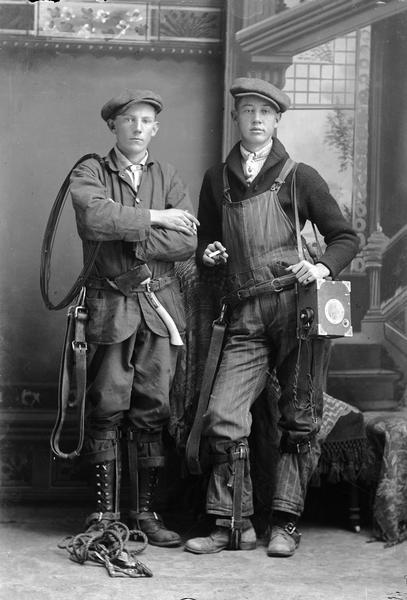
As I delved into the research, I came across an old photograph that really provided so much inspiration for my character, Trace Travers.


Just looking at this photo, I could so easily picture Trace in those bib overalls with the tall boots and the cap on his head set at a jaunty angle. 


He would have worn gaffs similar to these that fastened around his legs. The spikes on the back could be set into the wooden poles to keep the linemen from slipping. They also wore thick leather belts that fastened them to the poles to prevent (hopefully!) them from falling. 


Glass telephone insulators were used to install the wire on top of the poles. Today, you'll often see them in antique shops, the glass having turned blue or purple from years of exposure to the sun.
What I didn't know was that each part of the insulator has a name, like a crown, skirt, and petticoat. How fun is that? 

Trace certainly has fun with it in my story. 


And I had fun creating Trace's character. He's charming, funny, terrified of heights, and a part-time outlaw. 

I hope you'll have fun meeting him and Victoria in The Christmas Ring.

She’s desperate to forget her past
He’s determined to give her a future

Victoria Carter flees from the gossip that dogs her every step. She hopes to embark on a new chapter of her life at her brother’s home in eastern Oregon. What she didn’t plan on was the stagecoach being robbed on the way there, or the immediate attraction she feels to one of the outlaws. Then she meets a telephone lineman she finds charming, witty, and kind. Despite her intentions to avoid all members of the male species, her affections are torn between the two men.

A man of many secrets and talents, Trace Travers knows he has to stay focused on his work. Yet, the lovely sister of one of his friends threatens to capture not just his attention but also his heart. Resolved to ignoring Victoria and the emotions she stirs in him, he discovers she is a difficult woman to overlook, especially when she keeps popping up in the most unexpected places.

Trace and Victoria are swept into the town’s festivities as they ring in the holiday season. But will Christmas bring the forgiveness they both need if they hope to have a future together?

Enjoy this sweet holiday romance, rich with history, laughter, and heartwarming Christmas cheer.


“I want that ring and I’m not leaving until I get it.” The first outlaw pointed to Victoria. Even with most of his face covered, she could easily picture a snide sneer on his lips. “Cut it off.”
“I ain’t cuttin’ off her finger, you half-witted blockhead. The boss would have ten kinds of fits if we done did that.” The second outlaw reached into the stage, grabbed Victoria around the waist, and hauled her out, setting her on her feet in front of him.
An involuntary gasp rushed out of her at being handled so brusquely. The desperado had picked her up as though she weighed nothing and she’d felt hard, solid muscles beneath her hands as she reflexively grasped his arms for balance. She dropped her hands as though she held hot coals, appalled as she wondered if he was as handsome as she imagined behind the bandana hiding his face. Unlike the thief intent on taking her ring, this one wore spectacles with dark lenses that kept her from seeing the color of his eyes. The shade cast over his face by the hat kept her from being able to even see their shape. But she did notice an eyebrow raise in question as she openly gawked at him.
The sagebrush swindler lifted her hand and studied her finger. Without so much as a by-your-leave, he pulled her hand beneath his bandana and stuck her finger in his mouth. His tongue laved her finger, circling it several times. Dumbstruck by the man’s scandalous and unexpectedly intimate behavior, Victoria found it impossible to move. Goose bumps rose on her skin and her knees threatened to quake as he continued bathing her finger with his tongue.
A lightheaded feeling settled over her. For a fleeting moment, she thought she might faint, but then she felt the ring slide off. The second it did, she jerked her hand away from him, causing the bandana he wore to flutter slightly, giving her a partial glimpse of a strong chin covered in brown stubble.
He winked at her as he plucked the ring from his mouth then held it out to his fellow plunderer. “I got it, Guy. Let’s skedaddle.”


USA Today bestselling author Shanna Hatfield is a farm girl who loves to write. Her sweet historical and contemporary romances are filled with sarcasm, humor, hope, and hunky heroes. When Shanna isn’t dreaming up unforgettable characters, twisting plots, or covertly seeking dark, decadent chocolate, she hangs out with her beloved husband, Captain Cavedweller.
Shanna loves to hear from readers. 

Follow her online at:

Find Shanna’s books at:


Wednesday, January 8, 2020

American Travel in the Nineteenth Century - Part 1: Wagons


From the earliest of times, mankind has had a wanderlust, a need to see what’s over the next hill or if the next valley might be greener than the one they’re in. But those men—and the few women—who have traveled over great distances always proved few and far between before the development of travel.

Before the Nineteenth Century in the United States, most folks spent their entire lives within twenty miles of where they were born--the distance a wagon could travel in a day with dry weather conditions and rested draft animals. A horse and rider could do twice that in a hard day, but only a fool or desperate man would push his mount that hard too many days in a row.

Roads posed the biggest problem, usually nothing more than raw cleared, traffic-packed. They soon became rutted and easily washed out in hard rains. But in the first twenty years of the 1800s, men in the New England area built thirty-seven hundred miles of toll roads. And little by little, with the additions of good base and top gravel or bricks, country and town roads improved as well.

Every family, with the possible exception of those who lived right ‘in’ town, had a wagon to get around. They'd ride into town for supplies, go visiting a neighbor, or take the family to church on Sundays. Harnessed horses or mules usually pulled those wagons along. The better the roads got, the faster they could get from one place to another.

As more and more people came to America from all over the world, many wanted to move further out from the crowded New England states, out where they could buy land cheaper, settle on it and farm it. Or if they went far enough, they might get a grant and claim a piece of it for their own. Many of the territories and places like the Republic of Texas offered free land to attract the pioneers.

To travel those long distances to new territories, wagons needed to be bigger and have shelter from the elements, so metal frames were attached, and thick canvases pulled over them. The 'cover' protected not just the travelers, but all their supplies—food, water, furniture, and tools—necessary for the journey then setting up new homes once they arrived.

The wooden wagons were typically four feet wide, ten feet long, and its canvas gave the travels seven to eight feet in height. Some might be as wide as six feet and as long as fifteen feet. Not very much room to store all the provisions pioneers would even need for the trip, much less once they arrived at their destination.

They’re romantically referred to as prairie schooners.

Once the traveler acquired a wagon, he needed something to pull it. Horses had been used mostly on the farm, and they were fast, but required extra grain. That grain would take up too much valuable space in the wagon. Plus, they weren’t as sturdy as mules who could travel twice the distance in a day—twenty miles.

Mules though were often obstinate and would bolt at times, but for the treacherous climbs proved more surefooted. Mules did need some grain—not as much as their equine cousins though, and Indians didn’t steal them as often as horses. And they could take the heat better than the third option to pull the wagon . . . a team of oxen.

Now oxen were strong and sturdy and could subsist longer on poorer grasses. They were slower at fifteen miles a day, but almost never ran off or got stolen by natives. The favorite of most emigrants, oxen pulled one-half to three-quarters of the wagons going west during the mid-1800s!

As for cost, mules brought the highest price, then horses, and the oxen were cheapest at twenty-five to sixty-five dollars per yoke (two animals).

A prudent man would do his best to have seven yoke to pull his wagon, starting out from Missouri traveling the Oregon or California Trail.

Why? Because many would die on the way. Those would be eaten. But a wise man would have enough animals to get him all the way, over two thousand miles of rugged terrain, across rivers, and over mountains. The sojourner who traveled so far in a covered wagon embodies the essence of the American spirit.

I rode the Oregon Trail last year and blogged about my journey. If you like covered wagons, you might enjoy those. Here's the first: Carylin' On the Oregon Trail Day One  To read more, search for that same title (without the 'Day One').

BLESSINGS!


GIVEAWAY: As a special gift for my readers today, I’ve arranged for my Prairie Roses Collection story REMI to be free at Amazon. It’s a wonderful story of romance, hardships, and tragedy along the Oregon / California Trail in 1851. I hope you enjoy it and will share the link with your friends!

Caught between a wagon train and the deep blue sea, Agnes Remington Dalrumple--Remi for short--chooses the overland journey west over crossing the Atlantic with her mother and step-father. Though she’s never been on her own, she decides to go to California and try to find the father she’s never known.

Thwarted at every turn, almost every effort is dashed until a widower’s thirteen-year-old daughter intervenes on her behalf. How can the headstrong woman place herself under the responsibility of the young girl’s father, a perfect stranger? But if she doesn’t, her journey ends right there in Saint Joseph, Missouri. On the Oregon/California Trail, will her pride and independence deter her from the destiny God has prepared?

Asher Adams, a widower with two daughters and a desire to start anew has sold everything he owns and is headed to California with his recently wed sister and her husband. She and his girls conspire every step of the way, hoping he will find someone to be a companion and friend. Remi fits the bill as far as all the women in his life are concerned, but is it too soon?

REMI--while both are stand-alone books, continues the story of UNIQUELY COMMON with the same characters but different hero and heroine. Readers will enjoy reading both!


Bio: Award-winning author Caryl McAdoo prays her story gives God glory! Her best-selling novels are blessed with a lion’s share of 5-Star ratings! Her forty-nine titles surely do just that as Caryl’s faith and trust in God shine through her characters who readers love.

She enjoys writing as well as singing the new songs the Lord gives her—listen to a few at YouTube. With husband Ron, she produced four children who’ve given her eighteen grandsugars. The McAdoos live in the woods south of Clarksville, seat of Red River County, in far Northeast Texas, waiting expectantly for God to open the next door. 

Tuesday, January 7, 2020

Bringing and Ringing in the New Year by Kimberly Grist


Do we bring in or ring in the new year? I've often wondered which phrase was correct. Ringing in refers to the days when churches often made announcements by ringing their bells.

A poem written in 1850 called "Ring out, Wild Bells" by Alfred Lord Tennyson, suggested specific ways to change the world for the better by ringing out the negatives and ringing in positive things. 


Bringing in the new year also creates the image of a new beginning. Another poem written by Henry Wadsworth Longfellow was inspired by church bells ringing.  
In July 1836, Fanny Appleton was in Switzerland in the middle of a Grand Tour with her family. 

Henry Longfellow was a college professor and published author, traveling in preparation for his new position as Professor of Modern Languages at Harvard. He joined the Appleton family traveling around the Swiss Alps where he began courting Fannie. 

Fannie was not interested in marriage. But Longfellow was determined and finally seven years later, Fannie agreed and they were married in 1843. Fanny's brother Tom summarized their courtship: "She is a nature that ripens late. And she will be far happier than if she married earlier. With her to be understood and to understand is love."


Nathan Appleton bought the Craigie House, which George Washington occupied as his headquarters in 1775 and gave to Henry and Fanny for a wedding present.
Fanny and Henry Longfellow had six children. She is pictured with sons Charles and Ernest.
Tragically in 1861, Longfellow's beloved wife of eighteen years died after her dress caught on fire. Longfellow was unable to attend her funeral due to the extensive burns he received attempting to save her. His facial injuries caused him to stop shaving. He wore a beard from then on which became his trademark.

In March 1863, Longfellow's oldest son Charley, left home unannounced to travel to join the Union Army. On December 1, 1863, Henry received a telegram that his son had been severely wounded while involved in a skirmish during the battle of the Mine Run Campaign.


On Christmas day in 1863, Longfellow a 57-year-old widowed father of six children heard the Christmas bells proclaiming "peace on earth" and wrote, "I Heard The Bells on Christmas Day."


The poem was first published in 1865. Longfellow's despair can be felt in its message, that "hate is strong and mocks the song of peace on earth, good will to men."


The conclusion of the poem and song is the message of renewed hope. The powerful message resonates with many who are dealing with feelings of loss, worry and or grief during the holiday season.
Set to music in 1872, the song would later be called, "The Civil War Christmas Song" and continues to be popular. The song with background photos taken during the Civil War can be viewed here:
 I Heard The Bells on Christmas Day with historical background photos


About Kimberly Grist:


"Kim has enjoyed writing since she was a young girl. However, she began writing her first novel in 2017, "I wear so many hats working inside and outside the home. I work hard, try harder and then begin again the next day. Despite my best efforts, sometimes life just stinks. Bad things happen. I need and want an outlet, an opportunity to relax and escape to a place where obstacles are met and overcome." 
Fans of historical romance set in the late 19th -century will enjoy stories combining, History, Humor, and Romance with an emphasis on Faith, Friends and Good Clean Fun. 


Connect with Kimberly:


Settling in Texas by Abagail Eldan

The first true German immigrants in Texas were Johann Friedrich Ernst, the "Father of German Immigration to Texas," and Charles Fordtran. A few years later, in 1842, the Adelsverein was formed for the purpose of promoting German immigration into Texas. Some came to escape religious persecutions, others because of political problems in Germany, and still others came looking for better opportunities. (see Lonestar Genealogy)

My Brokken books are populated with German immigrants. The series is set in Brokken, Texas, the small Texas town founded by Franklin Brokken, a descendant of Wilhelm Brecheisen whose surname means “breaker of iron” in German. Not long after Wilhelm arrived in America, he became involved in a fistfight with a fellow German, a man named Frederick Eisen, whose name means "iron." When Eisen landed a blow and Wilhelm fell, breaking his hip in the process, one of the onlookers said, “The iron has broken the iron breaker.” And just like that, Brokken became Wilhelm’s last name. He cheerfully accepted the Americanization of his name but added the K, right in the middle. The K, he told his family, stood for kein, which means“not” in German. He declared to all who would listen that he was not broken. And he set out to prove it, soon becoming one of the richest men in Pennsylvania.

His grandson Franklin Brokken traveled to Texas to found the town that bears his name. With his first wife, Franklin had three sons, Fritz, Curt, and Karl. After the death of his first wife, Franklin remarried, and his wife bore him a daughter, Deborah. 

Beginning in This Brokken Road, we learn a little about the three sons. Many of the businesses in the town are owned by the Brokkens, and one of their businesses, the Brokken bank, is robbed by the owners themselves. In Brokken Brother we discover why. 

In Brokken Redeemed, the tale of the Brokkens continues with Deborah's story. When the town is attacked by a group of outlaws, Fritz bears the brunt of the blame for the destruction that ensues. 

Disillusioned, outcast by his own family, and his engagement broken, Fritz is given a mission--find the mother of Sally Jane whose grandmother was killed in the fiasco. 

In Brokken Promises, Fritz sets out on his journey, unaware of the repercussions from his lies and the broken promises he has left in his wake. 

His search leads him to Camellia Jenkins who harbors deep secrets. She is barely able to keep body and soul together and returns to Brokken, Texas with Fritz who promises to help her. 

When her secrets are revealed, will Fritz stand by his word? Will keeping promises break him further... or make him stronger? 

Brokken Promises is the latest in the Brokken Road Romances. 

Wishing you a Happy New Year!


Friday, January 3, 2020

How to Make Vinegar Like a Victorian by Kristin Holt

Kristin Holt | How to Make Vinegar Like a Victorian by Kristin Holt
by Kristin Holt, USA Today Bestselling Author

Where does vinegar come from? 

The grocery store, of course. Even pioneer women could purchase vinegar at their nearest town general store or grocery. Yet knowing the twin Victorian virtues of THRIFT and ECONOMY, it's evident many penny-pinching homemakers would have taken the advice in cook books of their day (yes, spelled as two words back then) and in their city newspapers. Thrifty advice: Make Your Own.

How?

Why, with ingredients and tools you have lying about the homestead, my dear. Things like rainwater, apple peels, cider, yeast, molasses, and brown paper. Never forget the brown paper. 

Why?


Beyond the economy of making your own vinegar, what if you live a long way from your corner store? With all those long hours of daylight, homesteading women had plenty of time (hear my sarcasm) to make their own vinegar. 

Let's explore a few short recipes, beginning with one shared in 1852:

Kristin Holt | Vinegar Recipe published in The Perry County Democrat newspaper of Bloomfield, PA on November 4, 1852. "To eight gallons of clear rain water, add three quarts of molasses; put into a good cask, shake well, and add two or three spoonfuls of good yeast cakes. If in summer, place the cask in the sun; if in winter, near the chimney, wher eit may be warm. In ten or fifteen days, add to the liquor a sheet of brown paper, torn into strips, dipped in molasses, and good vinegar will be produced. The paper will, in this way, form what is called the 'mother,' or life of the vinegar."
Vinegar Recipe explaining use of brown paper strips. The Perry County Democrat of Bloomfield, PA. November 24, 1852.

The instructions, ingredients, and method are worth revisiting, especially in the absence of this 1852 Pennsylvania newspaper clipping. Here's a careful transcription:

Making Vinegar.--Vinegar, according to a writer in the Genesee Farmer, is cheaply made. We re-publish his recipe: "To eight gallons of clear rain water, add three quarts of molasses; put into a good cask, shake well, and add two or three spoonfuls of good yeast cakes. If in summer, place the cask in the sun; if in winter, near the chimney, where it may be warm. In ten or fifteen days, add to the liquor a sheet of brown paper, torn in strips, dipped in molasses, and good vinegar will be produced. The paper will, in this way, form what is called the 'mother,' or life of the vinegar."

In 1860, Scientific American's recipe for vinegar appealed to the editors (??) of  The Mountaineer (Salt Lake City, Utah Territory), and they reprinted it. This one starts with forty gallons of rain water. Note that the key ingredient in this vinegar recipe is acetic acid.

Kristin Holt | How to Make Vinegar Like a Victorian: Recipe for Vinegar. Take forty gallons of rain water, one gallon mollasses, an dfour pounds acetic acid. It will be fit for use in a few days. Acetic acid costs 25 cents per pound. This is the recipe by which most of the cider vinegar is made, which is sold in the country stores.--Scientific American." Published in The Mountaineer of Salt Lake City, Utah Territory, April 14, 1860.
Vinegar Recipe calls for Acetic Acid. Published in The Mountaineer of SLC, Utah Territory. April 14, 1860.

Pretty cool, isn't it?

Now, it seems, some people will buy anything. Including a simple recipe for vinegar. In 1873, some dude sold a vinegar recipe to anyone who'd send him 50 cents.

Kristin Holt | How to Make Vinegar Like a Victorian. Vinegar Recipe for Sale in Democrat and Chronicle of Rochester, NY, November 26, 1873.
Vinegar Recipe for sale (50 cents), Democrat and Chronicle of Rochester, NY. November 26, 1873.

This 1883 recipe appeared in Our New Cook Book and Household Recipes, providing a good vinegar that costs only a pint of honey... and another that requires only apple peelings and hard work.


Kristin Holt | How to Make Vinegar Like a Victorian. Good Vinegar recipe calls for only a pint of strained honey and two gallons of soft water. Another requires only apple peelings--FREE to a dedicated housekeeper. Published in Our New Cook Book and Household Recipes, 1883.
Vinegar recipes: one calls for honey, another for daily apple peels. Published in Our New Cook Book and Household Receipts, 1883.

The following Corn Vinegar Recipe calls for field corn as a 'starter,' and also references a "mother that has formed on other vinegar...." I understand contextually, but have never seen one.

Wikipedia image: Mother of Vinegar. "Mother of vinegar is a substance composed of a form of cellulose and acetic acid bacteria that develops on fermenting alcoholic liquids, which turns alcohol into acetic acid with the help of oxygen from the air. It is added to wine, cider, or other alcoholic liquids to produce vinegar."
Wikipedia Image: Mother of Vinegar: "Wikipedia image: Mother of Vinegar. "Mother of vinegar is a substance composed of a form of cellulose and acetic acid bacteria that develops on fermenting alcoholic liquids, which turns alcohol into acetic acid with the help of oxygen from the air. It is added to wine, cider, or other alcoholic liquids to produce vinegar."

Note to Victorian-era housekeepers. Do not throw away the muck in the vinegar. You'll wish you had it later.


Kristin Holt | How to Make Vinegar Like a Victorian. Corn Vinegar Recipe published in New England Farmer of Boston, Mass. on September 25, 1886.
Corn Vinegar Recipe published in New England Farmer of Boston, Mass. September 25, 1886.

Ah! At last! Cider Vinegar-- something that sounds more familiar to our 2020 palates.

Kristin Holt | How to Make Vinegar Like a Victorian.Cider vinegar instructions published in The Daily Journal of New Bern, North Carolina on August 5, 1888.
Cider Vinegar by the drip method. Published in The Daily Journal of New Bern, North Carolina. August 5, 1888.

After comparing and contrasting this small collection of vinegar how-to-make-your-own recipes, United States Victorian-era style, I do believe I'll continue to buy mine at the store. But the ideas are percolating, brewing, about vinegar trouble to put my characters through...

Thanks for reading!

Kristin Holt | Sweet Romance in the American Old West by USA Today Bestselling Author Kristin Holt


Come see a few related articles both here on Sweet Americana Sweethearts and on my own site, KristinHolt.com.

Kristin Holt | Victorian-America's Crabapple Jelly and Preserves

Kristin Holt | Economical Victorian Housekeeping

Kristin Holt | Paper: Common in the Old West? Related to How to Make Vinegar Like a Victorian by Kristin Holt.

Kristin Holt | Victorian Yeast Bread-- Easier after the Centennial
 
Kristin Holt | Croquettes: Economic Victorian Dining


Kristin Holt | Housekeeping: Women's Work

Copyright Ⓒ 2019 Kristin Holt LC

Thursday, January 2, 2020

The Cowboy Breakfast


Ring in the new year with a Cowboy Breakfast!

Many of you probably don’t know that every year, San Antonio hosts a cowboy breakfast. Thousands of people come to this event and line up for a variety of tastes from the old west. Sure, we’ve all had eggs, sausage, bacon, and biscuits before. But not like this. The Texas-sized menu includes 20,000 servings of Picante sauce, 15,000 cups of coffee, 12,000 Kiolbassa Chorizo and egg tacos, 10,000 BBQ beef tacos, 8,000 pioneer biscuits, and Kiolbassa sausage, 8,000 bacon and egg tacos, 5,000 potato and egg tacos, 5,000 Kiolbassa sausage wraps, 5,000 pints of orange juice and 2,500 servings of biscuits and gravy. Whew, that’s a lot of food!


San Antonio’s annual Cowboy Breakfast is a fundraising event for scholarships to St. Phillips College and is now in its 40th year. What a great way to ring in the new year! And breakfast isn’t the only thing served. There’s barbeque and desserts as well. They even have a kiddie rodeo. Not exactly what cowboys had while driving their herds, but for us, we’ll take it!

Back in the day, the cowboy ate a lot of beans and bread. Flour, baking soda, and salt were easy to take along after all. That and coffee. Those cowboys drank lots and lots of coffee!

In case you didn’t know, chuckwagons were a military wagon that began its use after the civil war. A fellow by the name of Charles Goodnight invented it and designed a wagon with a sort of trunk at the end of the wagon bed that could carry food and other supplies, including a first aid kit. A chuckwagon cook had a few different roles, nursemaid among them.

So if you have a chance, check out San Antonio’s annual cowboy breakfast!